En 30 secondes
Matthew Berman briefly introduces DeepSeek-Prover-V2 and cites a DeepSeek researcher’s benchmark claims. The results concern formal mathematical proof under specific evaluation conditions, not general success at all math problems.
- 1A model for mathematical proofsBerman introduces DeepSeek-Prover-V2 and highlights its mathematical capabilities.
- 2miniF2F and PutnamBenchA DeepSeek researcher reports nearly 90% on miniF2F and improvement on PutnamBench. The results depend on the model and evaluation budget.
- 3Formalized AIME problemsThe researcher also reports a nontrivial result on formal versions of selected AIME 2024 and 2025 problems.
À retenir
- DeepSeek-Prover-V2 is designed for formal theorem proving in Lean 4.
- DeepSeek reports 88.9% on miniF2F-test for its 671B model with up to 8,192 attempts per problem.
- The researchers report 49 of 658 PutnamBench problems solved and results on selected formalized AIME questions.
- The video reports the researchers’ results and does not independently test the model.
Lire le texte remanié, chapitre par chapitre
DeepSeek-Prover-V2
Berman introduces the model and its focus on mathematics. The release concerns formal theorem proving.
DeepSeek, the company behind DeepSeek-R1, has released DeepSeek-Prover-V2. I am impressed by its reported performance on mathematics. The model is aimed at formal theorem proving in Lean 4, a more specific task than solving arbitrary math equations.
Reported benchmark results
He cites a researcher’s claims on miniF2F and PutnamBench. The comparison uses specific proof-search conditions.
According to a DeepSeek researcher, the model solves nearly 90% of miniF2F problems and substantially improves results on PutnamBench. The [technical report](https://arxiv.org/abs/2504.21801) reports 88.9% on the miniF2F test set for the 671B model with up to 8,192 proof attempts per problem, and 49 of 658 PutnamBench problems solved. These are researcher-reported results under particular evaluation conditions, not a single-attempt success rate.
AIME and comparison
Berman highlights results on formalized AIME problems and a chart comparing models. He encourages viewers to try the model.
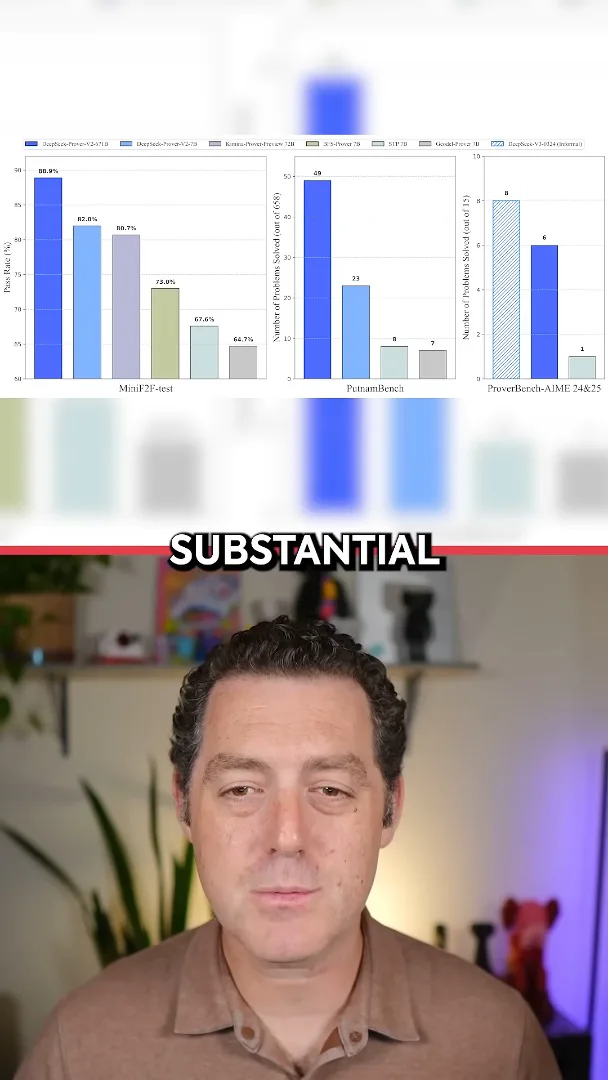
The researcher also reports a nontrivial success rate on formalized AIME 2024 and 2025 problems. The report’s ProverBench includes 15 selected AIME problems; the comparison shown distinguishes formal proof generation from an informal answer task. The chart shows substantial differences between the listed models, and I encourage viewers to try DeepSeek-Prover-V2. This short video does not independently test the claims.
Sur la même chaîne
 34:21EN
 Matthew Berman· 27 oct. 2026Matthew Berman Examines Anthropic’s IPO Filing, AI Growth and GovernanceMatthew Berman, Sam Altman · Forward FutureThe presenter reviews the S-1’s financial metrics, compute strategy and voting structure while questioning the tension between rapid AI development and safety.
 0:36ENMatthew Berman· 25 oct. 2026Kimi K3.1 and a Rubik’s Cube Solver DemonstrationMatthew Berman · Forward FutureMatthew Berman shows a scrambled virtual cube being solved and gives the Kimi K3.1 test a favorable assessment.
 25:50ENMatthew Berman· 24 oct. 2026Kimi K3.1 Pro Tested: Strong 3D Demos, Uneven Results and Competitive PricingMatthew Berman · Forward FutureMatthew Berman tests the open-weight model on coding, 3D rendering and visual explanations, then compares benchmark results and prices.
 32:20ENMatthew Berman· 23 oct. 2026Who Is Local AI For? The Costs, Trade-offs and a Hybrid FutureMatthew Berman · Forward FutureMatthew Berman weighs data control and independence against hardware cost, setup complexity and inference speed.
 1:03:37ENMatthew Berman· 23 oct. 2026Matthew Berman’s Team Tests Kimi K3.1 on Animation, Games, and ChartsMatthew Berman, Alex, Brian · Forward FutureA live team AMA turns into an informal test of Kimi K3.1, from personal-agent workflows to motion graphics, a browser game, and a benchmark chart.
 0:53ENMatthew Berman· 22 oct. 2026Sam Altman on AI and the Discovery of New KnowledgeSam Altman · OpenAIAltman expects progress in mathematical discovery to extend to biology, materials and energy.