En 30 secondes
Armin Ronacher argues that the first goal of AI coding should be making better, more ambitious software, not maximizing output. His own agent sessions show longer runs and fewer corrections as models improve, even though Pi’s core tools stayed the same. Yet of 141 projects he started, only about 10 to 15 received regular attention. He recommends intervening before verification with a short explanation, preserving shared formats, and designing long-running agents to pause and resume without wasting resources.
- 1Better models changed the agent without changing its core toolsRonacher says Pi retained the same core tools while improvements in models let him correct it less and give it longer tasks.
- 2The longest agent runs grew from minutes to over 14 minutesIn his sessions the 90th-percentile run grew from roughly two and a half minutes with Opus 4.6 to 14 minutes with a newer model. These are his own session measurements.
- 3Starting 141 projects did not increase the number maintainedRonacher started 141 repositories but regularly returned to roughly 10 to 15. Even an automated open-source project needs someone to care about its direction.
- 4A short explanation before verification creates a review pointHe has the agent produce a readable HTML summary before its final verification, letting him understand and redirect work even when he does not read every line.
- 5Independent implementations can break shared formatsAgents make it easy to build alternatives, but people still need to agree on specifications and interpretations for software to exchange files.
- 6Long-running agents need to stop and restartRonacher wants durable workflows that can suspend agents and their environments while waiting, then resume without wasting compute.
- 7Code can coordinate large batches of agent tool callsA small workflow can call tools and classifiers repeatedly without placing every intermediate result in the model’s context.
À retenir
- Spend attention on software quality and maintenance before scaling the number of projects.
- Ask an agent for a concise explanation before verification so you can redirect work while it is still underway.
- Keep shared protocols and file formats even when agents can rapidly build independent alternatives.
- Design long-running agent workflows to suspend and resume, including their execution environments.
- Use code to coordinate tool calls and inexpensive classifiers when a workflow has many repeated decisions.
Lire le texte remanié, chapitre par chapitre
Make software more ambitious, not just more abundant
Ronacher compares AI tools to equipment in an artist’s workshop. He wants better software before scaling a software factory.
I want to make the case for building a workshop before a software factory. An artist can use powerful machines to become more ambitious without making quantity the only goal. We can use coding agents to make better and more ambitious software, not simply more of it.
The models improved while Pi’s core tools stayed stable
His session data show fewer corrections and longer runs. He attributes much of the change to model capability.
Earendil works on the Pi coding agent, so we have a stake in this question. Pi’s core harness—the surrounding software and tools the model uses—has had the same tools since December. Yet the agent can do much more now because the models have improved.
Many prompting tricks and harness features that seemed important over the past year and a half have become unnecessary. I liked an extension called Pi AutoResearch for driving toward a goal such as performance, but a current leading model can often do that without the extension.
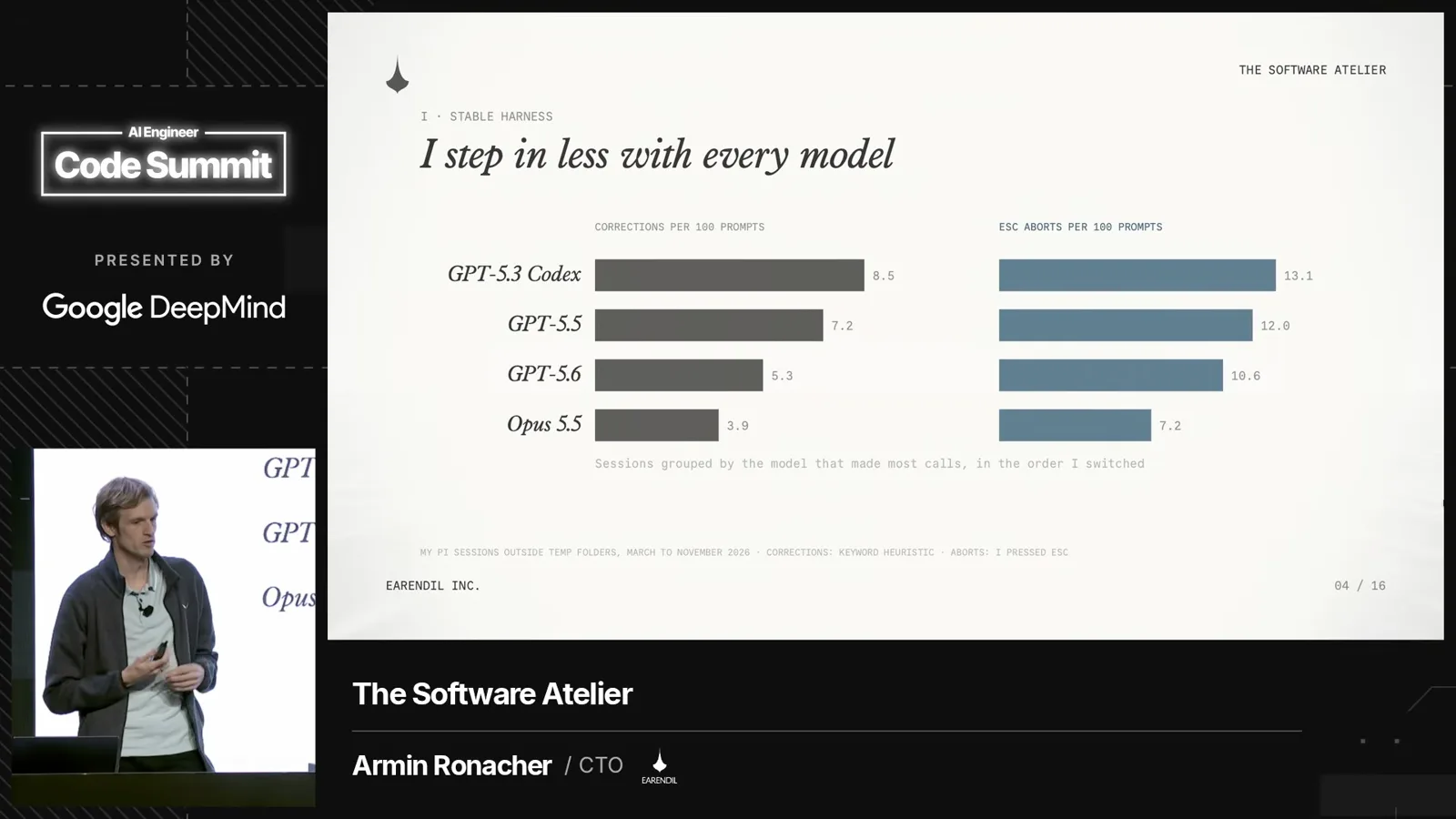
I examined my Pi sessions using the default setup. With successive models, I made fewer corrections and stopped the agent less often. The behavior changed even though the core agent setup did not.
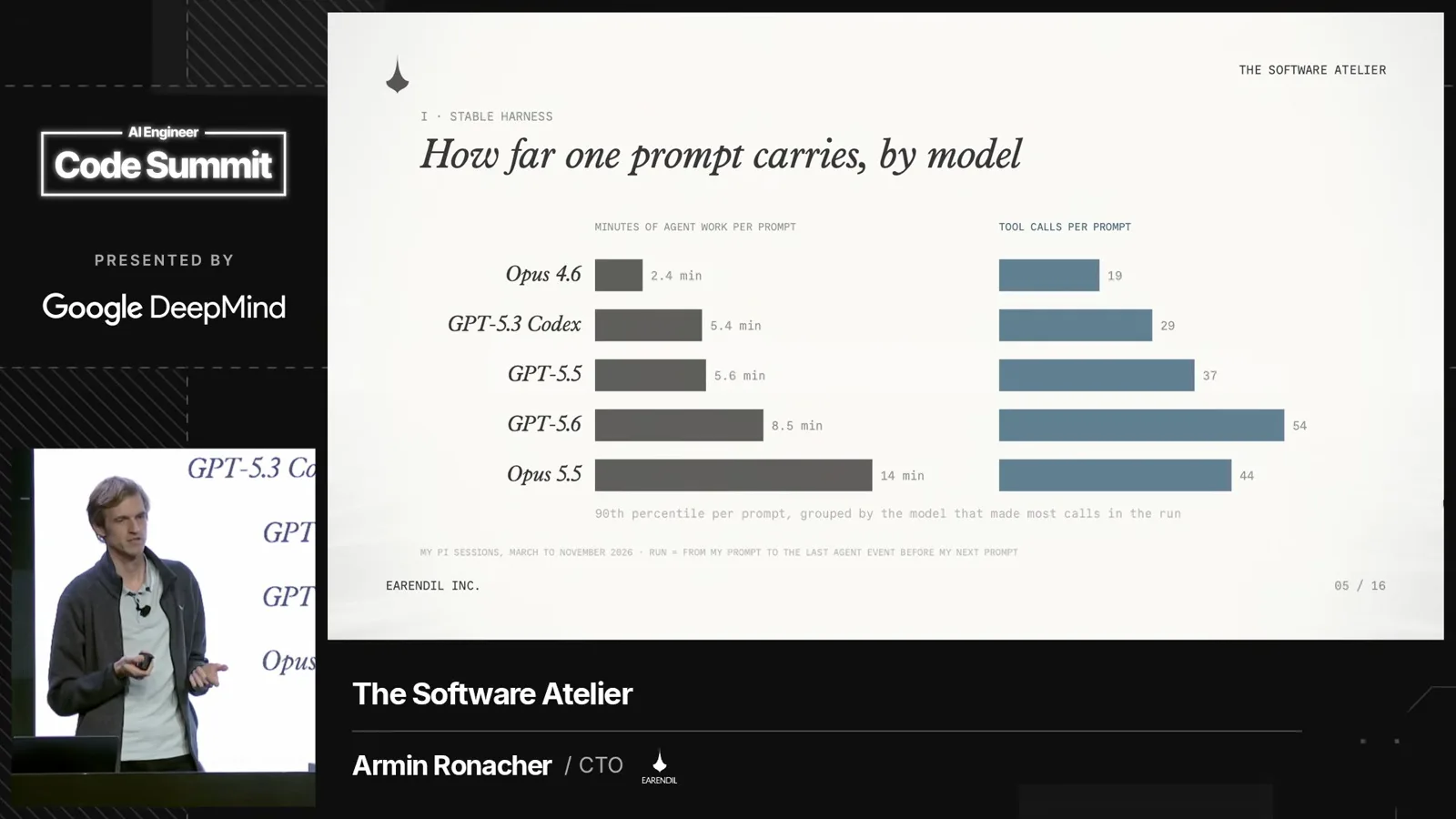
In my own sessions, the 90th percentile of time an agent ran after one prompt rose from about two and a half minutes with Opus 4.6 to 14 minutes with a newer model. That changes how I work with the agent. It is not an average across all tasks.
Current agents also seem more likely to use Bash, the command shell, than other available tools, even though the configuration has not changed. Some new behavior comes from the models themselves. I had too little data to show Astra and Sol cleanly, although my tests looked similar to Opus.
Human attention still limits maintenance
Starting projects is easier, but regular maintenance still takes attention. His own project count illustrates the gap.
What has not changed is that our attention is limited. Starting a project has become incredibly easy, but maintaining it has not become equally easy. Running more agents also puts pressure on external services, including established websites that were not designed for this new volume.
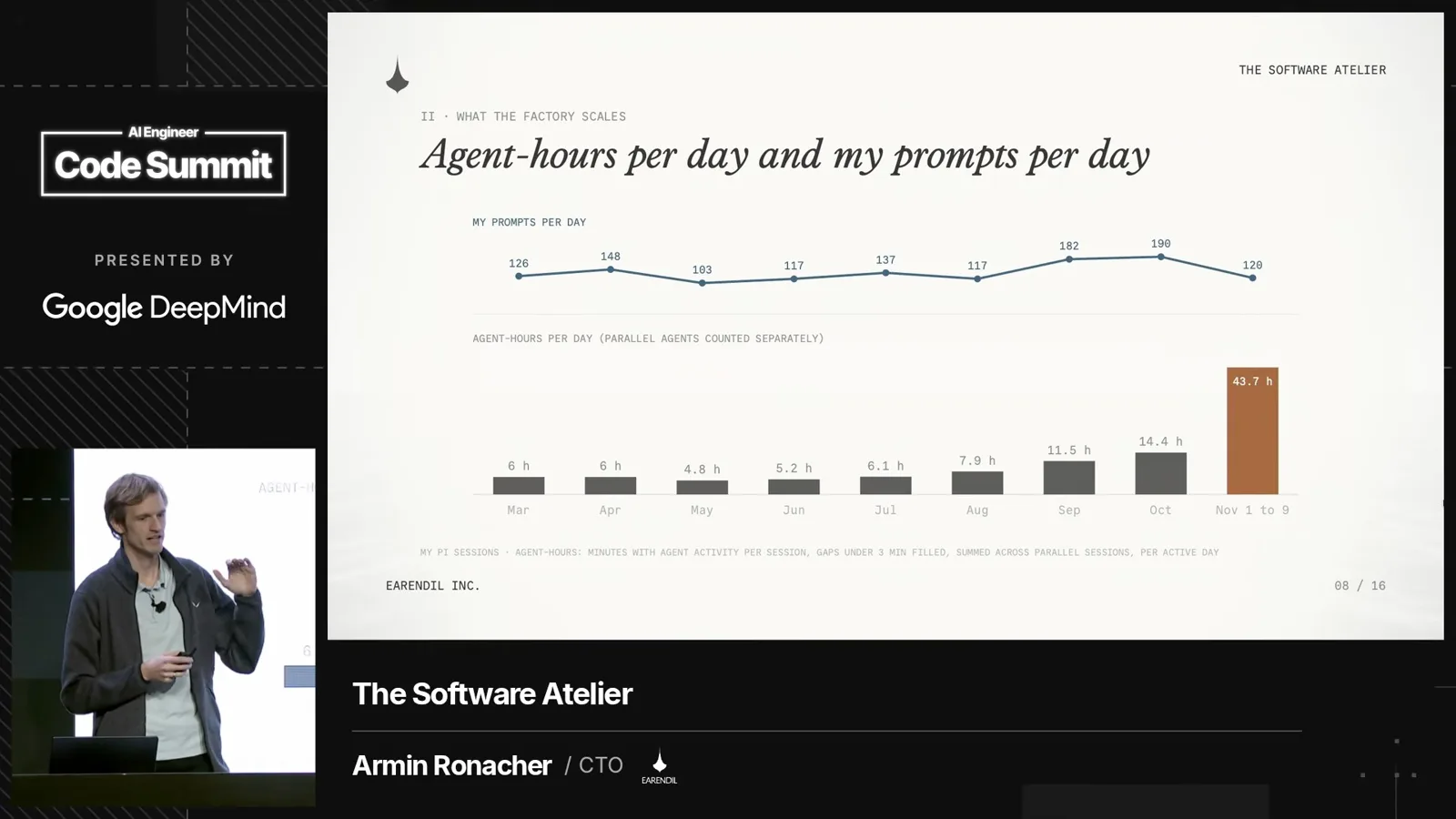
My own number of prompts has stayed roughly flat, around 120 to 190 a day, while the combined time agents spend working has risen to many times my working day. Parallel sessions count separately, so the total can exceed 24 hours.
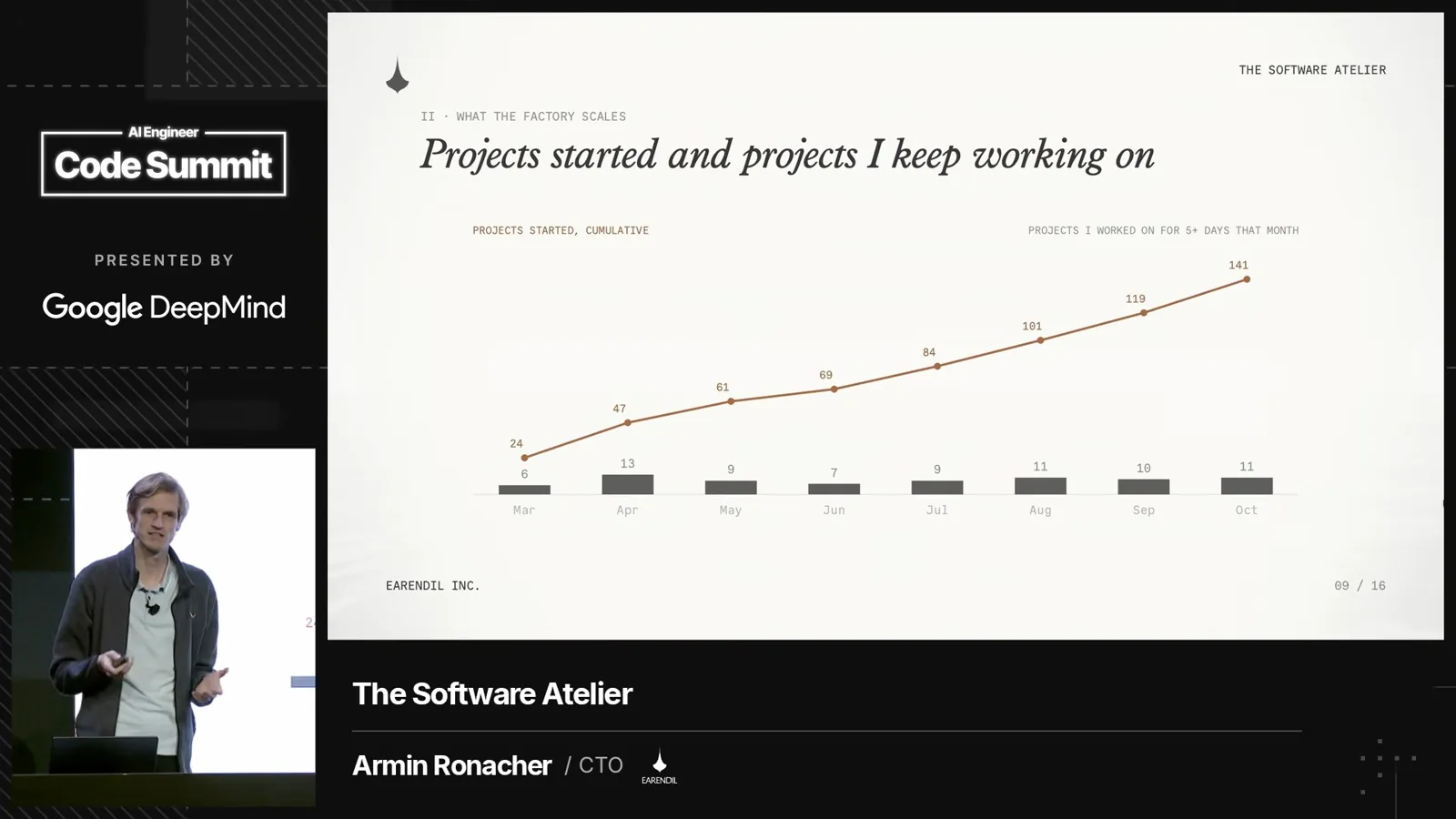
I started 141 Git repositories over the period, but regularly returned to only around 10 to 15. I counted a project as regularly worked on when I committed on more than five days and came back to it. Friends report a similar difficulty keeping projects alive.
One friend automated an open-source project’s issue handling, review and commits, then turned the setup off because he no longer cared enough about that project to spend the tokens. Even when the mechanics are automated, someone’s attention and interest still matter.
Intervene early and retain engineering judgment
An agent can complete a goal while creating a system that is hard to live with. Ronacher asks for summaries before verification so he can redirect it.
A good workshop requires knowing when to tell an agent that its approach is wrong. The agent is rewarded for completing a goal, but a completed feature is not necessarily something we will be happy maintaining. Repeated additions can create a collection of features that does not fit together.
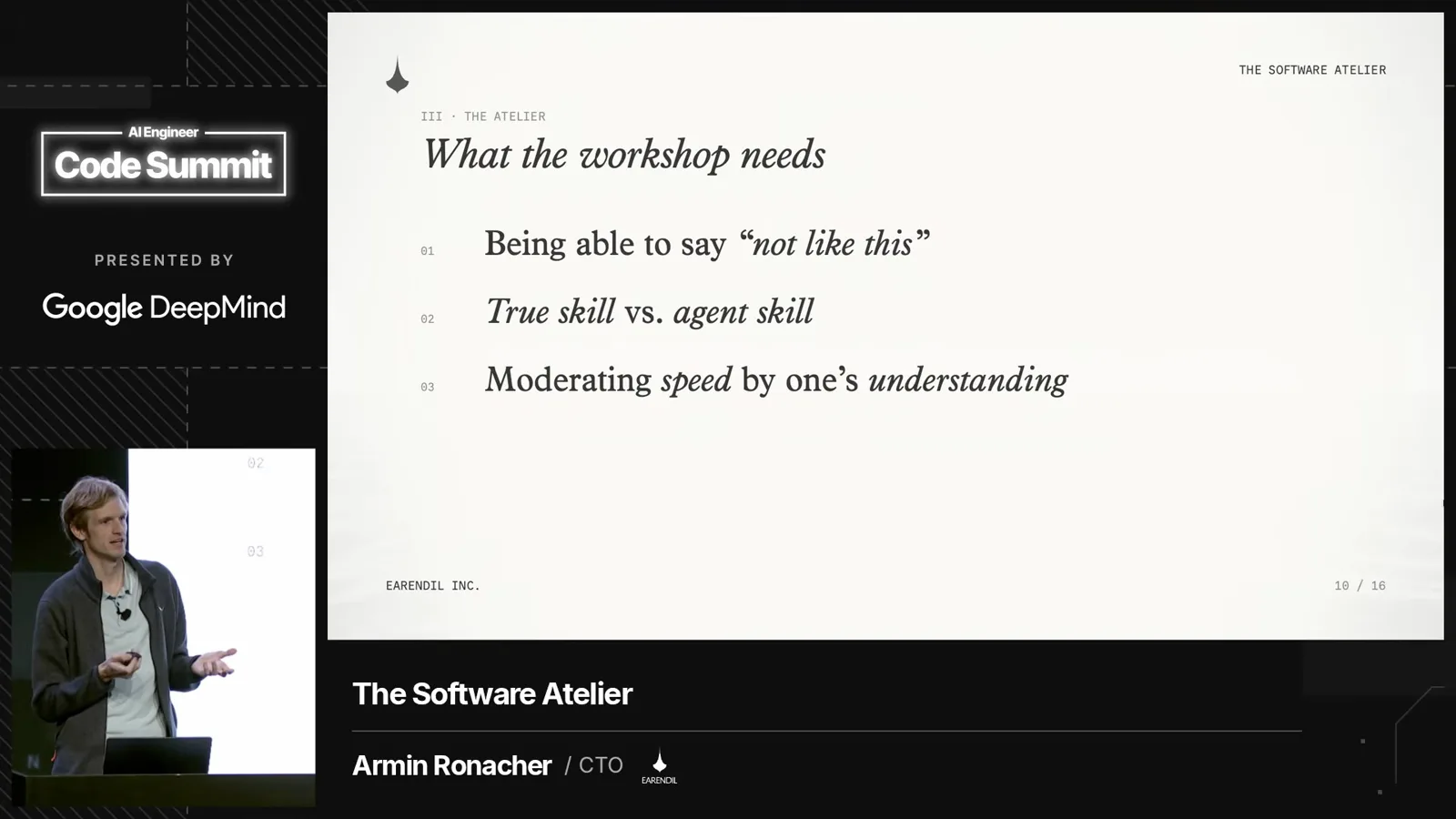
There is a difference between understanding software engineering and knowing how to direct an agent. My son sends pull requests to a project we share, and although we prompt the same system, his contributions differ because he is not a software engineer. Understanding the system and the problem still matters.
It is frustrating when a consequential discussion becomes a series of questions to agents from people who no longer understand the underlying system. We may need to moderate our speed so that our understanding can keep up with what we produce.
As my commits increased, I looked for a consistent point to understand a session before it ended. I now ask the agent for a short executive summary in a readable HTML page before it starts verification, roughly 70% of the way through. That helps me follow what it is doing even when I no longer read the code in many cases.
I like using fewer dependencies and writing more code ourselves, which agents can make easier. But uncontrolled growth becomes a problem when independently built software must work together.
Shared formats require people to cooperate
Independently generated implementations may interpret the same format differently. Standards and collaboration remain important.
A specially crafted tar archive recently demonstrated how different implementations can read the same file differently. Shared standards, specifications and formats matter. An agent can implement a format quickly, but people still have to agree what it means and how to interpret it.
It is possible to imagine everyone building their own image editor and then being unable to exchange files because their formats diverged. Sometimes the right response is to step back and cooperate with other people, rather than immediately build another isolated solution. I see more forks in open source where contributing changes upstream is harder.
Aim for faster, safer and more reliable software
He welcomes work on verification, memory safety and efficient native software, while acknowledging the difficulty of verification.
I want us to build software that strives for excellence. Formal verification is difficult and the tools are not yet where they need to be, but it is worth exploring for more stable systems. I am also glad to see interest in faster software with lower memory use and in memory-safe languages such as Rust.
Agent infrastructure may still need to change as work becomes longer-running. When a task takes two minutes, a person can restart it manually after a failure. That is not practical when thousands of issues are being handled overnight.
Pause durable agents and coordinate tools in code
Long jobs should survive interruptions and yield resources while waiting. Code can coordinate tools and cheap classifiers for repeated decisions.
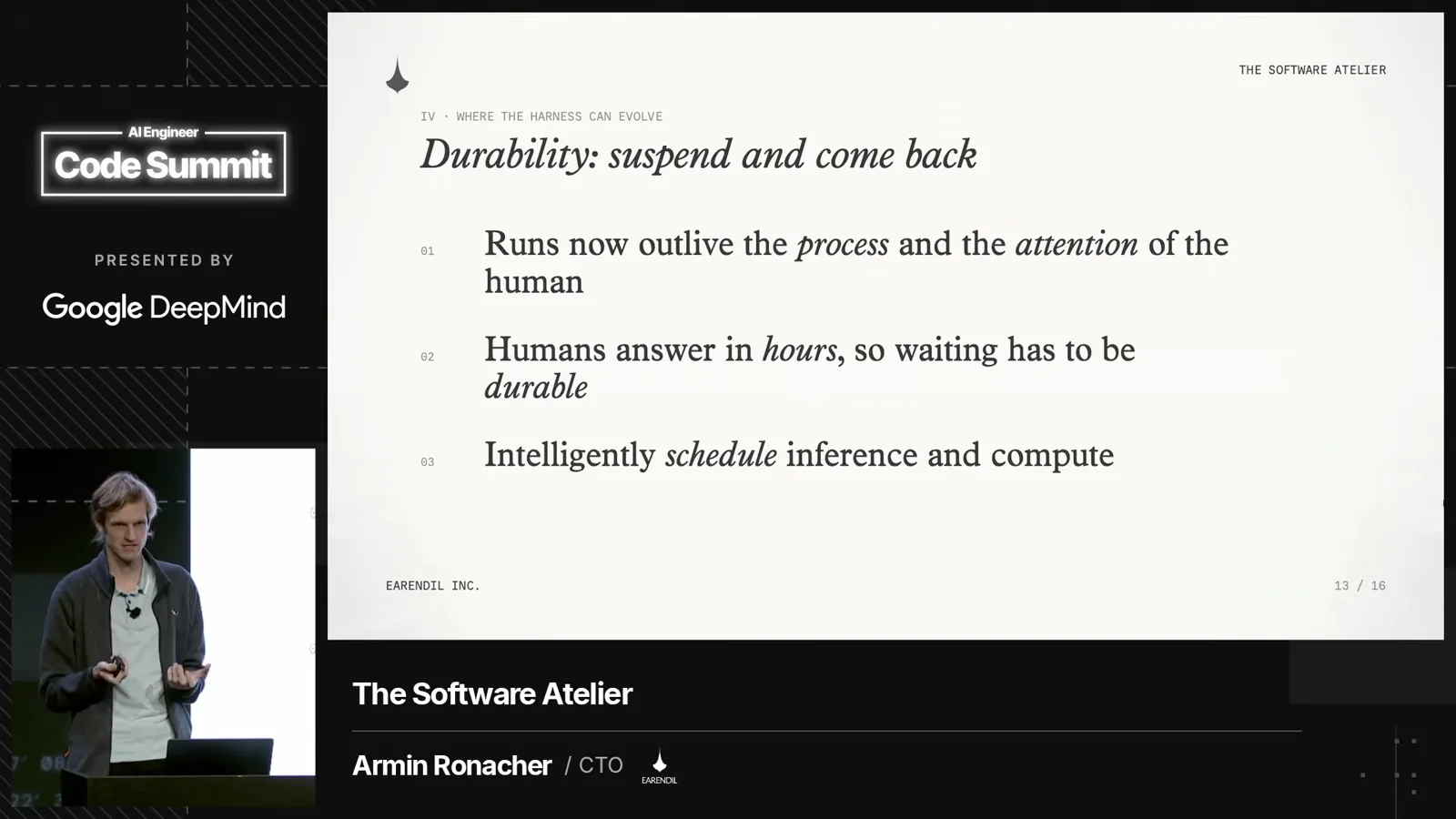
We believe in durable agents and workflows that can be started, stopped, suspended and resumed. This matters for reliability and cost. For example, cheaper flexible inference can pause for minutes; during that wait, an agent and its sandbox could be suspended rather than consuming other expensive resources.
Pi was motivated in part by the idea that Bash is enough to run tools. But coordinating subagents, classifiers and other models creates a need to compose workflows. Code mode gives an agent a programming language such as JavaScript to orchestrate tool calls rather than placing every intermediate call through the model’s context.
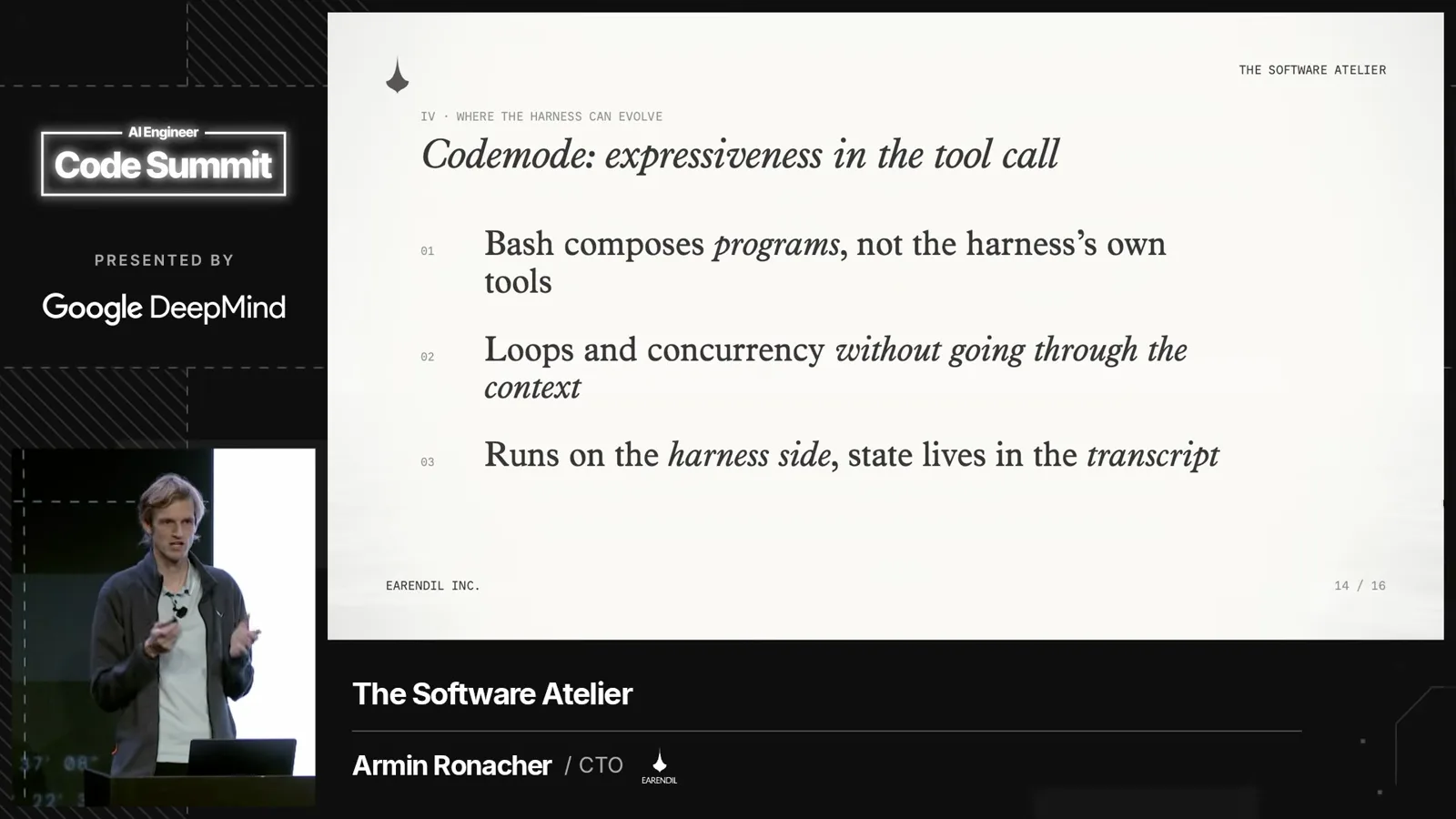
Cheap, fast classifiers create other opportunities. An agent could write a workflow for thousands of support requests and use a classifier at each decision point to route an issue to an agent or ask the customer for more information. Work that previously took hours could become much faster.
Now that we can build so much, we need not build everything. We should aim for software that is more enjoyable and more ambitious.
Sur la même chaîne
 56:08EN
 AI Engineer· 21 nov. 2026Ahmad Osman: Local AI Needs Better Systems, Not Just Better ModelsAhmad Osman · OsmanticThe Osmantic founder explains how hardware, tools and task-specific tests determine whether local AI is useful.
 14:28ENAI Engineer· 20 nov. 2026Zach Bruggeman: Ramp Made Its Coding Agent a Shared Team ToolZach Bruggeman · RampRamp made agent sessions visible to colleagues, spreading working practices and giving reviewers evidence for changes.
 18:30ENAI Engineer· 20 nov. 2026Zach Lloyd: Treat Coding Agents as a System You Can Measure and ImproveZach Lloyd · WarpWarp’s founder argues that teams can improve coding agents by recording their work, testing changes on real tasks and measuring cost and quality.
 19:08ENAI Engineer· 19 nov. 2026Thariq Shihipar: Keep a human-readable layer in AI-built softwareThariq Shihipar · AnthropicA fighting-game experiment gives its creator readable rules to edit while an agent handles the underlying engine.
 22:25ENAI Engineer· 19 nov. 2026Fabian Hedin: How Lovable keeps coding agents working for hoursFabian Hedin · LovableLovable separates agent history from execution, checkpoints working computers, and feeds verification results back into each task.
 17:50ENAI Engineer· 18 nov. 2026Melvin Johnson: Train coding agents to solve tasks, not game testsMelvin Johnson · Google DeepMindGoogle DeepMind’s post-training lead explains harder tasks, reviewer-style grading and rewards for honest reports.