En 30 secondes
Matthew Berman discusses Meta’s Llama 3.1 family, including the 405B model and upgraded 70B and 8B versions. He is enthusiastic about downloadable weights, synthetic data, local deployment and the potential for developers to build on a shared ecosystem, and briefly tests generated Snake code. His comparison uses a leaked benchmark table of uncertain provenance as well as Meta’s claims. The weights are downloadable under a conditional license, not unrestricted open source, and isolated examples do not establish that Llama universally surpassed competing models.
- 1Context and model sizesMeta announced 128K context, multilingual support and a 405B model alongside upgraded 8B and 70B models.
- 2Synthetic data and distillationBerman explains how large models can generate training data for smaller ones, while noting this is one possible workflow.
- 3A leaked benchmark chartThe displayed chart is described as leaked and possibly real; its results and setup are not independently verified in the video.
- 4The smaller modelBerman highlights increases in the leaked chart for the 8B model, but the displayed HellaSwag figure is about 76.8%, not the 67% he says.
- 5Training and infrastructureMeta reported training the 405B model on over 15 trillion tokens using more than 16,000 H100 GPUs; running it locally requires substantial resources.
- 6A Snake demonstrationBerman runs one generated Python game and finds it works in the brief test, not a comprehensive coding evaluation.
- 7The Llama Stack proposalMeta described proposed interfaces for inference, fine-tuning, evaluations and agent applications as part of a broader ecosystem.
À retenir
- Llama 3.1 launched with 405B, 70B and 8B models, a stated 128K context and support for eight languages.
- Downloadable weights allow customization, but Meta’s license includes restrictions and is not considered open source by the Open Source Initiative.
- The leaked chart in the video is not independently verified and cannot prove general superiority over GPT-4o.
- Synthetic data and distillation can support smaller models, though quality depends on data and evaluation.
- The 405B model has substantial memory needs; smaller models can be practical locally with suitable hardware.
- Meta proposed Llama Stack interfaces and released safety tools for an ecosystem of applications.
Lire le texte remanié, chapitre par chapitre
Llama 3.1 and synthetic data
Berman introduces the 405B model, smaller versions and longer context. He discusses synthetic data, distillation and Meta’s ecosystem strategy.
Meta has announced Llama 3.1, including a 405-billion-parameter model and updates to its 70B and 8B models. I am excited that a model with downloadable weights appears competitive with leading closed models on some evaluations. That is a July 2024 assessment, not proof that it wins every task or will remain at the frontier.
I describe the release as open source, but “open weight” is more precise: Meta provides downloadable weights under a license with conditions, and it did not release all training data. The Open Source Initiative has argued the Llama 3 family’s license is not open source. See [its assessment](https://opensource.org/blog/metas-llama-license-is-still-not-open-source).
I am especially interested in the smaller 8B model, which can be more practical for local and edge use than 405B. Meta says the new models support a 128K context window and eight languages. A larger window allows more input, but does not guarantee perfect retrieval or reasoning over the entire context.
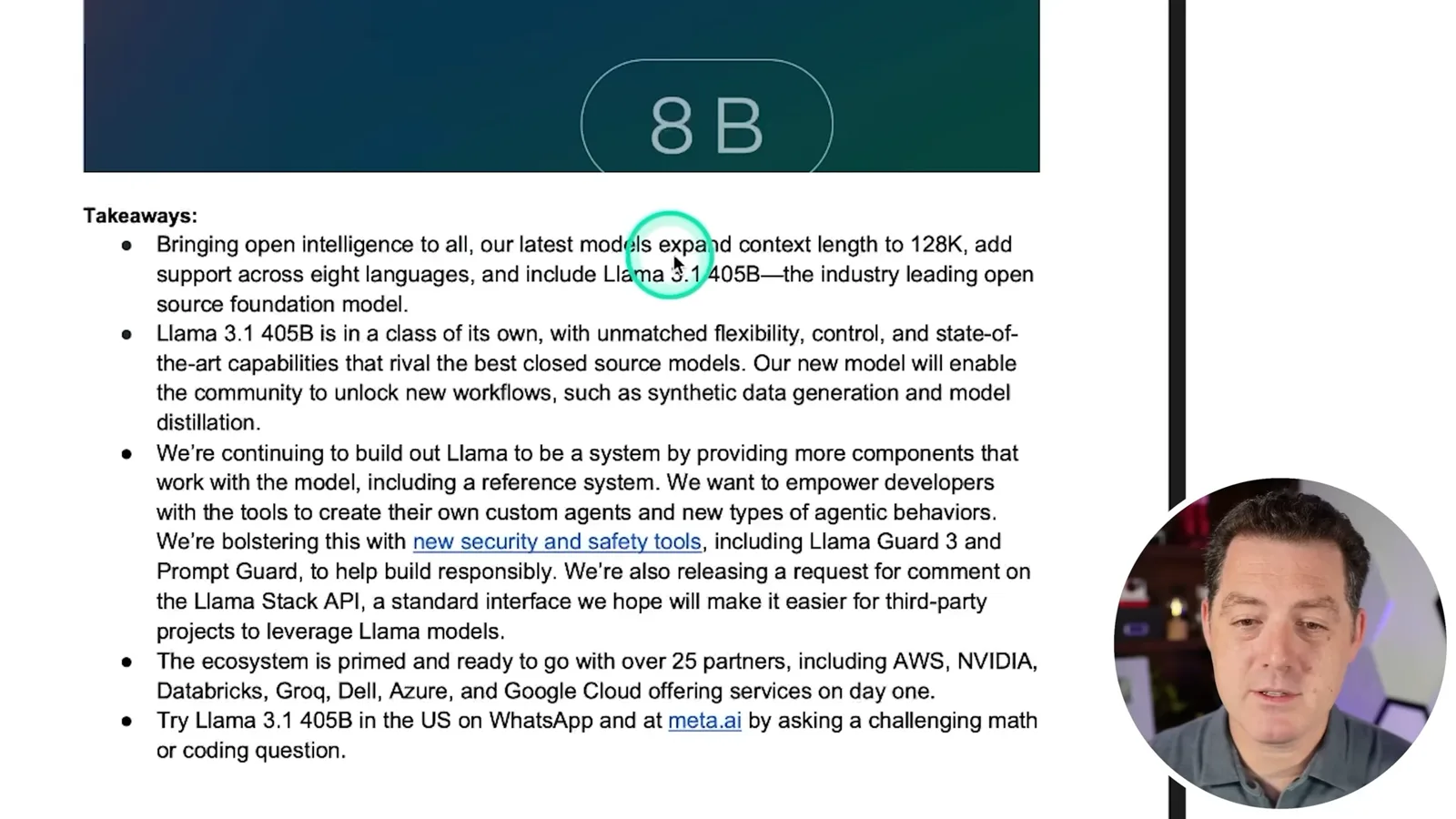
One use for a large model is creating synthetic examples to train or distill a smaller one. I compare this possibility with NVIDIA’s earlier Nemotron work: a team can use generated data to adapt a model without obtaining every example from a human-labeled dataset. The resulting quality still depends on the data, the process and independent evaluation.
Developer tools and benchmark comparisons
He reviews safety tools, partners and a purported leaked benchmark table. The chart is not independently verified, and some spoken figures differ from the display.
Meta is presenting Llama as an ecosystem rather than just a model release. It describes a reference system for building agents, Llama Guard 3 and Prompt Guard safety tools, and a request for comment on a Llama Stack API. I hope the interfaces will make it easy to swap providers and integrate with existing tools.
Meta lists more than 25 partners, including cloud and hardware companies, and says users in the United States can try 405B through Meta AI and WhatsApp. I plan to test it more thoroughly later. Availability and partner offerings described here reflect the 2024 announcement.
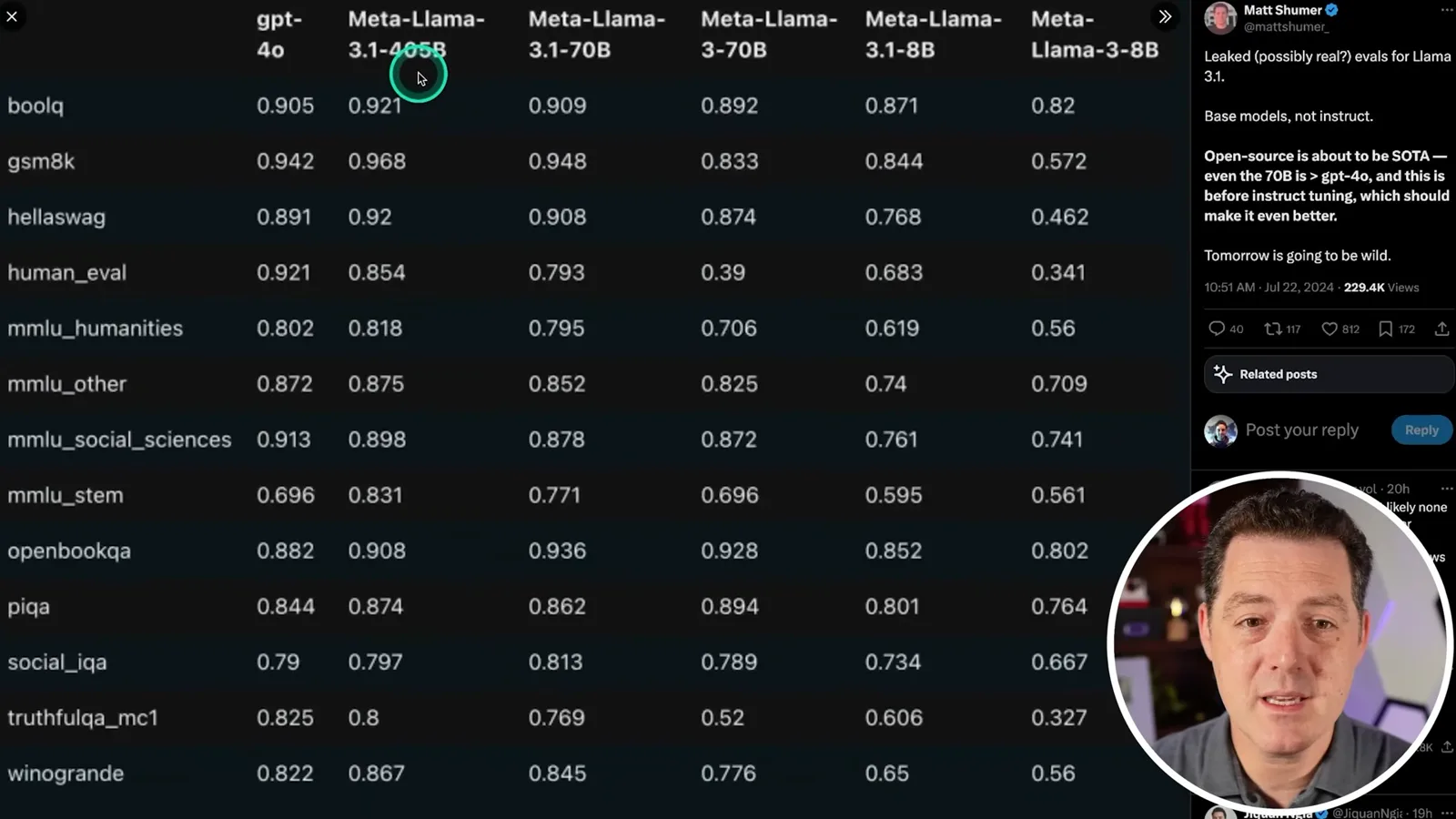
I show a table circulating as a leaked benchmark comparison between Llama 3.1, previous Llama versions and GPT-4o. The post itself says the leak may be real, and the video does not verify its origin or testing methodology. It suggests strengths and weaknesses on selected tasks, but cannot establish that any model is universally better.
The same table appears to show substantial gains for the 8B model. Berman says HellaSwag rose from 46 to 67, but the visible table shows approximately 46.2% to 76.8%; it shows HumanEval from 34.1% to 68.3%. Those are values in the unverified table, not necessarily Meta’s official measurements. Meta’s [model card](https://github.com/meta-llama/llama-models/blob/main/models/llama3_1/MODEL_CARD.md) reports results under its own evaluation settings.
Local models, policy and training
Berman considers routing and local inference, then quotes a political critique. He reviews Meta’s reported model training and post-training methods.
I imagine using a local 8B model for routine prompts and routing harder requests to a larger hosted model. I estimate it might handle 95–98% of prompts, but that is my speculation rather than a measured rate. Local inference can work offline once models and software are installed, although hardware, power and setup still have costs.
I also cite venture capitalist Bill Gurley’s criticism of AI regulation and his view that established closed-model companies seek rules that protect their position. That is his political argument and does not establish the motives of any company or legislator. I return to the model release after noting the debate.
Meta says the upgraded 8B and 70B models support longer context, multilingual use and tool use. It also says the license permits developers to use Llama outputs to improve other models. This could make synthetic-data and distillation workflows more accessible, subject to the actual license terms.
Meta reports evaluating models on more than 150 benchmark datasets and describes 405B as competitive with leading models across a range of tasks. It says 405B was trained on over 15 trillion tokens using more than 16,000 NVIDIA H100 GPUs. These are Meta’s reported training and evaluation details, not independent proof of performance in all uses.
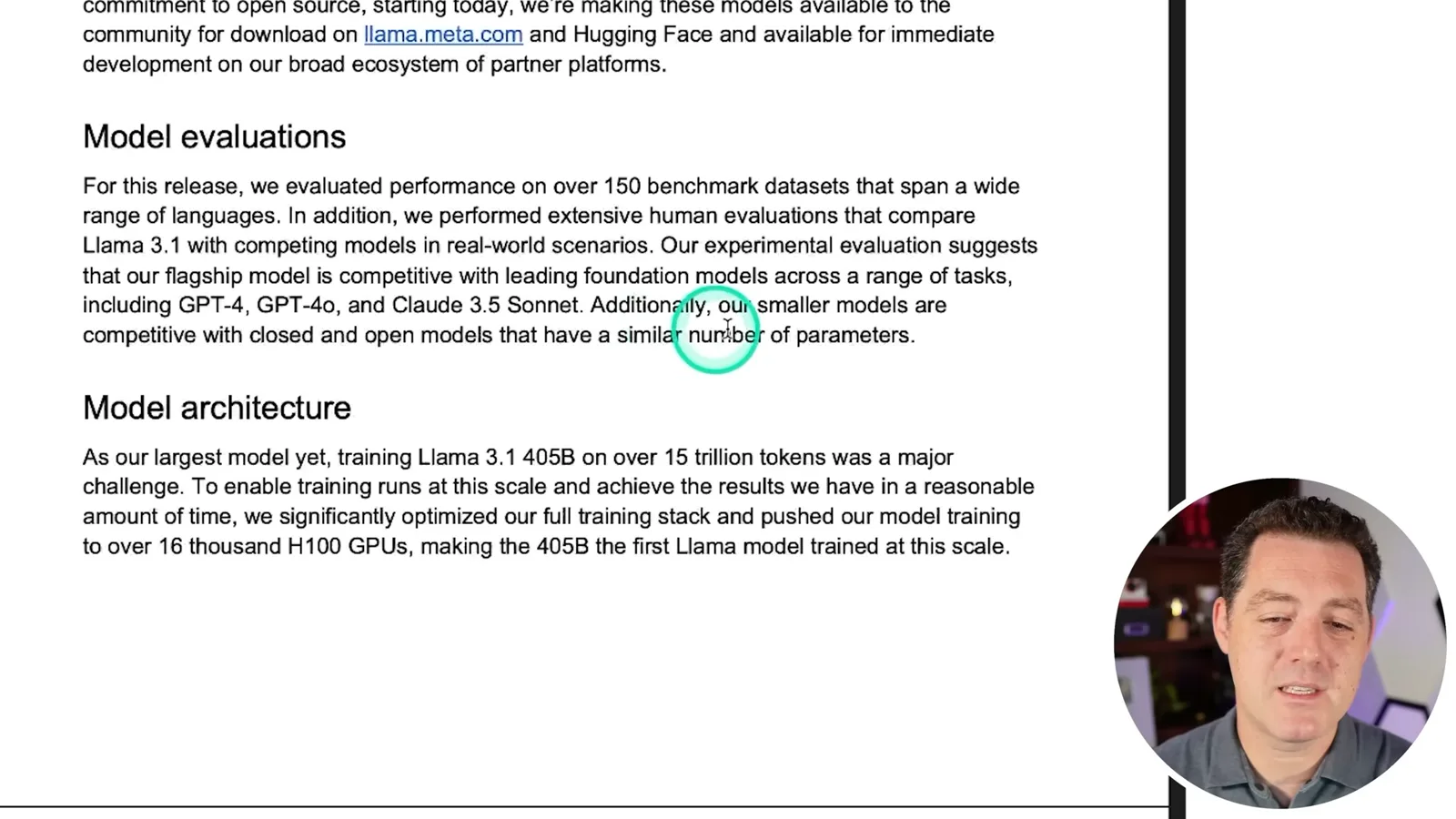
The 405B model is large enough that local deployment requires substantial memory and compute. Meta says it quantized the model from 16-bit to 8-bit to lower inference requirements and run it on a single server node. A server node is not necessarily a consumer laptop, and further quantization or hardware configurations involve their own tradeoffs.
For post-training, Meta describes supervised fine-tuning, rejection sampling and direct preference optimization, using synthetic data for much of the supervised fine-tuning data. I wonder whether 405B outputs were used to improve the 8B model, but the clip does not establish that specific training relationship.
Snake and Llama Stack
A generated Snake game runs during a short demonstration. Berman closes with Meta’s proposed developer interfaces and his hopes for the ecosystem.
I ask the hosted model to write Snake in Python, copy its output and run it. The game starts and responds during my short test, including restarting after a collision. That is a useful example of code generation, not a systematic assessment of coding reliability or security.
Meta’s Llama Stack proposal aims to standardize interfaces for components such as fine-tuning, synthetic data, inference and agent applications. I think releasing models and tools can also encourage developers to build in Meta’s ecosystem, giving the company a role in shaping standards. That is my interpretation of its business incentives.
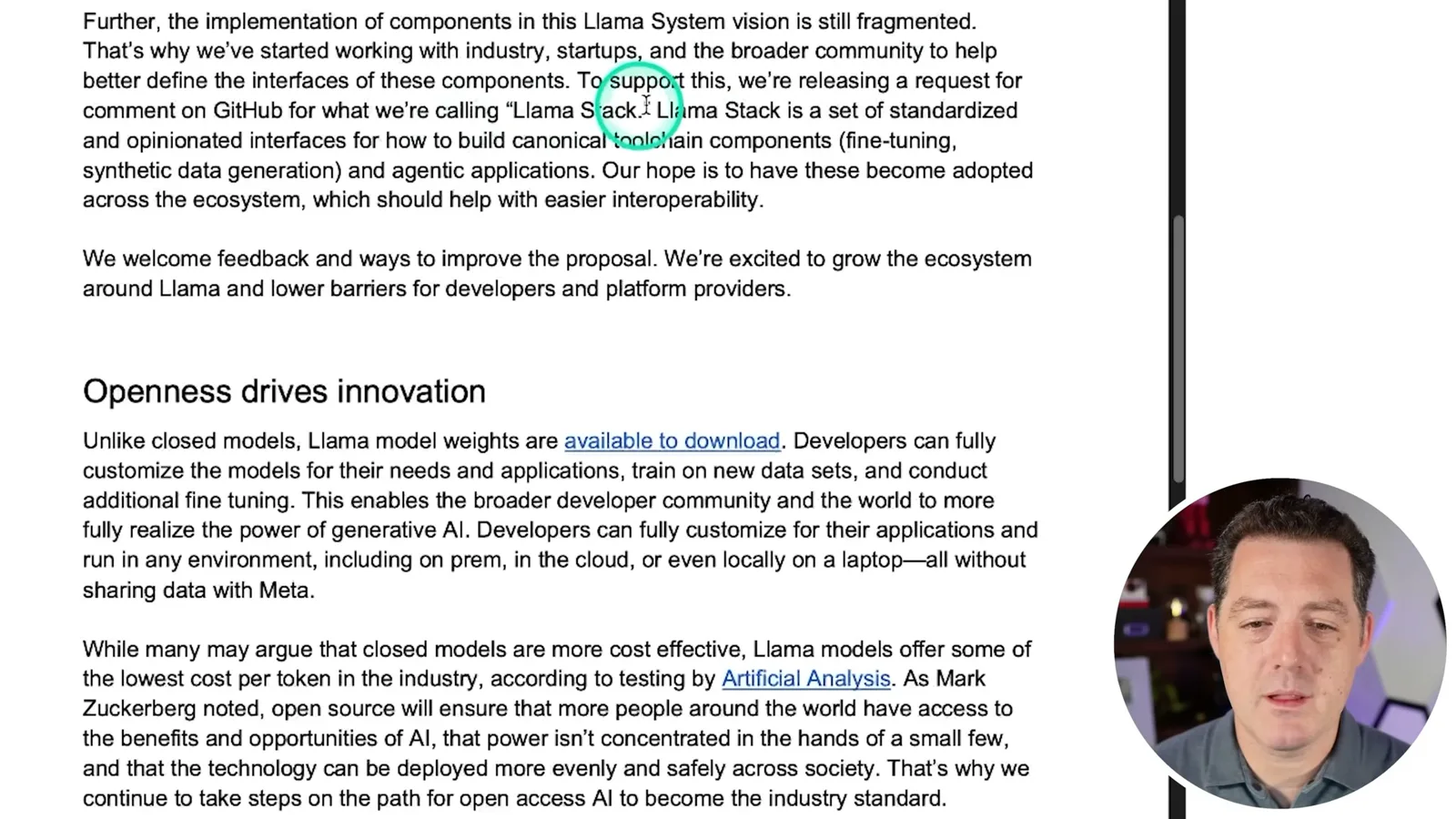
Downloadable weights give developers ways to customize and deploy models themselves, within the license and available resources. Meta also describes inference, evaluation, retrieval, function calling and other ecosystem components. I welcome the release and plan a more complete comparison of 405B and 8B, while acknowledging that the brief demonstration here cannot establish universal frontier performance.
Sur la même chaîne
 34:21EN
 Matthew Berman· 27 oct. 2026Matthew Berman Examines Anthropic’s IPO Filing, AI Growth and GovernanceMatthew Berman, Sam Altman · Forward FutureThe presenter reviews the S-1’s financial metrics, compute strategy and voting structure while questioning the tension between rapid AI development and safety.
 0:36ENMatthew Berman· 25 oct. 2026Kimi K3.1 and a Rubik’s Cube Solver DemonstrationMatthew Berman · Forward FutureMatthew Berman shows a scrambled virtual cube being solved and gives the Kimi K3.1 test a favorable assessment.
 25:50ENMatthew Berman· 24 oct. 2026Kimi K3.1 Pro Tested: Strong 3D Demos, Uneven Results and Competitive PricingMatthew Berman · Forward FutureMatthew Berman tests the open-weight model on coding, 3D rendering and visual explanations, then compares benchmark results and prices.
 32:20ENMatthew Berman· 23 oct. 2026Who Is Local AI For? The Costs, Trade-offs and a Hybrid FutureMatthew Berman · Forward FutureMatthew Berman weighs data control and independence against hardware cost, setup complexity and inference speed.
 1:03:37ENMatthew Berman· 23 oct. 2026Matthew Berman’s Team Tests Kimi K3.1 on Animation, Games, and ChartsMatthew Berman, Alex, Brian · Forward FutureA live team AMA turns into an informal test of Kimi K3.1, from personal-agent workflows to motion graphics, a browser game, and a benchmark chart.
 0:53ENMatthew Berman· 22 oct. 2026Sam Altman on AI and the Discovery of New KnowledgeSam Altman · OpenAIAltman expects progress in mathematical discovery to extend to biology, materials and energy.