En 30 secondes
In a 2011 AIAA question-and-answer session, Elon Musk discusses an early Mars transport concept, potential crew upgrades to Dragon, electric propulsion and the difficulty of recovering a rocket booster. He also describes a proposed Falcon Heavy propellant crossfeed option. These were concepts and estimates at the time: [SpaceX’s current Falcon Heavy description](https://new.spacex.com/vehicles/falcon-heavy) describes throttling the center core down and back up around side-core separation, rather than presenting crossfeed as its standard design.
- 1Mars transport would develop in stagesMusk gives tentative payload figures and imagines demand from lunar or Martian settlements.
- 2Dragon’s crew-escape system is a design proposalHe describes redundancy and using onboard propellant for escape, with propulsive landing discussed as an option.
- 3Electric propulsion and capsule entry involve tradeoffsMusk discusses thrust, power and the limitations of designs across different planetary atmospheres.
- 4A 2011 Falcon Heavy crossfeed ideaHe describes an optional approach to supplying the center core from side boosters; it should not be assumed to describe the later operational vehicle.
- 5Booster recovery requires managing reentry forcesMusk discusses balancing propellant, structural mass and thermal protection, including a possible engine restart.
À retenir
- Musk’s Mars payload figures and high launch-demand scenario were 2011 estimates, not demonstrated Mars missions.
- He describes crew escape, parachute redundancy and optional propulsive landing as proposed Dragon features; the first crewed Dragon flight ultimately returned by splashdown.
- Musk considers electric propulsion for interplanetary travel and discusses why a capsule’s lift-to-drag ratio affects entry design.
- The proposed Falcon Heavy crossfeed option and booster recovery approach were early engineering concepts; later Falcon designs evolved.
Lire le texte remanié, chapitre par chapitre
Mars payloads and demand
Musk gives tentative transport estimates and discusses the possible market for frequent flights.
In a 2011 AIAA Q&A, Elon Musk continues an answer about a vehicle that could deliver mass to Mars and return to Earth. He gives tentative payload estimates for Falcon Heavy and a larger reusable vehicle; these are early estimates, not demonstrated Mars landings.
Asked what demand could support hundreds of launches per year, Musk suggests a lunar or Martian settlement could eventually create demand for frequent transport. He doubts that satellite launches or extracting lunar material for Earth alone would require that rate.
Dragon crew safety and escape
He describes planned redundancy, a launch escape system and an optional powered-landing concept.
An audience member asks about Dragon and astronaut transport. Musk says Falcon and Dragon were designed with published NASA human-rating guidelines in mind and describes redundancy in engines, avionics and heat shielding.
Musk says the principal addition for crew transport would be a launch escape system. He describes an approach using propellant carried aboard the spacecraft rather than relying solely on a detachable escape tower.
He discusses using escape engines for optional propulsive landing while retaining parachutes, and speculates about deliveries to other worlds. This is a 2011 concept; the first crewed Dragon test flight returned by parachute and splashdown.
Electric propulsion and capsule entry
Musk discusses electric propulsion and lift-to-drag tradeoffs for different destinations.
Asked about electric propulsion, Musk says it could be useful for interplanetary travel, provided the system delivers meaningful thrust with adequate energy efficiency. He suggests power carried for a destination might also be used during transit.
Musk discusses adjusting a capsule’s lift-to-drag ratio and recalls the landing accuracy of a previous Dragon flight. He argues that a modest ratio can provide useful control without the complexity of a more elaborate lifting body.
He notes that atmospheric conditions differ between Earth and Mars and that a winged lifting-body approach would not provide the same benefits on an airless Moon. He emphasizes the robustness he expects from the capsule design.
Falcon Heavy crossfeed and booster reuse
He discusses a proposed crossfeed option and the challenge of returning a booster through the atmosphere.
Asked about Falcon Heavy crossfeed, Musk describes an optional 2011 concept in which side cores would supply propellant to engines on the center core. He estimates a possible payload benefit for demanding missions.
Musk says the proposed crossfeed would be used only when a mission needed it and mentions possible deep-space applications. This description is a concept from the talk, not a specification of the later operational rocket.
Asked how reuse efforts have gone, Musk says they have been extremely difficult. He notes that Dragon had been recovered but says a booster cannot carry the same level of protection without sacrificing payload.
He describes high reentry forces and the need to slow the first stage. The team is considering restarting engines to reduce speed, balanced against carrying extra propellant, stronger structures and thermal protection.
Musk says the proposed approach appears workable on paper but remains to be tested in practice. The excerpt ends after that qualification.
Sur la même chaîne
 21:08EN
 VideoFromSpace· 26 août 2025Musk explains the two technologies Starship needs for MarsDan Huot, Bill Riley, Elon Musk · SpaceXBefore Flight 10, SpaceX leaders described reusable heat shields, tower catches and orbital refilling as steps toward high-volume Mars flights.
 8:50ENVideoFromSpace· 30 mai 2025Musk sketches a tentative schedule for building a Mars settlementElon Musk · SpaceXIn 2025, Musk described launch windows, possible landing sites and the supplies he thinks a self-sustaining settlement would need.
 39:58ENVideoFromSpace· 29 mai 2025Musk’s 2025 Starship Plan: Reuse, Orbital Refueling and MarsElon Musk · SpaceXMusk explains why rapid reuse and orbital propellant transfer are central to SpaceX’s proposed Mars missions.
 10:02ENVideoFromSpace· 9 avr. 2025Isaacman faces questions on Musk ties and NASA’s Moon plansEdward Markey, Ted Cruz, Jared IsaacmanAt his April 2025 confirmation hearing, Isaacman declines to say whether Musk was present when Trump offered him the NASA job.
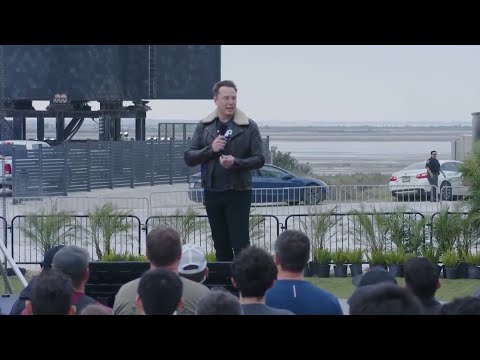 58:52ENVideoFromSpace· 13 janv. 2024SpaceX’s 2024 update: Falcon reuse and the road to StarshipElon Musk · SpaceXElon Musk reviews 2023 launches, Dragon and Starlink, then lays out Starship tests and the technology needed for lunar refueling.
 9:54ENVideoFromSpace· 5 oct. 2023Musk’s 2023 plan to catch Starship’s booster with launch-tower armsElon Musk · SpaceXAt the International Astronautical Congress, Musk discusses rapid reuse, satellite launches and a possible uncrewed Mars test.