En 30 secondes
In June 2026, Matthew Berman discusses Claude Tag, Anthropic’s shared assistant for Slack, and considers what persistent AI agents might mean for knowledge work. He welcomes the idea of agents working alongside teams but worries about dependence on one provider, spending, competition and control over company context. Anthropic describes access to selected channels and tools, not automatic access to everything in a company; ambient behavior is optional. Berman’s predictions about productivity, monopoly and replacing software are scenarios, not demonstrated outcomes.
- 1A shared Slack assistantClaude Tag can be invoked in Slack with access to selected channels and tools. Its access is scoped by configuration, not automatically all company data.
- 2Anthropic’s internal useAnthropic says 65% of its product team’s code comes from its internal version; the video does not provide the measurement method or a broad productivity comparison.
- 3A new interaction modelBerman discusses Andrej Karpathy’s view of a persistent assistant working alongside a team and predicts Anthropic may build a Slack competitor.
- 4Company-wide loopsBerman imagines agents using organizational context to run experiments continuously. The 1,000-fold productivity figure and unlimited improvement are hypothetical.
- 5Context lock-inBerman agrees with Ashwin Gopinath’s concern that dependence on an assistant’s accumulated context could make switching providers hard.
- 6Implications for softwareHe speculates that agents may take over interfaces and workflows, changing SaaS businesses; the video does not demonstrate that all software will disappear.
- 7Competition and controlBerman advocates open models, alternative providers and company control of its context as possible responses to platform dependency.
À retenir
- Claude Tag lets teams invoke a shared assistant in selected Slack channels with configured tools and context.
- Anthropic reported that its internal version produced 65% of its product team’s code; that is a company-specific claim, not a general productivity measure.
- Berman worries that storing organizational context in one agent platform could increase switching costs and dependency.
- Claims that an agent knows everything, delivers 1,000-fold productivity or will replace all software are speculative.
- Access, ambient behavior and spending controls depend on the organization’s configuration.
- Berman favors competition, multiple model providers and customer control over business context.
Lire le texte remanié, chapitre par chapitre
Claude Tag in Slack
Berman introduces Anthropic’s shared assistant and its reported internal use. He considers how it might change interaction with AI at work.
Anthropic has introduced Claude Tag, a way to bring a shared assistant into Slack. At first it looks like a convenient way to mention Claude, but I think its larger significance could be the integration of AI into everyday knowledge work. My concern that a single company could come to dominate that work is a prediction, not an established outcome.
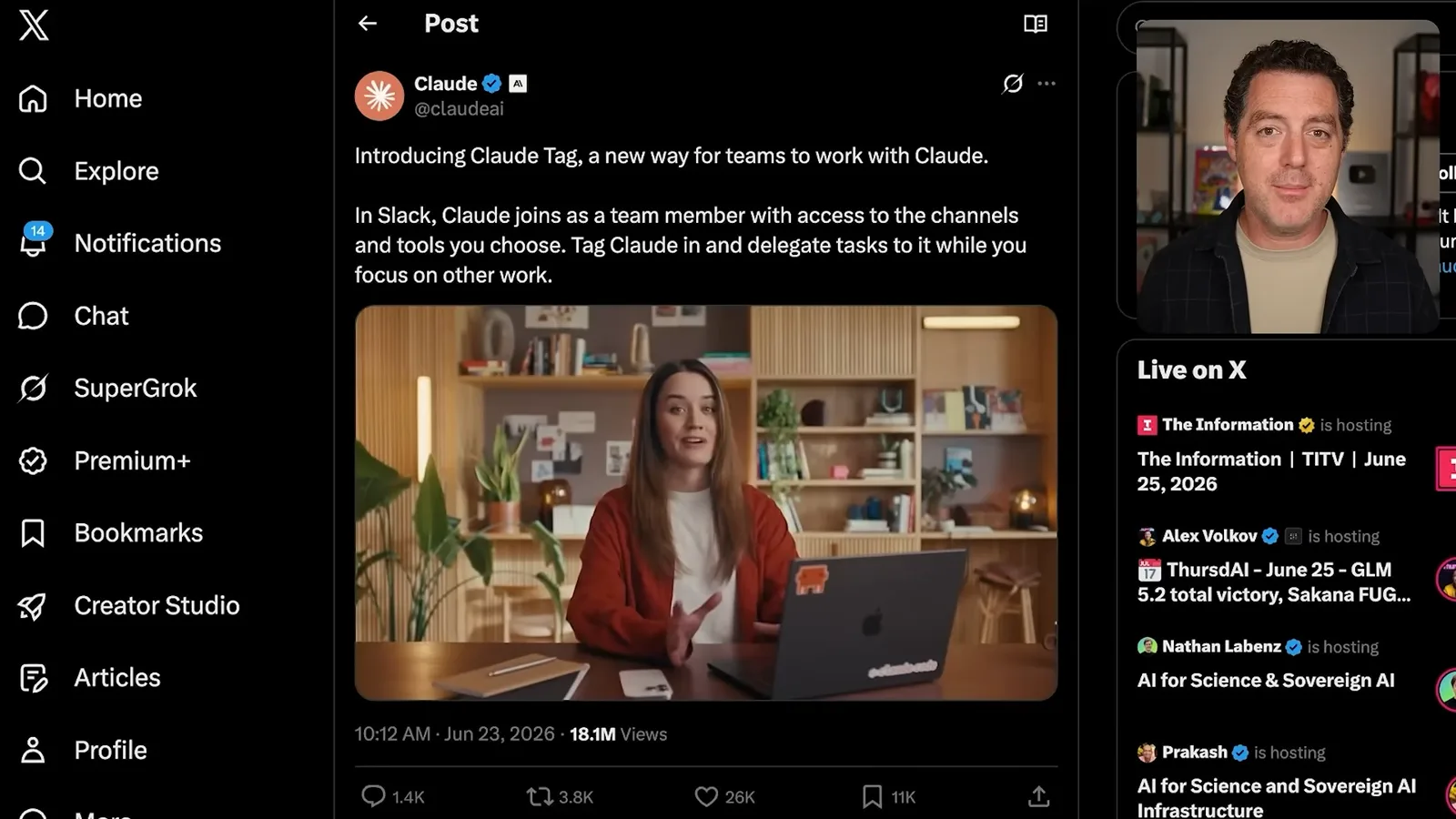
A team can tag Claude in Slack and delegate tasks using the channels and tools its organization configures. Anthropic describes a shared assistant with context and access to selected resources. It does not automatically have every conversation and document in a company; access depends on permissions and configuration, and proactive ambient behavior must be enabled. See [Anthropic’s announcement](https://www.anthropic.com/news/introducing-claude-tag).
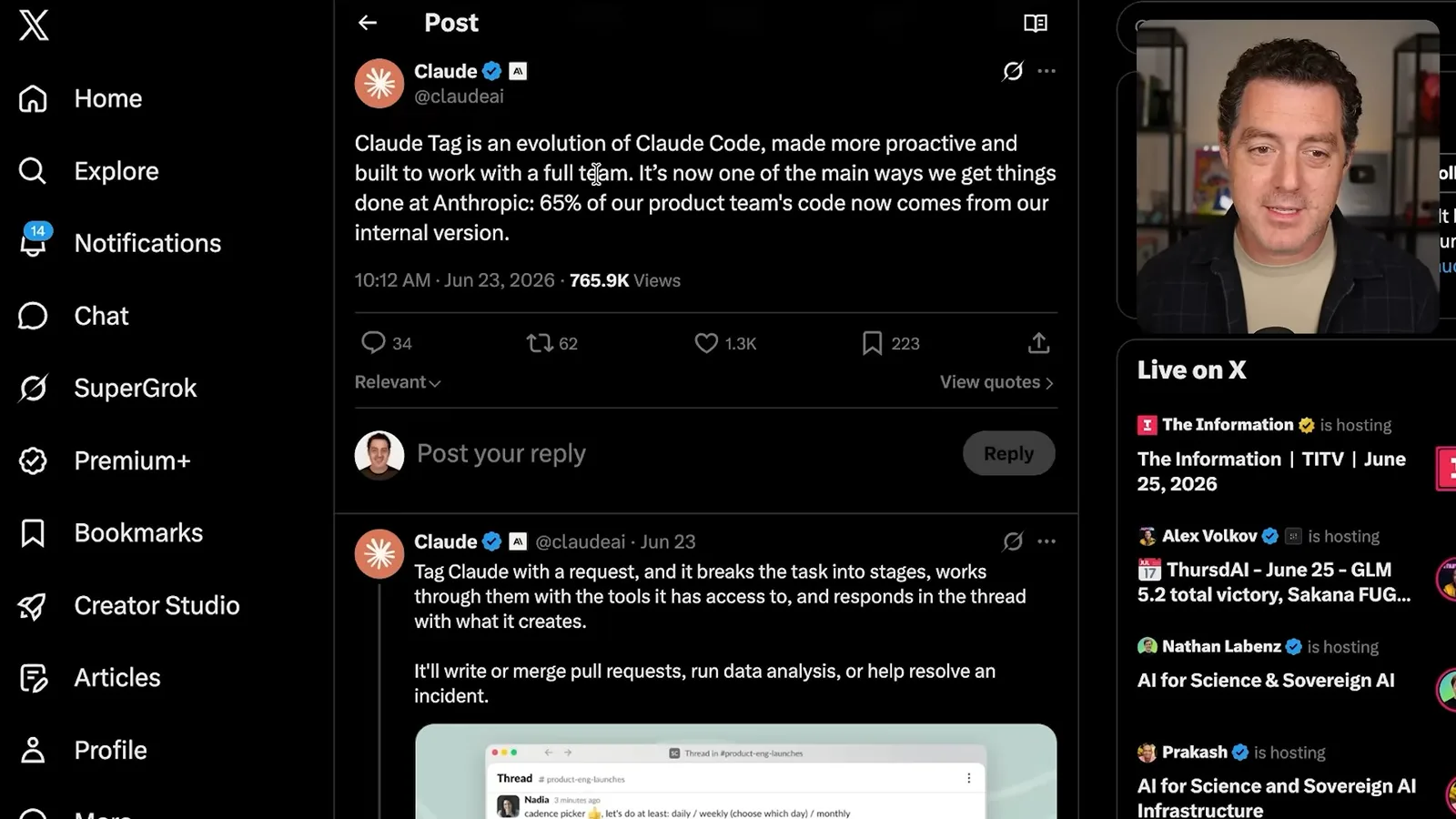
Anthropic describes Claude Tag as an evolution of Claude Code for teams and says its internal version creates 65% of its product team’s code. That is the company’s claim about its own team, and the video does not explain its measurement method or establish an equivalent gain elsewhere. I see the move from a separate coding interface into team conversation as significant.
An AI teammate and platform dependency
He discusses Andrej Karpathy’s framing and imagines an agent embedded in organizational workflows. He raises concerns about handing company context to a provider.
Andrej Karpathy describes a persistent, asynchronous assistant with tools and organizational context that works alongside a team. I interpret this as a possible new interface pattern: instead of opening a separate AI app, people may delegate work where conversations already happen. I predict Anthropic may eventually build a Slack competitor, but that is my speculation, not an announced product.
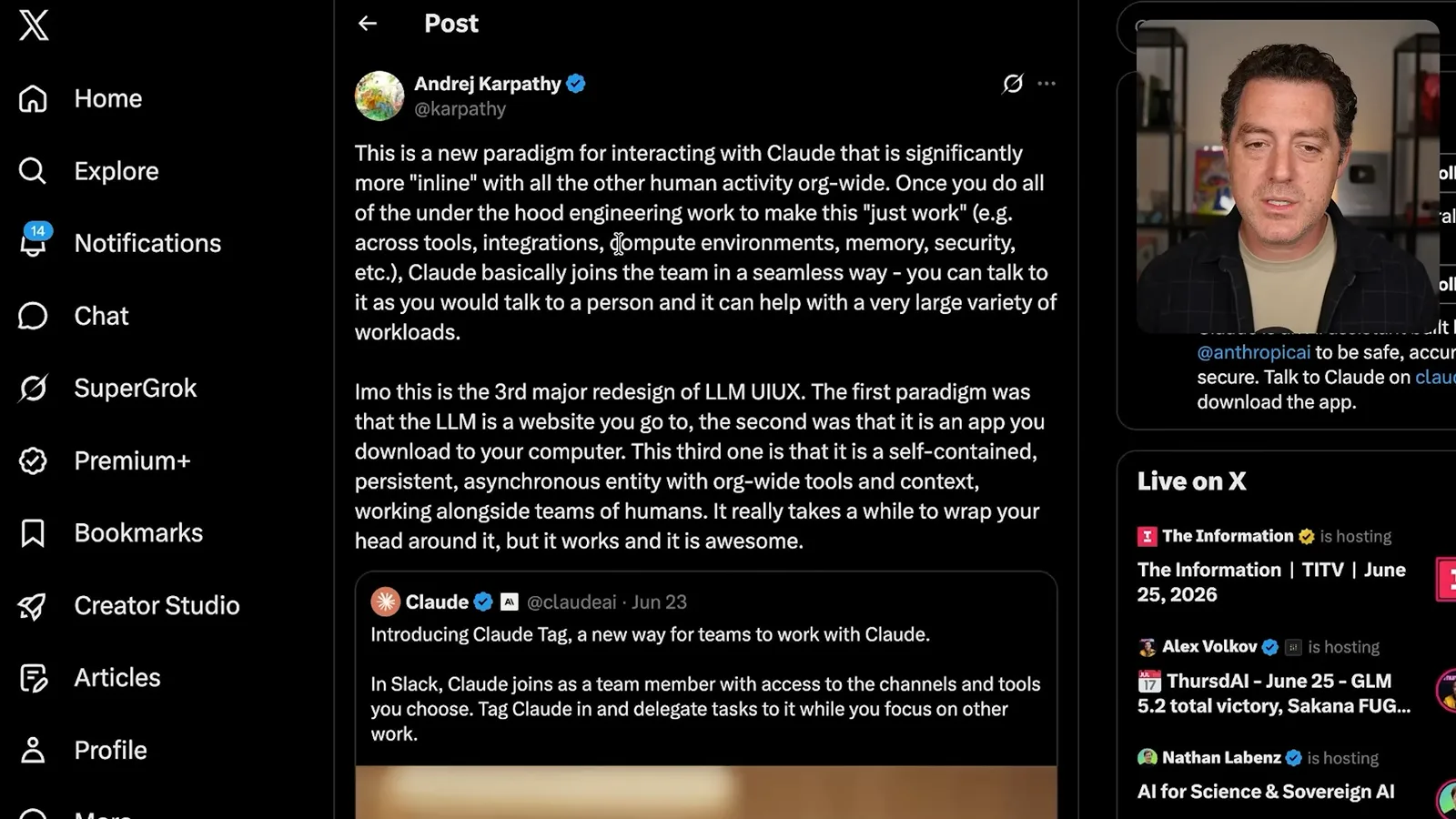
The appeal is that integrations, compute, memory and security could let an assistant carry out varied tasks while colleagues continue their work. I describe it as renting an AI teammate. That metaphor should not be taken to mean the system is a person or that its output can be trusted without review.
Karpathy frames this as a third phase after web-based chat and downloaded AI applications: a persistent assistant that shares context and works asynchronously with people. I find that framing persuasive, but I also worry about an organization becoming dependent on a vendor for both its work and accumulated knowledge.
My concern is control of company context. If a provider has access to conversations, documents and tools, the organization needs to consider what it shares and how it could move or recover that context later. The precise access and retention behavior depends on configuration and service terms; the video does not prove the provider receives every company record.
AI-native companies and context lock-in
Berman imagines agents running continuous experiments and explores how a single provider could become hard to replace. These scenarios and productivity claims are predictions.
Y Combinator has discussed the idea of an AI-native company, and I see Claude Tag as a possible step toward that vision. I imagine an assistant that helps people around the clock. My suggestion of a thousandfold productivity improvement is illustrative speculation, not a measured result from this product.
Consider a loop whose goal is to increase revenue: an agent might use company context to propose experiments and repeat the process. That is a hypothetical future workflow. Whether it improves a business depends on reliable data, evaluation, permissions, human decisions and cost; the video does not demonstrate an indefinitely successful autonomous loop.
I worry that organizations able to spend more on inference could gain an advantage, potentially concentrating economic power. That is a possible outcome rather than an established consequence. I also discuss a post by Ashwin Gopinath arguing that an AI vendor may become the place where work is interpreted, remembered and routed.
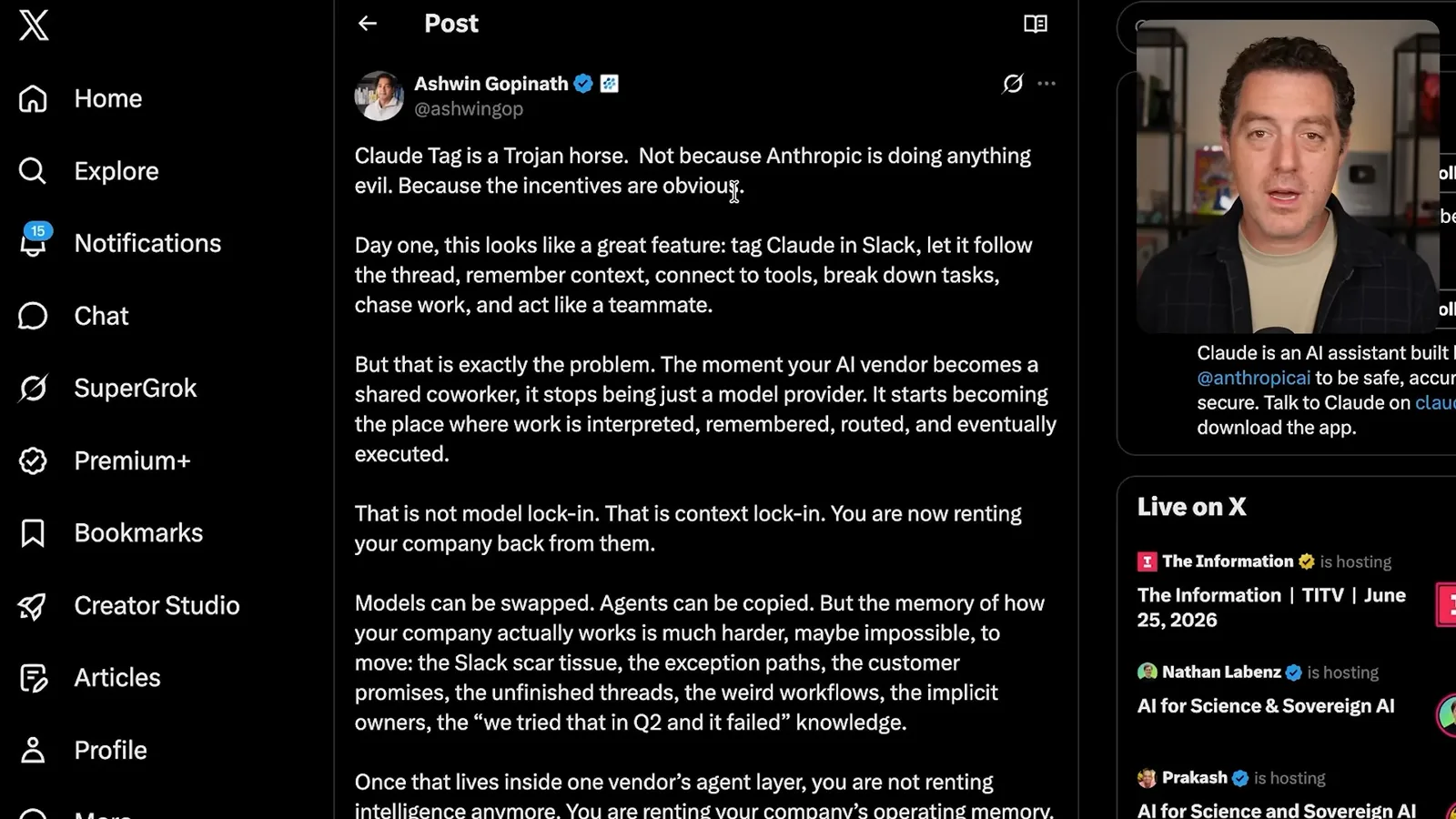
He calls this context lock-in: replacing a model may be easier than transferring the accumulated knowledge about how a company works. I compare the risk to earlier dependence on app stores or social platforms. The degree of lock-in depends on data portability, integrations, contracts and alternatives rather than following automatically from one feature.
Usage-based pricing adds another concern for me: an agent can keep doing work and consuming tokens. Calling the cost infinite is rhetorical; actual costs depend on usage, prices and configured limits. Organizations can evaluate budgets and spending controls when deciding how to deploy an assistant.
Software, competition and ownership
He speculates about agents changing software interfaces and workflows. He calls for competition and customer control of organizational context.
I imagine a SaaS customer asking an agent to operate software instead of opening its interface. If agents can also implement workflows and access data, I wonder how much of a software product remains distinctive. This is a scenario about changing interfaces and competition, not evidence that agents can already replace every application or its safeguards.
My most extreme concern is that one provider could accumulate control over knowledge work and software. I think regulation could become relevant, but whether that concentration occurs is uncertain. Open models, multiple providers and the ability to retain and move business context are alternatives I would like organizations to consider.
I remain optimistic that humans and AI can work together inside organizations rather than using an assistant only as a separate chat page. More competition and customer control over context would make that future more attractive to me. The scale of productivity gains and the ultimate market structure remain open questions.
Sur la même chaîne
 34:21EN
 Matthew Berman· 27 oct. 2026Matthew Berman Examines Anthropic’s IPO Filing, AI Growth and GovernanceMatthew Berman, Sam Altman · Forward FutureThe presenter reviews the S-1’s financial metrics, compute strategy and voting structure while questioning the tension between rapid AI development and safety.
 25:50ENMatthew Berman· 24 oct. 2026Kimi K3.1 Pro Tested: Strong 3D Demos, Uneven Results and Competitive PricingMatthew Berman · Forward FutureMatthew Berman tests the open-weight model on coding, 3D rendering and visual explanations, then compares benchmark results and prices.
 32:20ENMatthew Berman· 23 oct. 2026Who Is Local AI For? The Costs, Trade-offs and a Hybrid FutureMatthew Berman · Forward FutureMatthew Berman weighs data control and independence against hardware cost, setup complexity and inference speed.
 1:03:37ENMatthew Berman· 23 oct. 2026Matthew Berman’s Team Tests Kimi K3.1 on Animation, Games, and ChartsMatthew Berman, Alex, Brian · Forward FutureA live team AMA turns into an informal test of Kimi K3.1, from personal-agent workflows to motion graphics, a browser game, and a benchmark chart.
 0:53ENMatthew Berman· 22 oct. 2026Sam Altman on AI and the Discovery of New KnowledgeSam Altman · OpenAIAltman expects progress in mathematical discovery to extend to biology, materials and energy.
 0:22ENMatthew Berman· 21 oct. 2026A Robot Bodyguard Video Shows Dramatic Rescue ScenariosMatthew Berman · Forward FutureMatthew Berman reacts to a short robot demonstration depicting fighting and vehicle-rescue scenarios.