En 30 secondes
Theo reviews Anthropic's Sonnet 5 launch and reports that restrictions on Fable 5 had been lifted. He finds Sonnet's subagent orchestration promising, but argues that its token consumption can make model selection consequential; he plans to keep using other models for now.
- 1Two pieces of newsTheo introduces Sonnet 5 and says restrictions on Fable 5 have been lifted.
- 2Introductory pricingHe cites $2 per million input tokens and $10 per million output tokens through August 31, 2026, followed by announced standard rates of $3 and $15.
- 3Token efficiencyTheo points to a benchmark chart showing high token use and argues that the cheapest model per token may not be the cheapest for a task.
- 4Subagent coordinationHe says Sonnet 5 breaks work into pieces and orchestrates subagents, making it potentially useful to stronger models.
À retenir
- Anthropic describes Sonnet 5 as a more agentic model capable of planning and using tools.
- The launch pricing Theo cites was temporary, with a stated change after August 31, 2026.
- Theo argues that high token consumption can offset a lower per-token price for some tasks.
- He sees subagent orchestration as Sonnet 5's most interesting behavior and a potential role under stronger models.
Lire le texte remanié, chapitre par chapitre
The launch and agent capabilities
Theo discusses the release of Sonnet 5 and the lifting of restrictions on Fable 5. He reads Anthropic's description of Sonnet's planning and tool use.
This is a big moment for Claude fans: Sonnet 5 is out, and I understand that the Secretary of Commerce has lifted the restrictions on Fable 5. That latter news matters more to me, because I don't expect to use Sonnet 5 all that much.
Anthropic describes Sonnet 5 as its most agentic Sonnet yet, able to plan, use browser and terminal tools, and work autonomously at a level that recently required larger, more expensive models. To me, the product tiers feel as though they've shifted upward: tasks once suited to Haiku now go to Sonnet, Sonnet tasks to Opus, and Opus tasks to Fable. That's my interpretation of the lineup, and a clever way to make us spend more.
Price and token usage
Theo cites the launch-period and planned standard prices. He argues that token consumption matters when choosing a model for a task.
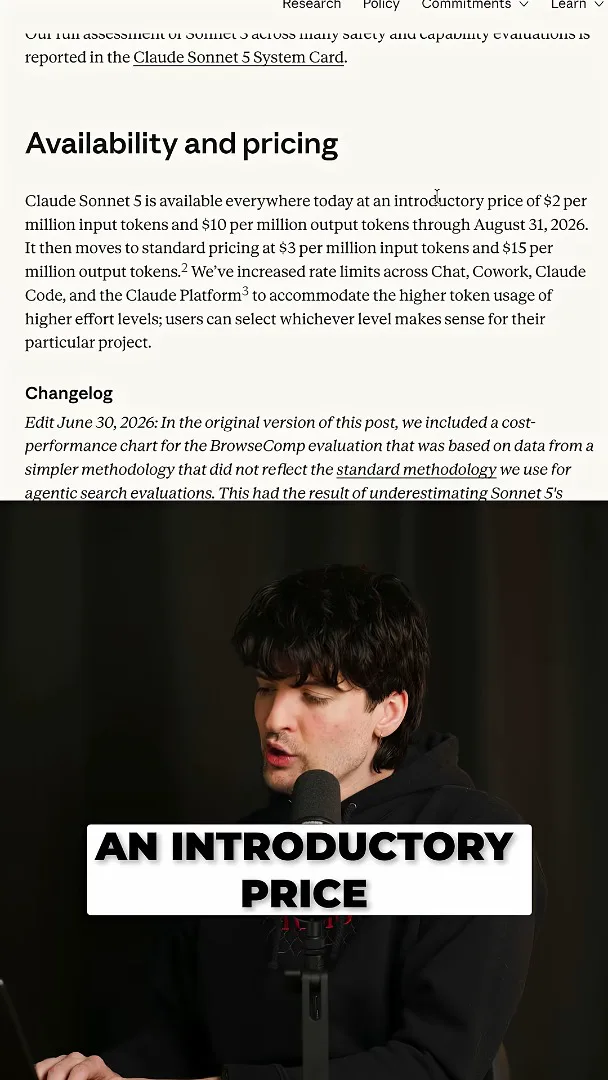
At launch, Anthropic announced an introductory API price of $2 per million input tokens and $10 per million output tokens through August 31, 2026, followed by standard prices of $3 and $15 respectively. Those figures describe the announcement at the time, not necessarily current pricing.
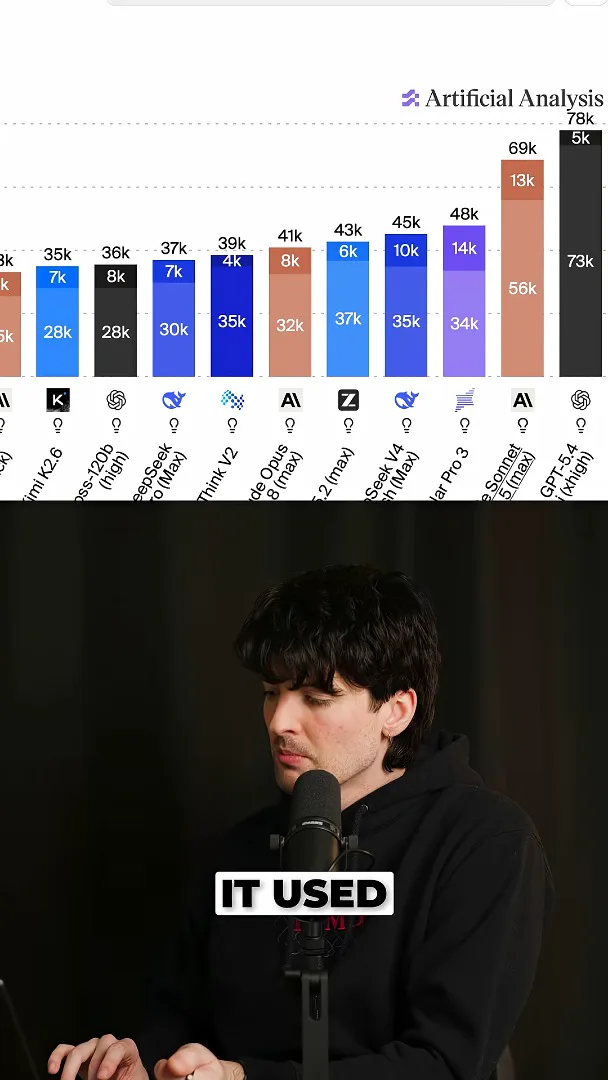
I'm filming this after discussing OpenAI model efficiency, and Sonnet looks like the opposite in the benchmark chart I cite: it uses 69,000 tokens, nearly twice the Opus figure and several times the GPT-5.5 figure. That's one benchmark comparison, not a universal cost result. My interpretation is that Sonnet keeps working toward an answer even when it struggles, so engineers must choose which model to use; getting that choice wrong can cost more than using the stronger model throughout.
Orchestration and model choice
He praises Sonnet's handling of subagents and imagines it working under stronger models. For now, he prefers other models for his own work.
What interests me is a behavior I'd previously seen in Fable 5: Sonnet likes subagents and is good at breaking work into smaller pieces, delegating them and staying on task. I think it may be most useful as a tool for smarter models that can orchestrate work well, such as Fable 5 or Mythos 5, and perhaps a future GPT-5.6. For now I'm sticking with GPT-5.5 and Opus, and I intend to return to Fable when I have access again.
Sur la même chaîne
 38:47EN
 Theo - t3․gg· 28 oct. 2026Theo’s Long-Running Agent Experiments: Verification, Compute and CostTheo Browne · Ping LabsA skateboard game and two compiler projects show how repeated checks and flexible compute can sustain agent work—and how expensive those loops can become.
 36:07ENTheo - t3․gg· 27 oct. 2026Theo on Token Costs, Coding Agents, and the Price of AI CapabilityTheo Browne · Ping LabsA viral estimate of Lauren's AI spending prompts a closer look at cache pricing, benchmarks, and the changing work of coding agents.
 30:37ENTheo - t3․gg· 26 oct. 2026Theo’s Three Skills for Reviewing and Shipping with Coding AgentsTheo Browne · Ping LabsHow sol-loop, full-send and full-stop encode review, verification and different levels of merge authority.
 0:43ENTheo - t3․gg· 23 oct. 2026Theo Distinguishes Security Vulnerabilities from Active AttacksTheo Browne · Ping LabsA short explanation of why disclosed software flaws and reported attacks are different kinds of security news.
 29:22ENTheo - t3․gg· 22 oct. 2026Theo on Security Vulnerabilities, Stolen API Keys and AITheo Browne · Ping LabsA look at the gap between vulnerability disclosure and patching, and a speculative account of why stolen inference keys may be valuable.
 31:13ENTheo - t3․gg· 20 oct. 2026Theo on Why Smarter Models Help More Than DevelopersTheo Browne · Ping LabsFrom game modifications to compiler experiments, Theo revisits his assumptions about who benefits from more capable AI.