En 30 secondes
Matthew Berman reviews the original 2025 ASI-Arch paper and its analogy to AlphaGo. The system uses researcher, engineer and analyst roles to propose architectures, test implementations and retain insights for future experiments. The paper reports 1,773 initial experiments and approximately 20,000 GPU hours, with 106 linear-attention architectures identified under its evaluation criteria. These are bounded research results, not proof of artificial superintelligence, unlimited self-improvement or exponential progress.
- 1The AlphaGo analogyBerman recalls a surprising move against Lee Sedol; the analogy does not prove general superintelligence.
- 2An iterative research loopASI-Arch combines researcher, engineer and analyst roles with external tools and stored results.
- 3Proposing and debuggingThe researcher builds on literature and prior candidates; the engineer trains and evaluates implementations.
- 4The experiment’s scopeThe original paper reports 1,773 explorations, about 20,000 GPU hours and 106 selected linear-attention architectures.
- 5Compute and future applicationsMore compute and other scientific domains are possible directions, but the video does not establish exponential progress or compute as the sole limitation.
À retenir
- ASI-Arch uses language models and tools to propose, implement, train and evaluate candidate architectures.
- The search uses human-designed prompts, evaluations, research literature and infrastructure.
- The original paper reports 106 linear-attention architectures under its specific evaluation criteria, not 106 universally superior models.
- The AlphaGo comparison is an analogy; the original AlphaGo also used human game records in training.
- Scaling compute and applying the method to medicine are possibilities discussed by Berman, not established results of the experiment.
Lire le texte remanié, chapitre par chapitre
The AlphaGo analogy
Berman describes his hopes for automated research and recalls AlphaGo’s unexpected move. The analogy does not establish that AI innovation will grow exponentially.
A 2025 paper presents ASI-Arch, a system for proposing, implementing and testing neural-network architectures. I find it exciting as an example of AI helping research on AI itself. The paper invokes an “AlphaGo moment,” but that is an analogy and the authors’ framing, not evidence that general artificial superintelligence has been achieved.
I argue that human research time can limit the rate of new AI ideas and imagine agents proposing hypotheses and running experiments at greater scale. That is a hypothesis about the future, not proof that human-led research grows only linearly or that automated progress will grow exponentially.
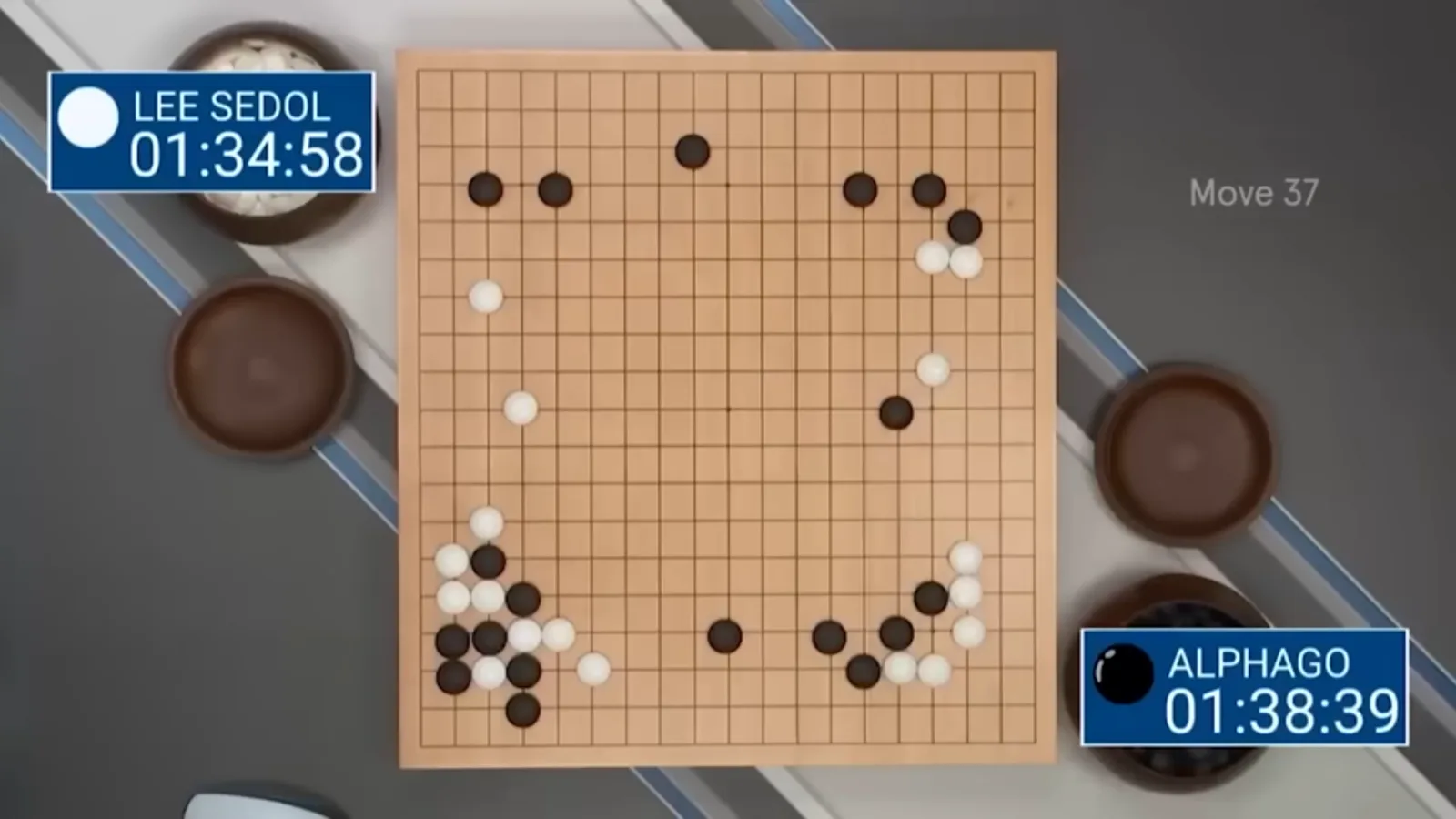
AlphaGo’s match with Lee Sedol provides the analogy. Its 37th move surprised commentators, and its value became clearer as the game developed. AlphaGo used training and search, including self-play; the original system also learned from human game records. Its success in Go does not by itself establish the capabilities of an architecture-search system.
Researcher, engineer and analyst
The system proposes and tests designs using literature, past experiments and tools. An analyst retains lessons for later iterations.
The proposed ASI-Arch loop uses language-model agents and tools to hypothesize designs, implement code, train candidate models and analyze results. I question the use of “ASI” in its name because artificial superintelligence is a loaded term. The system works within a human-designed research setup, with a chosen domain, models, evaluation procedures and external knowledge.
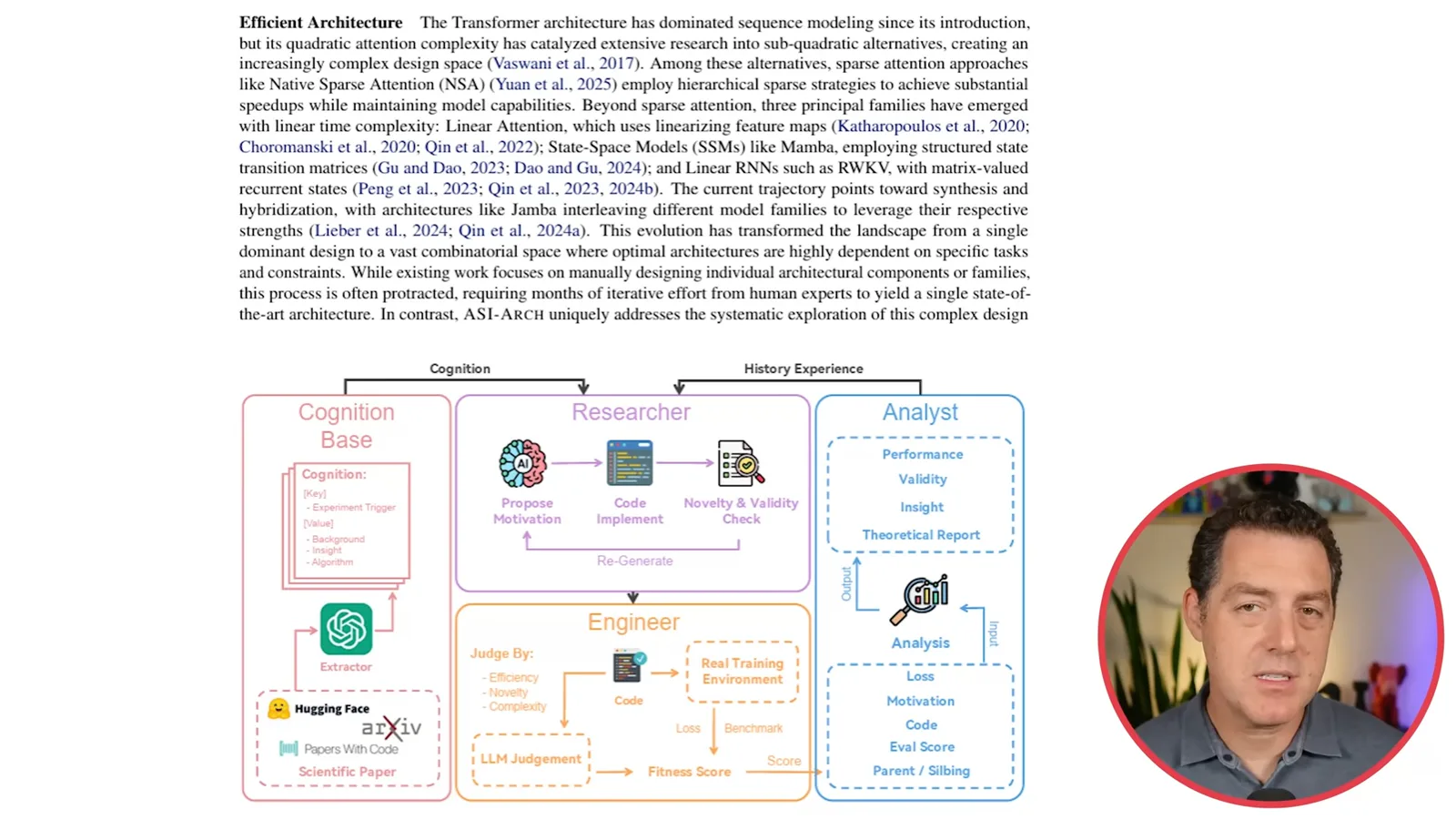
The researcher role draws on previous experiments and human literature to propose new designs, using strong candidates as parents and references. The engineer role implements and tests candidates, handling code errors where possible. This automated debugging can prevent some promising experiments from failing only because of implementation mistakes, though it does not guarantee every error is fixed.
The analyst reviews training logs, benchmark results and other evidence, then records insights for later proposals. The researchers describe a shared memory of candidates and lessons. This creates an iterative search loop in which past results influence the next generation of architectures.
Results and possible extensions
Berman reviews the reported experiment counts and considers larger compute budgets. He speculates about other sciences while the paper tests neural architectures.
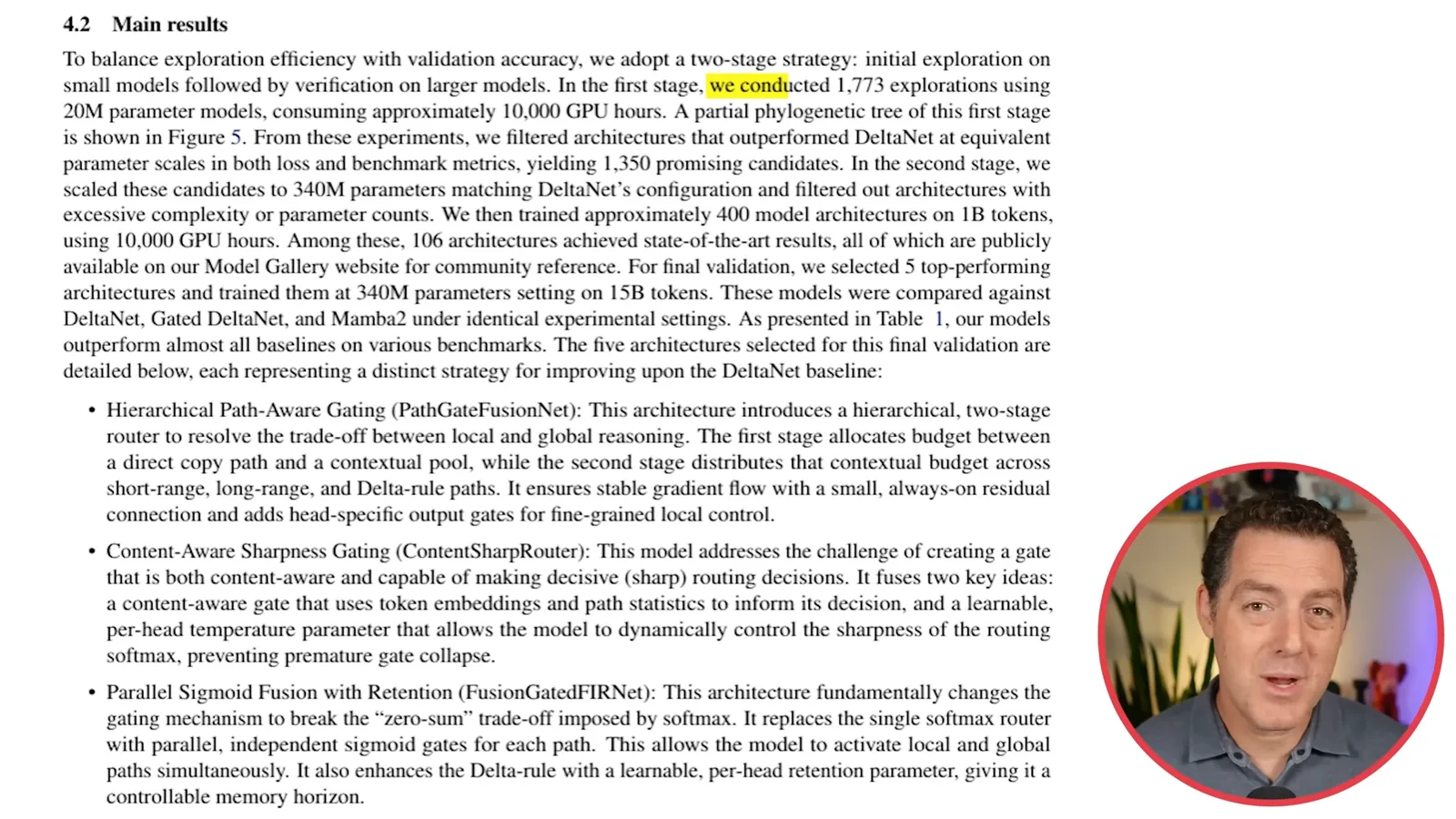
The original paper reports 1,773 initial experiments and approximately 20,000 GPU hours across its search and validation stages. It identifies 106 strong linear-attention architectures under its evaluation criteria. These results concern a particular architecture family, training budget and selected baselines; they do not mean 106 models outperform every existing architecture in every task.
The paper describes a two-stage process: initial exploration at small scale, then training selected candidates at 340 million parameters, followed by a more extensive validation of five designs against selected baselines. These details help define what was actually tested. They do not establish that the discoveries will transfer unchanged to frontier-scale models.
I imagine increasing the compute budget dramatically and running experiments in parallel. More resources could allow more trials, but the paper does not demonstrate that compute is the only limit or that innovation grows exponentially. Data, evaluation quality, implementation, available methods and the validity of the chosen benchmarks also constrain such a system.
I also wonder whether similar loops could contribute to biology or medicine. That is a possible direction, not a result established by this neural-architecture experiment. The authors released the framework and discovered architectures, and I see related work in AlphaEvolve, the Darwin Gödel Machine and Sakana AI’s AI Scientist as part of a broader effort to automate research.
Sur la même chaîne
 34:21EN
 Matthew Berman· 27 oct. 2026Matthew Berman Examines Anthropic’s IPO Filing, AI Growth and GovernanceMatthew Berman, Sam Altman · Forward FutureThe presenter reviews the S-1’s financial metrics, compute strategy and voting structure while questioning the tension between rapid AI development and safety.
 0:26ENMatthew Berman· 25 oct. 2026Sam Altman on Human Values and Problem-Solving in an AI WorldSam Altman · OpenAIIn a short interview excerpt, Altman considers the enjoyment of solving hard problems and the human role in interpreting results.
 0:36ENMatthew Berman· 25 oct. 2026Kimi K3.1 and a Rubik’s Cube Solver DemonstrationMatthew Berman · Forward FutureMatthew Berman shows a scrambled virtual cube being solved and gives the Kimi K3.1 test a favorable assessment.
 0:21ENMatthew Berman· 24 oct. 2026An AI-Generated Kimi Benchmark Chart Used Invented ScoresMatthew Berman · Forward FutureMatthew Berman asks for a graph of Kimi K3.1 Pro benchmarks, then discovers that the displayed figures are illustrative placeholders.
 25:50ENMatthew Berman· 24 oct. 2026Kimi K3.1 Pro Tested: Strong 3D Demos, Uneven Results and Competitive PricingMatthew Berman · Forward FutureMatthew Berman tests the open-weight model on coding, 3D rendering and visual explanations, then compares benchmark results and prices.
 32:20ENMatthew Berman· 23 oct. 2026Who Is Local AI For? The Costs, Trade-offs and a Hybrid FutureMatthew Berman · Forward FutureMatthew Berman weighs data control and independence against hardware cost, setup complexity and inference speed.