En 30 secondes
In January 2024, Matthew Berman watches Rabbit founder and CEO Jesse Lyu present the R1, a handheld AI companion built around natural-language interaction and a proposed “large action model.” The launch demonstration shows service logins, music, rides, food, travel planning, vision and an experimental teach mode. The examples are Rabbit’s launch presentation and product claims, not an independent test of shipping hardware. Berman is enthusiastic about the concept while questioning what distinguishes the action model from a language model; his predictions about software and programming are speculative.
- 1The large action modelRabbit founder Jesse Lyu describes a system intended to operate interfaces on users’ behalf; this is the company’s explanation of its approach.
- 2Handheld hardwareThe presentation shows a standalone device with a touchscreen, push-to-talk button, scroll wheel and rotating camera.
- 3Connected servicesRabbit demonstrates a web portal for linking services and shows examples involving music, rides and food.
- 4Experimental teach modeLyu records a Midjourney workflow and shows a later request using the taught process.
- 5Launch price and timelineRabbit announces a $199 price, no subscription and a planned spring 2024 shipping date.
- 6Berman’s assessmentHe questions the action-model terminology and speculates that natural-language computing could eventually reduce reliance on apps.
À retenir
- Rabbit presented the R1 as a standalone handheld companion using natural language to request actions across services.
- The launch video showed examples of music, ride, food and travel workflows, with confirmation before some transactions.
- Rabbit said third-party authentication occurred through the services themselves and claimed it did not store credentials; the presentation did not independently verify these claims.
- Teach mode was described as experimental and demonstrated by recording a Midjourney workflow.
- The announced launch price was $199 without a subscription, with shipping planned for spring 2024; these were launch-time terms.
- Berman’s prediction that apps and programming may eventually disappear is his opinion, not an established consequence of the demo.
Lire le texte remanié, chapitre par chapitre
Rabbit’s case for a natural-language interface
Berman introduces the launch video. Rabbit founder Jesse Lyu argues that app-based mobile workflows are fragmented and outlines the proposed large action model.
Matthew Berman introduces Rabbit’s R1, a handheld AI assistant announced in January 2024, and plays the company’s launch demonstration. He believes the concept points toward a different way of interacting with computers; his enthusiasm precedes an independent test of the device.
Rabbit founder and CEO Jesse Lyu says the company wants to make a simple computer centered on natural language. Rather than asking users to learn many interfaces, the proposed companion would understand requests and carry out tasks on their behalf.
Lyu argues that modern smartphones can require people to navigate many separate applications, menus and buttons to arrange transport or buy groceries. He sees a gap between a system that understands a request and one that can complete the associated actions.
Earlier voice assistants often failed to understand or complete requests, Lyu says, while language models improved natural-language interaction. He argues that chatbots and existing agents still struggle with reliable end-to-end execution, citing travel booking as an example.
Rabbit says it studied how people interact with software interfaces across devices. Lyu’s proposal is to have an AI operate interfaces on a user’s behalf, rather than depending only on individual app APIs or a browser extension.
He calls Rabbit’s approach a “large action model,” or LAM, and describes it as a system that learns interfaces and executes intentions. These are the company’s claims about its architecture and generality; the presentation does not independently establish that it can operate every interface.
Rabbit packages the model in Rabbit OS and introduces the R1, a standalone device designed with Teenage Engineering. The presentation frames it as a companion rather than a replacement for a smartphone.
The R1 device and connected services
The presentation describes R1 hardware and shows voice queries, service authentication, music, rides and food ordering. These are company-controlled demonstrations.
Lyu shows the hardware: a touchscreen, push-to-talk button, scroll wheel, microphone, speaker and rotating camera called Rabbit Eye. He says it supports Wi-Fi, Bluetooth and a SIM slot for 4G LTE connectivity.
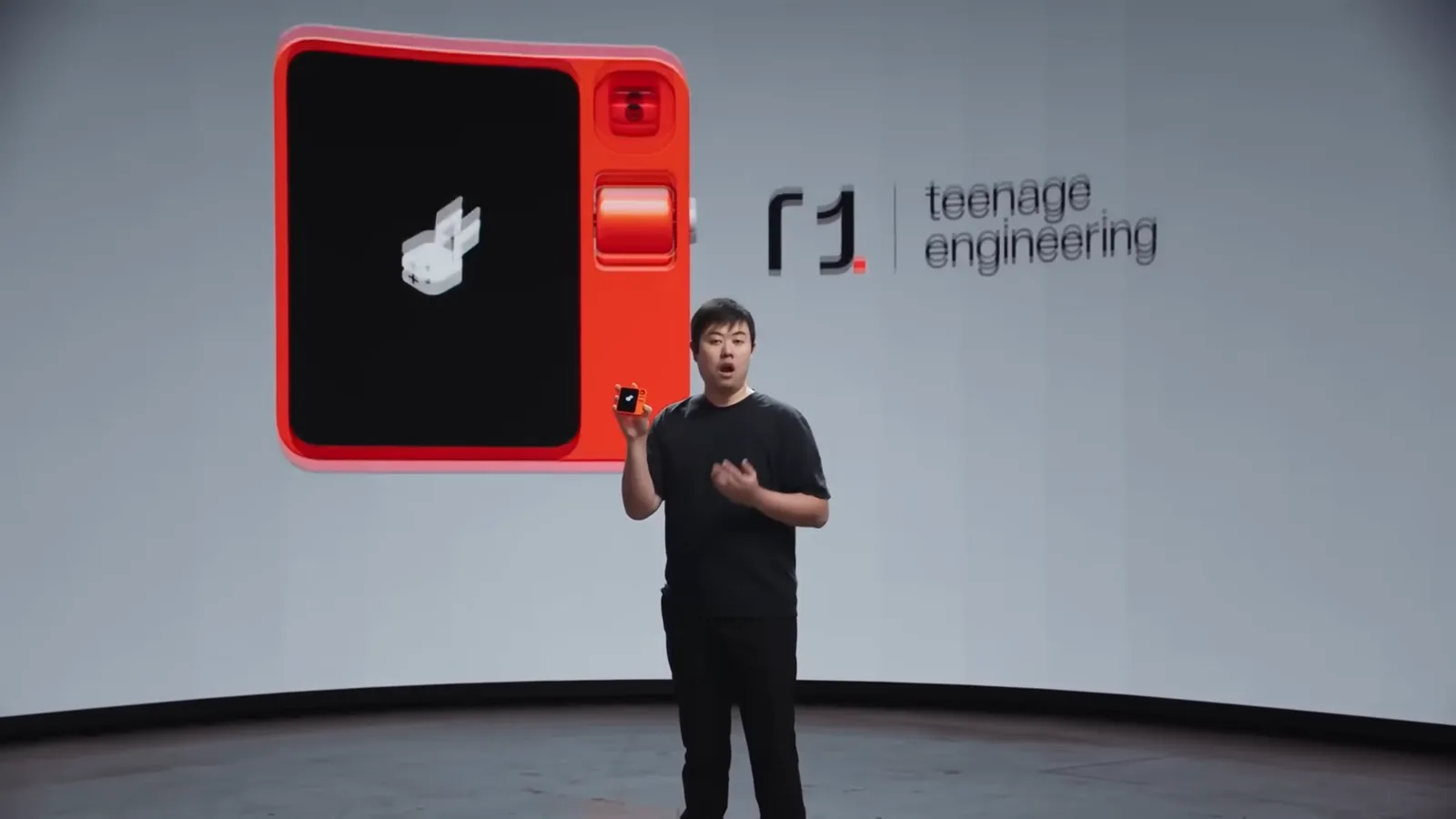
Rabbit claims responses can arrive within roughly 500 milliseconds and compares them favorably with other voice assistants. Lyu demonstrates spoken questions and says shaking the device brings up a keyboard; the timing comparison is a launch claim rather than a controlled measurement.
For actions in third-party services, Lyu introduces a web portal called Rabbit Hole. The user chooses a service and signs in; he demonstrates Spotify and says other services, including Uber and DoorDash, were authenticated before the presentation.
Lyu says Rabbit redirects users to the respective login pages and does not store third-party usernames and passwords or track user data. These are company privacy claims, and the launch demonstration is not an independent audit of how credentials and task data are handled.
The device is shown playing a song and another track from the same album, then answering questions about its writers and musical influence. The presentation illustrates a mixture of service control and information retrieval, not a verification that every generated answer is correct.
In the ride example, Lyu asks for transport home and then revises the request to accommodate six people and luggage. The device recommends a larger vehicle and asks for confirmation before the ride is ordered.
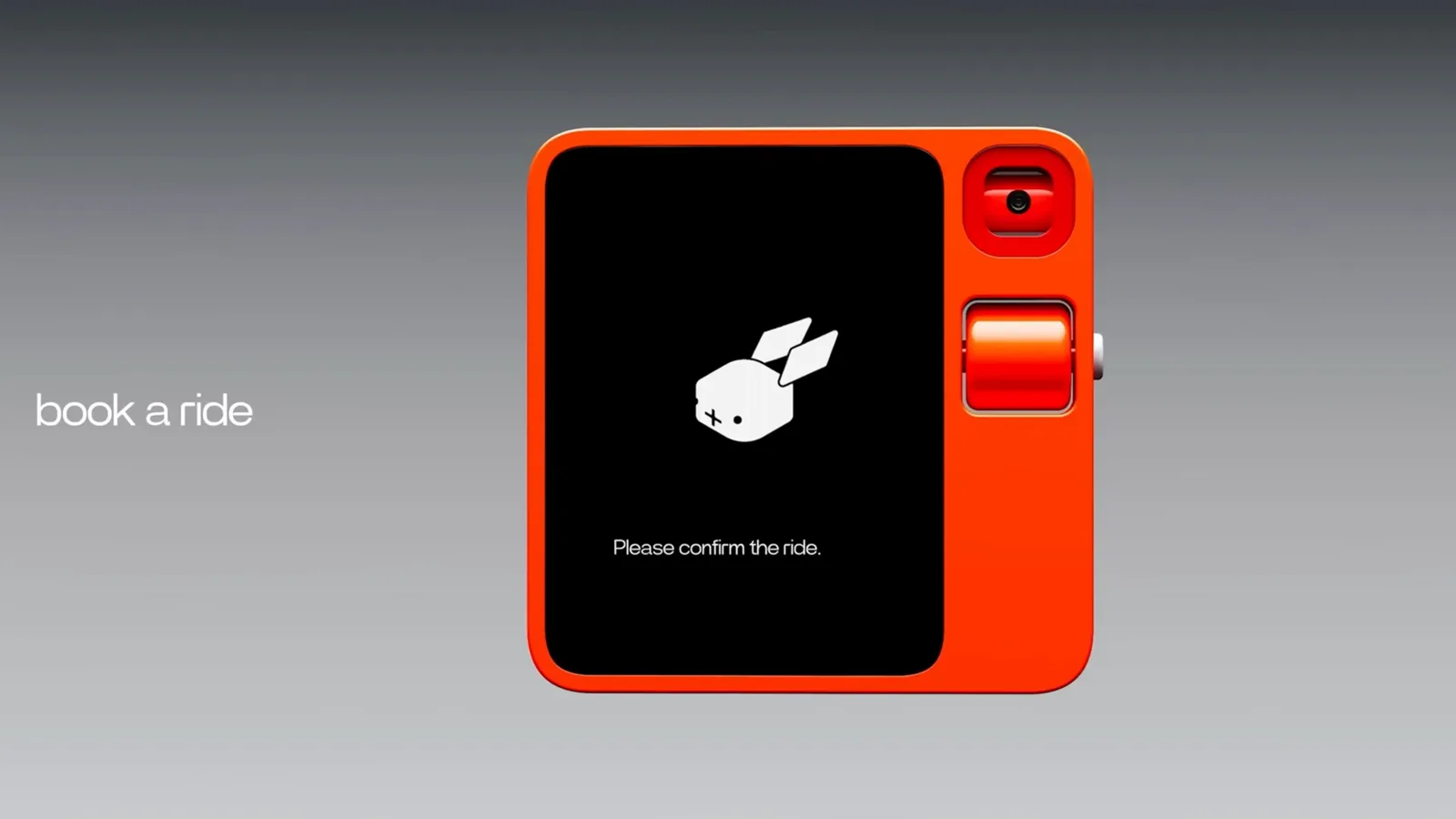
In a food-ordering demonstration, he asks for a 12-inch Pizza Hut pizza and accepts the most ordered option. The assistant describes a selected pizza and requests confirmation. The demonstration shows the intended workflow, not a guarantee that arbitrary ordering tasks will work.
Travel, translation and visual tasks
The device is shown planning a trip, answering questions about a refrigerator and processing a document. The presentation also describes translation and note-taking.
Lyu asks the device to plan a family trip to London with dates, a child, nonstop flights, seats together, an SUV and a hotel with Wi-Fi. The assistant reports flight, hotel and rental options and requests confirmation of individual selections.
He then asks for an itinerary and follows up by requesting a more relaxed schedule. Rabbit presents the revised plan as an example of keeping conversational context while changing the result; the video does not independently inspect the quality of every booking or itinerary detail.
The presentation also describes bidirectional translation and note-taking. Lyu says the device can recognize spoken languages and use its camera to interpret its surroundings, activating the camera with a double press.
In a visual example, Rabbit looks at refrigerator contents and suggests a low-calorie omelet using available ingredients. Another demonstration has it examine a questionnaire table, add a matching column and email a result, then refine the requested column through a reply.
Experimental teach mode
Lyu demonstrates recording a Midjourney workflow and invoking it with a new prompt. Rabbit labels teach mode experimental.
Lyu introduces teach mode as an experiment for workflows the device has not already learned. He compares teaching the system to showing another person how to perform a task, while the demonstration shows a specific recorded example rather than proving universal learning.
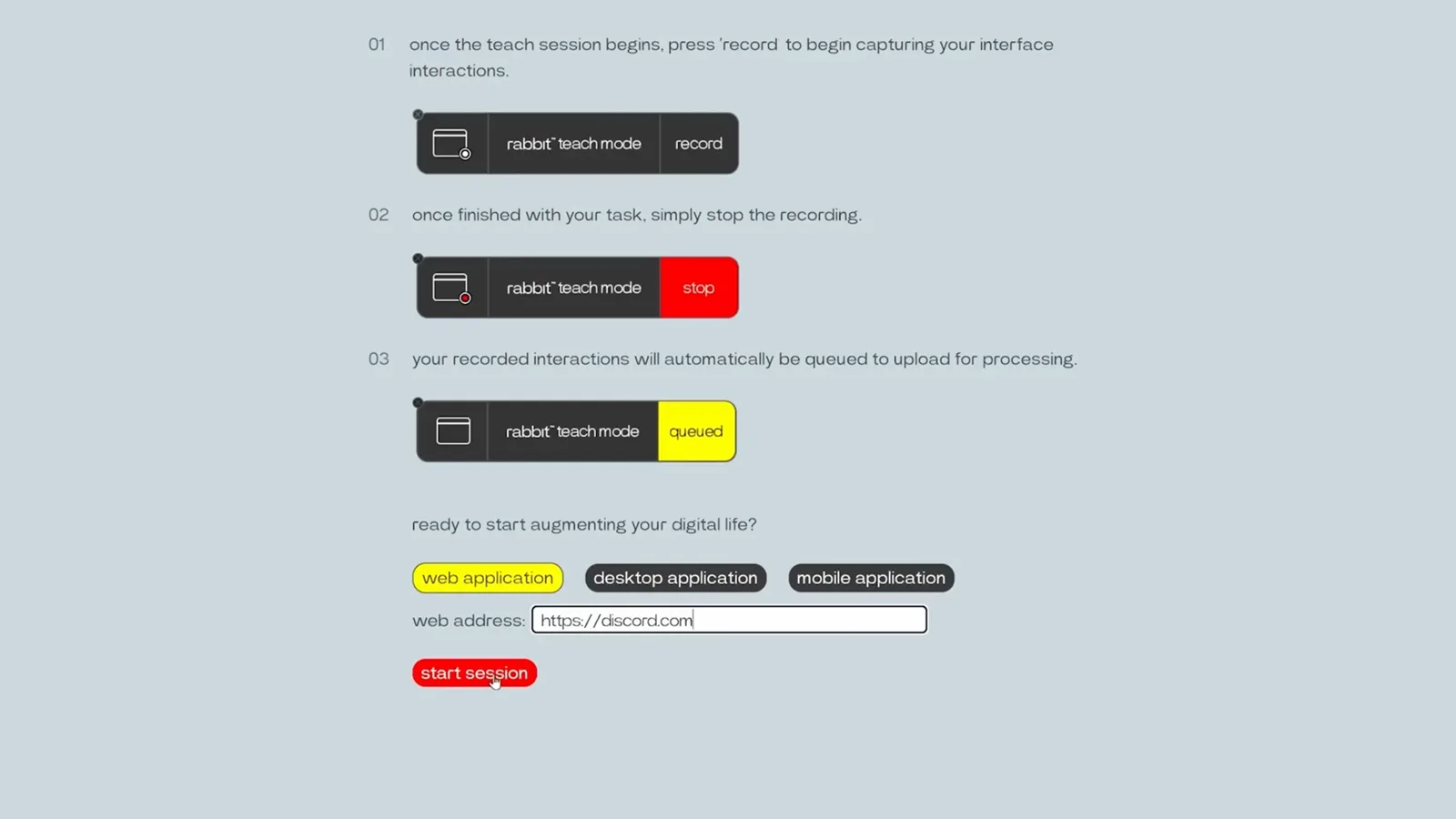
Using the web portal, he records the steps for generating an image with Midjourney through Discord: select a server and channel, enter an image command and wait for the result. He then annotates the workflow so a later request can substitute a different subject.
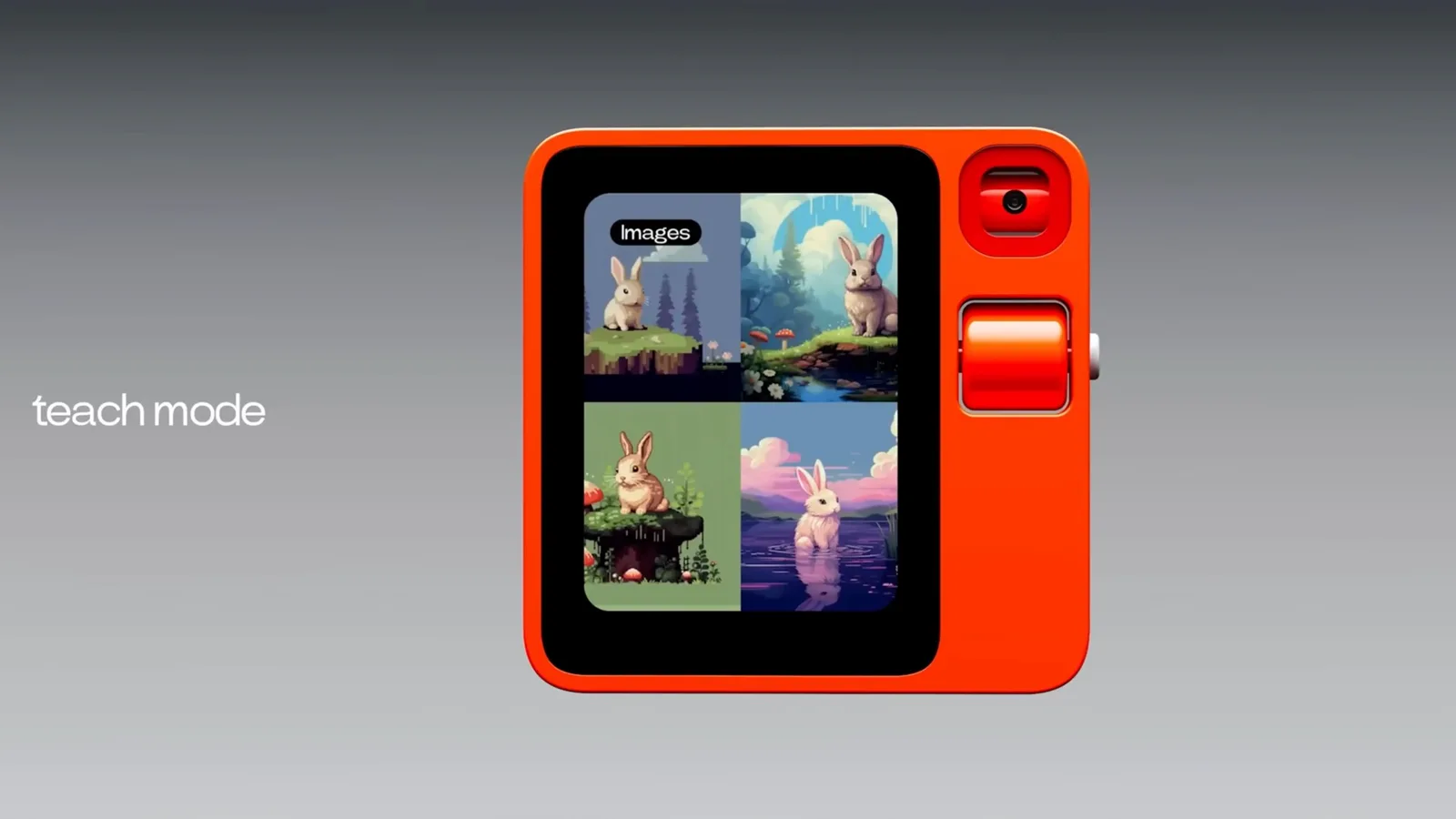
After processing the recording, Lyu asks the R1 to use the taught workflow to generate a pixel-art bunny. The presentation shows an image returned and calls the process watch, learn and repeat. Teach mode is presented as experimental, and no independent reliability test is shown.
Launch terms and Berman’s reaction
Rabbit positions the R1 as a companion to a phone and announces its initial price and shipping plan. Berman discusses the device’s possible implications and his uncertainty about the model terminology.
Lyu says Rabbit is not trying to replace a phone. He summarizes its intended capabilities: natural-language questions and actions, visual input, notes, translation and teach mode. He argues that a new generation of AI-native devices can coexist with app-based phones.
The launch presentation compares the R1 with smartphones, smart speakers and other announced AI devices. Rabbit announces a $199 price with no subscription or hidden fees and says shipping is planned for Easter 2024. These are the terms and timeline announced at launch.
Berman says he has ordered one and likes its orange design and the price relative to the Humane AI Pin. He is particularly interested in a device that can accept requests in natural language and, in the demonstration, learn additional workflows.
Berman questions whether “large action model” describes a fundamentally different model or is partly marketing terminology for a language model adapted to actions. He discusses Rabbit’s materials showing examples of people operating apps and suggests the system was trained to learn those interactions.
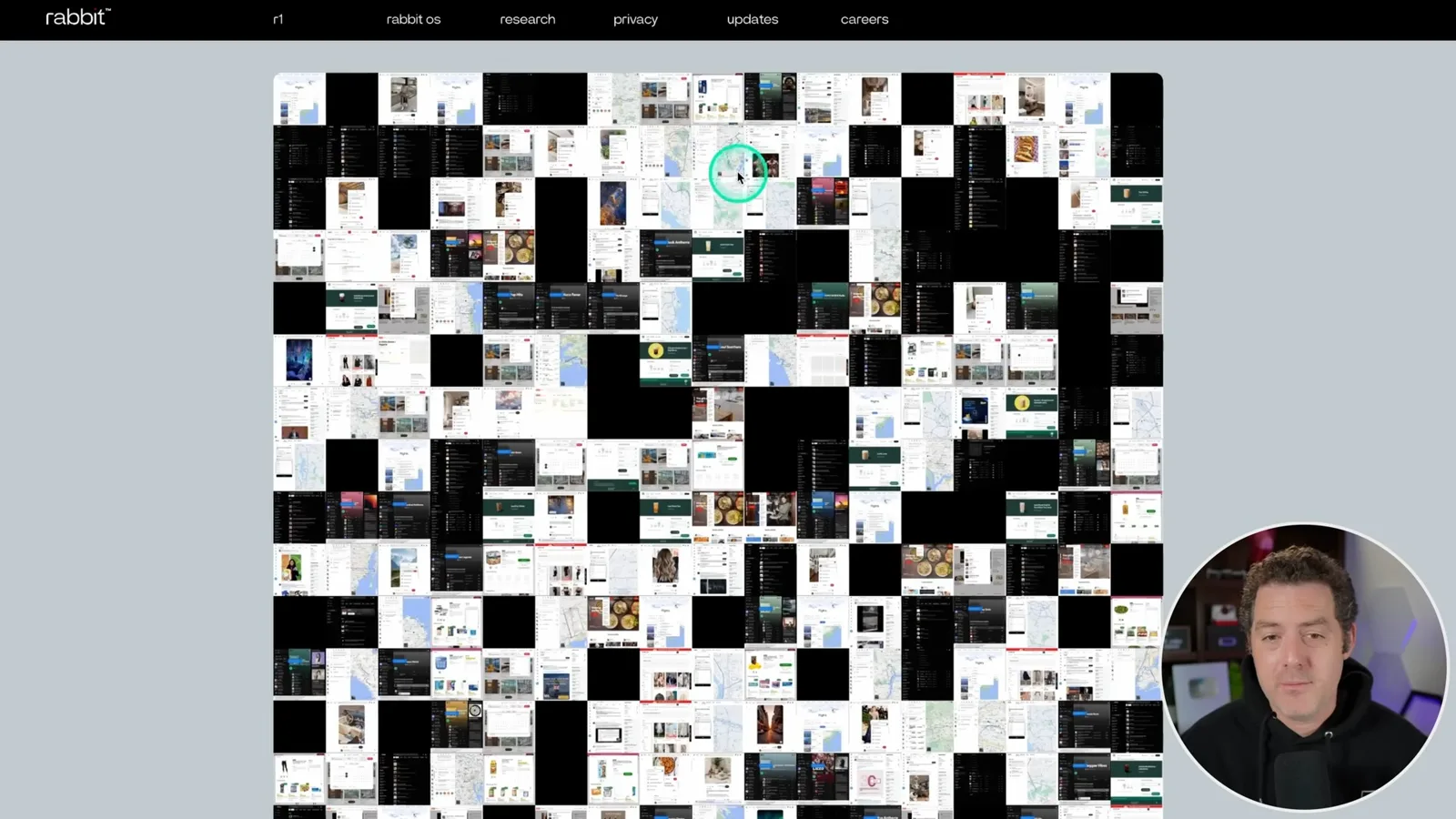
He speculates that AI could first operate existing applications for users and eventually replace apps with direct natural-language computing. He connects that idea to his broader prediction about the future of programming; neither outcome is established by the launch demo.
Berman acknowledges that a similar experience might be possible as a phone app, though platform restrictions could affect it. He expects major phone makers to pursue related features, but prefers Rabbit’s attempt to explore a dedicated form factor. Whether the device succeeds remains open at the time of the video.
Sur la même chaîne
 34:21EN
 Matthew Berman· 27 oct. 2026Matthew Berman Examines Anthropic’s IPO Filing, AI Growth and GovernanceMatthew Berman, Sam Altman · Forward FutureThe presenter reviews the S-1’s financial metrics, compute strategy and voting structure while questioning the tension between rapid AI development and safety.
 25:50ENMatthew Berman· 24 oct. 2026Kimi K3.1 Pro Tested: Strong 3D Demos, Uneven Results and Competitive PricingMatthew Berman · Forward FutureMatthew Berman tests the open-weight model on coding, 3D rendering and visual explanations, then compares benchmark results and prices.
 32:20ENMatthew Berman· 23 oct. 2026Who Is Local AI For? The Costs, Trade-offs and a Hybrid FutureMatthew Berman · Forward FutureMatthew Berman weighs data control and independence against hardware cost, setup complexity and inference speed.
 1:03:37ENMatthew Berman· 23 oct. 2026Matthew Berman’s Team Tests Kimi K3.1 on Animation, Games, and ChartsMatthew Berman, Alex, Brian · Forward FutureA live team AMA turns into an informal test of Kimi K3.1, from personal-agent workflows to motion graphics, a browser game, and a benchmark chart.
 0:53ENMatthew Berman· 22 oct. 2026Sam Altman on AI and the Discovery of New KnowledgeSam Altman · OpenAIAltman expects progress in mathematical discovery to extend to biology, materials and energy.
 0:22ENMatthew Berman· 21 oct. 2026A Robot Bodyguard Video Shows Dramatic Rescue ScenariosMatthew Berman · Forward FutureMatthew Berman reacts to a short robot demonstration depicting fighting and vehicle-rescue scenarios.