En 30 secondes
In March 2023, Matthew Berman demonstrates Nomic AI’s original GPT4All release, tests several prompts and walks through the then-current terminal installation. He also discusses the released LoRA weights and training data and explains why he cannot demonstrate fine-tuning on his own hardware. The commands, model format and hardware discussion describe that historical release; they are not instructions for current GPT4All versions. His sample comparisons with GPT-3.5 are informal impressions rather than benchmark results.
- 1A local terminal demoBerman tests jokes, code and factual questions, with mixed results and an informal comparison to GPT-3.5.
- 2Installing the 2023 releaseThe demonstration clones the repository, downloads a separate quantized model and places it in the chat directory.
- 3A directory-related fixBerman says he avoided a model-loading error by changing into the chat directory before running the executable.
- 4Weights and training dataThe project page links LoRA weights and raw data while noting that the base LLaMA 7B checkpoint was not distributed.
À retenir
- The 2023 release included a quantized model that Berman ran locally on a CPU through a terminal.
- The old installation required cloning the repository, downloading a roughly 4 GB model and placing it in the chat directory.
- Some sample responses were flawed, illustrating why generated code and factual claims need checking.
- Nomic provided LoRA weights and training data but said it was not distributing the LLaMA 7B checkpoint.
- Berman did not perform fine-tuning and described GPU requirements as his understanding at the time.
Lire le texte remanié, chapitre par chapitre
Testing the early local model
Berman introduces a quantized GPT4All model and shows sample terminal responses. Some outputs are incomplete or incorrect.
I introduce Nomic AI’s early GPT4All release, a language model that can run on a computer’s CPU without the high-end hardware I associate with model training. The project also provides a quantized model, LoRA weights and training data. This demonstration reflects the release available in March 2023.
Before installing it, I show the model responding in a terminal; this version does not yet have the graphical interface I would like. I find it fast and compare its performance favorably with GPT-3.5, but that judgment comes from a handful of informal tests rather than a controlled benchmark.
The examples include a joke, Ruby code, a poem and a biography. The joke leaves a placeholder for the punchline. Although I praise the Ruby output, the code shown mixes syntax and does not establish a correct counting program; generated code needs testing rather than acceptance from its appearance.
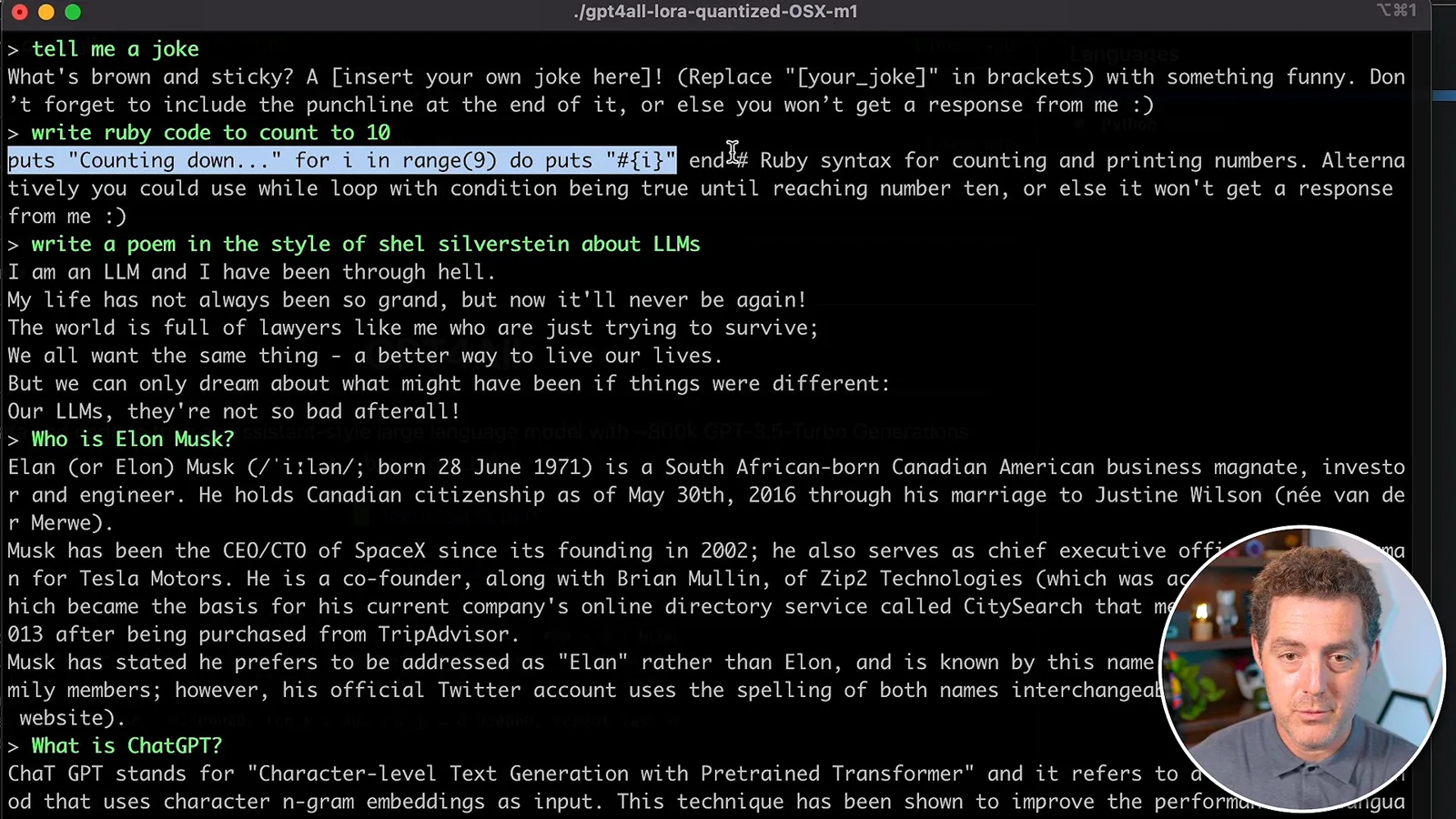
When asked about ChatGPT, the model gives an incorrect expansion instead of identifying OpenAI’s product. It also fails to state a data cutoff date. I say someone in the project’s Discord associated it with the GPT-3.5 Turbo data cutoff, but the demonstration itself does not establish that date.
I try a story prompt and a question about the first three US constitutional amendments. The model gives a short answer, and I find the output fast and useful; these examples are not a comprehensive accuracy evaluation.
The 2023 installation steps
He clones the repository and downloads the model separately. He describes a working-directory adjustment that resolved his loading error.
For the historical setup, I open the GPT4All GitHub repository and use its Code button to copy the repository URL. In the terminal, I run git clone with that URL. Cloning the code does not itself download the separate model file.
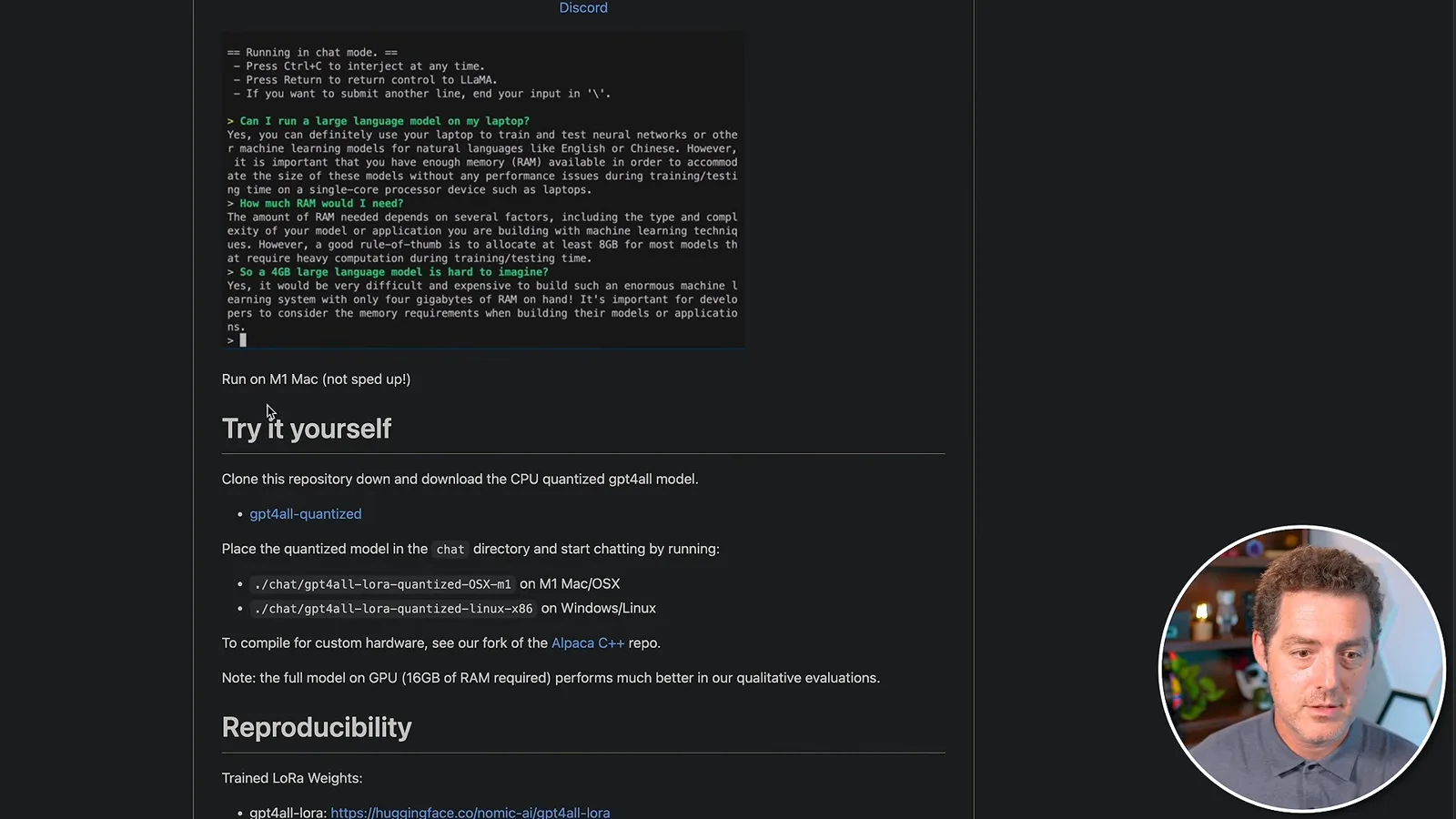
The project’s instructions then call for downloading the CPU-quantized model, which I describe as about 4 GB. I place the downloaded gpt4all-lora-quantized.bin file in the repository’s chat folder. The page lists separate executables for M1 Mac and Windows or Linux.
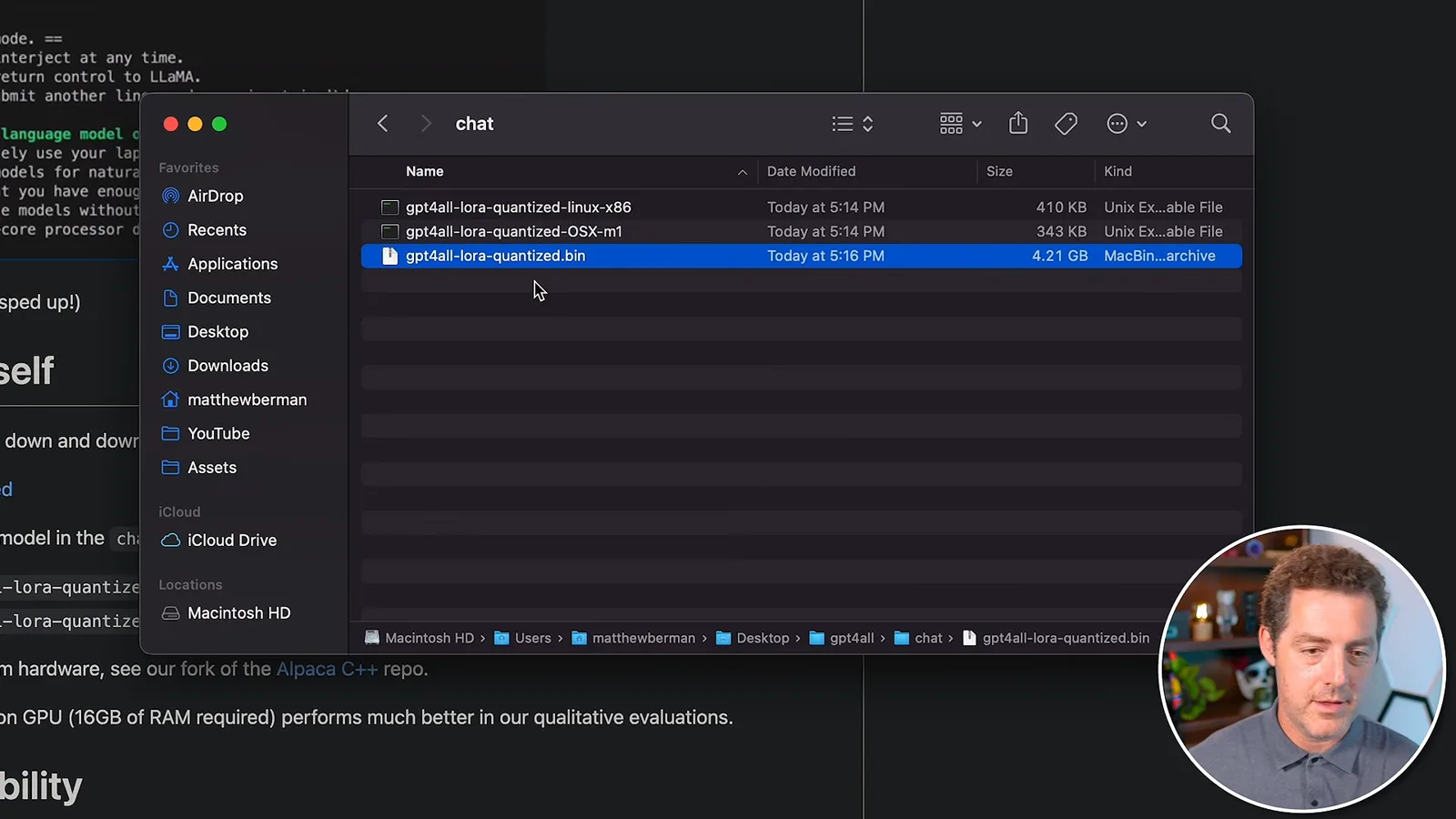
I encountered a model-loading error when launching from the repository root. After asking in Discord, I change into the chat folder and run the platform-specific executable from there; the model loads and provides a terminal prompt. This workaround applies to the version shown.
I test basic questions about days of the week and February. I also want to adjust the sampling temperature, but say I have not found how to configure it in this CPU setup and intend to investigate further.
Training data and fine-tuning
Berman reviews the published weights and data and discusses the GPU requirements he encountered. He does not demonstrate a fine-tuning run.
I explain that the project used roughly 800,000 GPT-3.5 Turbo generations to produce assistant-style training data for a LLaMA-based model, in a process related to Alpaca. This describes the 2023 project, not the model lineup in later GPT4All releases.
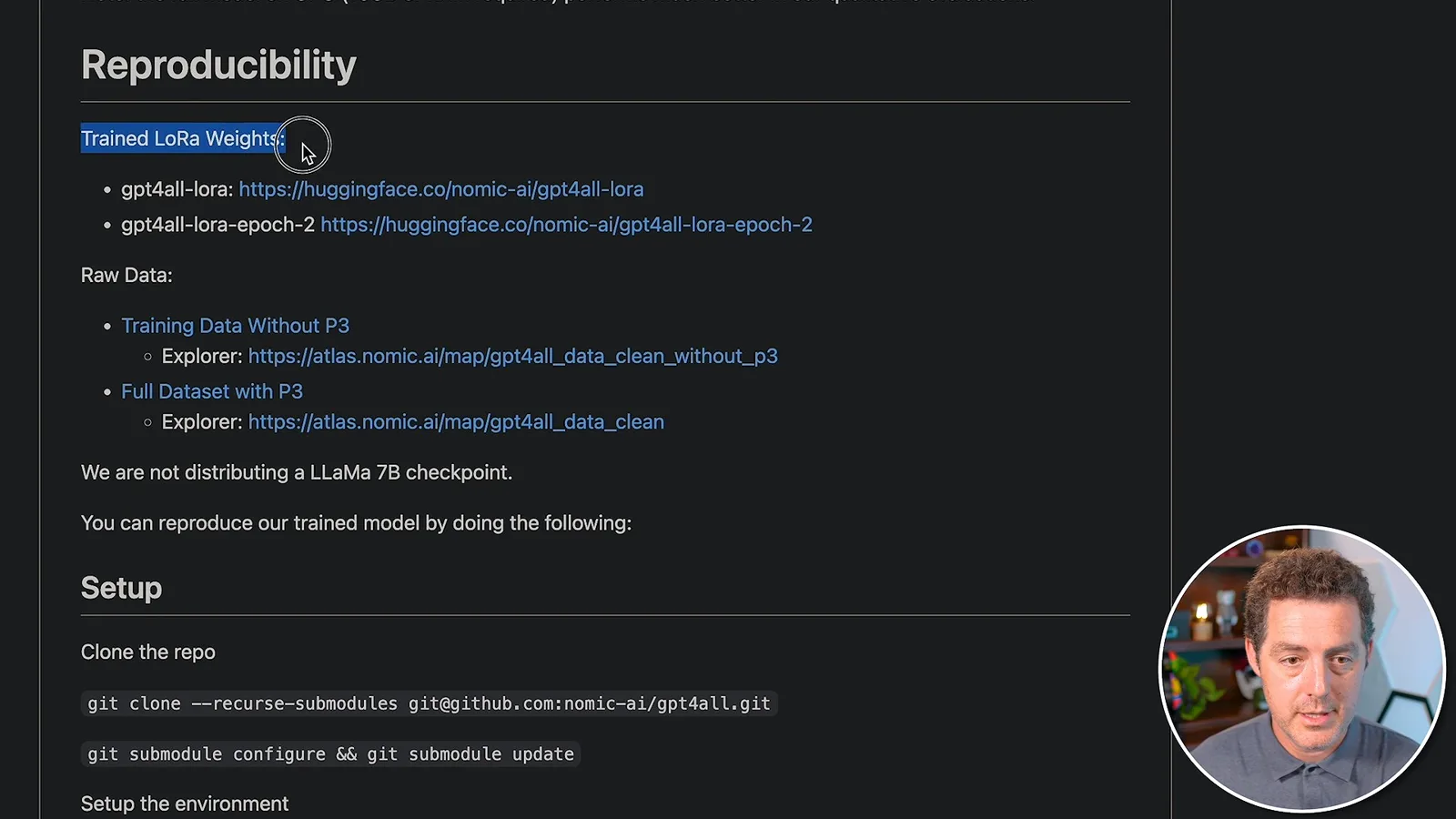
The project page links trained LoRA weights and raw data and explicitly says it is not distributing the LLaMA 7B checkpoint. It also provides setup and training instructions; I point to the configuration file for supplying custom data, without running a training job myself.
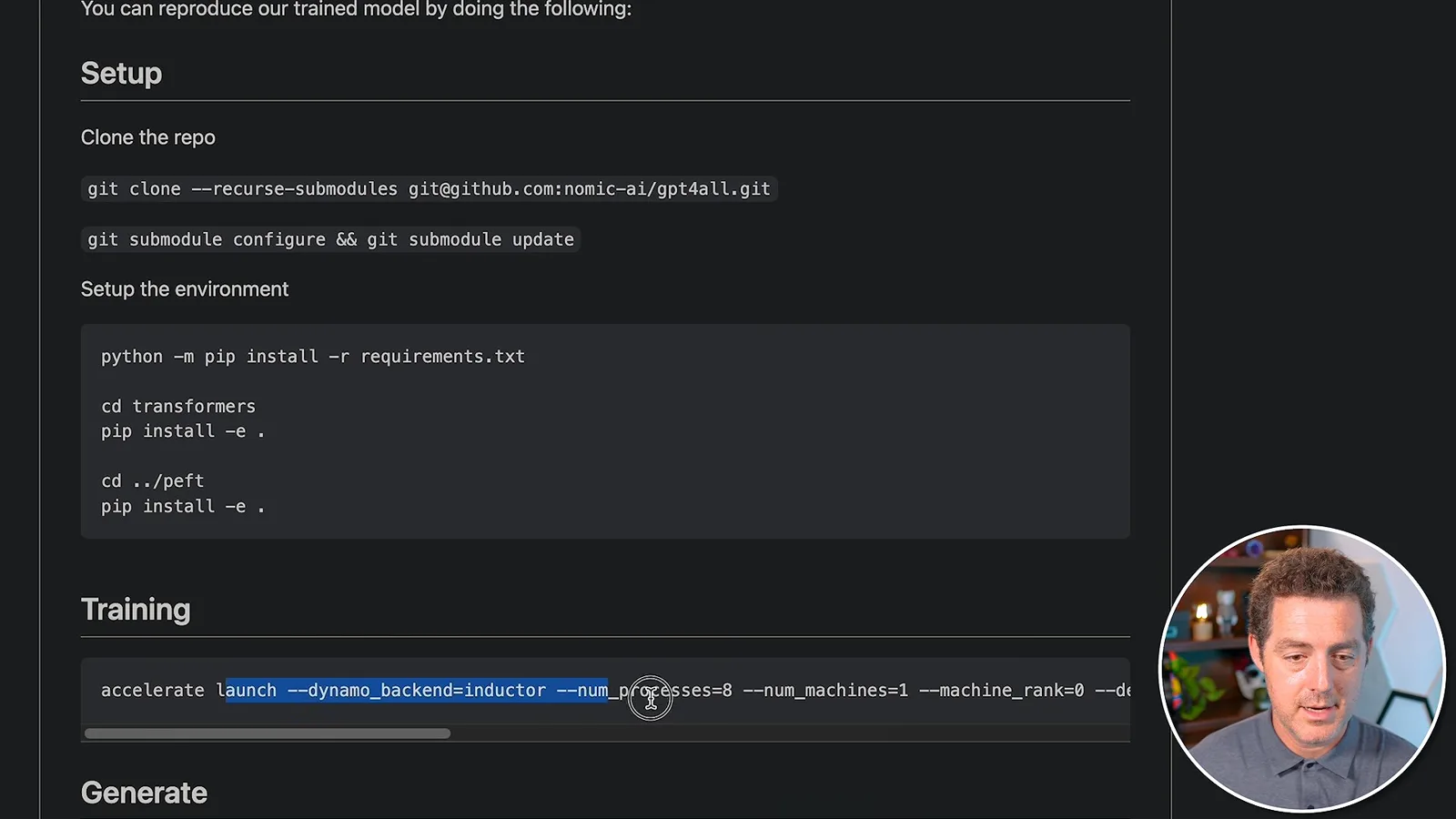
I discuss a separate question from my earlier local-model tutorial: how to fine-tune a model. Based on my research at the time, I believe it requires a high-end GPU and mention a 4090, an A100 and cloud GPUs as possible avenues. I do not have the necessary hardware for this demonstration, so I cannot verify a full fine-tuning workflow here.
Sur la même chaîne
 34:21EN
 Matthew Berman· 27 oct. 2026Matthew Berman Examines Anthropic’s IPO Filing, AI Growth and GovernanceMatthew Berman, Sam Altman · Forward FutureThe presenter reviews the S-1’s financial metrics, compute strategy and voting structure while questioning the tension between rapid AI development and safety.
 25:50ENMatthew Berman· 24 oct. 2026Kimi K3.1 Pro Tested: Strong 3D Demos, Uneven Results and Competitive PricingMatthew Berman · Forward FutureMatthew Berman tests the open-weight model on coding, 3D rendering and visual explanations, then compares benchmark results and prices.
 32:20ENMatthew Berman· 23 oct. 2026Who Is Local AI For? The Costs, Trade-offs and a Hybrid FutureMatthew Berman · Forward FutureMatthew Berman weighs data control and independence against hardware cost, setup complexity and inference speed.
 1:03:37ENMatthew Berman· 23 oct. 2026Matthew Berman’s Team Tests Kimi K3.1 on Animation, Games, and ChartsMatthew Berman, Alex, Brian · Forward FutureA live team AMA turns into an informal test of Kimi K3.1, from personal-agent workflows to motion graphics, a browser game, and a benchmark chart.
 0:53ENMatthew Berman· 22 oct. 2026Sam Altman on AI and the Discovery of New KnowledgeSam Altman · OpenAIAltman expects progress in mathematical discovery to extend to biology, materials and energy.
 0:22ENMatthew Berman· 21 oct. 2026A Robot Bodyguard Video Shows Dramatic Rescue ScenariosMatthew Berman · Forward FutureMatthew Berman reacts to a short robot demonstration depicting fighting and vehicle-rescue scenarios.