En 30 secondes
Matthew Berman shows a personal knowledge base for articles, videos and social posts, then asks it for saved items about OpenAI. The displayed conversation says semantic search missed recent items and the system queried the database directly. The video description specifies a proposed retrieval-augmented generation system with local SQLite storage and hosted embedding options. The short does not establish that every relevant source is retrieved or that all processing stays on the laptop.
- 1Saving sourcesBerman describes collecting articles, videos and social posts in one knowledge base and says the material is saved on his computer.
- 2Querying saved materialHe asks for items about OpenAI. The visible response says semantic search missed recent items and reports querying the database directly.
- 3The shared build promptThe description requests a RAG system with source extraction, local storage, embedding search and citations; this is a specification, not proof every feature works.
À retenir
- Berman demonstrates saving links into a personal knowledge base and asking for related items.
- The displayed response says semantic search missed recent items and describes a direct database query.
- The shared build prompt requests source extraction, deduplication, chunking, embeddings, and source-cited retrieval.
- The proposed storage is local SQLite, but the prompt names hosted embedding providers, so local storage does not imply entirely local processing.
- A short demonstration does not verify that every relevant source was found.
Lire le texte remanié, chapitre par chapitre
Building a personal knowledge base
Berman describes collecting articles, videos, and posts in one place. He shows saving a source and says the data is stored locally.
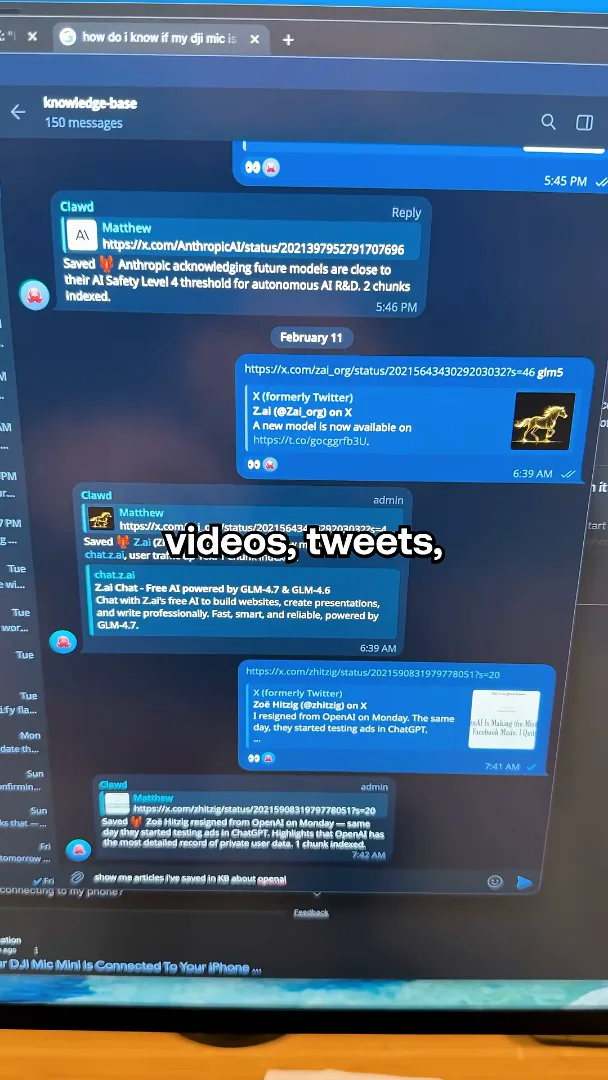
I use a personal knowledge base to collect articles, videos, posts, and other material I encounter. I show myself adding a link and say the content is saved on my computer. I call it a powerful system because I can search my own collection rather than relying on memory.
Searching saved sources
He asks for OpenAI-related sources and displays a list. The screen notes that a direct database query was used after semantic search missed recent items.
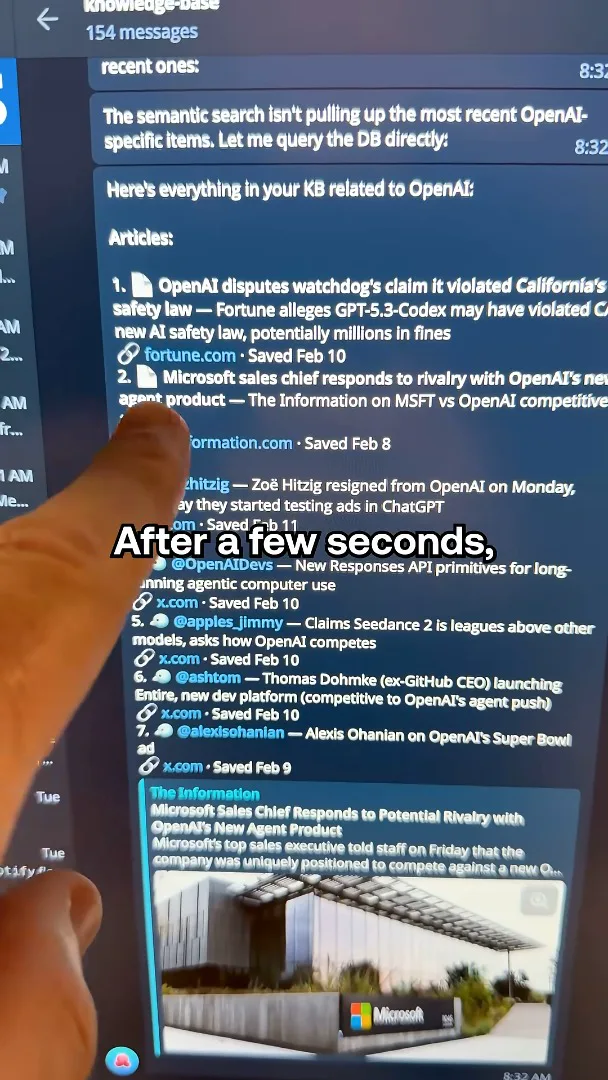
I ask for saved material about OpenAI, and the interface returns a list of articles and posts. Although I say it found everything, the on-screen response notes that semantic search missed recent OpenAI-specific items and says it queried the database directly. The short demonstration does not independently verify that the results are exhaustive.
The video description includes a build prompt for a retrieval-augmented knowledge base. It requests source extraction with fallbacks, duplicate detection, chunking and embeddings, SQLite storage, similarity search, and answers with source references. The prompt specifies hosted Google or OpenAI embedding options, so storing data locally would not necessarily mean every processing step is local; the clip does not verify the full implementation.
Sur la même chaîne
 34:21EN
 Matthew Berman· 27 oct. 2026Matthew Berman Examines Anthropic’s IPO Filing, AI Growth and GovernanceMatthew Berman, Sam Altman · Forward FutureThe presenter reviews the S-1’s financial metrics, compute strategy and voting structure while questioning the tension between rapid AI development and safety.
 0:26ENMatthew Berman· 25 oct. 2026Sam Altman on Human Values and Problem-Solving in an AI WorldSam Altman · OpenAIIn a short interview excerpt, Altman considers the enjoyment of solving hard problems and the human role in interpreting results.
 0:36ENMatthew Berman· 25 oct. 2026Kimi K3.1 and a Rubik’s Cube Solver DemonstrationMatthew Berman · Forward FutureMatthew Berman shows a scrambled virtual cube being solved and gives the Kimi K3.1 test a favorable assessment.
 0:21ENMatthew Berman· 24 oct. 2026An AI-Generated Kimi Benchmark Chart Used Invented ScoresMatthew Berman · Forward FutureMatthew Berman asks for a graph of Kimi K3.1 Pro benchmarks, then discovers that the displayed figures are illustrative placeholders.
 25:50ENMatthew Berman· 24 oct. 2026Kimi K3.1 Pro Tested: Strong 3D Demos, Uneven Results and Competitive PricingMatthew Berman · Forward FutureMatthew Berman tests the open-weight model on coding, 3D rendering and visual explanations, then compares benchmark results and prices.
 32:20ENMatthew Berman· 23 oct. 2026Who Is Local AI For? The Costs, Trade-offs and a Hybrid FutureMatthew Berman · Forward FutureMatthew Berman weighs data control and independence against hardware cost, setup complexity and inference speed.