En 30 secondes
At an April 30, 2025 cabinet meeting, President Trump and his advisers reviewed their first 100 days, defending tariffs, agency restructuring and immigration enforcement. Musk praised the administration, and Trump cited $150 billion in government savings; that figure was a claim, not an independently audited total. Officials outlined plans for trade, air traffic control, health and energy. Reporters later questioned Trump and Secretary of State Marco Rubio about deportations, the economy and an agreement with Ukraine.
- 1GDP fell while a separate private-demand measure roseTrump cited a 3% measure. BEA’s initial estimate showed a 0.3% annualized decline in overall real GDP and a 3% rise in real final sales to private domestic purchasers.
- 2Transportation officials seek a new air traffic systemDuffy says staffing and equipment need attention and asks Congress for funding. Trump argues for one principal contractor.
- 3Trade representative says tariff negotiations are underwayGreer shows a tracker of offers and talks, saying some agreements are weeks away.
- 4Trump cites $150 billion in DOGE savingsMusk praises the first 100 days and Trump says additional work could increase the figure. The figure is an administration claim rather than an independently audited total.
- 5Reporters question Rubio and Trump about deportationRubio declines to discuss diplomatic communications about Kilmar Abrego Garcia; Trump says he is relying on legal advice.
À retenir
- Trump cited $150 billion in DOGE savings; reported savings estimates and realized budget reductions are different measures.
- First-quarter 2025 real GDP fell at a 0.3% annual rate in the initial estimate; a separate measure of private domestic demand rose 3%.
- Trade officials said dozens of countries were negotiating after U.S. tariffs, but did not announce completed deals in the meeting.
- Cabinet members described proposed changes to air traffic control, federal agencies, education and health; several results remained future plans.
Lire le texte remanié, chapitre par chapitre
Trump opens on borders, growth and tariffs
Trump praises border enforcement and trade policy. The day’s GDP estimate and his cited private-demand measure capture different parts of the economy.
The recording begins mid-sentence as President Donald Trump praises border officials and describes the administration's designation of criminal organizations as foreign terrorist groups. He criticizes judges who have restricted some deportation actions and says border enforcement was central to his election campaign.
Trump turns to the day's economic figures and attributes the quarter's results to the previous administration. He cites a 3% measure that excludes some components. The [Bureau of Economic Analysis](https://bea.gov/news/2025/gross-domestic-product-1st-quarter-2025-advance-estimate) reported that first-quarter real GDP fell at a 0.3% annual rate, while real final sales to private domestic purchasers rose 3%; the measures are different.
Trump says companies are committing to U.S. investment and attributes their plans to tariffs. He describes nearly $8 trillion in commitments, a figure presented as his estimate, and asks Commerce Secretary Howard Lutnick about a semiconductor site in Arizona.
Lutnick describes plans for a $165 billion investment in the Arizona semiconductor project and expected construction and manufacturing jobs. He argues tariffs drove the expansion. The company had [announced earlier Arizona investment plans](https://pr.tsmc.com/english/news/3122), including more than $65 billion in planned capital spending in 2024.
Trump contrasts tariffs with the CHIPS Act and says companies have the money to finance construction themselves.
Trump discusses the scale of the semiconductor project and says companies can finance construction from their own funds. He says they can build electricity generation for their facilities and connect any surplus to the grid.
Trump says first-quarter figures cover the period around his January inauguration and that tariffs have not fully taken effect. He says he hopes for a trade agreement with China while alleging that tariffs are hurting Chinese factories and shipping.
Defense, trade and air traffic control
Hegseth and Lutnick describe their priorities. Duffy and Trump discuss staffing and a new air traffic system.
The president invites cabinet members to report on their departments. Defense Secretary Pete Hegseth says military recruiting and retention have improved, describes changes to personnel policy and says the department is redirecting spending toward military readiness.
Hegseth says troops are supporting border operations and calls for NATO allies to contribute more. He also mentions operations against the Houthis and the administration's approach to China.
Lutnick describes an investment accelerator and cites announced commitments from technology companies and foreign investors.
Lutnick says pharmaceutical and auto manufacturers also have reasons to build in America. He says he is working with Labor and Education officials on preparing the workforce and mentions demand for a proposed gold-card immigration program.
Lutnick discusses collecting tariffs and ending a low-value import exemption for some packages. He argues these steps will help small businesses, while Trump calls the previous arrangement unfair.
Transportation Secretary Sean Duffy says the administration plans to revise vehicle fuel-economy standards and remove the social cost of carbon from infrastructure calculations.
Duffy says states and localities receiving transportation funds will be expected to comply with federal requirements. He also describes ending funding for some university transportation research that the administration considers inconsistent with its priorities.
Duffy says the United States lacks enough air traffic controllers and describes plans to retain experienced workers and train new ones. Trump asks him to explain a proposed replacement of the air traffic control system.
Duffy says the country needs a new air traffic control system and asks Congress to help fund it. He points to the recent collision near Washington and says aging infrastructure requires attention.
Duffy says aging technology needs an overhaul and asks Congress to fund a new system. He argues that modern equipment could make air travel more efficient and safer.
Trump refers to a recent collision and argues that better warning equipment could have prevented it. He says a replacement system should alert controllers and pilots when aircraft are too close; this is his assessment of what the equipment might do.
Trump criticizes past technology procurement and says he wants one principal contractor responsible for a unified system. Duffy says the difficulty is upgrading the system while aircraft continue to take off and land.
Veterans, trade and national security reports
Collins discusses VA care; Greer outlines negotiations; Waltz and Ratcliffe review national security.
Veterans Affairs Secretary Doug Collins says his department is reducing a disability-claims backlog and expanding choices for veterans to receive care in VA facilities or in their communities.
Collins says the department has brought employees back to offices and is processing claims. He cites a reduction in the backlog and says money previously used for contracts is being redirected to community care and health-records management.
Collins discusses contract terminations, facility openings and changes to departmental programs. Asked about veteran suicide, he says the department is working with outside organizations and studying possible new treatments; he says research is needed.
Collins discusses contract terminations, facility openings and changes to departmental programs.
Asked about veteran suicide, Collins says the department is working with outside organizations and studying possible new treatments. He says the research must establish whether they are appropriate.
Trade Representative Jamieson Greer says the administration is negotiating with dozens of countries after imposing tariffs. He holds up a tracker showing stages of offers and talks, and says some agreements remain weeks away.
National security adviser Mike Waltz describes cooperation among agencies on foreign policy, the return of detained Americans and the capture of a suspect in the Abbey Gate bombing.
Waltz says agencies are also cooperating on shipbuilding, cyber issues and space. Trump says the suspect in the Abbey Gate attack will be prosecuted.
CIA Director John Ratcliffe says the agency has worked on national security and the release of detained Americans, while declining to detail classified activities. He says the CIA is being reorganized to focus on its core mission.
Ratcliffe says the CIA helped secure the return of detained Americans. He says it is being reorganized to focus on its core mission and avoid what he describes as politicization.
Budget, housing and agriculture priorities
Officials describe tax legislation and proposed agency changes. Turner and Rollins discuss housing and agriculture.
Budget director Russell Vought says the administration is working on spending legislation and proposed rescissions, and describes a goal of eliminating regulations.
Vought offers a projected value for regulatory savings. He then describes ending a consumer-finance enforcement policy that he argues harmed a small mortgage lender.
Vought says the Consumer Financial Protection Bureau had pursued a Chicago mortgage lender over alleged discriminatory practices and says the administration overturned the action. He presents the decision as an example of changing enforcement priorities.
Trump asks about progress on a large budget and tax package. An official says negotiations are continuing over border and defense resources and tax changes. Trump argues the bill would reduce taxes and criticizes the opposition.
White House chief of staff Susie Wiles thanks the cabinet for its work during the administration's first 100 days and urges members to continue communicating with communities and the media.
Housing and Urban Development Secretary Scott Turner says the department is changing housing rules, working with Homeland Security on eligibility, and exploring federal land for housing.
Turner says the department is working with Interior on using underutilized federal land for housing. He also describes changes affecting access to women’s shelters and cites claimed contract and funding savings.
Agriculture Secretary Brooke Rollins says egg prices have fallen and describes a water agreement with Mexico that she says will help farmers near the border.
Rollins discusses higher agricultural costs and a trade deficit, and says federal assistance was distributed quickly to farmers. She says agriculture also contributes to energy production through timber, minerals and biofuels.
Rollins says the Agriculture Department has canceled contracts with DOGE's help and is restructuring. She says she and Health Secretary Robert F. Kennedy Jr. are working on nutrition and food assistance.
Rollins says she and Health Secretary Robert F. Kennedy Jr. are working on nutrition and food assistance. She describes plans to restructure the department and put more emphasis on farmers.
Rollins describes a South Dakota ranching family's dispute over a fence and says federal criminal charges had been dropped. She presents the case as an example of what she calls government overreach.
Treasury, Justice, Labor and Energy updates
Bessent discusses the economy, Bondi describes enforcement, and Labor and Energy officials outline their programs.
Treasury Secretary Scott Bessent says the administration’s first 100 days have set up future trade, peace and tax agreements. He discusses energy prices and domestic manufacturing.
Bessent praises Treasury technology work, including updates to IRS systems, and says the administration wants to connect tax and trade policy with domestic manufacturing.
Vance praises the administration’s first 100 days and says military recruiting has improved. He criticizes press attention to deportations and asks reporters to examine the recruiting change.
Attorney General Pam Bondi describes lawsuits against the administration and reports drug and firearms seizures.
Bondi says the Justice Department is pursuing people accused of attacking Tesla property. She also describes terrorism and trafficking investigations and the extradition of people accused of cartel crimes.
Labor Secretary Lori Chavez-DeRemer says she is touring states and working with other departments on apprenticeships and workforce training.
Chavez-DeRemer cites apprenticeship growth and says she wants training to meet employers’ needs. She discusses notice to states concerning unemployment benefits and immigration status.
Chavez-DeRemer says the department recovered unused pandemic funds, canceled foreign programs and reduced staffing through a voluntary departure offer. She says critical worker-safety functions will remain in place.
Energy Secretary Chris Wright says expanding energy production can support manufacturing and AI infrastructure.
Wright argues that data centers and renewed manufacturing will require more energy. He says the United States can expand production by making it easier for companies to invest.
Wright discusses liquefied natural gas exports and nuclear cooperation with Poland. He argues that U.S. energy exports can help European partners diversify supplies.
Border, small business and DOGE
Noem and Loeffler describe their departments. Musk and Trump discuss the government-efficiency effort.
Homeland Security Secretary Kristi Noem praises border enforcement and describes Coast Guard drug interdiction.
Noem disputes comparisons with prior deportation totals and cites her department’s enforcement and tariff-collection figures. She thanks other departments for helping obtain travel documents and coordinate removals.
Small Business Administration head Kelly Loeffler cites loan volumes and describes visits to manufacturers.
Loeffler says her agency is increasing support for small manufacturers and describes businesses she visited. She says DOGE helped identify contracts for cancellation and argues small firms are important to jobs and communities.
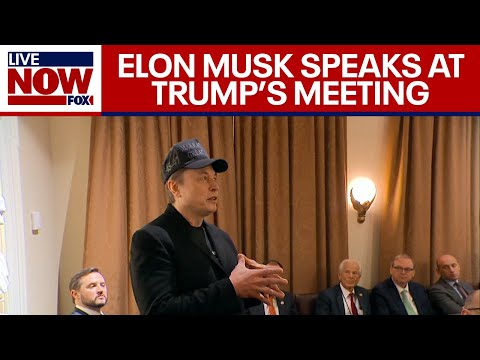
Trump invites Elon Musk to speak and thanks him for his work on government efficiency.
Musk praises the administration’s first 100 days and thanks cabinet officials for working with him. Trump thanks Musk for his work and says he may stay involved as long as he wishes.
Trump cites $150 billion and says additional work could increase the figure. The remark is the administration’s savings claim, not an independently audited total; in 2026, [GAO found limits](https://files.gao.gov/reports/GAO-26-108615/index.html) in the evidence and methods supporting some published DOGE estimates.
Intelligence, environment, education and health
Gabbard, Zeldin, McMahon and Kennedy report on agency changes and policy plans.
Director of National Intelligence Tulsi Gabbard says her office is sharing information on designated criminal groups with other agencies.
Gabbard describes staffing and program reductions in her office and says more cuts are planned. She also says alleged leaks of classified information have been referred for investigation.
Environmental Protection Agency administrator Lee Zeldin says his agency is pursuing deregulation and has canceled grants with DOGE’s help.
Zeldin discusses proposed changes to emissions standards and says his agency can protect the environment while supporting growth. He also notes that he is ending his Army service and thanks military colleagues.
Education Secretary Linda McMahon says the department has reduced staffing and is shifting responsibility toward states.
McMahon discusses university funding disputes and says the government is enforcing civil-rights protections. She says Harvard has challenged the administration in court; Trump criticizes the university.
McMahon says collection on defaulted student loans is scheduled to resume and that borrowers can seek a suitable repayment arrangement. She also discusses AI and state education programs.
Health Secretary Robert F. Kennedy Jr. describes plans concerning food dyes, dietary guidelines, school meals and food assistance.
Kennedy says he is working with Agriculture Secretary Rollins on dietary guidelines, school meals and possible state changes to food assistance. He argues the government should address chronic disease through nutrition.
Kennedy discusses fluoride and cites research on higher exposure. The [National Toxicology Program](https://ntp.niehs.nih.gov/research/assessments/noncancer/completed/fluoride) says evidence is insufficient to determine whether the recommended 0.7 mg/L community-water fluoride level affects children’s IQ.
Kennedy predicts early answers from autism research by September and definitive answers later. He also alleges misconduct in prior care of migrant children and cites claimed savings at his department; these are his statements and forecasts.
Interior and State discuss resources and foreign policy
Burgum describes energy and border land; Rubio discusses diplomacy and the State Department.
Interior Secretary Doug Burgum argues for expanded development of energy and minerals on federal land.
Burgum discusses coal, oil, gas and critical minerals, arguing that domestic supplies can support industry and AI. He describes a proposed increase in leasing on federal lands.
Burgum describes transferring some federal border land to the Defense Department to support enforcement. He also mentions a wildlife refuge named in memory of Jocelyn Nungaray.
Secretary of State Marco Rubio says foreign policy should make the United States stronger, safer and more prosperous.
Rubio discusses foreign-aid cancellations and a State Department reorganization. He argues that U.S. taxpayers should not fund projects that do not advance the administration’s foreign-policy priorities.
Rubio says the government is seeking cooperation from other countries on deportations and has revoked some student visas. He defends these actions as part of the administration’s security policy.
Rubio discusses passport processing, forthcoming international sports events and diplomatic efforts involving the Democratic Republic of the Congo and Rwanda. He also cites the return of Americans held abroad.
Questions on deportation, the economy and Ukraine
Trump and Rubio answer reporters about El Salvador, markets, a minerals agreement and border enforcement.
Trump thanks the cabinet and says he expects results from the policies to emerge over the next 100 days. He then opens the meeting to reporters’ questions.
A reporter asks Rubio about efforts to return Kilmar Abrego Garcia from El Salvador. Rubio declines to discuss diplomatic communications and argues that foreign policy belongs to the executive branch. Trump says he has not spoken to El Salvador's president about the question and is relying on legal advice.
Asked about earlier claims of credit for stock-market gains and later declines, Trump says he is not taking credit or blame for the market. He argues that his administration inherited difficult economic conditions.
Trump argues that his administration inherited difficult economic conditions and says he does not view the stock market as the only indicator of performance. He again criticizes previous trade arrangements.
Asked about a proposed Ukraine minerals agreement, Bessent says the U.S. side is ready to sign and describes discussions about last-minute changes.
Trump says he wants an agreement that gives the United States a stake in Ukrainian resources. He describes his goal of ending the war and says American involvement at resource sites could provide a form of security.
A reporter asks whether Trump is considering invoking the Insurrection Act at the southern border. He says he is discussing the question with officials and argues that the border is now secure, while criticizing judicial restrictions on deportations.
Trump reiterates his claims about border security and criticizes judicial restrictions on deportations. He says his administration is working with multiple agencies to remove people it considers dangerous.
Canada, China and the next 100 days
Trump discusses Canadian relations, trade with China and legal challenges before ending the meeting.
Asked about relations with Canada after its election, Trump says he has spoken with the incoming prime minister and expects a good relationship. On China, he argues tariffs will force fairer trade terms, while acknowledging that some consumer goods could cost more.
On China, Trump argues tariffs will force fairer trade terms. He acknowledges that some consumer goods could cost more and says the United States does not need all the goods it imports.
Trump says he hopes the next 100 days will bring further results. Asked about legal injunctions, he says there are ways to respond but does not specify the approach. He thanks the cabinet and says he is working hard but likes the job.
Sur la même chaîne
 8:23EN
 LiveNOW from FOX· 5 août 2026SpaceX Revenue Grows as Investors Weigh Heavy SpendingMike Pache, Lauren Simonetti · LiveNOW from FOXA Fox Business discussion examines the first public earnings report, Starlink growth and the cost of SpaceX’s AI and rocket plans.
 45:47ENLiveNOW from FOX· 13 janv. 2026Musk Welcomes Hegseth as Pentagon Outlines AI and Innovation PlanElon Musk, Pete Hegseth · SpaceXAt SpaceX’s Starbase, Musk describes his spaceflight ambitions before Hegseth announces military AI and procurement plans.
 1:13:21ENLiveNOW from FOX· 10 avr. 2025Trump cabinet meeting puts tariffs and Musk’s savings forecast in focusDonald Trump, Elon Musk, Pete Hegseth, Howard Lutnick, Linda McMahon, Susie Wiles, Lee Zeldin, Sean Duffy, Brooke Rollins, Scott Bessent, Pam Bondi, Lori Chavez-DeRemer, Kristi Noem, Jamieson Greer, Tulsi Gabbard, Kelly Loeffler, Robert F. Kennedy Jr., Doug Burgum, Marco RubioAfter a tariff pause, officials discuss trade, government spending and health policy; Musk projects $150 billion in fiscal 2026 savings.
 31:26ENLiveNOW from FOX· 28 mars 2025Musk’s DOGE Team Explains Its Cuts and Computer-System PlansBret Baier, Elon Musk · Fox NewsIn a March 2025 Fox News interview, DOGE members describe proposed savings, retirement processing and Social Security changes.
 47:00ENLiveNOW from FOX· 24 mars 2025Trump’s March 2025 Cabinet Meeting: Cuts, Tariffs and Foreign PolicyDonald Trump, Elon MuskCabinet officials discuss federal spending, trade and agency changes as reporters ask about Greenland, Ukraine and the economy.
 9:50ENLiveNOW from FOX· 26 févr. 2025Musk Defends DOGE Savings Target and Federal Worker EmailsDonald Trump, Elon MuskAt a February 2025 cabinet meeting, Musk discusses a $1 trillion savings goal and a disputed request for federal employees to report their work.