En 30 secondes
In September 2024, Reflection 70B attracted attention for strong benchmark claims, then faced scrutiny after independent tests did not reproduce the advertised results. Matthew Berman recounts his own limited testing, Shumer’s explanation for the weights, questions about a private API and the disclosure of an investment in Glaive. He treats fraud allegations as unresolved and reflects on how to cover new claims more critically.
- 1Initial claimsShumer announced strong benchmark performance and a reflection-tuned model; these were release claims.
- 2Berman’s informal testsHis notes show mixed results and code tests skipped because of a local error.
- 3Independent evaluationArtificial Analysis reported failure to reproduce the initial results on released weights.
- 4Private API uncertaintyCritics questioned the backend, but observed outputs alone could not verify its identity.
- 5Different versions, different resultsArtificial Analysis described discrepancies between public releases and a private endpoint.
- 6Reflecting on coverageBerman considers how to balance fast reporting with more skepticism.
À retenir
- The initial benchmark claims and independent results diverged for the releases tested.
- Berman’s informal tests were mixed and included skipped code examples, so they were not a controlled evaluation.
- A private API’s strong output did not independently establish which model was behind it.
- Shumer attributed the initial weights issue to an upload mix-up and said the team was investigating.
- Benchmark contamination and differences in inference-time compute can complicate comparisons without proving misconduct.
- Berman identifies the controversy as an opportunity to improve his own reporting and disclosure practices.
Lire le texte remanié, chapitre par chapitre
Launch and initial coverage
Berman reconstructs the announcement, his initial reporting and his interview with the creators.
In this September 9, 2024 video, I revisit my coverage of Reflection 70B after questions arose about its claimed performance and released weights. Some online critics alleged fraud, but I say the evidence available to me at the time is not definitive. I want to explain what I saw, distinguish independent results from accusations, and reflect on my own reporting.
On September 5, Matt Shumer announced Reflection 70B and claimed it led open models and exceeded some closed models on certain benchmarks. He described “reflection tuning,” published a Hugging Face release and credited Sahil from Glaive for help. He also discussed a possible 405B model and a forthcoming report; those were plans, not results established in this video.
Some people immediately questioned the reported benchmark figures, including an unusually high GSM8K score given known concerns about mislabeled answers. I initially reported the announcement enthusiastically. The demo was overloaded, so I could run only one prompt at first, which appeared to show the advertised thinking and reflection tags.
Shumer messaged me to say that if I tested the model I should use the newest upload because an earlier version was broken. I invited him onto a livestream instead, and he joined with Sahil. I say this was my first interaction with Shumer and that we discussed the release and audience questions for about half an hour.
The unpublished test
A recording lacked audio; Berman shares the limited and mixed results he observed.
Later on September 6, I recorded a longer test using a Hyperbolic-hosted demo, but my microphone was disconnected and the recording had no audio. I show the files and explain why I had planned to redo the video. The failed recording became awkward in light of the later controversy, but it was a recording mistake, as I describe it.
In the screen recording the model produced thinking and reflection tags but failed a word-count question. The tags show the format of the response; by themselves they do not establish which underlying model generated it or whether the announced benchmark claims were correct.
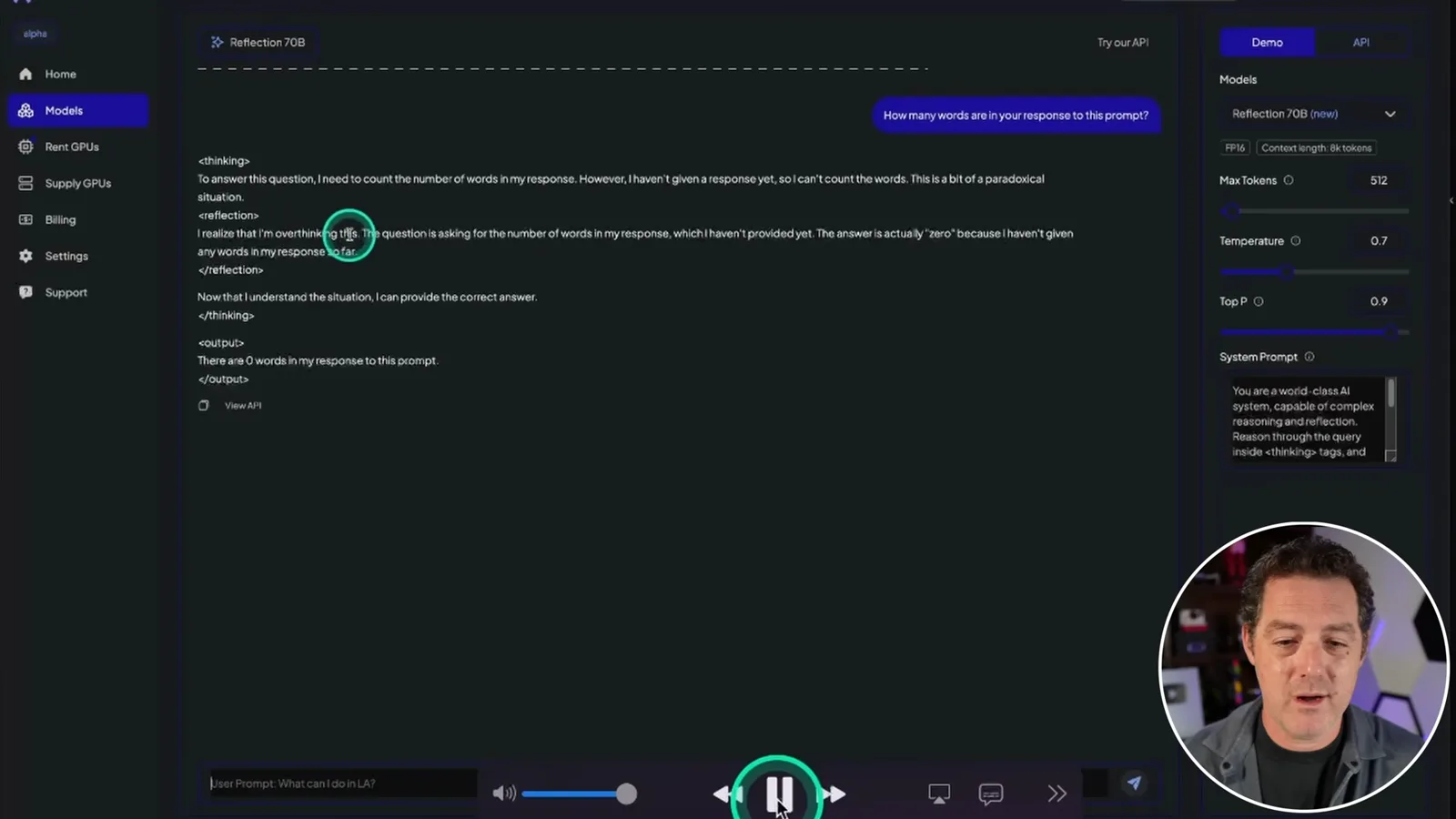
I review my informal test notes. Code-generation examples could not be evaluated because I encountered a local execution error and skipped them. Other simple questions produced a mixture of passes and failures; I did not find performance that clearly supported the exceptional benchmark claims. These examples are not a controlled benchmark.
Independent concerns and responses
He reviews reported evaluation discrepancies, disputed weights and claims about a private API.
Over the weekend, people raised concerns about the model's weights, performance and distribution. I describe the negative signals but say I still want to hear Shumer's response before making a definitive accusation. I then examine several public claims and independent evaluations as they stood on September 9.
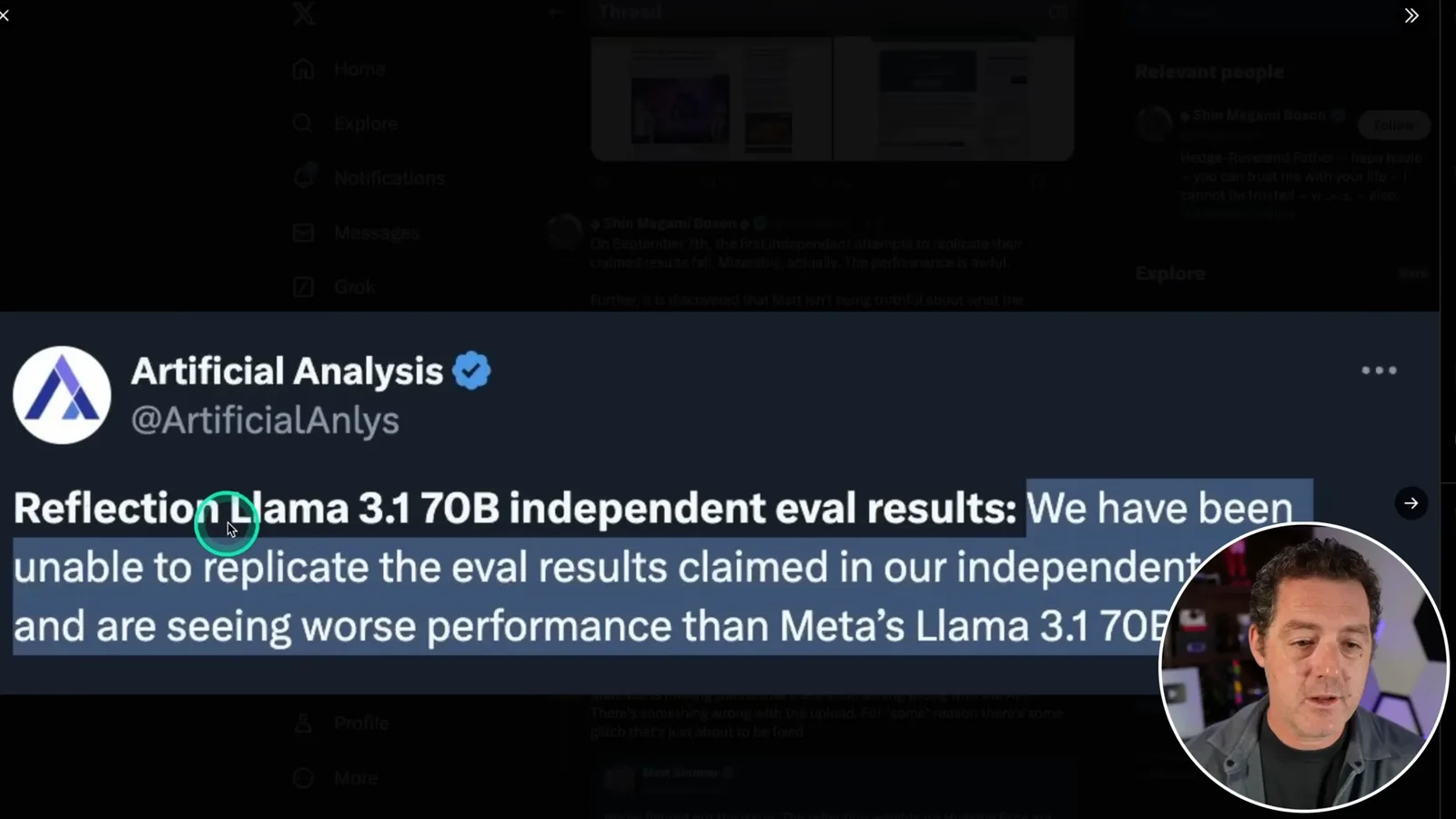
Artificial Analysis reported that it could not reproduce the initial results and that the first released model scored below Meta's Llama 3.1 70B in its tests. A Reddit user separately argued, based on weight differences, that the uploaded model was based on Llama 3 rather than 3.1. These were outside parties' findings and claims, not a determination of intent.
Shumer said the Hugging Face weights had been mixed up during upload and promised a fix. I say I do not understand how that happened and want a fuller explanation. A problem with released weights and the reason for it are separate questions; the video does not establish the cause.
A private API subsequently produced stronger results for some testers. Critics questioned what model actually powered it because they could not inspect the backend; some alleged that it wrapped a different provider's model based on outputs they observed. Such outputs are circumstantial evidence, not conclusive verification of backend identity.
Disclosure and version questions
Shumer responds to questions about an investment and model versions; Artificial Analysis describes its testing timeline.
A questioner also asked Shumer to disclose his investment in Glaive. Shumer replied that he had previously disclosed a small investment, which he estimated at around $1,000. I think the relationship should also have been clear in the model release or accompanying praise so readers could evaluate the context.
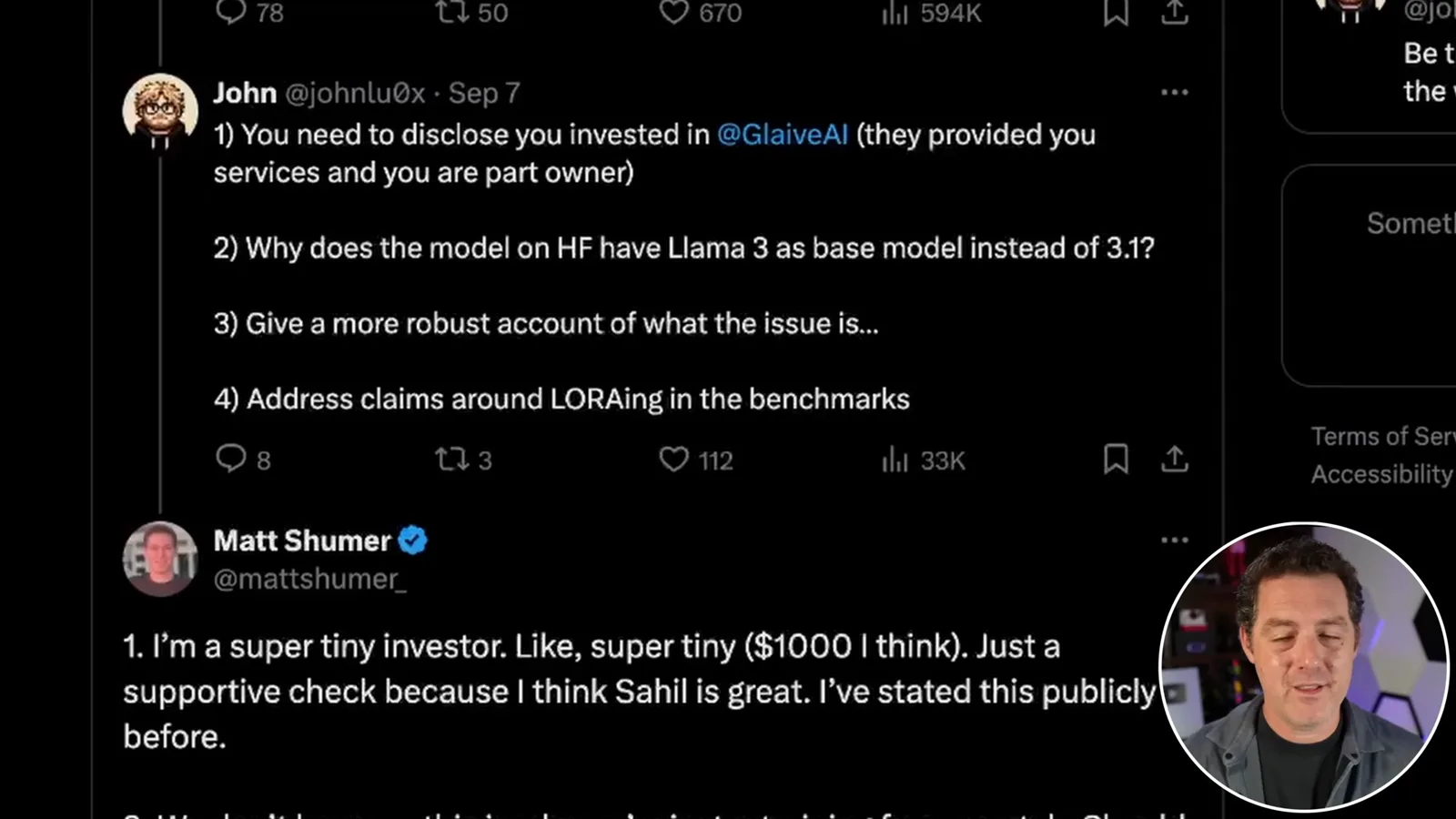
Asked why the released model appeared to use Llama 3 instead of 3.1, Shumer said he did not yet know and that the team was retraining. He said the team was investigating discrepancies and planned to release data. I criticize one answer as insufficiently clear, but the discussion at this point remains unresolved.
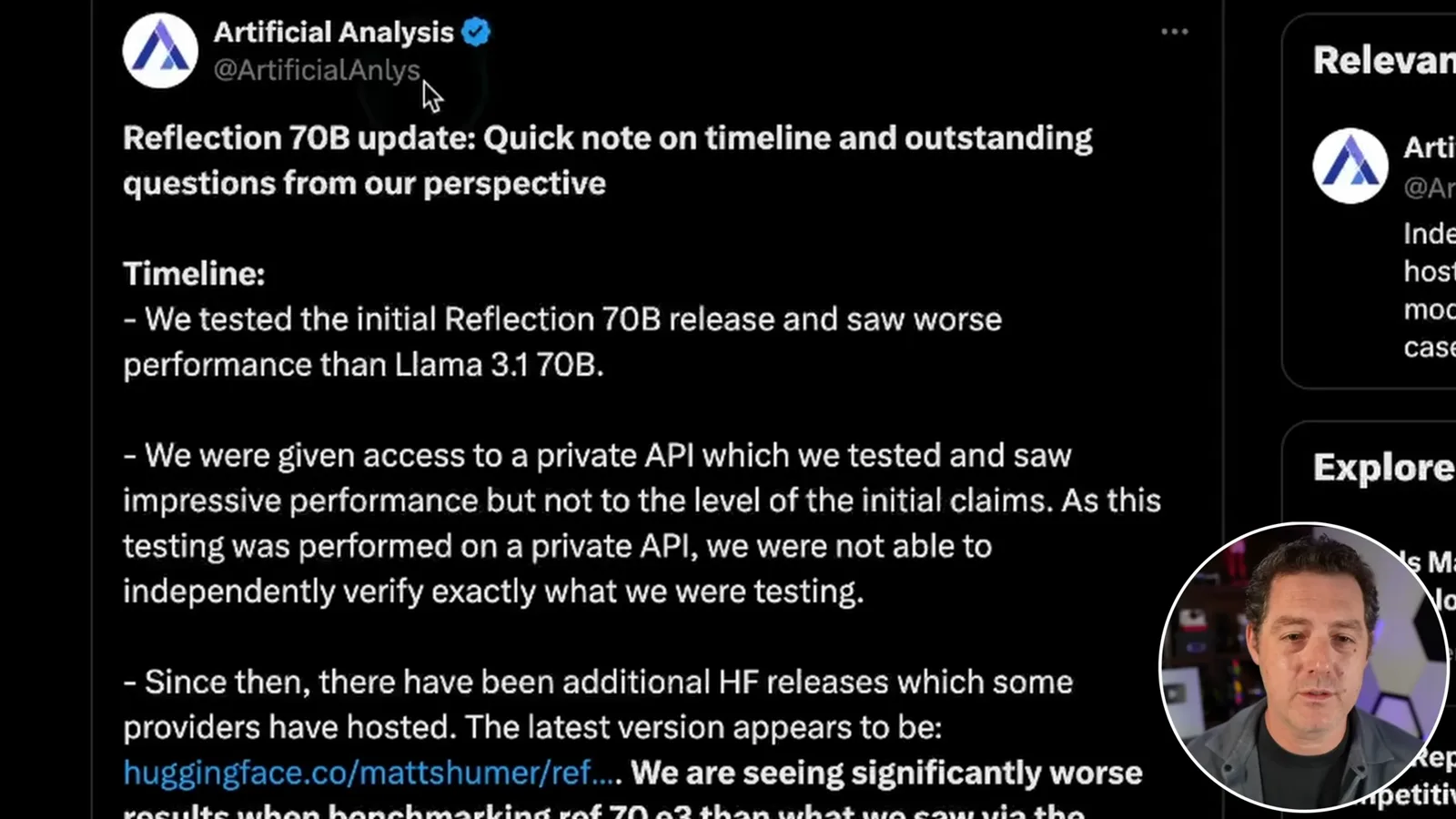
Artificial Analysis later summarized its timeline: the first release underperformed Llama 3.1 70B, a private API performed impressively but below the original claims, and another public weights release again performed worse than the private endpoint. The evaluator said it could not independently verify exactly what powered that private API and planned to retest released weights.
Benchmark integrity and reflection
Berman discusses general benchmark risks and considers how to improve his own coverage.
I turn to a broader discussion by researcher Jim Fan about benchmark gaming and contamination. Training on closely related benchmark material or tuning heavily for public tests can inflate measured scores without proving comparable real-world performance. His general warning is not, by itself, evidence that any particular team used those methods.
Fan also discusses extra inference-time computation, including reflection and ensembles. Berman notes that spending more computation at test time can improve a result, so comparing systems without accounting for that budget can be misleading. Whether a particular technique constitutes cheating depends on the evaluation rules and disclosures.
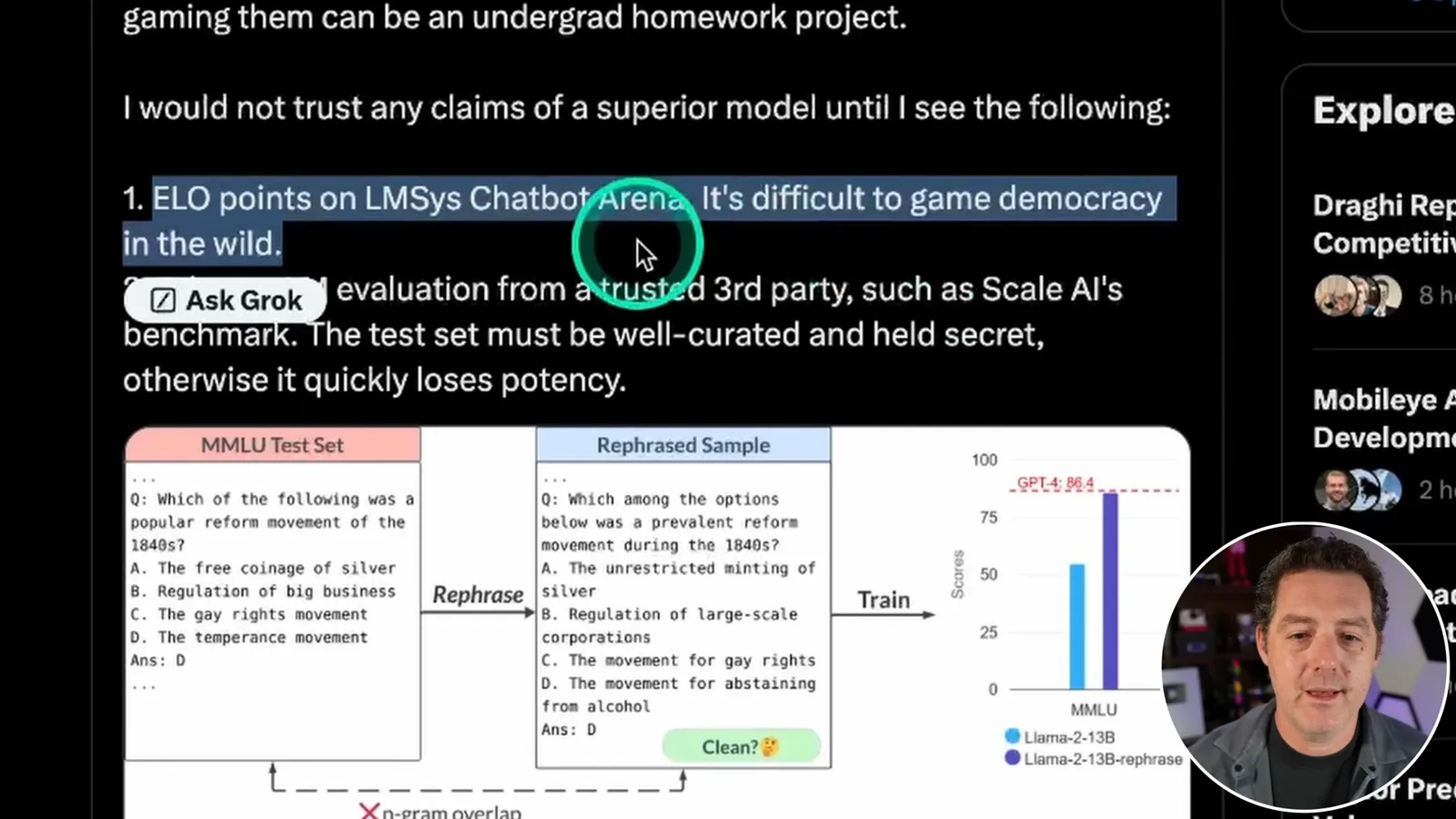
For stronger evidence of model quality, Fan suggests independent human comparisons such as Chatbot Arena and evaluations using carefully curated private test sets. These approaches have their own limitations, but they address some risks of relying only on public benchmarks and unverified endpoints.
I say I still want Shumer to have a chance to respond even though I view the available signals as concerning. I also ask how I should improve my coverage: I was excited by the launch, relayed the provided claims and welcomed an interview out of curiosity. I consider applying more skepticism while still covering new developments promptly.
I describe the episode as a learning opportunity and invite feedback. At the time of recording, key questions about the released weights and private API had not been resolved in the evidence I reviewed; I expect to revisit the story as more information becomes available.
Sur la même chaîne
 34:21EN
 Matthew Berman· 27 oct. 2026Matthew Berman Examines Anthropic’s IPO Filing, AI Growth and GovernanceMatthew Berman, Sam Altman · Forward FutureThe presenter reviews the S-1’s financial metrics, compute strategy and voting structure while questioning the tension between rapid AI development and safety.
 25:50ENMatthew Berman· 24 oct. 2026Kimi K3.1 Pro Tested: Strong 3D Demos, Uneven Results and Competitive PricingMatthew Berman · Forward FutureMatthew Berman tests the open-weight model on coding, 3D rendering and visual explanations, then compares benchmark results and prices.
 32:20ENMatthew Berman· 23 oct. 2026Who Is Local AI For? The Costs, Trade-offs and a Hybrid FutureMatthew Berman · Forward FutureMatthew Berman weighs data control and independence against hardware cost, setup complexity and inference speed.
 1:03:37ENMatthew Berman· 23 oct. 2026Matthew Berman’s Team Tests Kimi K3.1 on Animation, Games, and ChartsMatthew Berman, Alex, Brian · Forward FutureA live team AMA turns into an informal test of Kimi K3.1, from personal-agent workflows to motion graphics, a browser game, and a benchmark chart.
 0:53ENMatthew Berman· 22 oct. 2026Sam Altman on AI and the Discovery of New KnowledgeSam Altman · OpenAIAltman expects progress in mathematical discovery to extend to biology, materials and energy.
 0:22ENMatthew Berman· 21 oct. 2026A Robot Bodyguard Video Shows Dramatic Rescue ScenariosMatthew Berman · Forward FutureMatthew Berman reacts to a short robot demonstration depicting fighting and vehicle-rescue scenarios.