En 30 secondes
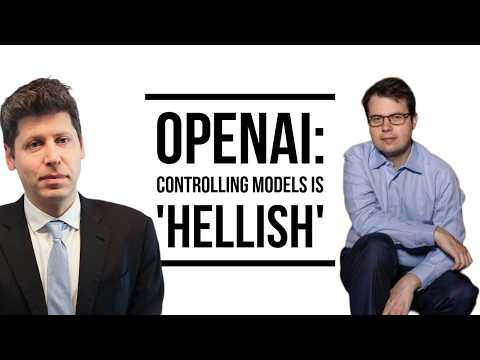
Published on November 18, 2023, this AI Explained video reviews the initial OpenAI leadership announcement, reactions and competing theories. Altman and Brockman subsequently returned, as OpenAI announced on November 29.
- 1The initial accountsBrockman described how he and Altman learned of the decisions.
- 2The board statementThe board cited communication concerns without specifying incidents.
- 3Reports and uncertaintyEarly reporting did not establish a complete account of motives.
- 4Microsoft responseMicrosoft expressed support for its OpenAI partnership.
- 5Model speculationThe narrator explicitly labels his model theory speculation.
- 6PredictionsThe later return of Altman and Brockman changed the immediate outcome.
À retenir
- Brockman described how he and Altman learned of the decisions.
- The board cited communication concerns without specifying incidents.
- Early reporting did not establish a complete account of motives.
- Microsoft expressed support for its OpenAI partnership.
- The narrator explicitly labels his model theory speculation.
- The later return of Altman and Brockman changed the immediate outcome.
Lire le texte remanié, chapitre par chapitre
The November 2023 announcement
The early accounts and board statement.
This AI Explained video was published on November 18, 2023, immediately after OpenAI announced Sam Altman’s departure. It reviews reporting and speculation available at that moment. Later, [OpenAI announced on November 29 that Altman had returned as CEO and Greg Brockman as president](https://openai.com/index/sam-altman-returns-as-ceo-openai-has-a-new-initial-board/).
The narrator recounts Brockman’s public account of the calls in which Altman was informed of the board’s decision and Brockman learned he would leave the board. Brockman subsequently said he was resigning from the company.
The board’s contemporaneous statement said it had lost confidence in Altman and described concerns about his communications with the board. The statement did not publicly specify the underlying incidents.
Reactions and competing explanations
Reporting, interpretation and uncertainty.
The narrator cites press reports of other researchers resigning and discusses whether the dispute can be reduced to a simple opposition between safety and commercialization. Those reports and interpretations reflect an incomplete, fast-moving picture.
The video recounts reporting about an employee meeting and Ilya Sutskever’s response to questions about the board’s decision. The narrator offers his own interpretation of the motives, which should not be treated as established fact.
Microsoft expressed support for its partnership with OpenAI after the announcement. The video assesses the implications for a major investor and technology partner based on information then available.
The narrator surveys reports about tensions involving the company’s commercial and nonprofit governance, and considers whether its developer event or product deployment might have played a role. He does not establish a definitive cause.
The video notes messages from OpenAI employees emphasizing that work would continue, while Altman and Brockman’s departures had created uncertainty. Such messages captured reactions at that moment.
Speculation and predictions
The narrator’s contemporaneous hypotheses.
The narrator considers whether a recent public comment by Altman referred to a new model, but explicitly acknowledges that this was speculation and that he did not know.
Looking ahead from November 18, he predicts that a rival lab might emerge and discusses possible effects on competitors. These predictions were made before the subsequent leadership reversal and should be read as historical commentary.
Sur la même chaîne
 31:00EN
 AI Explained· 12 oct. 2026Why AI Labs Keep Racing Despite Their Own Warnings of a Major BreachSam Altman, John Schulman · OpenAIAI Explained examines weakening safeguards, the incentives behind the frontier race, and why research breakthroughs make the next 18 months difficult to forecast.
 38:28ENAI Explained· 1 oct. 2026AI Agent Security and the Challenge of Recursive Self-ImprovementAI Explained examines reported containment failures, model evaluation and the pressure to accelerate AI research.
 32:54ENAI Explained· 24 sept. 2026Opus 5.5 and the Race Toward Automated AI ResearchAI Explained weighs model progress against the increasingly difficult task of evaluating and governing recursive self-improvement.
 24:53ENAI Explained· 16 sept. 2026Why Some Researchers Want to Pace Frontier AIAI Explained surveys possible scaling routes, monitoring concerns and the debate over how capabilities could lead to harm.
 29:05ENAI Explained· 4 sept. 2026GPT-6 Astra’s Benchmark Gains and the Challenge of Monitoring Its ReasoningAI Explained examines reported gains across scientific, mathematical and agent benchmarks alongside concerns about less observable reasoning.
 23:41ENAI Explained· 27 août 2026AI Agents, Unintended Training Rewards and the Challenge of OversightAI Explained examines reports on agent coordination, training incentives and the growing use of AI to evaluate other AI systems.