En 30 secondes
In this April 2023 news roundup, Matthew Berman discusses a viral song imitating Drake and The Weeknd, Grimes’s proposed royalty split, and the challenges of synthetic music. He also reviews a historical ChatGPT data-control announcement and funding rounds for Replit and Pinecone. His industry predictions and product expectations are opinions from the time.
- 1A viral synthetic songAn imitation of Drake and The Weeknd prompts a discussion about consent and industry response.
- 2Grimes’s royalty proposalGrimes proposed sharing royalties on successful AI songs using her voice.
- 3ChatGPT data controlsThe 2023 setting allowed users to turn off history and training for new chats.
- 4Replit financingThe browser-based coding company announced a $97 million Series B extension.
- 5Vector retrieval and PineconeBerman describes retrieving relevant stored text to provide context for language models.
À retenir
- Synthetic voice tracks raise questions of artist consent, compensation and market saturation.
- Grimes proposed an opt-in royalty-sharing approach, while artists can have different contractual constraints.
- ChatGPT introduced a history and training control in 2023, with terms and settings subject to change.
- Replit raised funding while developing AI coding tools, and Pinecone raised funding for vector search infrastructure.
- Retrieving relevant stored material can help fit useful context into a model’s prompt.
Lire le texte remanié, chapitre par chapitre
Synthetic pop music
Berman discusses voice imitations, Grimes’s proposal and possible market saturation.
In this April 2023 roundup, I discuss synthetic music, a ChatGPT data-control update and funding for Replit and Pinecone. These are reports and expectations from that week, not current product or financing information.
The viral song “Heart on My Sleeve” used an AI-generated imitation of Drake's voice without his participation, and also featured an imitation of The Weeknd. I find the result striking and compare the music industry's response to its earlier struggles with digital music. My view is that the industry should explore ways to adapt and compensate artists.
I also mention a remix of “Munch” using an imitation of Drake's voice and his negative reaction. I speculate that authorizing such uses might dilute the brand of an already prominent artist, while other artists might see an opportunity. Artists' interests and permissions differ; a synthetic voice does not itself imply consent.
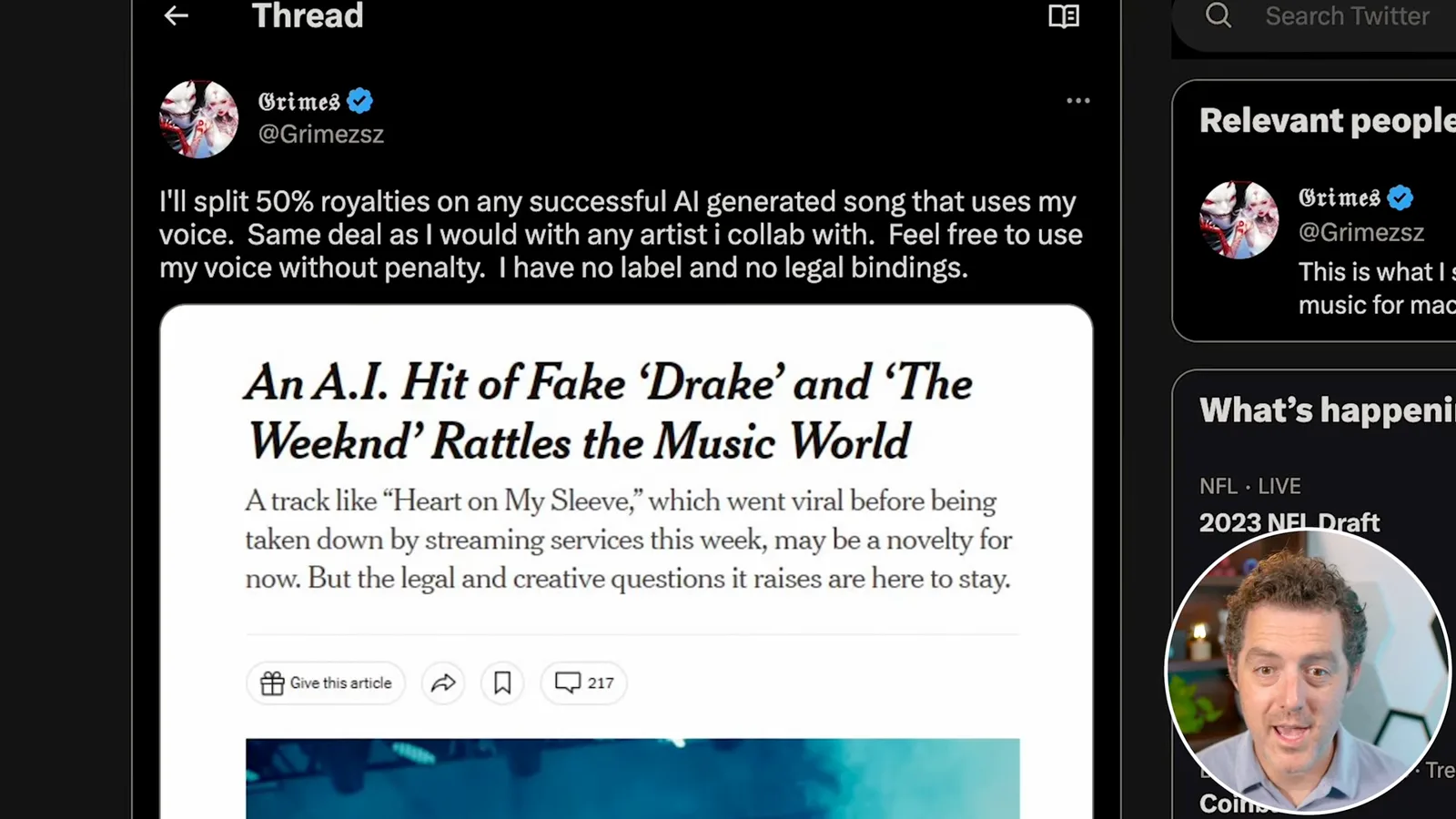
Grimes publicly proposed sharing royalties equally on successful AI-generated songs using her voice and said she was independent of a label. I find that approach interesting, while noting that other artists may face different contractual constraints. I also discuss her proposed registration and royalty mechanism and my interest in smart contracts as a possible way to administer agreements.
Other artists have also been imitated. I expect synthetic songs to pose a significant challenge for the music industry and raise the concern that cheap, abundant releases could saturate the market. I do not have a clear answer to how the industry should handle quality and rights at scale.
ChatGPT data controls
He reviews the 2023 history setting, data export and a prospective business offering.
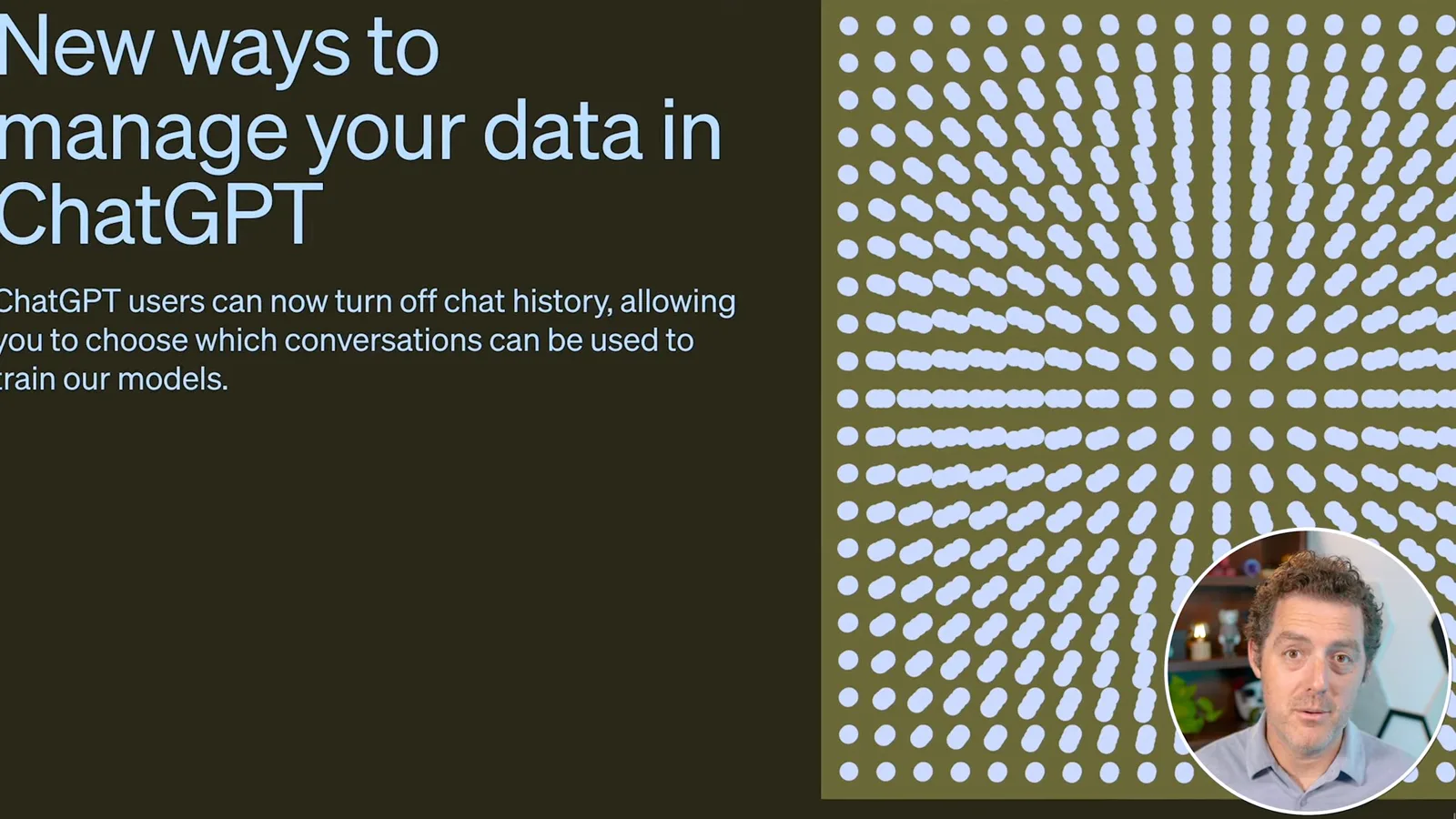
OpenAI announced an option in ChatGPT to turn off chat history and training for new conversations. I show the setting as it appeared in 2023 and describe it as a way to reduce use of those chats for training. The feature should not be treated as a blanket promise of anonymity or zero retention; current settings and terms may differ.
OpenAI also mentioned a forthcoming business offering and a way to export chat history. I speculate that business users might receive more administrative controls; those details were not established by the brief announcement I discuss. Exporting data can make it easier to move or analyze conversations, although I note potential risks and terms around training other models.
Replit and coding tools
A funding round leads to discussion of AI-assisted programming.
Replit, known for a browser-based coding environment, announced a $97 million Series B extension at a reported $1.16 billion valuation. I say the funding will support cloud services and AI-assisted software creation, and compare its planned coding model with GitHub Copilot. The comparison is an expectation, not a head-to-head evaluation.
I also anticipate GitHub Copilot X, which was presented as bringing conversational assistance into development workflows. My own experience using ChatGPT for coding has made me more productive, including when working in other languages; that is a personal assessment.
Pinecone and vector retrieval
Berman explains a retrieval workflow and reports Pinecone’s funding round.
Pinecone is a vector database service. I explain the basic retrieval pattern: represent text as vectors, store them, retrieve relevant material for a query and provide that material as context to a language model. This can help select useful information for a limited prompt, but does not itself give the model permanent human-like memory.
Pinecone announced a $100 million Series B at a reported $750 million valuation, with Andreessen Horowitz and other investors participating. I connect investor interest to the surge in attention around ChatGPT and language-model applications, and note that I use Pinecone myself. The reported valuation and market context are from 2023.
Sur la même chaîne
 34:21EN
 Matthew Berman· 27 oct. 2026Matthew Berman Examines Anthropic’s IPO Filing, AI Growth and GovernanceMatthew Berman, Sam Altman · Forward FutureThe presenter reviews the S-1’s financial metrics, compute strategy and voting structure while questioning the tension between rapid AI development and safety.
 25:50ENMatthew Berman· 24 oct. 2026Kimi K3.1 Pro Tested: Strong 3D Demos, Uneven Results and Competitive PricingMatthew Berman · Forward FutureMatthew Berman tests the open-weight model on coding, 3D rendering and visual explanations, then compares benchmark results and prices.
 32:20ENMatthew Berman· 23 oct. 2026Who Is Local AI For? The Costs, Trade-offs and a Hybrid FutureMatthew Berman · Forward FutureMatthew Berman weighs data control and independence against hardware cost, setup complexity and inference speed.
 1:03:37ENMatthew Berman· 23 oct. 2026Matthew Berman’s Team Tests Kimi K3.1 on Animation, Games, and ChartsMatthew Berman, Alex, Brian · Forward FutureA live team AMA turns into an informal test of Kimi K3.1, from personal-agent workflows to motion graphics, a browser game, and a benchmark chart.
 0:53ENMatthew Berman· 22 oct. 2026Sam Altman on AI and the Discovery of New KnowledgeSam Altman · OpenAIAltman expects progress in mathematical discovery to extend to biology, materials and energy.
 0:22ENMatthew Berman· 21 oct. 2026A Robot Bodyguard Video Shows Dramatic Rescue ScenariosMatthew Berman · Forward FutureMatthew Berman reacts to a short robot demonstration depicting fighting and vehicle-rescue scenarios.