En 30 secondes
At Tesla’s 2021 shareholder meeting, Elon Musk said the company’s rapid vehicle growth depended on securing chips and batteries. Tesla would buy as many affordable cells as suppliers could provide while also making its own, he said, prioritizing vehicles before stationary storage. Musk announced plans to move headquarters to Austin while expanding production in California and Nevada. He also presented targets for factories, Model Y and autonomy as projections, and argued for recycling batteries and a carbon tax.
- 1Chip supply could limit rapid delivery growthMusk points to record deliveries and says sustaining growth depends on suppliers, especially access to semiconductors.
- 2Tesla planned to buy supplier cells as well as make its ownMusk says Tesla would take as many affordable cells as suppliers could produce and use excess capacity for Powerwall and Megapack after prioritizing vehicles.
- 3Production was shifting closer to customersMusk says Shanghai output had exceeded Fremont and discusses new factories in Texas and Berlin, while planning further Fremont expansion.
- 4Musk viewed old batteries as a source of materialsHe says lithium, nickel and other battery constituents can be recovered from used batteries rather than only mined from rock.
- 5AI Day was also a recruiting effortMusk says Tesla designs both the car’s inference computer and a training computer, and points to increased applications after AI Day.
- 6Tesla would move its headquarters to AustinMusk announces the move and says Tesla would continue expanding in California. He cites factory crowding and housing and commuting pressures in the Bay Area.
À retenir
- In 2021 Musk said chip shortages and battery supply could constrain Tesla’s growth.
- Tesla planned to supplement supplier batteries with its own cells, prioritizing cars before stationary storage.
- Musk announced a headquarters move to Austin while saying Tesla intended to expand California and Nevada production.
- He argued that spent batteries can become a source of recovered materials for new batteries.
- Musk’s sales and production figures for future years were forecasts made at the meeting.
Lire le texte remanié, chapitre par chapitre
Delivery growth depends on suppliers
Musk reviews vehicle deliveries and predicts continued growth. He says chips, production costs and factory output are important constraints.
Elon Musk opens Tesla’s 2021 annual shareholder meeting in Austin by thanking employees. He points to record vehicle deliveries and says he expects strong growth to continue if suppliers can provide enough chips.
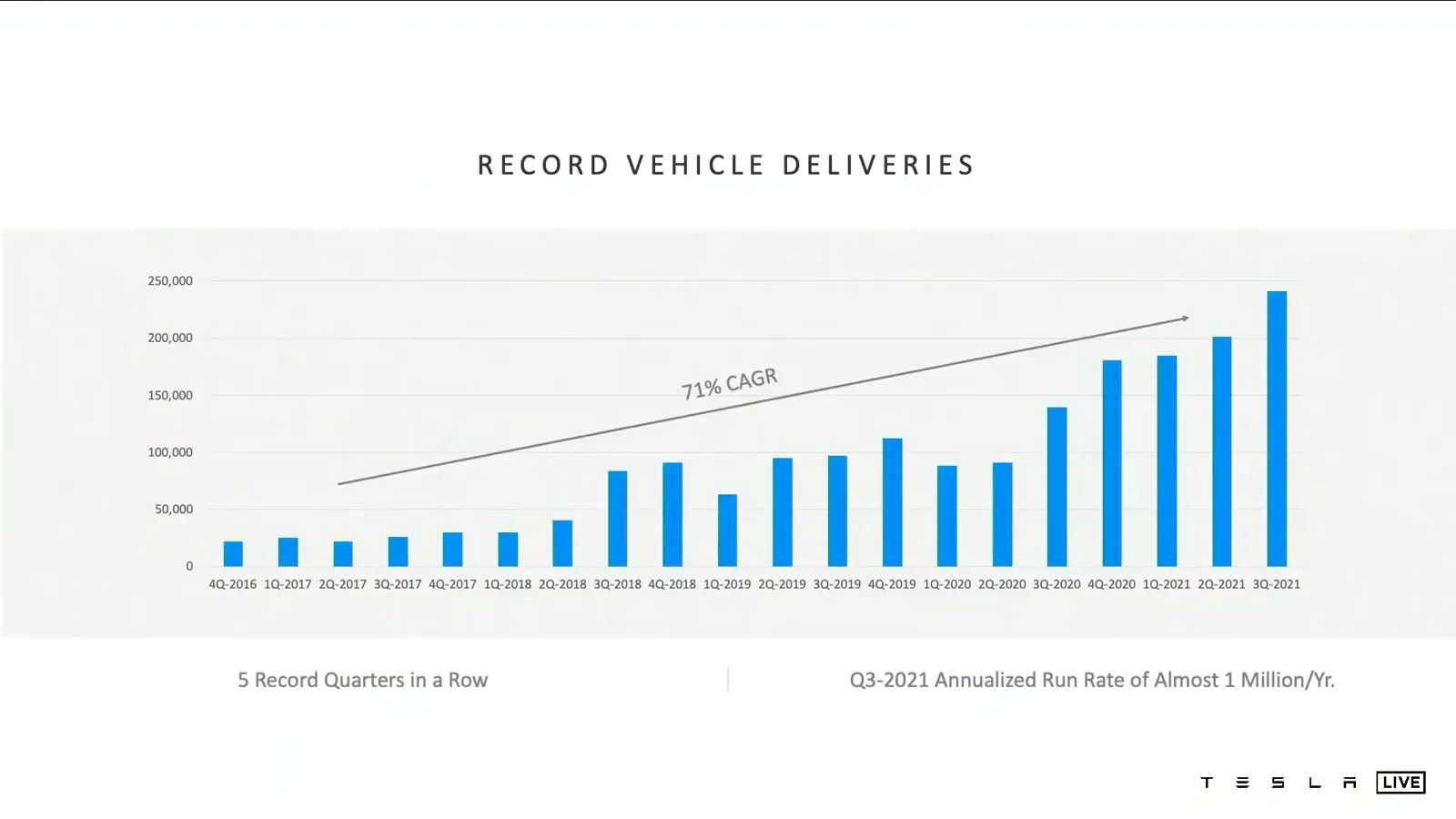
Musk says Model 3 had become a leading premium vehicle and predicts Model Y could eventually exceed it. In 2021 he estimates Model Y might lead global vehicle sales by revenue the following year and by unit volume in 2023, depending on production ramps in Austin and Berlin.
He contrasts the company’s cash flow with the difficult years of 2017 and 2018, and expects continued improvement through higher volume and more efficient factories. Musk also says Tesla would be willing to license its future autonomy technology to other manufacturers because he expects it to improve safety.
Musk says Tesla reduced average selling prices with Model 3 and Model Y while maintaining gross margins. He says supply-chain costs had put upward pressure on vehicle prices, including the expense of flying parts around the world, but hopes prices can fall over time.
Battery supply for vehicles and storage
Tesla plans to buy supplier cells and make its own. Musk connects stationary batteries with intermittent solar and wind power.
Batteries are a major need. Musk says suppliers have asked whether Tesla’s own cell production would replace them; his answer is that Tesla plans to buy as many cells as they can supply at an affordable price, while also making its own.
He says Tesla will prioritize cells for vehicles and use excess supply in Powerwall and Megapack stationary storage products. Musk expects stationary storage demand eventually to be at least as large as vehicle battery demand.
Musk describes solar and wind generation, stationary batteries and electric transport as the main elements of a sustainable energy system. Since wind and sunlight vary, he says, batteries can store electricity for use at other times.
He offers estimates of the land needed for solar panels and batteries to supply the United States, arguing the physical footprint need not be prohibitive. He says Tesla and its suppliers are working to lower battery cost per kilowatt-hour.
Musk says the company’s value should be judged by how much it accelerates sustainable energy. He praises the Shanghai factory team and says its output had exceeded Fremont’s, while Tesla still hoped to increase Fremont production.
Factories, environmental impact and recycling
Musk discusses Shanghai, Fremont, Texas and Berlin. He advocates battery recycling and a carbon tax, and describes the role of storage in a power outage.
Musk argues that high-volume vehicles should be produced close to customers, reducing long shipping distances. He discusses progress on the Texas and Berlin factories and says they are intended to include cell production as well as vehicle manufacturing.
Musk directs shareholders to Tesla’s impact report and returns to his vision of solar and wind power, stationary batteries and electrified transport. He says a cleaner electricity grid would improve electric vehicles’ lifecycle emissions, and calls for a carbon tax.
Musk says methane breaks down into carbon dioxide and suggests it deserves less concern than carbon dioxide. [UN Environment Programme](https://www.unep.org/en/explore-topics/climate-action/facts-about-climate-emergency) notes that methane is a powerful greenhouse gas, with over 80 times the warming potential of carbon dioxide over the first 20 years after release.
Musk describes used batteries as a concentrated source of lithium, nickel and other materials. He says Tesla has begun recycling and expects other companies to do so as well, comparing the material in old batteries to high-grade ore.
He recalls being in Austin during a severe winter storm when power, heating and internet service were unavailable. Musk says solar panels and a Powerwall could have helped supply electricity, and mentions satellite internet as another part of a resilient setup.
Safety, AI hiring and the Austin move
Musk discusses factory safety and AI recruiting. He announces a headquarters move to Austin while saying Tesla will keep expanding in California.
On factory safety, Musk says Tesla has improved its injury metrics and gives a comparison with an industry average. He says new lines can have more problems initially, with safety improving as workers gain experience and issues are addressed.
Musk says Tesla is a software as well as a hardware company. He describes its in-car self-driving inference computer and a training computer under development, and says applications for AI roles rose after the company’s AI Day.
He says self-driving is one application of AI, while adding that he has concerns about AI risks and wants its development to produce beneficial outcomes. He then announces that Tesla plans to move its headquarters to Austin, Texas.
Musk says the move does not mean leaving California: Tesla intends to expand output at Fremont and in Nevada. He describes crowding at the Fremont factory and the cost of housing and long commutes in the Bay Area, and says the Austin site offers room for growth.
Sur la même chaîne
 3:35:00EN
 CNET Highlights· 2 mars 2023Tesla’s 2023 Investor Day: the plan to scale clean energy and carsElon Musk, Zach Kirkhorn, Drew Baglino, Franz von Holzhausen, Lars Moravy, Colin Campbell, Pete Bannon, David Lau, Ashok Elluswamy, Rebecca Tinucci, Karn Budhiraj, Roshan Thomas, Tom Zhu, Mike Snyder, Laurie Shelby, Brandon Ehrhart · TeslaTesla leaders outline a global electrification scenario, a lower-cost vehicle platform and the factories and supply chains needed to scale.
 41:04ENCNET Highlights· 2 mars 2023Tesla’s 2023 investor Q&A puts battery supply and costs in focusElon Musk · TeslaExecutives explain refining, factory localization and dry-electrode scaling, while Musk discusses affordability and a future autonomous fleet.
 8:15ENCNET Highlights· 1 mars 2023Tesla’s 2023 plan estimates the scale of a fully electrified energy systemElon Musk, Drew Baglino · TeslaMusk and Drew Baglino describe a proposed energy transition requiring batteries, renewable generation and manufacturing investment.
 53:25ENCNET Highlights· 1 déc. 2022Neuralink researchers on implant durability, safety and wireless dataElon Musk · NeuralinkAt a 2022 Q&A, the team explained animal results, device-removal concerns and ways to compress brain signals.
 7:20ENCNET Highlights· 1 déc. 2022Neuralink’s 2022 monkey demo selected highlighted keysElon Musk · NeuralinkMusk showed cursor control with an implant, while stressing the monkey was following prompts rather than spelling independently.
 3:39:05ENCNET Highlights· 1 déc. 2022Neuralink’s 2022 update: from neural signals to a working interfaceElon Musk, DJ Seo · NeuralinkEngineers explain cursor decoding, implants and robot-assisted insertion, while separating animal demonstrations from clinical ambitions.