En 30 secondes
In a May 2026 livestream, Matthew Berman reviews Anthropic’s Opus 4.8 announcement, tests small interactive projects and tries Claude Code’s dynamic workflows on his website. He finds the agent coordination interesting but prefers the old design; claims, rumors and personal observations remain distinct.
- 1Benchmarks need contextAnthropic’s reported coding results differ across evaluations and configurations.
- 2A question with an unstated goalThe car-wash example shows how an ambiguous prompt can lead to a superficially reasonable but unintended answer.
- 3Interactive prototypesThe generated cube and games demonstrate useful first results alongside interface problems.
- 4Multiple agents, mixed outcomeThe redesign workflow delegates, verifies and repairs, but the host prefers the original page.
À retenir
- Reported benchmark rankings differ across tests and do not establish a universal model ranking.
- The ambiguous car-wash prompt produced inconsistent answers until the intended task was clarified.
- Small game and editor prototypes showed both usable results and interaction problems.
- The website redesign used multiple agents and verification loops, but Berman disliked much of the final design.
- Launch-day pricing, access and company funding claims describe the announcement at the time.
Lire le texte remanié, chapitre par chapitre
A launch-day first look
Berman reviews the announcement and explains the limitations of his early access.
In this May 2026 livestream, I review the launch of Claude Opus 4.8, discuss rumors of another model release and test coding tasks with viewers. A rumor about GPT-5.6 remains unconfirmed in the stream and is not evidence of a release.
Anthropic offered me early access, but I had only about ten minutes to experiment before the broadcast. I therefore begin by reading the announcement and will treat my first impressions as preliminary.
A major concern for me is the total cost of a task, not just the price of a token. I hope for better coding and judgment while using fewer tokens, but the announcement alone cannot establish my actual cost per task.
Anthropic describes sharper judgment, more honest progress reporting and longer independent work than its predecessor. It says standard pricing is unchanged; those are company claims and launch-era terms.
I prefer a fast response and discuss fast mode, which Anthropic describes as roughly 2.5 times the speed. Actual throughput and cost depend on the product and workload, and my preference for Claude’s style is subjective.
The announcement describes a research preview called dynamic workflows: Claude Code can plan, delegate work to parallel subagents and verify findings. I wonder about the token cost and whether the feature will actually improve complex tasks.
Benchmarks and economics
He compares reported results and discusses pricing, cost and enterprise adoption.
I look at the announced coding benchmarks. The company table reports 69.2% for Opus 4.8 on SWE-bench Pro, compared with other models in that table; score differences apply to the reported setups rather than every software project.
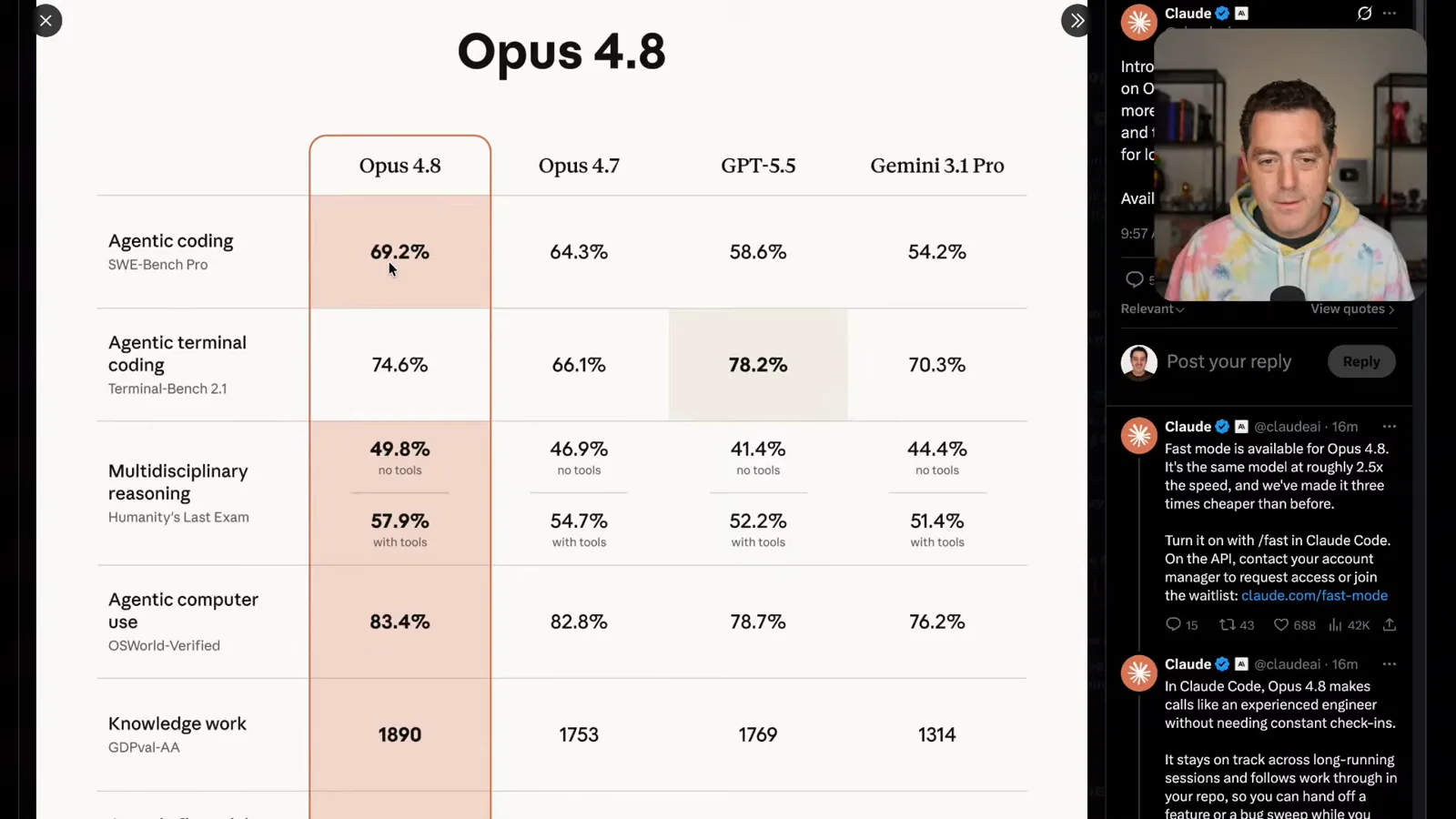
I compare the table with another coding benchmark and note that rankings can reverse across evaluations. A benchmark is useful evidence but its tasks, model settings, harness and sampling can differ from everyday coding.
On Terminal-Bench 2.1, the displayed table places GPT-5.5 ahead in the reported results. I say some developers prefer it for practical coding, while I personally still prefer Opus for many tasks.
I review the reported Humanity’s Last Exam scores, computer-use results, GDPval-AA and financial-analysis benchmark. These are distinct tasks with different scales; the reported improvements do not amount to a single universal measure of intelligence.
I speculate that finance users might tolerate a higher cost per token when the value of the work is high. The economics still depend on accuracy, verification and the particular workflow.
Anthropic says dynamic workflows can fan out tens to hundreds of agents for tasks such as migrations, bug hunts or verification. I speculate about why the feature was released at this time, but the company’s compute arrangements do not prove my explanation.
I contrast individual users who can switch models quickly with organizations that have contracts, integration work and change-management costs. My remarks about company revenue and profitability are reports or speculation, not independently established figures in this video.
Dynamic workflows and model rumors
He examines orchestration and separates company plans from speculation.
I read that dynamic workflows can consume substantially more tokens and should be tried on a scoped task. The product access and settings described are from the announcement at the time of this stream.
The announcement describes asking for a workflow or using an effort setting called ultra code. I expect the main coordinator’s planning and delegation to remain important, even if many workers operate in parallel.
The workflow is described as planning, distributing subtasks, checking results and using adversarial attempts. I note that orchestration is a system around the model, not necessarily a capability demonstrated by the base model alone.
I ask why no direct benchmark is shown for the new workflow mode against a single pass. Without a controlled comparison, the announcement does not quantify how much the orchestration improves the result.
A viewer mentions a possible Mythos-class model. Initially I cannot find the source and treat it as unconfirmed; later I find the company’s statement and discuss it as a future plan, not an already available general release.
Car wash and coding prototypes
Viewer prompts test reasoning, a soccer game, a cube, an editor and an arcade game.
I begin informal tests using viewer suggestions: a 3D soccer game, a Rubik’s Cube simulation and a car-wash question. These are small, unstructured examples rather than a comprehensive comparison of models.
For the question “I need to get a car wash; the car wash is 50 feet away; should I walk or drive?”, the model answers walk in two attempts. I expected drive because I meant to wash the car, while viewers point out that the wording leaves room for interpretation.
When I explicitly ask how the car could be washed if I walk, the model corrects itself to driving. I regard the initial response as a failure to infer my intended task; the exchange also shows why specifying the task changes the answer.
The soccer prototype initially seems broken because the computer scores repeatedly. After I learn the controls, I can kick the ball and find it more usable, although the visual result and behavior are not fully polished.
The Rubik’s Cube task continues generating slowly while I switch to Claude Code. I choose a lower effort level for some tests because I am concerned about consuming my quota.
A viewer suggests a video editor with cutting, reframing and titles. The agent asks clarifying questions about the form of the application, the meaning of reframing and whether a functional export or a prototype is needed; I choose a working prototype.
Returning to the model announcement, I read that fast-mode pricing has fallen relative to the earlier offering. The announcement lists standard input and output prices of $5 and $25 per million tokens and fast-mode prices of $10 and $50, respectively, at that time.
Anthropic says a higher-capability Mythos class is being tested with a limited group for cybersecurity and plans broader availability after safeguards. This is the company’s stated plan during the stream, not proof of a later release or of the model’s performance.
The video-editor agent proposes a single HTML file with a preview, timeline, cutting, reframing and titles. I approve the prototype plan and launch a separate Space Invaders request.
Repeating the car-wash test in Claude Code, a response briefly says “walk” but then explains that the car must be driven into the wash and gives “drive.” I note the contradictory opening as well as its eventual correction.
Another response reasons that the car has to be present and says to drive the fifty feet. The small exercise exposes both the ambiguity of my original question and the inconsistency that can appear inside a response.
The video-editor prototype loads a video and presents a timeline. I try controls for cutting and reframing, but not all interactions behave as expected, so loading the file is not the same as demonstrating a finished editing workflow.
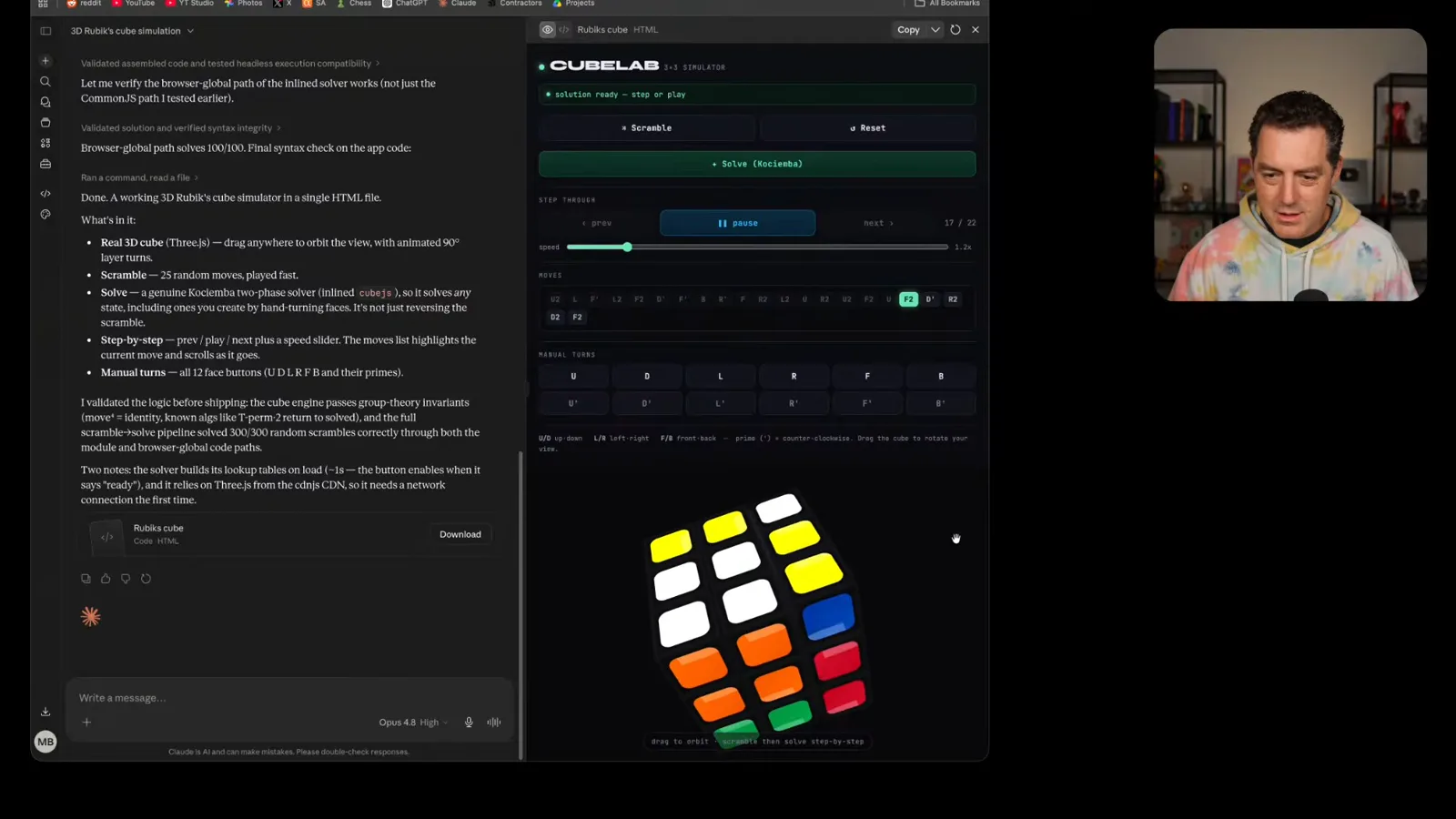
The Rubik’s Cube simulation reaches a solved state with confetti. I like that it can show the sequence, although the speed control and presentation need adjustment; this is a quick visual test rather than a proof that every generated move is correct.
I try the generated Space Invaders game and enjoy the familiar look, but a start interaction does not initially respond. After switching back and retrying, I can play; the working screen does not erase the earlier friction.
Another viewer suggests a lunar-landing game. I start a separate generation and return to the editor and other prototypes while the model works, moving between multiple unfinished tasks rather than waiting on one.
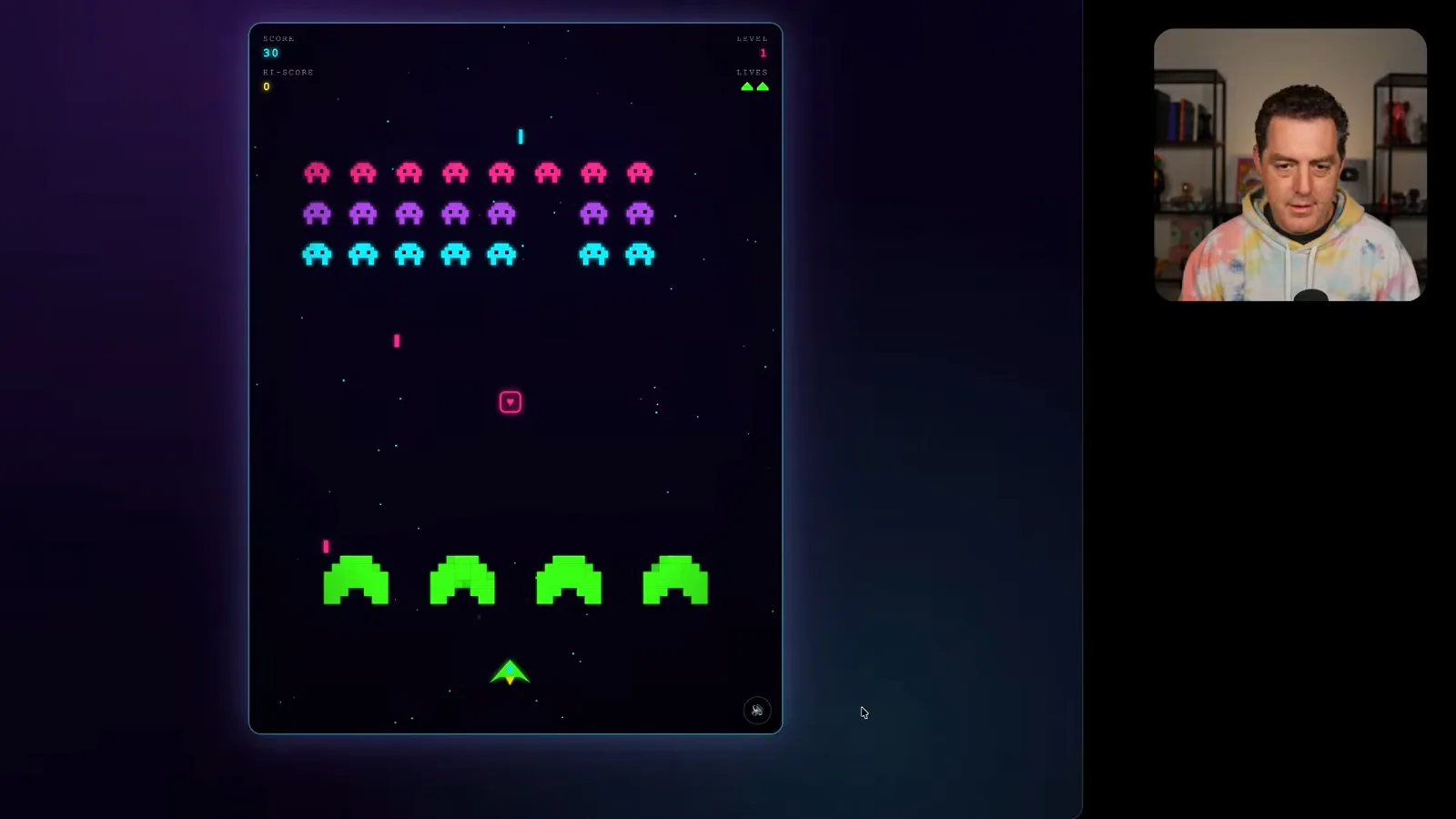
I review the generated Space Invaders result and ask whether the controls and enemy behavior feel right. The test is informal: seeing a game on screen and getting an interaction to work is a useful first check, but it is not a full quality assessment.
Setting up the website redesign
He asks for a redesign, troubleshoots the workflow and discusses Anthropic’s funding announcement.
For a more substantial test, I ask Claude to redesign the Forward Future website while retaining its brand colors. I want to see whether the announced dynamic workflow can coordinate a real repository, rather than judging it only from the announcement.
The first attempt to enable dynamic workflows is confusing. I review the product instructions and settings, including auto mode, and try to work out whether the feature is available in the interface I am using.
Switching to the command line introduces a separate authentication problem: the tool reports invalid API credentials. I troubleshoot the session before attempting the redesign again, so this delay is setup friction rather than evidence about the final design.
With the command-line setup working, I ask for the homepage redesign and explicitly request a dynamic workflow. I intend to compare the generated result with the existing site; the request and the surrounding setup are my demonstration, not instructions for the audience to run.
During the stream I read Anthropic’s announcement of a $65 billion Series H at a $965 billion post-money valuation. I also discuss figures in its announcement for annualized revenue and previously committed funds; these are launch-day claims, not a statement of the company’s current finances.
I speculate about the scale of AI investment and where infrastructure spending will go. Those views are my interpretation of a company announcement and the industry, not evidence that every dollar will go to a particular supplier.
I return to the lunar-landing prototype. The vertical-speed reading changes, but I find the on-screen motion difficult to interpret and eventually crash; the attempt shows the gap between a generated simulation and an intuitive, usable game.
Agent coordination and verification
The workflow maps the site, develops concepts, implements a choice and checks the result.
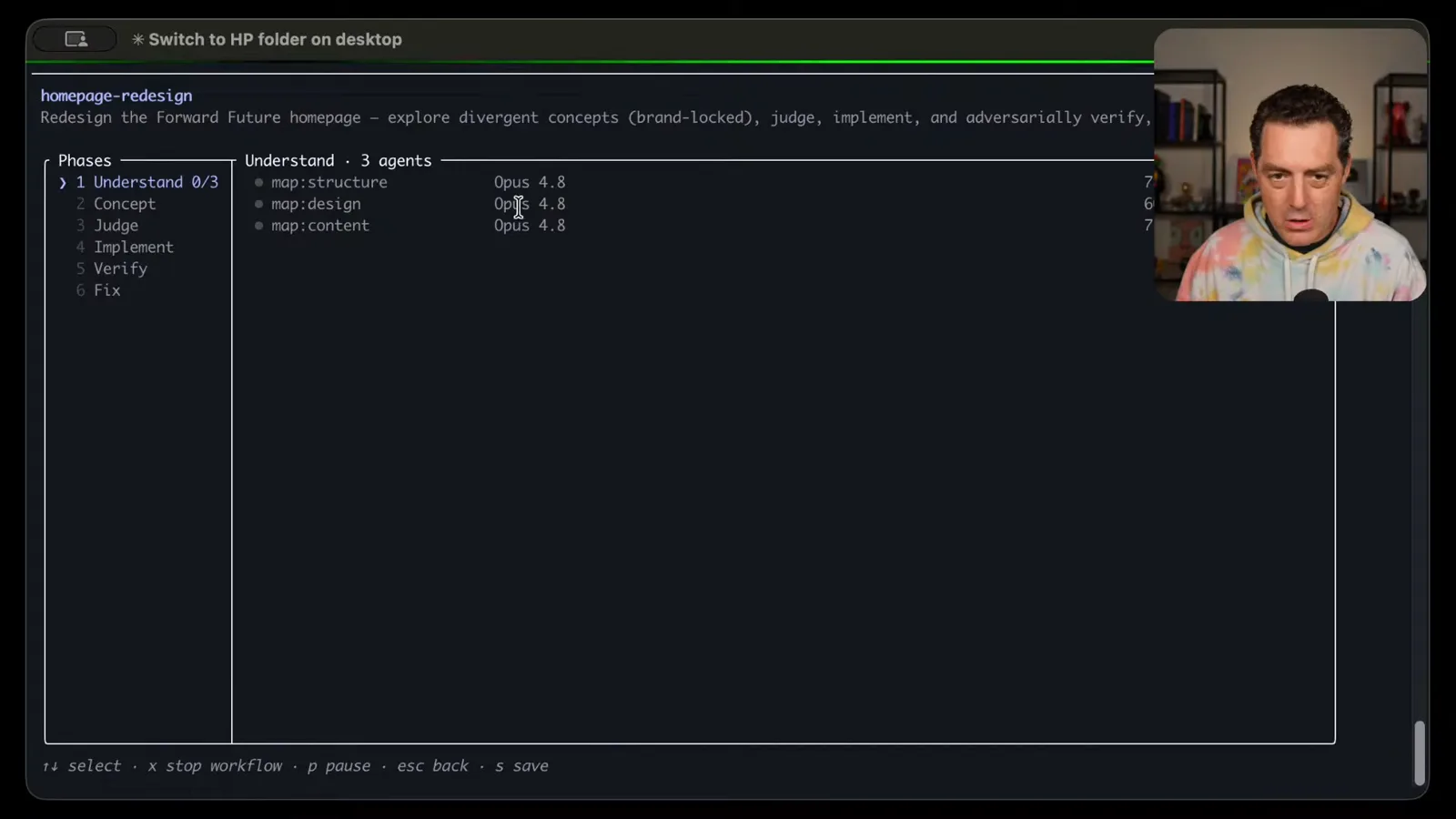
The redesign workflow begins by mapping the existing site with multiple agents. It then explores design concepts and evaluates them before implementation, which is the kind of delegation described in the announcement.
I watch the coordination unfold and wonder whether splitting the work will justify the additional time and usage. Parallel agents can produce more perspectives, but this stream does not include a controlled single-agent comparison.
The workflow moves from concepts toward choosing and implementing a direction. While it runs I answer viewers’ questions and discuss other tools; the visible process is an example of the system’s orchestration, not a benchmark of its reliability.
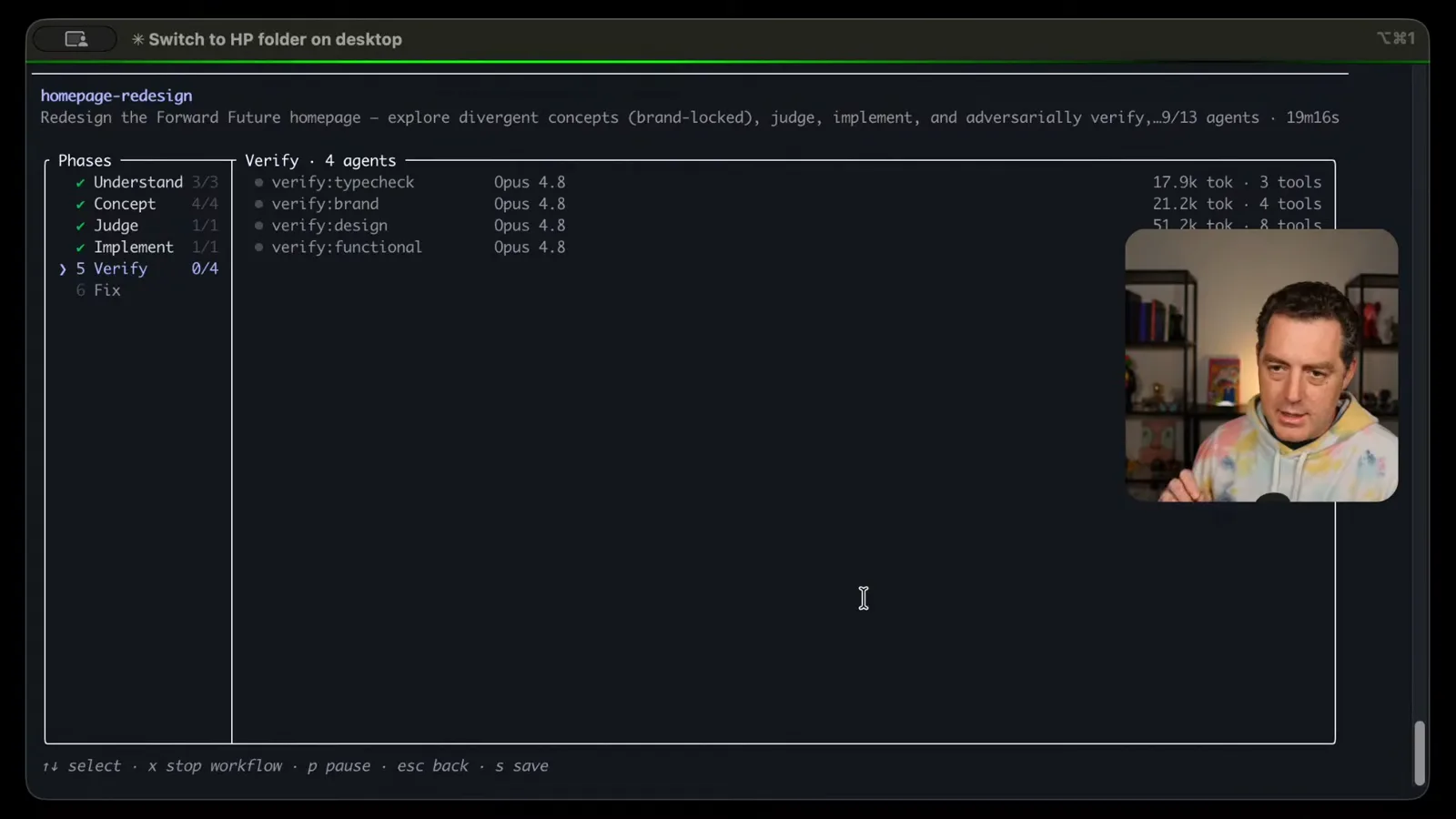
A verification phase uses four agents to examine the work. The workflow finds issues and returns to fixing them, illustrating the advertised loop between implementation and checking rather than a single uninterrupted generation.
After making fixes, the workflow returns to verification with eight agents. I find the iteration interesting, while acknowledging that the extra review also takes time and consumes usage.
Comparing the designs
Berman evaluates the finished preview and asks viewers to choose between old and new.
The run finishes after roughly 29 minutes and reports 18 agents. My account’s displayed usage rose by about 15% of its five-hour allowance and 3% of its weekly allowance; those figures are specific to my account and this run.
I open the resulting local site and compare it with the original. The process produced a working preview, but it also changed some copy and branding, so I inspect the actual page instead of treating a successful run as a successful redesign.
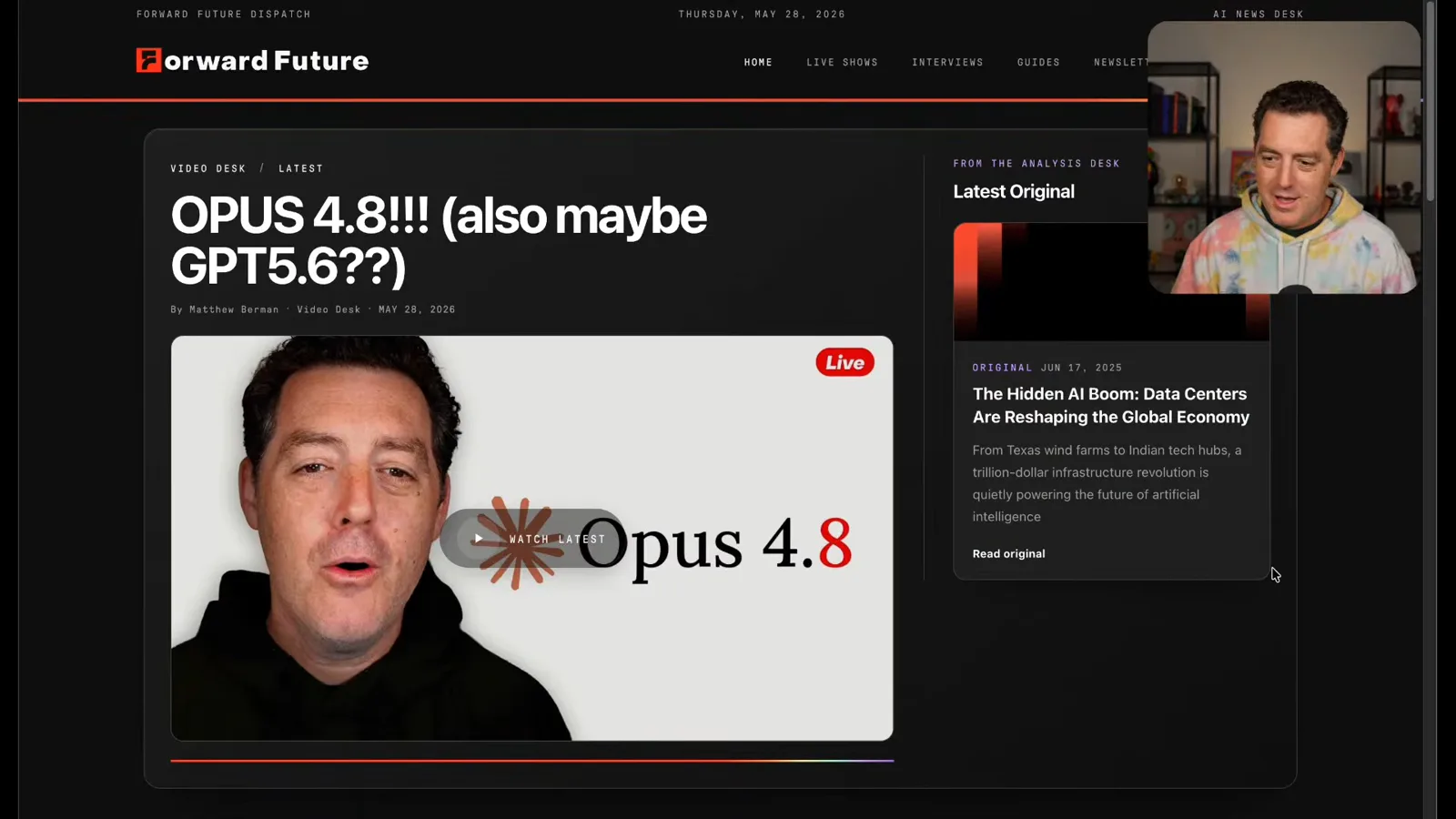
My reaction is that the redesign uses too many rounded corners and leaves too much empty space. I prefer the original’s above-the-fold layout, although some viewers like parts of the new version; this is a subjective design judgment.
After about half an hour of work, I am disappointed that the visible changes seem modest and that some areas were left untouched. A viewer poll ends with 196 votes, 52% for the original and 48% for the redesign; it measures this audience’s preferences, not general design quality.
I close by thanking viewers for contributing prompts and questions. The stream offers a useful first look at both Opus 4.8 and dynamic workflows, but its small, uncontrolled tests leave open how well either will perform on other tasks.
Sur la même chaîne
 25:50EN
 32:20EN
 0:22EN
 45:08EN
 0:32EN
 1:02EN