En 30 secondes
Matthew Berman and Daniel Miessler discuss AI news and audience questions in an August 2024 livestream, assisted by Melissa and Alex. They weigh the benefits and risks of personal AI memory, debate open model releases, and imagine changes to software and creative work. Their forecasts and product descriptions are historical and speculative.
- 1Recall and privacyA searchable screen history could help users recover information, while creating a sensitive record requiring consent and protection.
- 2Open and closed modelsBerman and Miessler debate openness, security and the possibility of delaying a powerful release.
- 3GameNGen’s Doom simulationThe research generated interactive frames from a model trained on recorded gameplay; its specific demonstration is not a general software engine.
- 4The cost of inferenceA $1.44-per-hour token calculation relies on a fixed rate and usage assumption and excludes other costs.
- 5Testing AI outputMiessler proposes multiple checks, while the conversation recognizes the need to assess what those checks actually cover.
À retenir
- Personal memory tools can be useful but create sensitive records that require clear consent and layered protections.
- The speakers favor openness in different degrees; open weights and open-source code are not identical, and openness alone does not ensure security.
- AI-assisted coding and GameNGen demos suggest possibilities but do not prove reliable automation of arbitrary software.
- A token-cost calculation is not the full cost of replacing a worker, and employment outcomes remain uncertain.
- Generated code and media need independent checking, provenance and safeguards appropriate to their use.
Lire le texte remanié, chapitre par chapitre
Fabric and the live discussion
Berman introduces Miessler and his open-source prompt framework. They describe patterns used in daily work.
Matthew Berman hosts an August 2024 live discussion with Daniel Miessler of Unsupervised Learning, with Melissa and Alex helping the stream. They cover privacy, AI coding, generated games, costs and audience questions. Predictions and product details reflect the date of the conversation.
Berman introduces Miessler’s open-source Fabric project, which collects reusable prompts or patterns for augmenting human work. Miessler previously worked in information security and moved into independent AI work.
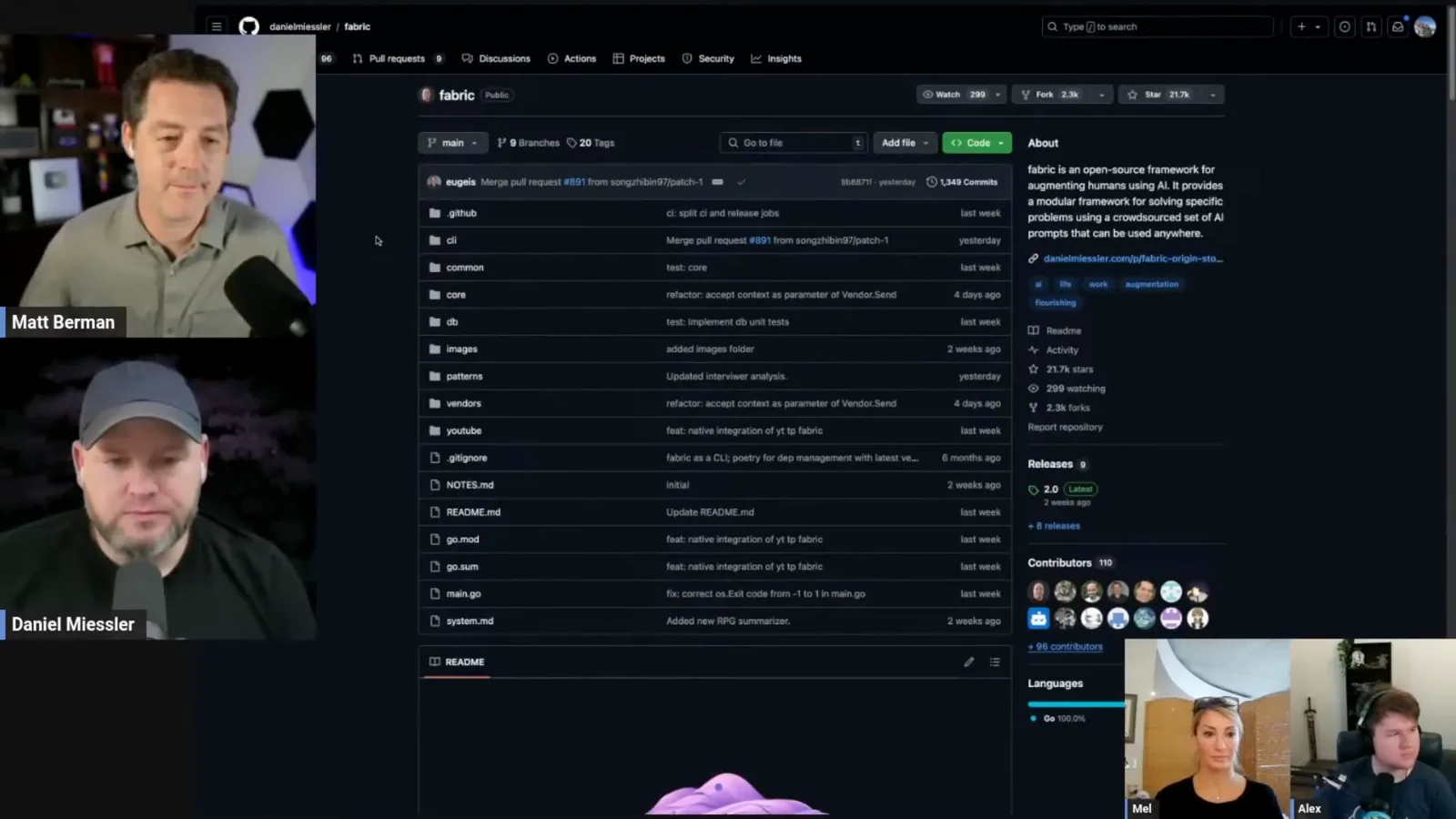
Miessler says he uses an extract-wisdom pattern repeatedly and created another to explain difficult material as a story. Fabric was primarily command-line based, with a GUI and community integrations such as Raycast.
Recall, privacy and personal memory
The speakers weigh searchable activity records against security and consent. They compare screen capture with wearable recording.
The first news topic is Microsoft Recall, which was intended to capture screen activity so users could search for information they had previously seen. In 2024 Microsoft delayed its rollout after security and privacy concerns; the speakers discuss a planned tester release.
Berman likes the idea of finding an email or other item from a vague recollection, without knowing which application contained it. He favors local processing and believes users should choose whether to enable a feature that records screen activity.
Miessler wants the capability but understands the concerns from security researchers. Both discuss the tradeoff between a useful memory and the risks of collecting a detailed record of sensitive activity.
Berman says local storage sounds appealing, while recognizing that screenshots could capture passwords. Local processing is not a complete security solution: access controls, encryption, retention and what gets captured also matter.
Miessler says large platform companies may have more security resources than small startups, though he criticizes Microsoft’s initial communication. Neither the size of a company nor encryption alone guarantees protection.
They discuss confusion over opt-in and opt-out behavior and the importance of a clear choice. Berman says he wants to test the feature; their description reflects the proposed 2024 rollout, not current settings.
The speakers compare Recall with Rewind and the planned Limitless pendant. A device that records real-world interactions raises related questions about storage, consent and the sensitivity of collected data.
Miessler says he avoided recording all of his desktop activity with a startup product because screen captures might contain API keys. He nonetheless likes the potential of personal memory tools and expects people to weigh capability against privacy differently.
Frontier models and openness
They discuss 2024 reports, government testing and the competing arguments for releasing or restricting model weights.
They move to reports about OpenAI’s “Strawberry” and “Orion.” Berman describes claims about improved reasoning and synthetic data, explicitly recognizing that much of the information was rumor at the time.
Berman asks about reported access for government safety testing. Miessler sees strategic reasons for cooperation, drawing on his military background and a view of international competition; Berman is more concerned about concentrating access.
Berman favors widely available model weights and describes Meta’s argument that keeping advanced weights secret is difficult. Miessler agrees security is hard but prefers some caution before releasing a potentially powerful system. These are competing policy judgments.
The speakers argue that open development can enable inspection and experimentation. More eyes do not automatically guarantee security, and open weights alone do not necessarily include training data, code or unrestricted licensing.
Miessler describes a possible pause if a new model represented a large capability advance. Berman doubts any one actor will achieve a sudden overwhelming lead, a forecast he offers as opinion rather than established fact.
They mention an agreement for pre-release testing with the US AI Safety Institute and debate government involvement. Berman raises the possibility of regulatory capture; neither the effect of oversight nor future capabilities is settled by the announcement.
AI-assisted coding and future applications
Cursor demonstrations lead to different visions of personalized software, shared APIs and machine-generated code.
The discussion turns to Cursor, an AI-oriented editor based on VS Code. Berman describes natural-language coding demonstrations, and Miessler says the familiar interface and closer integration with a codebase make the product appealing.
They discuss developer enthusiasm and examples of people building applications with assistance. Berman notes that similar pieces can be assembled in other editors, while integration and user experience can make a meaningful difference.
Berman shows examples, including a child’s chatbot and an AI-assisted video editor. These demonstrations show what particular builders reported making; they do not establish that complex software can always be produced safely without programming knowledge.
Both expect AI tools to lower the barrier to creation. Berman speculates that in the longer term the traditional application layer might fade, while Miessler expects more people to be able to express ideas through software.
They describe a voice-controlled prototype in which requests change an interface. Miessler imagines an iterative conversation in which users direct the system without writing each line of code; this is a forecast of a possible interface.
Berman imagines applications generated just in time, tailored to an individual rather than installed from a store. Miessler counters that useful capabilities might still be hosted and shared as services or APIs.
Miessler pictures many creators publishing capabilities and personal assistants choosing among them. Berman instead emphasizes highly customized interfaces. Both are exploring possible architectures rather than announcing products.
Berman wonders whether AI-written code could eventually become difficult for humans to read. Miessler connects the idea to Andrej Karpathy’s “Software 2.0,” where learned model weights encode behavior instead of all behavior being hand-written.
GameNGen and generated worlds
The speakers discuss an interactive Doom simulation and speculate about creative tools and shared experiences.
They introduce GameNGen, research that used a neural model to simulate Doom interactively. The displayed paper describes a diffusion model trained on recorded gameplay and actions, not a general-purpose language model independently inventing the entire game.
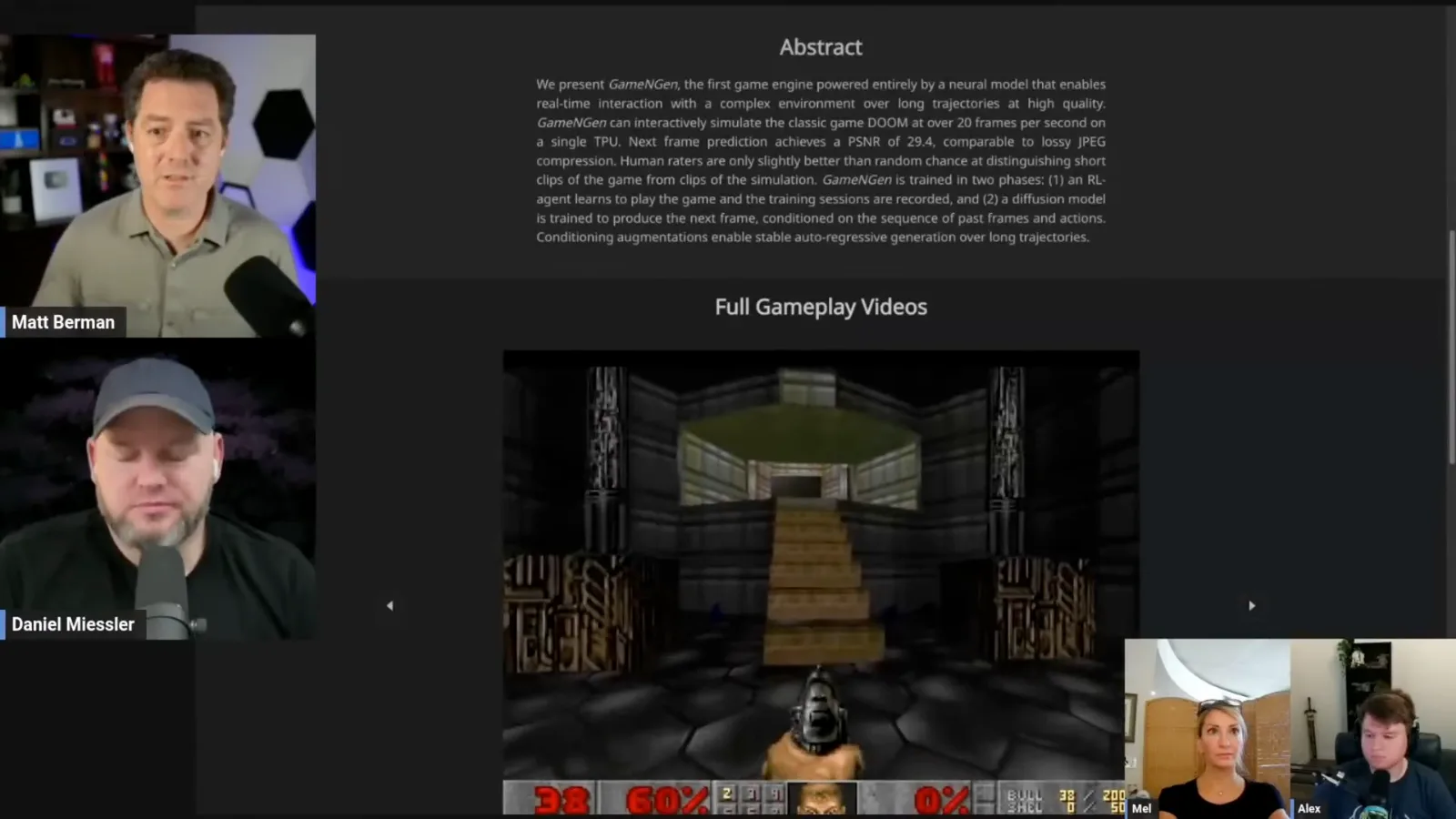
Berman cites the paper’s reported rate of over 20 frames per second on one TPU and its short-clip human comparison. Those results concern this specific research setup and do not prove that arbitrary games or complete software systems can be generated reliably.
They briefly discuss the tradition of running Doom on unusual devices, including a laptop touch bar. The comparison is a cultural aside; the research example instead generates frames conditioned on prior frames and actions.
Miessler is struck by real-time generation and imagines more people creating films, stories or interactive worlds without the resources traditionally needed for production. This is a possibility suggested by the demo, not a demonstrated end-to-end filmmaking system.
Berman asks what happens to shared culture if every person receives unique content. Miessler imagines persistent shared worlds in which many people participate in the same evolving story, combining personalization with a common experience.
They return to the role of developers. Miessler imagines creative direction becoming central as implementation grows easier. Berman says he values novel ideas and has not seen models match the creative experiences he most admires.
Miessler worries that even creative work could change and speculates about human involvement in future rules. Both acknowledge uncertainty about how quickly these capabilities or protections might develop.
Inference costs and work
A token-cost calculation prompts a debate about productivity, displacement and new roles.
Berman introduces an Andrew Ng calculation about falling inference prices. At a hypothetical blended rate of $4 per million tokens and 100 tokens per second, the arithmetic gives $1.44 per hour. This is token expenditure under stated assumptions, not the full cost or productivity of a worker.
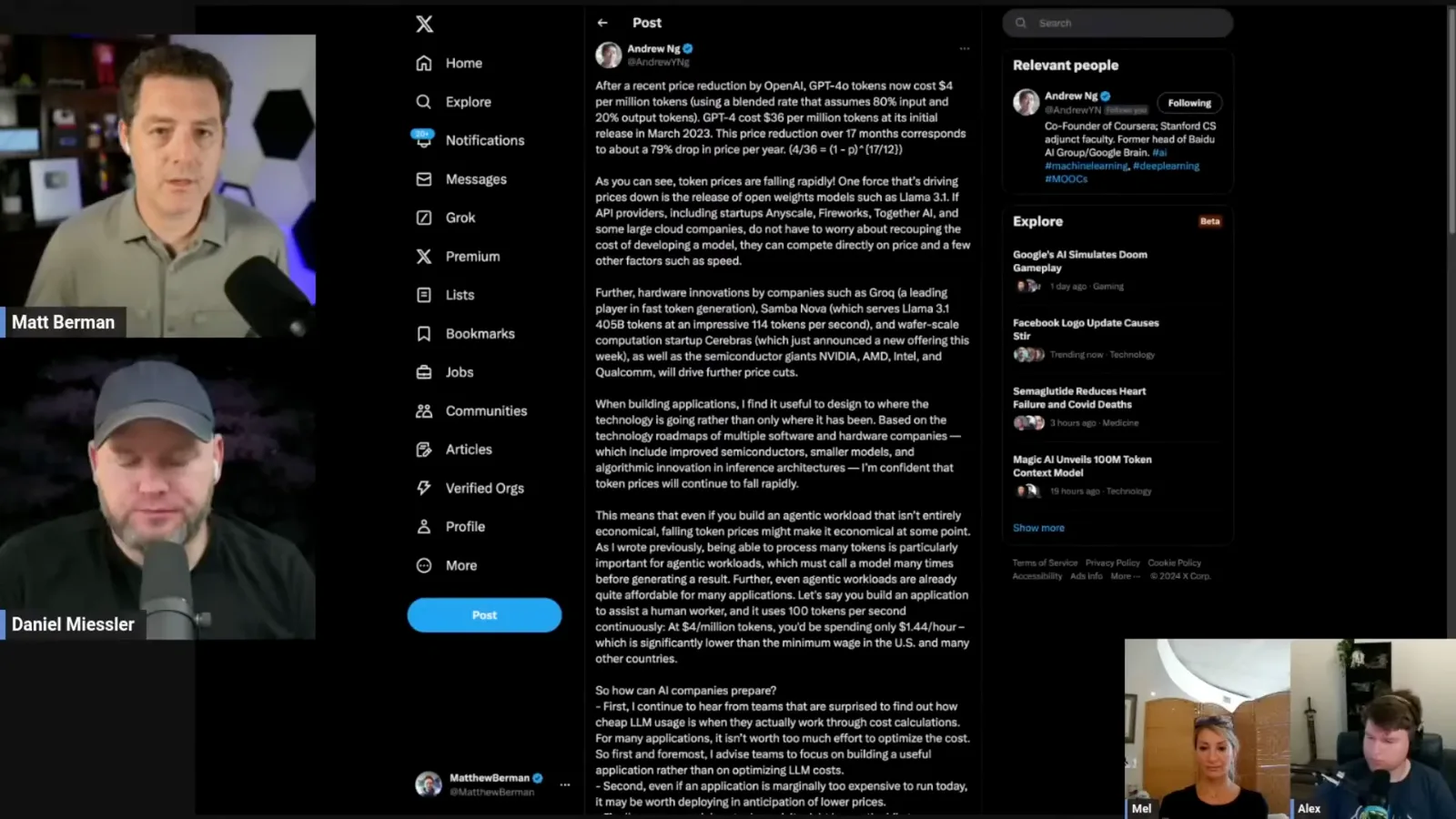
Miessler thinks cheaper inference could have major implications for knowledge work and worries about employment. Lower token prices alone do not establish that complete jobs can be automated: reliability, integration, oversight and other costs matter.
Berman is more optimistic that people will use greater productivity to create new work, pointing to earlier technological transitions. Miessler argues the comparison may be incomplete if AI increasingly performs cognitive tasks themselves.
They agree the question deserves more discussion, including possible basic-income policies. Neither speaker has a settled answer about the scale or timing of displacement.
Audience questions
Questions cover coding workflows, security, generated instruction, energy, testing, driving and content provenance.
In audience questions, Miessler describes using Neovim with Copilot and his own Fabric integrations. He uses explanation patterns to compare unfamiliar Go code with Python.
He says Fabric moved to Go partly to simplify installation and upgrades compared with managing Python dependencies. Berman says he had not used Zed enough to compare it with Cursor.
Asked about the security of AI-generated applications, Miessler observes that human-written code also has vulnerabilities. His concern is that a larger volume of generated code and APIs can multiply the consequences of mistakes.
He hopes AI can help with guardrails and review, and Berman emphasizes testing. Automated review and open-source inspection are useful layers, but neither guarantees secure software; independent verification and appropriate permissions remain important.
A viewer asks whether movies or instructional content might be generated for each person. Berman imagines a video tailored to a specific question; Miessler imagines an explanation delivered in the style of a favored teacher.
They note the identity and consent questions raised by synthetic portrayals. A generated tutorial can also be wrong, so its appearance or familiar voice should not be treated as evidence of accuracy.
Asked about energy for AI, the speakers discuss data-center power, distributed training and possible energy sources. Miessler favors solar; the actual feasibility of energy systems depends on storage, transmission, land and local conditions.
Berman describes a solar thermal installation near Las Vegas and a proposed orbital reflector. Miessler questions a promotional demonstration and both recognize the proposal was an idea with substantial hurdles, not an established capability.
A viewer asks how the Doom simulator was trained. Berman explains that agents played the original game to produce recorded training data, which was then used to train the model.
On quality assurance for AI-written code, Miessler describes a proposed pipeline of multiple checks, including independent sources and security and quality reviews. More checks can help, but their coverage and correlated failures must be evaluated.
Berman wonders whether smaller models could help verify larger ones. Both discuss layered checks and the fact that human experts also disagree; neither suggests a concrete guarantee that AI can fully verify every output.
They compare AI systems with human performance rather than requiring perfection, using autonomous driving as an example. Their numerical illustration and anecdotes are not a controlled safety comparison; meaningful comparisons require matched conditions and independent data.
Miessler describes a positive Waymo ride, while Berman recalls needing close attention when using Tesla’s driver-assistance system. A personal experience cannot establish fleet-wide safety, and driver-assistance features require the supervision specified by their operator.
Asked whether AI-generated content should carry a watermark, Berman favors disclosure but recognizes that malicious actors may omit it. Miessler imagines signed media provenance, where platforms verify a chain from camera to viewer.
They briefly discuss Worldcoin as an example of a proposed human-verification system and speculate about its possible future uses. Verification, privacy and governance tradeoffs remain separate questions; their description is not an endorsement or proof of future outcomes.
Berman thanks Miessler, Melissa, Alex and the audience. The discussion closes with a reminder that many of the visions explored in this 2024 conversation remain hypotheses rather than established outcomes.
Sur la même chaîne
 25:50EN
 32:20EN
 45:08EN
 0:32EN
 12:14EN
 10:36EN