En 30 secondes
Matthew Berman discusses Safe Superintelligence Inc., founded by Ilya Sutskever, Daniel Gross, and Daniel Levy, following its 2024 funding announcement. He connects the startup to OpenAI's 2023 leadership crisis and questions how a safety-first mission fits venture investment. His claims about the founders' private motives and unreleased OpenAI technology are speculation; OpenAI's independent review reported a breakdown of trust rather than a product-safety cause for the board's decision.
- 1The OpenAI board crisisBerman recalls Altman's 2023 removal and return. OpenAI's later review attributed the decision to a breakdown in trust, not product-safety concerns.
- 2SSI's stated missionThe company said it would pursue safety and capability together while seeking insulation from short-term product pressure.
- 3Funding and incentivesSSI announced $1 billion from investors including a16z and Sequoia. Berman questions how venture returns align with its mission.
À retenir
- SSI announced a $1 billion funding round in September 2024 and said it would focus on building safe superintelligence.
- Berman questions how the company's stated insulation from short-term commercial pressure fits venture capital expectations.
- The causes of Sutskever's departure and alleged hidden technical breakthroughs should not be inferred from the funding announcement.
- The startup's leadership later changed: SSI said Gross left in 2025, Sutskever became CEO, and Levy became president.
Lire le texte remanié, chapitre par chapitre
OpenAI's leadership crisis
Berman recounts Sam Altman's removal and return and Sutskever's subsequent departure. He also speculates about motives and unreleased research.
In September 2024, Matthew Berman discusses Safe Superintelligence Inc. (SSI), the AI company founded by Ilya Sutskever, Daniel Gross, and Daniel Levy. He frames the startup as a potential competitor to OpenAI and asks what its new funding reveals about the market for frontier AI research.
Berman recounts the November 2023 OpenAI board crisis, when Sam Altman was removed as CEO and soon returned. The original board statement said Altman had not been consistently candid in communications. Berman interprets that as lying, but the public statement does not establish the specific conduct behind that characterization.
Berman repeats speculation that Sutskever saw a frightening new technology or acted because of safety concerns. Those claims are not established by the evidence he presents. OpenAI's March 2024 account of an independent review said the decision followed a breakdown in trust and did not arise from concerns about product safety, security, or development pace.
Sutskever announced his departure from OpenAI in May 2024 and publicly expressed confidence in its leadership. Berman doubts the sincerity of that statement and suggests a safety disagreement motivated the move. Those are Berman's interpretations of another person's motives, not verified facts.
The video also discusses contemporary rumors about projects called Strawberry and Q* and possible uses of synthetic data for future models. Berman presents potential research directions, but the specific internal projects and their connection to the leadership crisis were not established by the material in the video.
SSI's mission and founders
The company describes a singular focus on safe superintelligence. Berman questions how it will balance safety and commercial incentives.
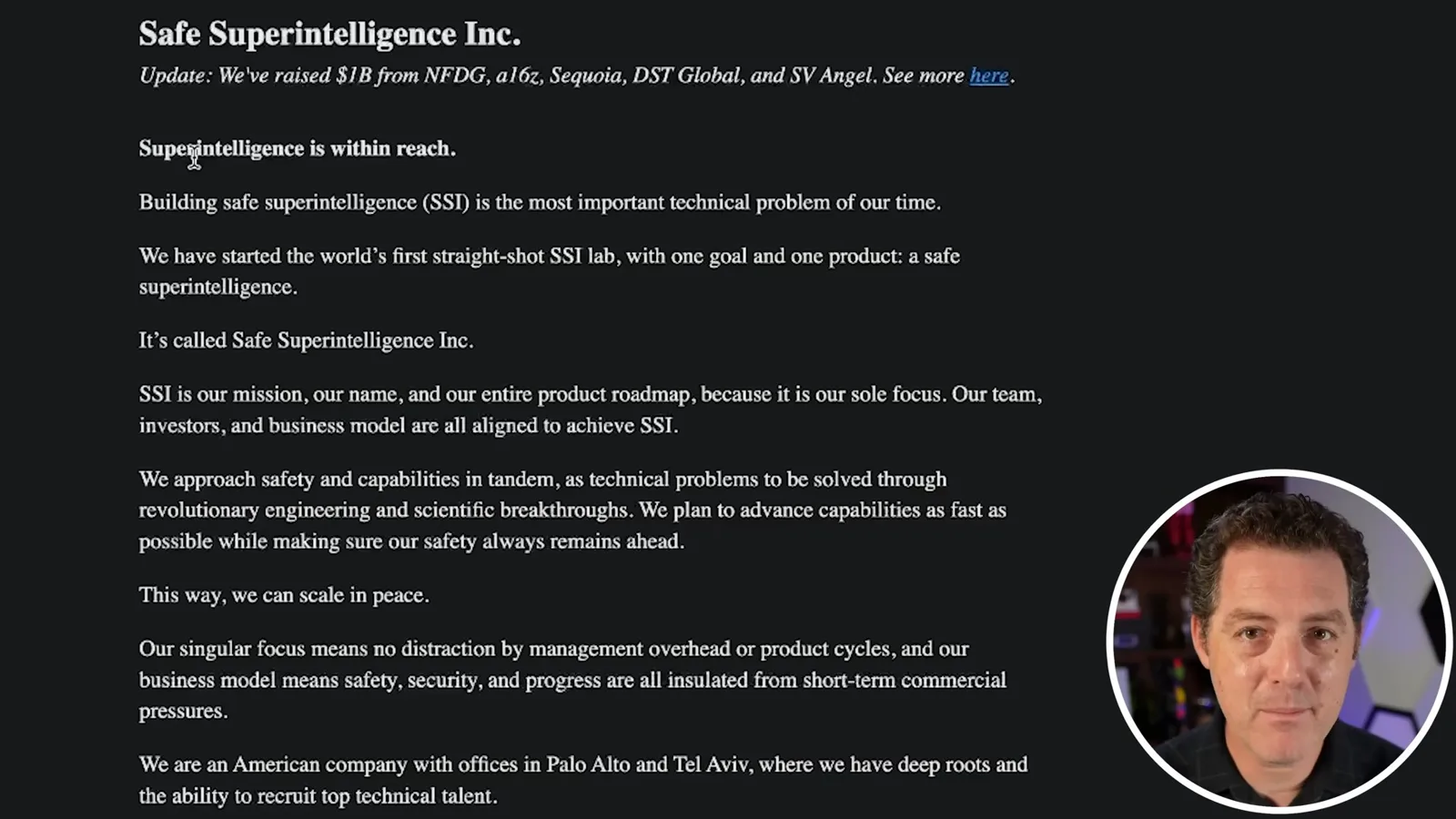
SSI's founding statement says its single mission is to build safe superintelligence, treating safety and capability as linked technical challenges while attempting to avoid short-term product pressure. Berman questions how that focus will coexist with investors' expectations of a financial return. The company statement describes an aim; it does not prove the safety of any future system.
The founding team includes Sutskever, Gross, and Levy. Berman mistakenly calls Gross a former OpenAI chief scientist; that role was held by Sutskever. Gross was an entrepreneur and investor, while Levy was a researcher who had worked at OpenAI.
Funding and future plans
SSI announced a $1 billion round in 2024. Berman discusses investors, hiring, and compute plans.
SSI announced that it had raised $1 billion from investors including NFDG, a16z, Sequoia, DST Global, and SV Angel. Berman cites reporting of a $5 billion valuation and plans to use funds for computing and talent. He questions how a safety-first mission will work alongside venture capital's return expectations.
Berman notes that some investors also backed OpenAI and asks whether investing in both companies presents conflicts. Shared investors can create commercial and information-management questions, but an investment in two companies does not by itself establish improper conduct. He also distinguishes SSI's for-profit structure from OpenAI's governance arrangement at the time.
The video closes with SSI's hiring and compute plans as reported in 2024. Subsequent context: SSI announced that Gross left in June 2025, Sutskever became CEO, and Levy became president. The company later announced a strategic compute partnership with NVIDIA in July 2026.
Sur la même chaîne
 25:50EN
 32:20EN
 45:08EN
 0:32EN
 12:14EN
 10:36EN