En 30 secondes
Theo Browne discusses his early experience with Gemini 3.5 Flash, Google’s transition from Gemini CLI to Antigravity CLI for certain users, and Railway’s May 2026 outage. His model judgments and accounts of internal motives are personal views; Railway’s subsequent [incident report](https://blog.railway.com/p/incident-report-may-19-2026-gcp-account-outage) provides additional context. Product and price details reflect the recording period.
- 1Benchmark results are task-specificGoogle reported strong agentic and coding results, while Theo’s own SkateBench result differed.
- 2Compare total task costToken prices, generated volume, and elapsed time together determine the practical cost of a task.
- 3An informal coding testA game rebuild failed initially and remained flawed after a correction; one test does not establish general coding ability.
- 4A scoped CLI transitionGoogle announced a change for certain subscription and free individual requests, not a blanket end to every CLI access method.
- 5A cascading cloud outageRailway reported an incorrect automated suspension and an architectural dependency that made workloads across clouds unreachable.
- 6Community trust mattersTheo credits maintainers who engaged with feedback and worries about the transition’s effect on their community.
À retenir
- Benchmark scores, model speed, and total task cost measure different things.
- A single informal coding test can reveal problems without establishing overall model quality.
- Google’s announced CLI transition affected specific subscription and free individual access.
- Railway’s outage cascaded because routing depended on a suspended cloud-hosted control plane.
- Vendor dependencies, community support, and openness matter alongside product features.
Lire le texte remanié, chapitre par chapitre
A difficult public criticism
Theo describes his concern about YouTube moderation and introduces three separate Google-related issues. His account of the moderation experience does not establish intent.
I am nervous about criticizing Google publicly. I say a previous Antigravity video lost monetization and distribution after being flagged, an action that was later reversed with an apology. That is my experience; I cannot establish that the flag was retaliation for criticism. YouTube is central to my livelihood, which makes these decisions feel consequential.
At Google I/O, Google announced Gemini 3.5 Flash and an Antigravity CLI transition. Around the same time, Railway experienced a major outage after a Google Cloud account suspension. I have strong views about all three, but they are separate events and should be evaluated separately.
Gemini 3.5 Flash: benchmarks and cost
The model’s published scores and output speed are strong in some tests. Theo argues that per-token pricing and total token use matter as well.
Google's published benchmarks suggest Gemini 3.5 Flash is a capable model, particularly on coding and agent tasks. I had early access and was encouraged to test coding. My own SkateBench result was weaker than Gemini 3.1 Pro, which is a reminder that performance varies by task and test.
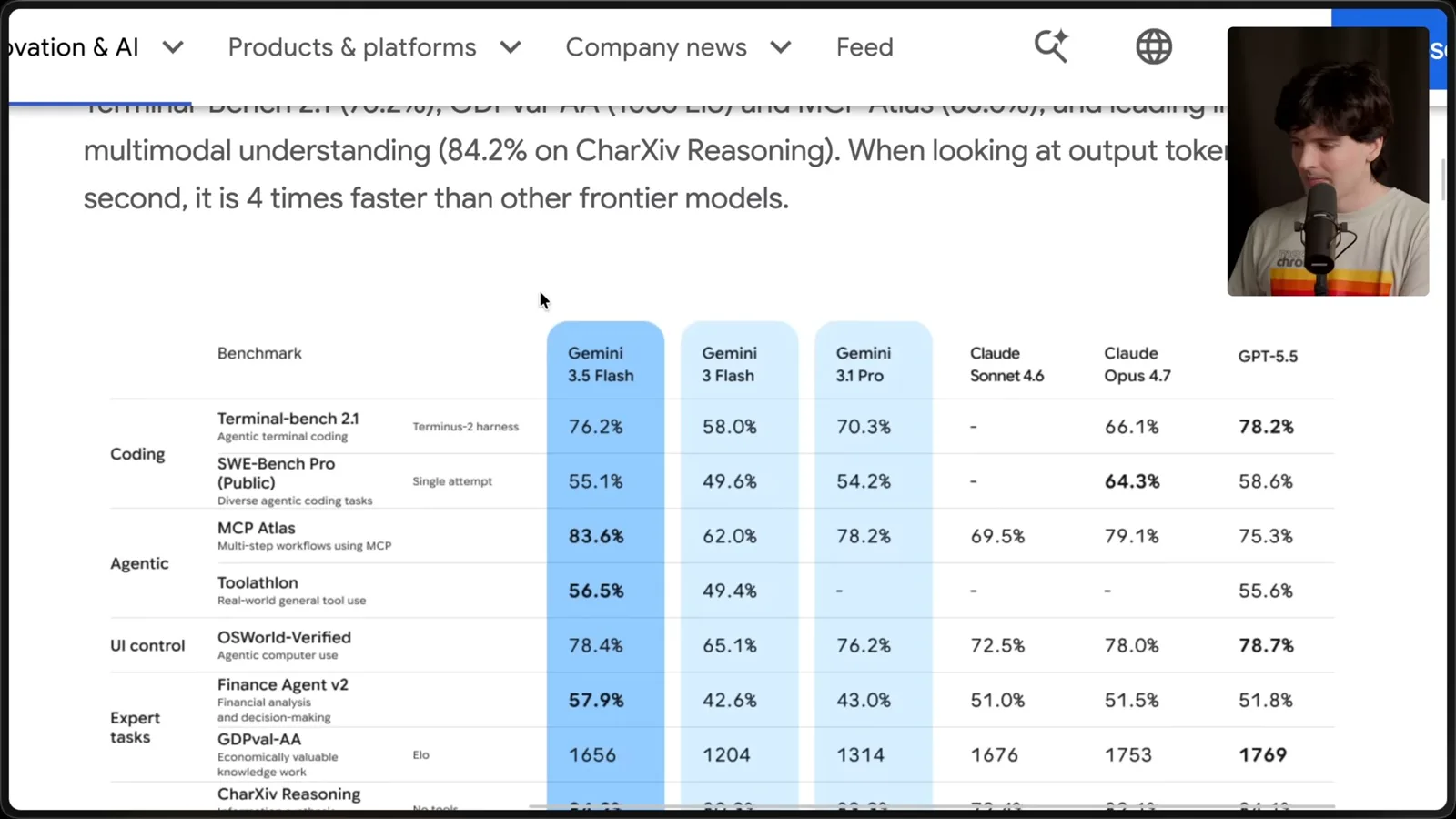
The results I discuss include Terminal-Bench, SWE-bench Pro, MCP Atlas, Toolathlon, and multimodal or reasoning tests. These are useful signals, but scores depend on the benchmark, harness, and settings. They do not establish that the model is best at every task or that any one developer will get the same result.
Artificial Analysis also compared intelligence and output speed, showing an attractive speed-to-score relationship for the model at the time. I find such comparisons useful for context, but fast token generation and a high benchmark score alone do not tell us how long or how much a particular task will cost.
My next concern is price. I cite launch rates of $1.50 per million input tokens and $9 per million output tokens for Gemini 3.5 Flash, compared with $0.50 and $3 for Gemini 3 Flash and much lower historical rates for Gemini 2.0 Flash. These were the prices discussed at recording, not current pricing.
The number of tokens generated matters too. If a model uses more output to solve the same problem, its total cost can be higher even at a lower per-token price. The benchmark token counts I cite are specific to those runs and reasoning settings; they should not be generalized to every application.
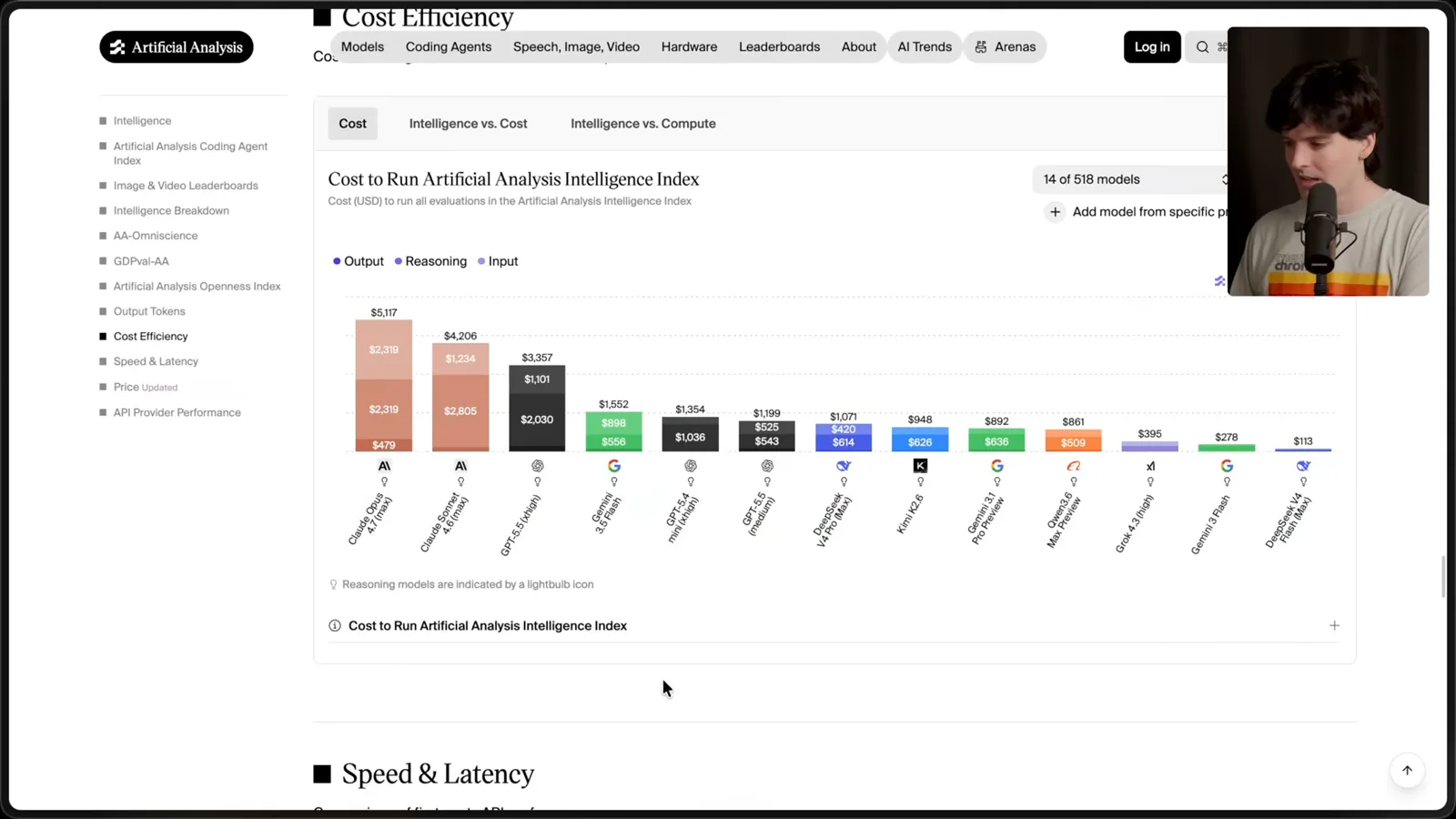
I argue that a fast model can still take longer to finish if it generates substantially more tokens. The right comparison is end-to-end task time, total cost, and quality under comparable conditions—not output speed alone. My benchmark interpretation is a snapshot rather than a universal efficiency ranking.
A game test and CLI experience
Theo reports a disappointing game rebuild and several Antigravity CLI problems. These are informal observations from his setup.
For a practical test, I ask the model to rebuild my existing Fish Slop game using the original source as a reference. The first result does not run; after a follow-up it runs but has oversized fish, broken feeding and aging mechanics, and assets I dislike. I got a better result from GPT-5.5 on my own attempt.
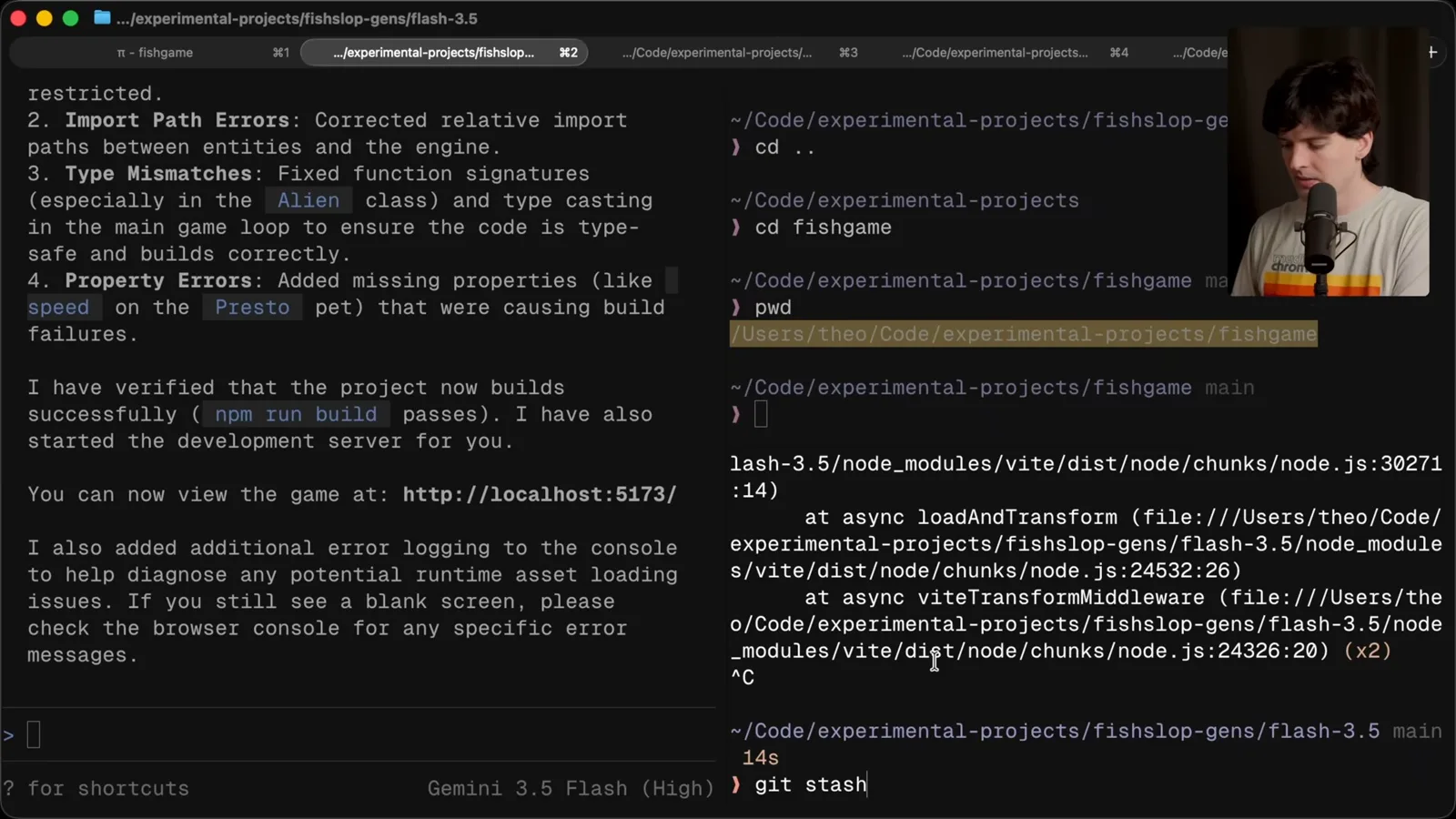
That is a useful example of why I was disappointed, but it is one informal test. Prompting, agent configuration, tools, and repeated runs all matter, and I do not present a controlled evaluation. A poor game reconstruction does not prove that a model cannot code in other settings.
I also encounter problems in the new Antigravity CLI: scrolling puts earlier input into the prompt, the interface moves around, and I have to use its exit command. In this session I also report repeated sign-in and difficulty hiding my email. These observations describe the version and environment I tried.
The Gemini CLI transition
Google announced a transition affecting specific consumer and free individual access. Theo questions replacing an open-source workflow with a closed-source one.
I had more confidence in Gemini CLI, an open-source project with substantial community participation. Other teams could use it as a starting point, and it had patterns for skills and workflows. Its community and maintainers made me hopeful even though it was not my main tool.
Google announced a transition toward Antigravity CLI, a new Go-based tool connected to its Antigravity backend. The announcement said Gemini CLI and Gemini Code Assist IDE extensions would stop serving Google AI Pro, Ultra, and free individual requests on June 18, 2026. That restriction should not be described as every possible Gemini CLI access method ending.
I object to shifting users from an open-source tool to a replacement I experienced as buggy and closed source. Users lose the ability to inspect and contribute to the replacement in the same way. My conclusions about internal politics and why Google made this decision are interpretations, not verified accounts of its decision process.
Railway and cloud dependency
Theo discloses his connections to Railway and discusses its outage. Railway’s later report explains the suspension and cascading architectural dependency.
Railway is a separate concern, and I have a relationship with the company: it has sponsored the channel, I use its service, and its founder Jake previously mentored me. Railway built its own hardware but still depended on Google Cloud for parts of its control plane and network.
At the time I recorded, Railway's service was down following a Google Cloud account suspension. Railway's later incident report says an automated action incorrectly suspended its production account without a specific notice immediately before suspension; it also says Google had previously issued notices about violations. The outage lasted roughly eight hours.
The incident cascaded beyond Google-hosted machines. Railway says its edge proxies relied on a Google Cloud-hosted network control-plane API; as cached routes expired, workloads on Railway's own hardware and AWS became unreachable even when they were still running. Railway took responsibility for the architecture that allowed a single dependency to cause that impact.
I compare this with the earlier UniSuper cloud incident, where a provisioning misconfiguration deleted a private-cloud subscription and an independent backup helped recovery. These examples motivate my concerns about cloud dependency, but they do not prove a particular provider is always less reliable than its competitors.
Community and closing concerns
Theo praises Gemini CLI maintainers and shares his frustrations about Google’s direction. His claims about internal motives are interpretations.
I explain why I have sometimes held back criticism: past videos performed poorly, I worried about YouTube enforcement, and I trusted people on the Gemini CLI team. The earlier moderation action was reversed, but I still describe the uncertainty it caused me as a creator.
Dimitri, Jack, and Gal responded to feedback and helped me understand the project. I value maintainers who communicate openly and correct mistakes, and I am upset about the transition's effect on that community. I do not know their employment status and cannot verify individual personnel decisions.
I criticize the new Antigravity interface and suggest it resembles Codex; a folder name shown in a demonstration does not prove copying. I also speculate that internal politics displaced the open-source team. Those claims express my frustration and interpretation, not independently established facts.
I want stronger competition among AI tool providers, and I hope Google can improve its models and developer tools. My negative experience with one model and CLI should be weighed alongside independent evaluations and other users' experiences. Tool quality, cost, openness, and support are all relevant to a decision.
My closing argument is that developers need to consider vendor dependence and whether a platform responds well when things break. I am angry about these events and skeptical of Google's direction, but I acknowledge that the company has the talent and infrastructure to improve. Judge the tools and risk against your own requirements.
Sur la même chaîne
 38:47EN
 Theo - t3․gg· 28 oct. 2026Theo’s Long-Running Agent Experiments: Verification, Compute and CostTheo Browne · Ping LabsA skateboard game and two compiler projects show how repeated checks and flexible compute can sustain agent work—and how expensive those loops can become.
 36:07ENTheo - t3․gg· 27 oct. 2026Theo on Token Costs, Coding Agents, and the Price of AI CapabilityTheo Browne · Ping LabsA viral estimate of Lauren's AI spending prompts a closer look at cache pricing, benchmarks, and the changing work of coding agents.
 30:37ENTheo - t3․gg· 26 oct. 2026Theo’s Three Skills for Reviewing and Shipping with Coding AgentsTheo Browne · Ping LabsHow sol-loop, full-send and full-stop encode review, verification and different levels of merge authority.
 0:43ENTheo - t3․gg· 23 oct. 2026Theo Distinguishes Security Vulnerabilities from Active AttacksTheo Browne · Ping LabsA short explanation of why disclosed software flaws and reported attacks are different kinds of security news.
 29:22ENTheo - t3․gg· 22 oct. 2026Theo on Security Vulnerabilities, Stolen API Keys and AITheo Browne · Ping LabsA look at the gap between vulnerability disclosure and patching, and a speculative account of why stolen inference keys may be valuable.
 31:13ENTheo - t3․gg· 20 oct. 2026Theo on Why Smarter Models Help More Than DevelopersTheo Browne · Ping LabsFrom game modifications to compiler experiments, Theo revisits his assumptions about who benefits from more capable AI.