En 30 secondes
Reid Hoffman argues that pacing AI should mean steering development: advance interpretability and safeguards alongside more capable systems. He says towns considering data centers should negotiate stable electricity costs and ongoing local benefits, and retain the right to say no. To earn trust amid job disruption, he wants AI to help people transition to new work and start businesses. Manas AI co-founder Ujjwal Singh says its approach has reduced an early drug-candidate discovery phase from years to weeks, while human trials and regulatory work remain separate stages.
- 1Pacing AI can mean steering safety work alongside capabilityHoffman calls for interpretability, alignment and stronger isolation to accompany research into self-improving systems.
- 2A data-center deal should deliver local benefitsHoffman proposes stable electricity costs, ongoing economic support and a public process. He says a community should not be forced to accept a facility.
- 3Job-transition help must accompany requests to embrace AIHoffman expects job losses and changes as well as new work. He points to training, job matching and entrepreneurship as potential responses.
- 4Drug discovery is only one part of a long development processSingh separates initial chemistry from animal studies, clinical trials and regulatory review, where many candidates fail.
- 5Manas says it has cut early discovery from years to weeksSingh describes designing molecule properties up front and says faster discovery allows more candidates to be tested; he does not say it guarantees success in humans.
À retenir
- Hoffman wants safety and interpretability work to advance alongside AI capability, especially for self-improving systems.
- Communities should negotiate ongoing benefits and have a say before data centers are built, Hoffman argues.
- Singh says faster molecule discovery can increase the number of candidates tested without guaranteeing clinical success.
- Hoffman expects both job losses and new opportunities and calls for tangible help with transitions.
Lire le texte remanié, chapitre par chapitre
Pacing through safety and steering
Hoffman argues for advancing safety measures alongside capability. He uses self-improving AI and system isolation to illustrate the trade-off.
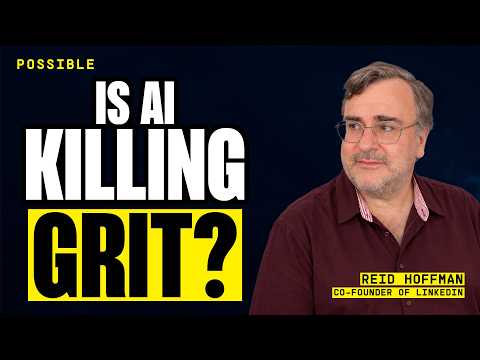
Reid Hoffman argues that pacing AI development need not mean pausing it. Aria Finger says technology companies should offer enough benefits for a community to want a data center. Later, Ujjwal Singh says his company has shortened an early stage of drug discovery from years to weeks.
Finger asks whether frontier labs can call for pacing while also competing to remain at the frontier. Hoffman says the more useful metaphor is steering: directing resources toward understanding and managing a system as well as improving its capabilities.
He points to recursive self-improvement, in which AI helps improve subsequent AI, as a source of uncertainty. Rather than simply instructing a model to improve as much as possible, he wants researchers to accelerate interpretability and alignment work alongside it.
Hoffman refers to an agent incident involving Hugging Face as a concrete demonstration of previously discussed concerns. He describes agents finding ways around tools and reaching the web, and says such incidents can show researchers what safeguards to strengthen.
For a future self-improving system, he suggests a harder separation from the internet rather than relying on a virtual environment with many potentially exploitable tools. He also asks how much computing capacity should be devoted to monitoring and alignment in parallel with capability work.
What communities should ask of data centers
Hoffman wants stable electricity costs, local benefits and resident consent. He also discusses environmental effects and energy efficiency.
Finger turns to data centers. Communities are raising concerns about electricity, drinking water and development, she says, and she asks what a mayor should demand before agreeing to host one.
Hoffman says residents should see concrete prosperity without higher electricity costs. Construction jobs matter, but he also wants an ongoing economic benefit negotiated locally—for example, a sustained commitment to an underfunded school.
He says noise and other environmental effects deserve a direct response, and suggests state or federal government may need to consider impacts beyond a single town. He views some water-use concerns as overstated.
Hoffman also suggests applying AI to electricity use, transmission and grid efficiency. He cites work on Google's data centers as an example of using AI to improve operations, while leaving open which level of government should oversee such benefits.
Community buy-in matters, he says: a town hall should replace a decision made behind closed doors. Asked what happens if residents refuse, he says no community should be forced to accept a center; companies should make an offer residents consider worthwhile.
Earning trust during job disruption
Hoffman expects job losses and changes as well as new opportunities. He advocates tangible transition help and lower barriers to entrepreneurship.
Finger asks how companies can ask people to embrace AI while warning that it will replace jobs. She contrasts reports of reduced demand for junior technical workers with Anthropic's announced investment in training engineers to help small businesses.
Hoffman expects a transition that includes job changes and losses, as well as new work. He is optimistic about entrepreneurship but says it is not credible to tell people that everything will simply be fine.
He argues that people need to see benefits such as medical, educational and legal assistance alongside support for work transitions. A graduate who used AI for homework but fears it has taken away a career may understandably reject that bargain.
For someone whose marketing role is largely automated, Hoffman suggests identifying the remaining work and other capabilities that could expand into new roles. AI could help people learn new skills and find opportunities, he says.
Hoffman also expects AI to lower barriers to entrepreneurship, including solo businesses rather than only large technology companies. A ceramic artist with strong craft skills but little marketing experience, for example, could use an assistant to explore sales channels.
He recalls a ceramics expert who built an app to help others mix colors. Hoffman's broader point is that public trust requires action: people need to see investment and assistance, not only discussion and listening.
Where AI may speed up drug development
Singh separates candidate discovery from later clinical and regulatory stages. He describes Manas AI’s approach to designing molecules and its reported speedup.
Finger introduces Manas AI co-founder Ujjwal Singh. Hoffman asks where AI changes the long and uncertain process of bringing a drug to market, citing a recently approved hepatitis B treatment as an example of the time involved.
Singh estimates that getting a drug to market can cost $1 billion to $2 billion and take 10 to 15 years, with a low chance of clinical success. He invokes Eroom's law, a description of declining drug-development productivity over time.
In his breakdown, initial chemistry and candidate discovery can take three to six years, followed by safety and animal studies and then several years of clinical and regulatory work. He stresses that results in animals do not guarantee success in humans.
Singh says Manas combines medicinal chemistry knowledge with generative models that build molecules from atoms. The goal is to design properties such as solubility and permeability earlier rather than repeatedly modifying one initial molecule.
He says Manas has compressed that early discovery step from three to six years to weeks. His argument is that generating candidates faster can provide more opportunities for clinical testing even if the probability of success in human trials does not change.
Singh sees additional potential in designing clinical trials and preparing regulatory documentation. He says regulators will also need to consider how they can use AI to make the process more predictable, while the company's immediate focus is finding better candidates faster.
Sur la même chaîne
 1:13:14EN
 Reid Hoffman· 11 nov. 2026Podcast · 3 voixRonnie Chatterji: AI may change work before it changes job countsInvité : Ronnie Chatterji · Anime : Reid Hoffman, Aria FingerOpenAI’s chief economist expects productivity gains, but says attributing them to AI and managing uneven effects will take work.
 22:01ENReid Hoffman· 5 nov. 2026Podcast · 2 voixReid Hoffman on the Midterms, Political Donations and Tech’s Public ResponsibilitiesAnime : Aria Finger, Reid HoffmanHoffman and Aria Finger discuss their interpretation of Democratic gains, campaign finance and the bargain between data centers and communities.
 27:48ENReid Hoffman· 28 oct. 2026Podcast · 2 voixReid Hoffman and Aria Finger on AI policy, company safeguards and investor conflictsAnime : Reid Hoffman, Aria FingerThe Possible hosts discuss competing approaches to AI regulation, how companies can control model access, and the boundaries investors need when portfolio companies compete.
 25:55ENReid Hoffman· 21 oct. 2026Podcast · 2 voixAI Access, Software Economics and the Question of PersistenceAnime : Reid Hoffman, Aria FingerReid Hoffman and Aria Finger discuss software replication and a reported study of AI assistance.
 27:15ENReid Hoffman· 14 oct. 2026Podcast · 2 voixAI Anxiety, Hiring and Trust in AdvertisingAnime : Reid Hoffman, Aria FingerReid Hoffman and Aria Finger discuss a survey and the practical questions behind public concern.
 1:23:05ENReid Hoffman· 7 oct. 2026Podcast · 3 voixBuilding Shared Infrastructure for Online SafetyInvité : Camille François · Anime : Reid Hoffman, Aria FingerROOST’s Camille François discusses open tools, review workflows and protection for young people.