



Résultats
80 articlesTrier
 56:01EN
 AI Engineer· 26 oct. 2026Xander Song on Evaluating Agents with Harbor and PhoenixXander Song · Arize AIArize AI engineer Xander Song explains how Harbor runs realistic agent tasks in isolated sandboxes, and how his team uses Phoenix to compare prompt changes, inspect trajectories, and test a SQL tool.
 35:19ENAI Engineer· 25 oct. 2026SallyAnn DeLucia: How to Write Your First AI EvalSallyAnn DeLucia · Arize AITurn an agent’s real traces into concrete pass/fail criteria, then build an LLM judge you can test, align with people, and run in production.
 1:50:48EN
 Y Combinator· 24 oct. 2026Why Inference Matters 12× More Than TrainingFrançois Chaubard, Dan Fu, Jeff Morgan, Joe Fioti, Liangsheng Yin · Y CombinatorYC Paper Club walks the inference stack from an API request down to GPU kernels. Four talks from Together AI, Ollama, Luminal, and SGLang argue that serving quality, not just training FLOPs, is where most of the compute and the money now sit.
 34:11EN
 GOTO Conferences· 23 oct. 2026Anatoliy Bilenko and Alberto Carretero: Making Database Protocols Reliable with Formal Methods and AIAnatoliy Bilenko, Alberto Carretero · CanonicalCanonical’s database engineers connect executable specifications, model-based tests, failure exploration, and reconstructed execution histories—and explain why none of these techniques proves a real system correct on its own.
 1:48:29EN
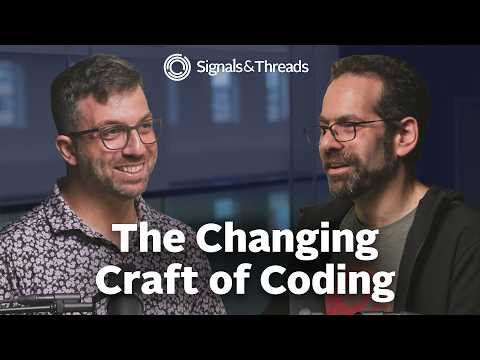
How AI Is Changing Programming: John Crepezzi and Ron MinskyYaron Minsky, John Crepezzi · Jane StreetJane Street’s AI tooling lead and the Signals and Threads host examine agent infrastructure, security, code review and the changing experience of writing software.
 56:49EN
 Stanford AI Club· 15 oct. 2026Alfred Lin on Building in the AI Era: The Diffusion Gap, Founder Conviction, and Fire and IceAlfred Lin, Jason Zhang, Tanvir Bhathal · Sequoia CapitalAt Stanford AI Club, Sequoia’s Alfred Lin explains where he sees opportunity in AI and why learning, human understanding, and operating discipline still shape enduring companies.
 38:10EN
 Google DeepMind· 1 oct. 2026From deepfakes to DNA: how SynthID watermarks AIHannah Fry, Pushmeet Kohli, Jeremy Ratcliffe · Google DeepMindHannah Fry sits down with Pushmeet Kohli and Jeremy Ratcliffe to explain SynthID: a mathematical watermark now used on text, images and video, and being extended to protein sequences so DNA synthesis companies can tell AI-designed molecules from nature.
 1:36:37EN
Aaron Bauer on Teaching Software Engineering in the Age of AIYaron Minsky, Aaron Bauer · Jane StreetHow learning goals, active practice and editor design shape engineering education when models can generate the code.
 1:05:45EN
Cyrus Omar on Live Programming and a Computational Commons for Humans and AICyrus OmarA demonstration of Hazel shows how immediate feedback, structured collaboration and carefully scoped permissions could support people and AI agents working together.
 1:25:00EN
Eric Mannes on Turning Messy External Data Into Trading ResearchRon, Eric Mannes · Jane StreetFrom commodity futures and an Excel risk system to point-in-time datasets and AI, Eric Mannes explains the domain knowledge behind data engineering at Jane Street.
 1:16:29EN
Grant Sanderson and Alok Puranik: Positional Encodings Through Group TheoryGrant Sanderson, Alok Puranik · 3Blue1BrownStarting with assumptions about attention, they derive matrix exponentials and connect rotations, decay and Jordan blocks to RoPE and ALiBi.
 1:34:29EN
Jacob Baskin on Building Superstore and Scheduling the HiveYaron Minsky, Jacob Baskin · Jane StreetThe Jane Street engineer traces the design choices behind a distributed analytical database and the challenge of allocating a growing research cluster.
 1:34:36EN
Nate Foster: Treating the Network as a ProgramYaron Minsky, Nate Foster · Jane StreetFrom programmable switches to BGP, a programming-languages researcher explains how higher-level policies and formal models can make networks easier to change.
 1:08:22EN
Mark Doss on Production Engineering for High-Stakes TradingMark Doss · Jane StreetWhy every order matters, how event-based monitoring detects unexpected failures, and what a realistic incident reveals about trading operations.
 46:35EN
Jon Gjengset on the Cost of Concurrency CoordinationJon GjengsetWhy shared cache lines can make even read-heavy locks slow, and how a different data structure trades writer work for scalable reads.
 1:48:21EN
Will Wilson on Deterministic Simulation and the Hard Problems of Software TestingYaron Minsky, Will Wilson · Jane StreetThe Antithesis co-founder explains how replayable simulations explore complex software, why properties matter and where testing meets its limits.
 1:22:49EN
Bryan Cantrill: Why Software and Hardware Must Be Designed TogetherBryan Cantrill · Oxide Computer CompanyFrom a stubborn CPU reset to disappearing drives, Oxide’s cofounder makes the case for designing and debugging computing systems across the hardware–software boundary.
 1:20:57EN
Matt Godbolt: Inside Skylake’s Out-of-Order PipelineMatt GodboltA guided tour of instruction decoding, register renaming, execution and memory ordering, grounded in reverse engineering and careful measurements.
 1:00:15EN
Arjun Guha on How Language Models Represent Code and How People Prompt ThemArjun Guha · Northeastern UniversityExperiments with activation steering and student-written prompts reveal how programming models behave—and why evaluating them requires more than a single benchmark score.
 47:43EN
Making GPU Training Faster: Pipelines, Fusion and Custom KernelsCorwin de Zahr · Jane StreetTwo Jane Street speakers explain how to diagnose idle GPUs, reduce memory traffic and build a parallel reduction kernel.
 55:03EN
Neil Mitchell: How Pyrefly Checks Python at ScaleNeil Mitchell, Roman · MetaA tour of Python's type system and the incremental architecture behind a fast, open-source checker and language server.
 52:05EN
Corwin de Zahr: Exploring OCaml Runtime Safety Through a CTF ChallengeCorwin de Zahr · Jane StreetA deliberately restricted OCaml sandbox becomes a way to examine type safety, callbacks, memory representation and binary debugging.
 1:12:58EN
Chris Lattner on Mojo and the Search for Portable GPU PerformanceYaron Minsky, Chris Lattner · Jane StreetRon Minsky and Chris Lattner discuss the language and compiler design behind Modular’s effort to make accelerator programming both portable and fast.
 1:01:23EN
Will Crichton on Making Rust More UnderstandableWill Crichton · Brown UniversityOwnership visualizations, interactive trait diagnostics and program slicing illustrate an evidence-based approach to developer tools.
Charger plus24 sur 80 affichés