En 30 segundos
Anthropic used 1,000 Claude agents to formalize an existing proof of Fermat’s Last Theorem in about 30 hours, says Lance Martin. Given Git, a database and a lead role, the agents organized their own work without a mathematics-specific coordination system or human direction of the solution. Martin also describes memory experiments: stronger models selected more useful notes, while a separate reflection process corrected a mistaken Pokémon memory and improved a company wiki.
- 1An earlier formalization used a specialized system and human supportMartin says the September effort used about a dozen agents, a mathematics-specific coordination system and substantial help from a researcher.
- 2A thousand agents received Git and a database, not a mathematical workflowOne lead and 999 helpers worked in isolated environments. Safety monitoring remained in place, but the team did not receive a domain-specific harness or human direction on the solution.
- 3The lead agent created tables to coordinate workIt made tables for announcements, assignments, notes, subtasks and landed work. The agents used them to organize and reassign pieces of the proof during the roughly 30-hour run.
- 4A memory directory helped stronger models more than Sonnet 4.6In a sequence of database questions, the models could leave notes for later sessions. Martin says Sonnet 4.6 did not reliably know when to write or read them, while stronger models made better use of memory.
- 5Reflection repaired a mistaken memory that trapped a Pokémon agentAn incorrect landmark location led the agent into a repeated setback. Processing its memories allowed it to correct the mistake and proceed.
- 6A generated wiki improved with more reflectionFor 25 questions about an anonymized company corpus, search alone scored 53%. Martin says combining a wiki with search improved results as more computation was spent building the wiki.
Conclusiones
- Give agents shared tools for coordination and let them create structures suited to the task, while retaining isolation and monitoring.
- Distinguish formalizing an existing mathematical proof from discovering the proof itself.
- Test whether agents actually read and write useful memories; simply providing storage may not help a weaker model.
- Revisit accumulated notes and transcripts to correct errors, fill gaps and build more useful representations.
- In Martin’s company-document experiment, a generated wiki and search together answered more questions than search alone.
Lee el texto editado por capítulos
Formalizing an existing proof, not finding a new one
Andrew Wiles proved Fermat’s Last Theorem in the 1990s. Martin describes the later effort to express that proof in Lean so its steps can be checked computationally.
I want to tell two stories about extending Claude’s capabilities: a team of agents working on a mathematical formalization, and memory for long-running tasks.
Fermat’s Last Theorem says that for whole-number exponents greater than two, no positive whole numbers satisfy aⁿ + bⁿ = cⁿ. It resisted proof for about 350 years until Andrew Wiles proved it in the 1990s after years of work.
Since then, mathematicians have worked to formalize that proof: expressing the logical steps in a system such as Lean, which can check them computationally. Anthropic reported a formalization in September. This is work on an existing proof, not a new proof of the theorem.
That earlier effort used roughly a dozen agents. They initially coordinated poorly, so we gave them a mathematics-specific system called Prove to Me, which helped manage the state of the project and exposed a graph of the work.
A thousand agents get a database and Git
The new experiment replaces a specialized mathematical coordination system and human guidance with a lead agent, helpers and shared tools. Isolation and safety monitoring remain.
For Fable 5.2 we tested a larger team: 1,000 agents, without that domain-specific coordination system and without a person steering the mathematical solution. The earlier report had included both the specialized system and substantial researcher support.
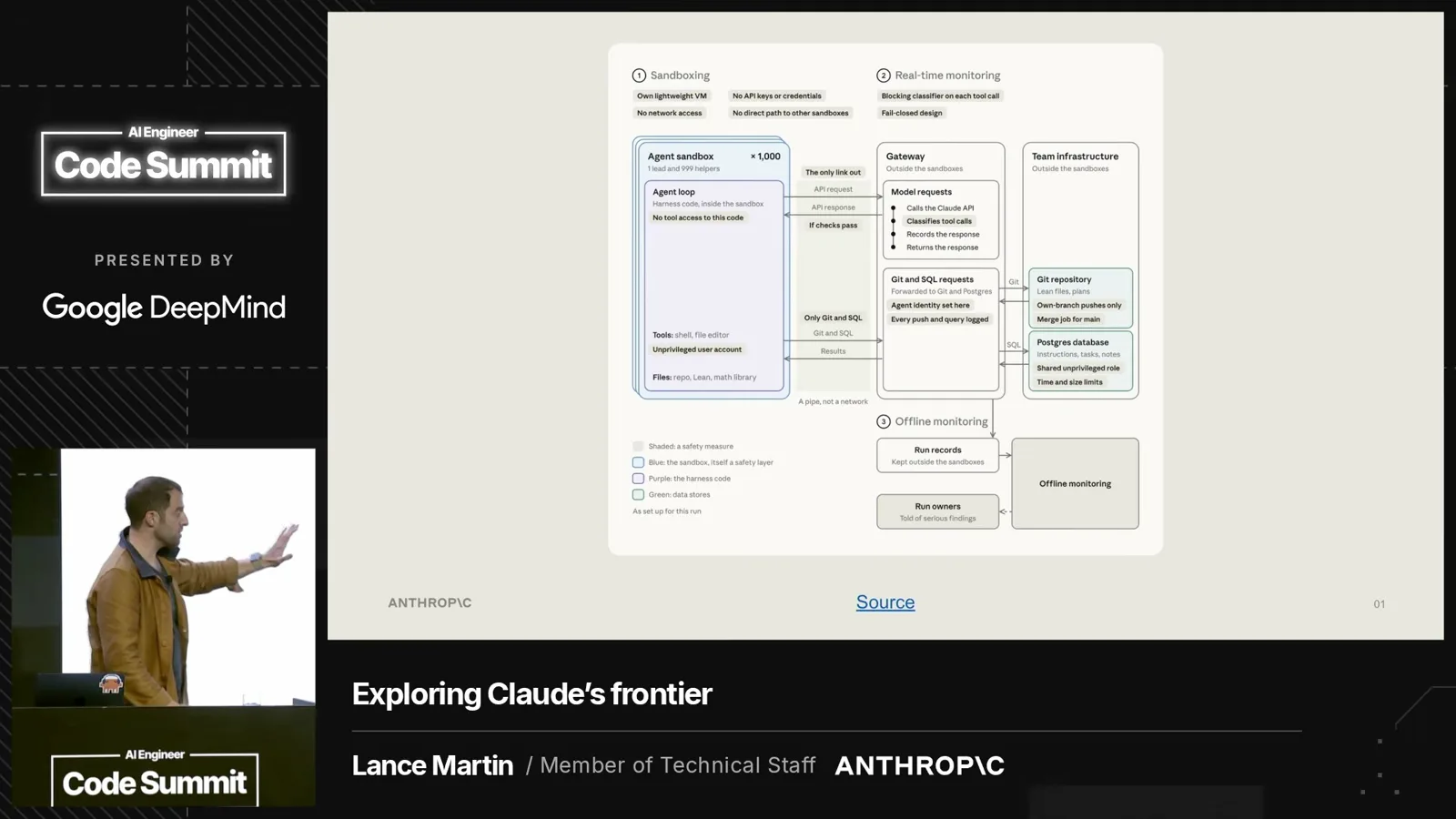
Each agent ran in its own sandbox with restricted access. The agents could reach Git and a SQL database. Real-time monitoring inspected tool calls for safety issues, and offline monitoring reviewed agent runs every ten minutes.
The prompt established one lead, 999 helpers, the problem and the availability of Git and the database. It did not prescribe the team’s coordination tables. About five minutes into the run, the lead created them itself.
The lead builds its own coordination tables
The agents create and use tables to assign work, share notes and track completed tasks. They reallocate themselves as a proof containing 60 statements progresses.
The tables handled announcements, assignments, notes, subtasks and completed work. Agents read and wrote them to communicate progress and coordinate. The lead could announce a global change or assign helpers to statements in the proof.
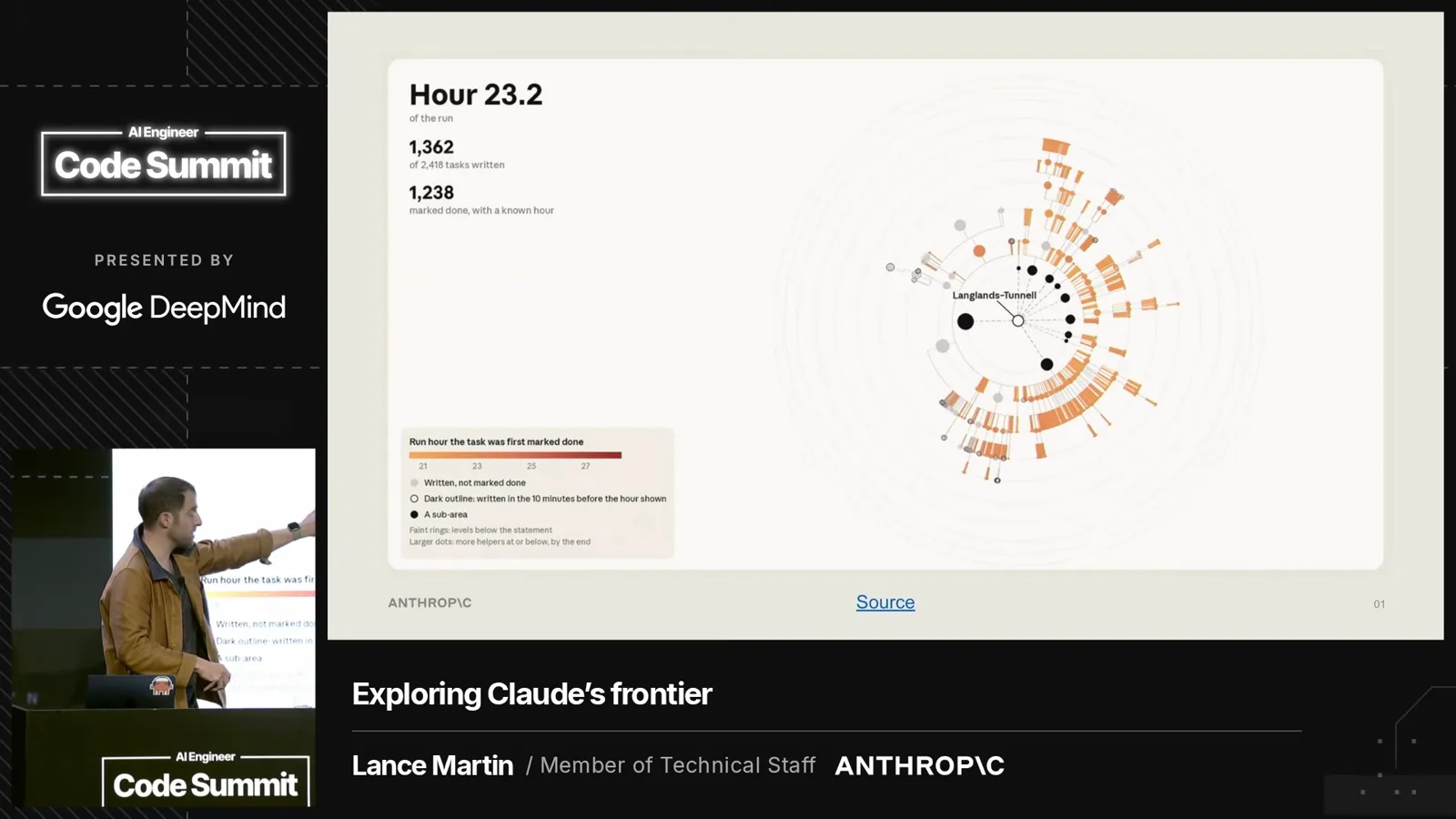
The run lasted about 30 hours. For a difficult part involving Langlands–Tunnell, the agents developed their own abstractions and a task tree showing dependencies. The team reallocated effort as the work progressed through 60 statements.
The result shows a team organizing a long-running task using relatively simple shared tools, rather than a mathematics-specific harness. It still had considerable safety and monitoring infrastructure; those safeguards were not removed.
Why memory needs both notes and reflection
An agent writes notes while focused on its immediate task, but its long-term knowledge needs to be coherent. Martin compares this with the distinction between daily experience and consolidated memory.
The second story is memory. Agents write notes as they work, when they can only judge what seems important to the immediate task. A useful memory must later form a coherent, nonredundant map of knowledge.
I compare this with a distinction often made in human memory: daily experiences and the later consolidation of important pieces into longer-term knowledge. We found that separating immediate notes from later reflection can also help agents.
Stronger models select and use memories better
A database benchmark and Pokémon gameplay show different memory behavior. Stronger models wrote more selective, strategic notes in the examples Martin presents.
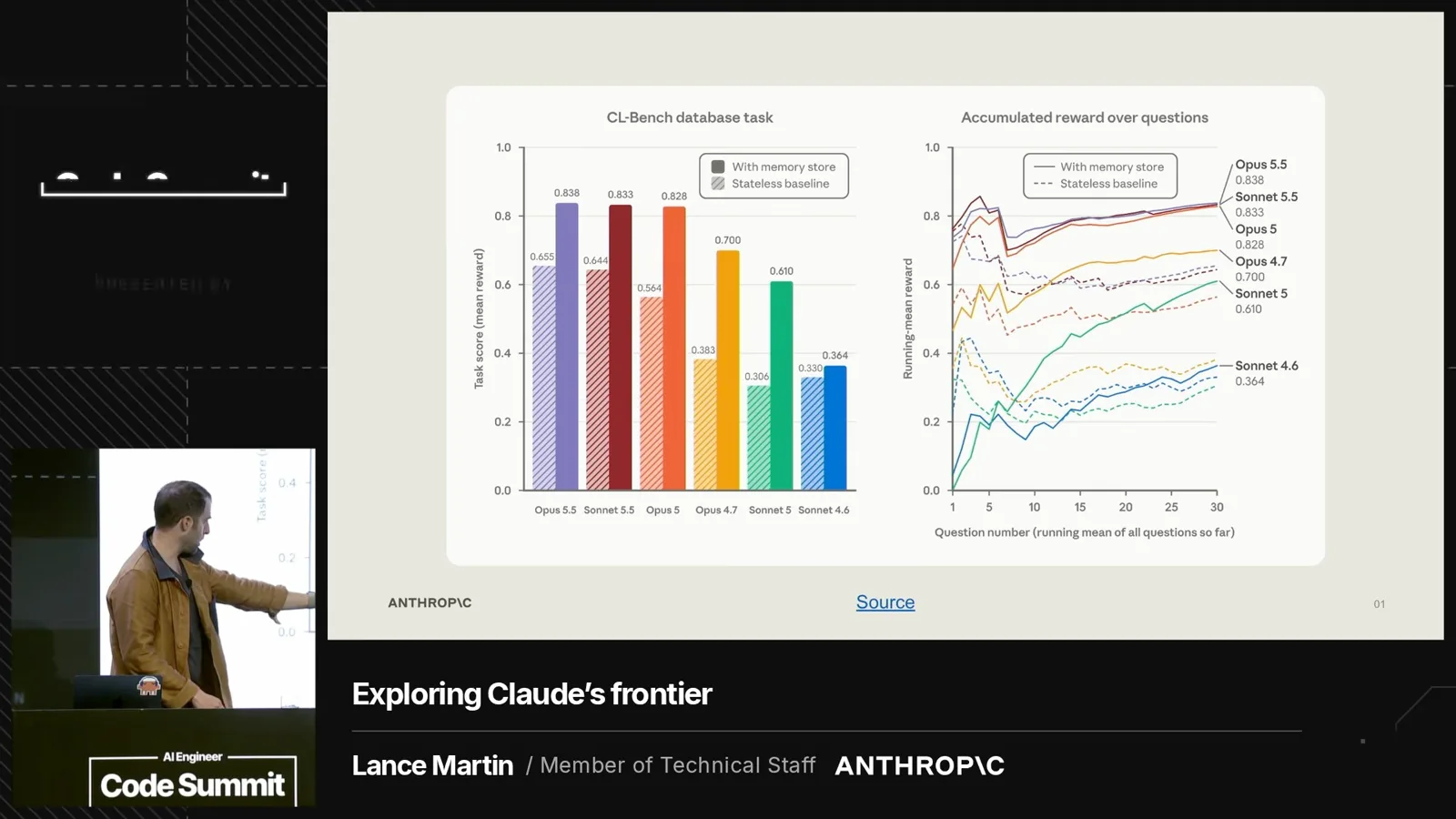
In a continual-learning benchmark, Claude answers a sequence of database questions, with a fresh session for each one. It has a memory directory where it may leave notes for later sessions. We simply tell it that the directory exists and it can use it.
Sonnet 4.6 gained little from the memory store in this test. Looking at its behavior, we found it did not reliably know when to write a useful memory or retrieve one. With the same simple instruction, stronger models used the store more effectively.
The stronger models’ notes also tended to be better: verified statements or predictions relevant to the database, rather than lower-quality fragments. The issue is not just providing storage; a model must recognize what is worth saving and later retrieving.
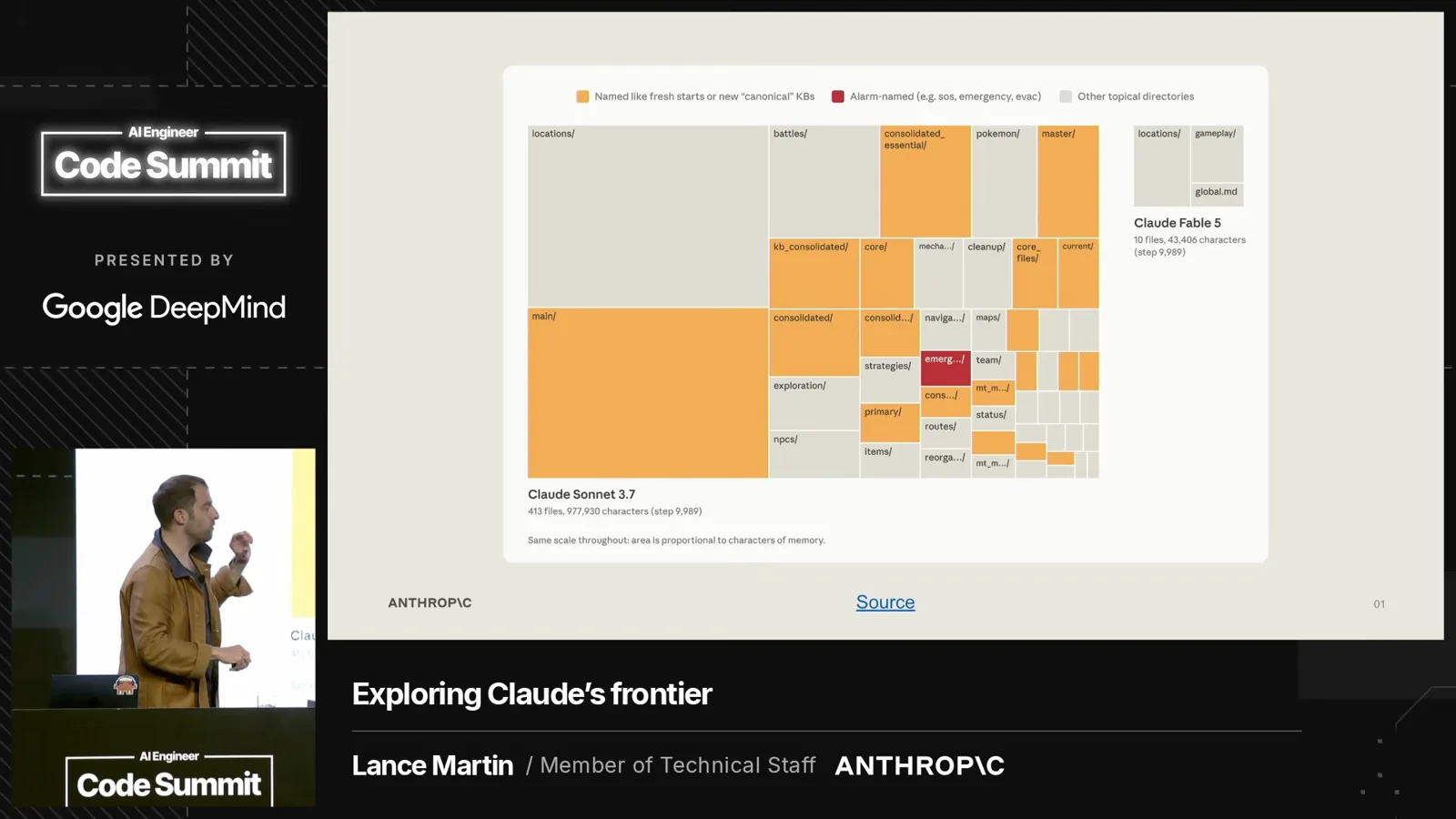
Pokémon provides another illustration. We gave Claude a directory in which to write anything while playing. Sonnet 3.7 created a large collection of notes, many recording experiences that were not particularly useful or strategic.
Fable 5’s directory was much smaller and focused on strategic and tactical knowledge that was hard to recover from the current game state. In the example, it also progressed further in the game. Better selection of what matters can make memory more usable.
In both examples the agent writes notes during the task. A separate process we call dreaming lets it reflect on existing transcripts and notes, correct errors and create new representations of what it has learned.
Dreaming can correct bad notes and build a wiki
A separate reflection process can inspect transcripts and notes, correct mistakes and construct representations. Martin gives Pokémon and company-document examples.
A simple memory system could search transcripts from previous sessions, but transcripts are large and only a small portion may matter. Notes are more compact. Reflection can turn those sources into a wiki or promote useful facts into context loaded for later sessions.
One Pokémon agent wrote the wrong location for a landmark. It then repeatedly mislocated itself, fell through a trapdoor and returned to an earlier level. The bad memory kept producing the same failure.
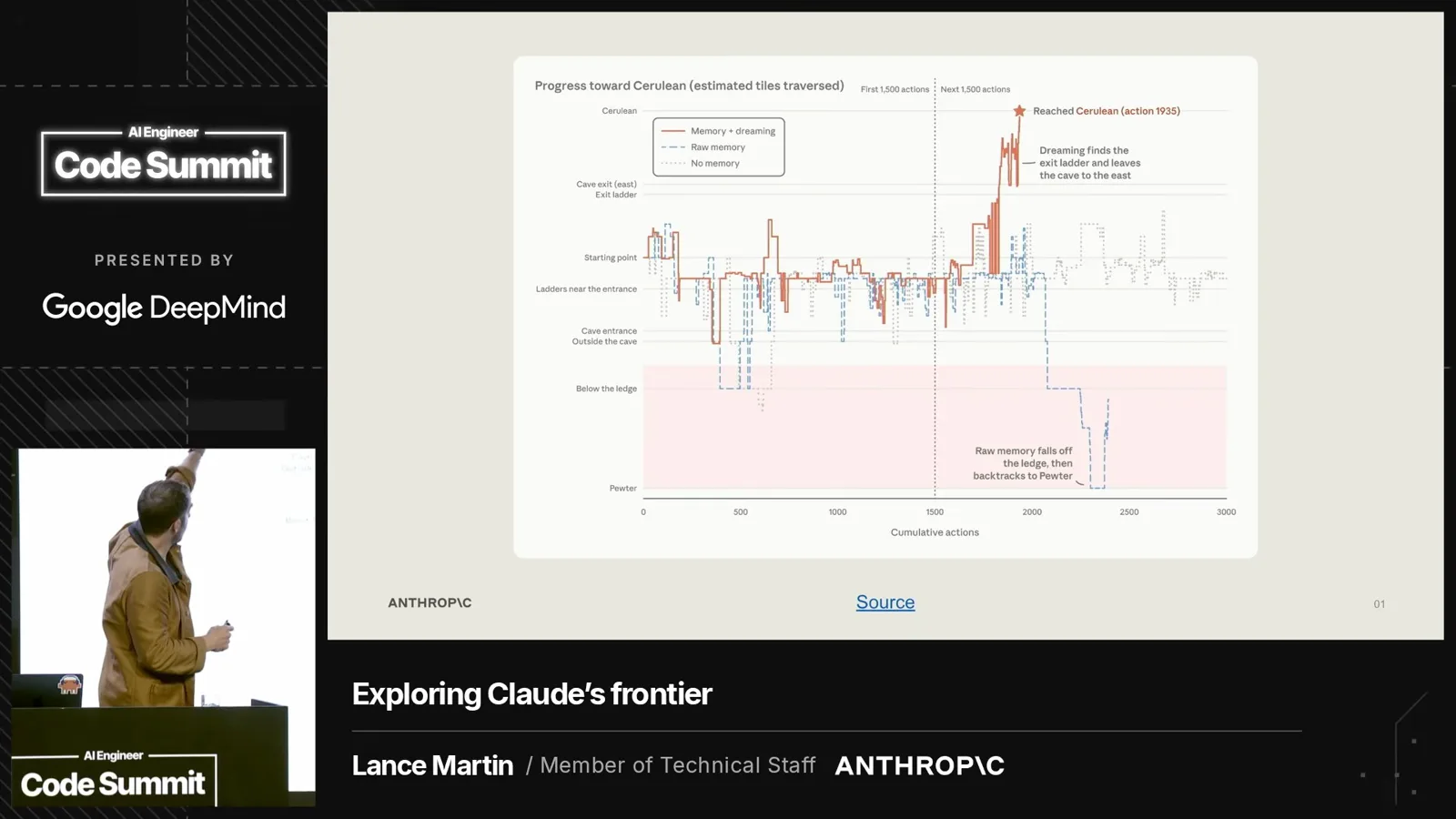
When the agent could reflect over its memories, it corrected that mistake and progressed to the next area. In the comparison, raw memory alone led it back into the trap; reflection provided an opportunity to repair an otherwise persistent error.
We also tested building a company wiki. After Anthropic acquired Stainless, we made an anonymized corpus of company documents and messages and a set of 25 questions answerable from that material.
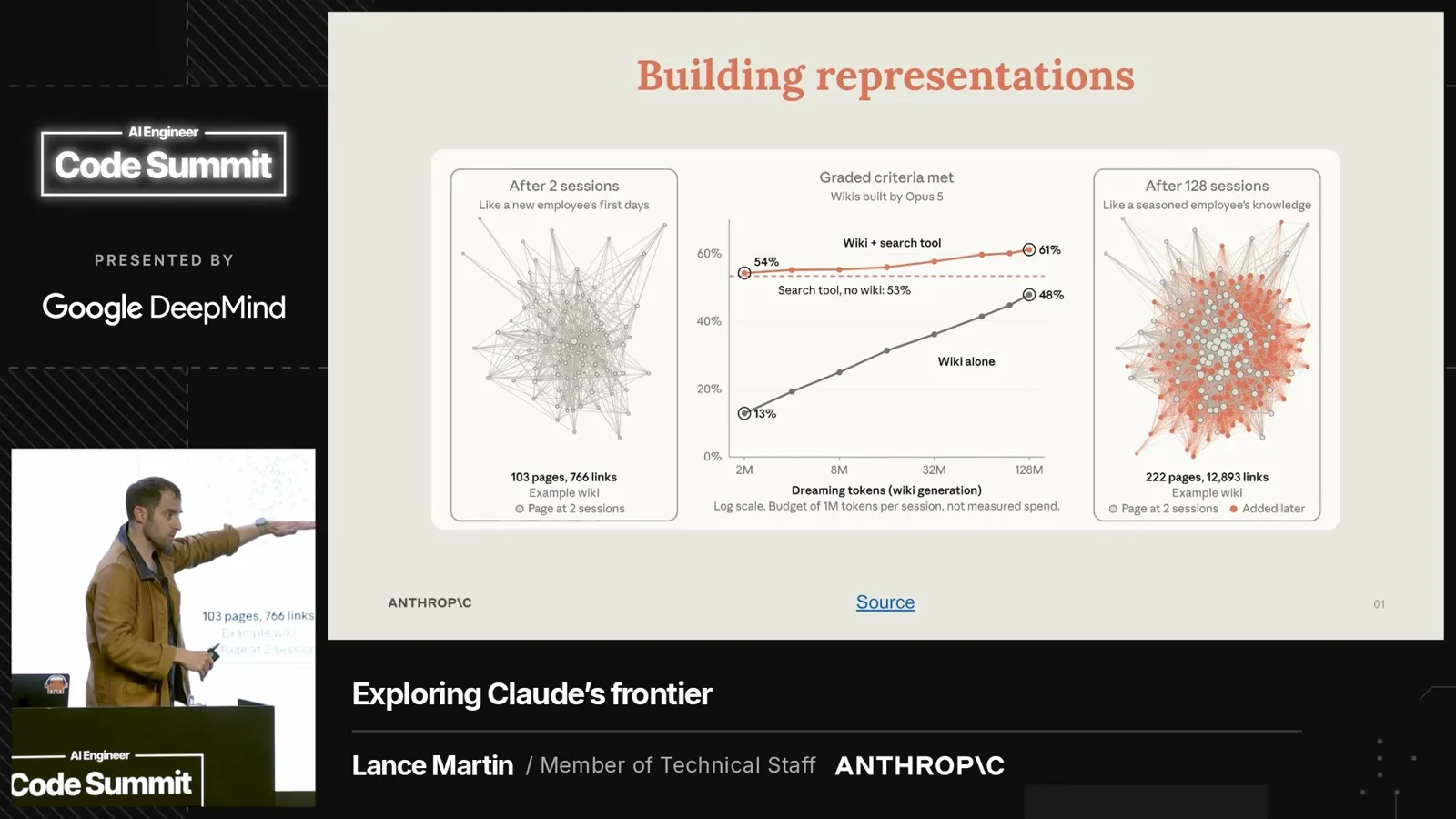
A semantic-search baseline scored about 53%. We then let Claude construct a wiki from the corpus. As we spent more computation on reflection, the wiki became more useful for answering questions; combining the wiki with search improved results beyond search alone.
In another example, an initial wiki contained placeholders for pages that did not exist. Reflection let Claude inspect the representation, fill missing pages and create an index. It can improve memory by correcting errors, filling gaps or building a new way to navigate existing information.
Más de este canal
 18:03EN
 AI Engineer· 26 nov 2026Justin McCarthy: Automate Existing Software, Discover New DemandJustin McCarthy · DiffusionKeep proven products fast and safe with continuous feedback, then use the freed capacity to find what customers will actually buy.
 18:01ENAI Engineer· 25 nov 2026Quinn Slack: How Amp Built a Company Around AgentsQuinn Slack · AmpA year without hiring pushed Amp to ship in small steps, put customer work in agent threads and give 21 people broad ownership.
 22:29ENAI Engineer· 24 nov 2026Jarred Sumner: Independent Tests Made Millions of Agent-Written Lines ShippableJarred Sumner · AnthropicBun’s creator explains why existing tests, three-way comparisons and repeated measurement mattered more than code volume.
 21:22ENAI Engineer· 24 nov 2026Steve Yegge's software factory hit a human bottleneckSteve Yegge · Gas TownHis game-building agents produced more changes than players could absorb, while cost, accumulated context and stalled tasks demanded active management.
 20:24ENAI Engineer· 23 nov 2026Dex Horthy: software factories still need people to review the workDex Horthy · FactoryFaster agent-written code needs checks, proportionate planning and human review, especially when a codebase must remain maintainable.
 19:56ENAI Engineer· 22 nov 2026Armin Ronacher: Build a Software Workshop Before a FactoryArmin Ronacher · EarendilAgents can start projects faster, but human attention still limits which ones become good and stay maintained.