En 30 segundos
At Tesla’s September 2012 Supercharger event, Elon Musk said six stations were already installed and presented fast charging as a way to make long-distance electric driving practical. He outlined solar generation plans, projected rapid network expansion and promised free charging for eligible Model S configurations. That offer was specific to the period and vehicles discussed: [Tesla’s current support page](https://www.tesla.com/support/charging/supercharging) describes site-specific charging prices and potential fees.
- 1A fast-charging network for longer tripsMusk presents the Supercharger as a response to concerns about range, electricity generation and cost.
- 2Musk describes 20–30 minute stopsHe says the initial system charges at about 100 kW and imagines drivers charging while taking a meal break.
- 3Six stations and an expansion mapTesla shows four locations in use; Musk says six are installed and projects broad U.S. coverage within two years.
- 4Solar generation and eligible Model S chargingMusk describes a planned annual solar energy offset and free charging for the vehicle configurations he specifies.
Conclusiones
- Musk said the first six Superchargers were installed and described charging at about 100 kW, with a potential increase to 120 kW.
- He projected coverage of much of the United States within two years; the map shown was a 2012 plan, not proof of later coverage.
- Tesla planned solar generation to offset more energy annually than cars used, according to Musk; this was a network-level energy claim.
- The event’s free-charging promise applied to specified Model S battery and hardware configurations and should not be treated as a current universal offer.
Lee el texto editado por capítulos
Introducing the Supercharger
Tesla introduces the launch and Musk identifies the problems the network is intended to address.
Tesla chief designer Franz von Holzhausen welcomes the audience to the company’s Hawthorne design studio and introduces Elon Musk.
Musk says the Supercharger is intended to address three concerns about electric vehicles: convenient long-distance driving, emissions associated with electricity generation and the cost of driving.
Charging speed and the first stations
Musk describes a road-trip charging stop, shows locations and highlights early drivers.
He describes a plan to install chargers near highway restaurants and connect the system with solar power. Musk says the charger operates at about 100 kW, with a possible future increase to 120 kW.
Musk imagines a driver traveling for three hours, then charging during a 20- to 30-minute meal and rest stop. He argues that this could make long-distance electric travel more convenient.
Tesla shows footage of four Supercharger locations in use. Musk says six stations have already been installed and introduces early users who drove to the event from the Tahoe area and Las Vegas.
He describes the early California network and says the stations were built before the public announcement. He presents their opening as a concrete first step rather than a future concept.
Network expansion and solar generation
He presents coverage projections and explains Tesla’s planned annual solar generation offset.
Musk projects more stations in California and routes extending to Nevada and Oregon, followed by coverage of much of the United States within two years. The map is Tesla’s projection at the time of the 2012 event.
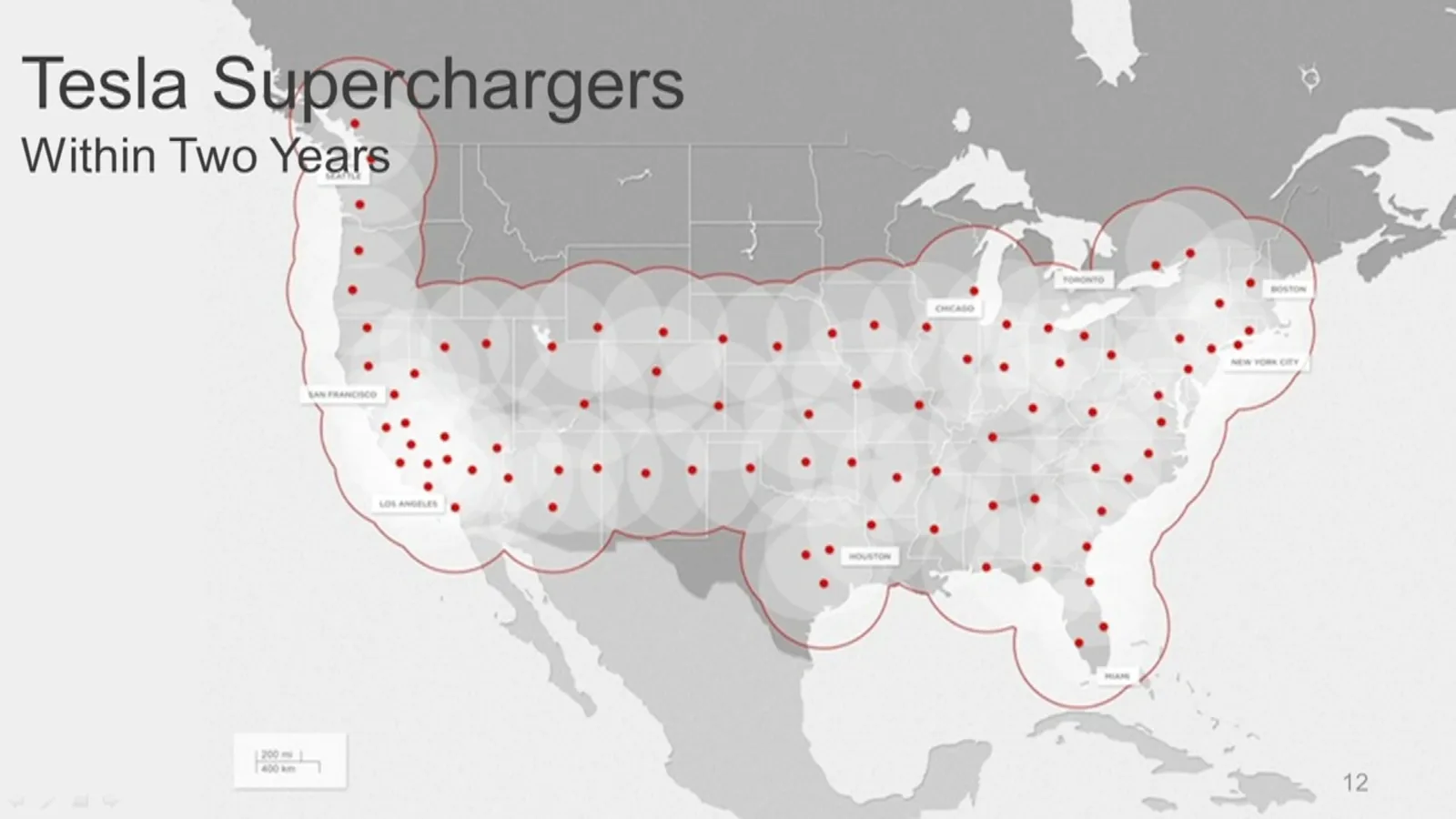
He gives a longer-term goal of covering the United States and southern Canada within roughly four or five years, with chargers also planned for Europe and Asia. These are plans from the presentation.
Musk says Tesla and SolarCity intend to size solar systems to generate more electricity over a year than cars use. This is an annual energy-balance claim; it does not establish that every charging session is directly powered by sunlight.
The original charging offer
Musk outlines free charging for specified Model S configurations and closes the presentation.
He says the system’s design and shared Model S charging technology allow Tesla to offer free Supercharging to customers with the necessary hardware. He specifies the 85 kWh battery configuration and an additional hardware charge for the 60 kWh configuration.
Musk argues that fast charging can change perceptions that electric cars restrict travel. He imagines a long trip with no charging bill under the offer he has just described.
The presentation briefly returns to a Model S being charged at the event. Musk notes that it gained a significant amount of charge during the presentation and thanks the audience.
Más de este canal
 24:44EN
 Tesla· 6 nov 2026Elon Musk Unveils the Cybertruck: Steel Body, Cracked Glass and a New Pickup DesignElon Musk · TeslaAt Tesla’s 2019 event, Musk introduced the electric pickup and demonstrated its body, glass, suspension and cargo bed.
 59:56ENTesla· 21 oct 2026Tesla Q3 2026: Cash Flow, FSD Demand and the Cost of Scaling RobotsElon Musk, Vaibhav Taneja, Travis Axelrod · TeslaExecutives discuss quarterly margins, capital spending and plans for Cybercab, Optimus and chip production.
 23:21ENTesla· 16 oct 2026Tesla’s Roadster Event: A Ramp Stunt, Aerodynamics and a 2028 Production TargetElon Musk, Franz von Holzhausen, Lars Moravy · TeslaElon Musk, Franz von Holzhausen and Lars Moravy demonstrate a prototype developed with SpaceX engineering.
 1:09:55ENTesla· 22 jul 2026Tesla’s Q2: Margins Narrow as Spending on Robots and AI RisesTravis Axelrod, Elon Musk, Vaibhav Taneja, Ashok Elluswamy, Lars Moravy · TeslaTesla reported higher energy deployment and negative free cash flow while executives outlined Robotaxi and Optimus plans.
 27:27ENTesla· 21 may 2026Tesla’s Final Model S and X Deliveries: How the Cars EvolvedElon Musk, Franz von Holzhausen, Lars Moravy · TeslaElon Musk and Tesla’s team recall a tent-based design studio, years of changes, and plans for the former production line.
 1:05:20ENTesla· 22 abr 2026Tesla Plans a $25 Billion Investment Year as It Prepares OptimusTravis Axelrod, Elon Musk, Vaibhav Taneja, Lars Moravy · TeslaOn Tesla’s Q1 2026 call, executives detail one-time margin gains, battery constraints and plans for robots and driving software.