En 30 segundos
Joon Sung Park's Smallville experiment let 25 generative agents live, work, and throw a Valentine's party with no script. The project is now Simile, an applied AI lab that simulates people for companies such as CVS, after a study of 1,000 Americans predicted behavior 85% as accurately as people reproduce their own answers. Park's bet is that frontier models are the CPU of intelligence, and that the missing GPU is a model of human diversity — with a longer horizon of a CERN for society.
- 1While colleagues marveled that foundation models could classify and generate, Park fixated on something else: these models encode human behavior. The live question was what happens if you push that as far as it will go.
- 2Labs chase superintelligent machines that are rational and good at problems with objective answers. People are irrational, with subjective values, preferences, and taste, and Park says the current modeling paradigm has plateaued at simulating them even as model size goes up.
- 3Simile does not need a superhuman model. It wants models as human as possible, more like a GPU of intelligence whose subunits represent real sub-populations, while frontier models coordinate the research plan.
- 4The operating bar for quantitative work is total variation distance below 0.15, which Park treats as strong enough evidence for decisions, including the randomized trials at the core of customer work.
- 5The say-do gap is real, and most LLM training data is attitudinal. Park's team found that asking people to tell the story of their life — where they grew up, hard decisions they made — is long-tail information that helps translate attitudes into behavior.
- 6Park's science-fiction picture of a mature society has two pillars, AGI and simulations that guide it. The product vision is a CERN of human society, including runs that might one day cost a hundred million dollars and take months.
Lee el texto editado por capítulos
The missing ingredient for complex agents was already sitting in the training data
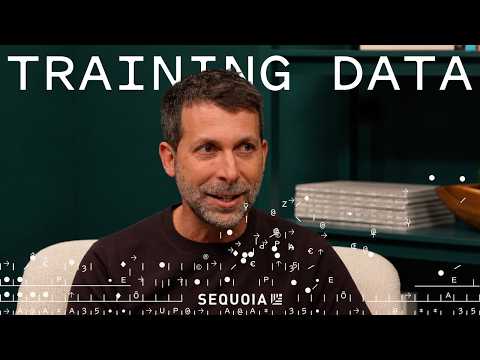
Sonya Huang of Sequoia's *Training Data* sits down with Joon Sung Park, founder and CEO of Simile, and takes him back to Smallville. The Stanford project put 25 generative agents in a game town, each with a persona plus memory, planning, and reflection. They woke up, ran through routines, went to work, and formed relationships the way people do. The experiment was a stress test: if language models really encode human behavior, what does a society of these agents look like when you push that as far as it will go?
The scene that stuck is the day before Valentine's Day. Isabella, the cafe owner, decides a party would be a good idea, gathers materials, and tells customers to come. On the day itself an emergent gathering forms at the cafe. Some residents get invited and forget. Klaus uses the invitation to ask his crush out, and they actually show up. No one assigned those plot points.
The demo is now a company. After the generative-agents paper, social scientists wanted to run experiments and randomized trials on the platform; Fortune 500 executives who had seen the work asked whether market questions they could not answer with surveys could be run in simulation. Park's team simulated 1,000 people across the U.S. population and showed they could predict behavior 85% as accurately as people replicate their own answers. That was the point they felt comfortable selling a decision platform. CVS is a customer; Gallup is a strategic partner for reaching real people.
The observation underneath Smallville was narrower than a virtual town. Large language models, trained on the web and social media, encode a lot of human behavior. Probed from the right angle — given a specific situation, what would this person do? — they produce surprisingly plausible micro-behaviors. Park's group treated that as the ingredient they had been waiting for, then paired a generative model with memory, planning, and reflection so agents could have a lived experience over time instead of a one-shot reply.
That lived experience is what made the party feel eerie rather than cute. Isabella's persona is a cafe owner; she independently plans the event, shops for it, and invites regulars. Klaus brings a date. Other agents simply fail to show up because they forgot, which is a very human kind of error. The point, Park tells Huang, was not to puppeteer a cute scene. It was to see whether a small society of these agents would produce the kind of emergent phenomena designers of real social systems never get to rehearse.
Once the paper was out, the email was not mostly from other AI labs. It was from social scientists who wanted a place to run experiments and RCTs, and then from CEOs and board members who visit Stanford, have seen the demo, and are tired of spending heavily on surveys that still cannot answer the market questions they actually have. Can we run that in simulation? That question, Park says, showed a unusually clear line from research to real-world impact.
Research is breadth-first; a company is how they chose a hill and climbed it
Park's Stanford career started in 2020, the year GPT-3 was about to land. His first project was the widely read *Opportunities and Risks of Foundation Models* paper, led by Percy Liang, now a co-founder and head of Stanford's center for foundation models. Colleagues were stunned that the models could classify and do simple generation without being taught those tasks. From an interaction-design point of view, Park already knew how to use systems like that. The surprise for him was that the models include human behavior, and what it would mean to take that all the way.
He comes out of social computing inside human-computer interaction: how to build platforms that support collaboration at scale. Testing the UI is the easy part. The hard part is what happens when tens, then millions, then billions of people create emergent phenomena, good and bad. Until recently the only test was a field test. If a feed is more likely to propagate a negative emotion, you find out after the harm is in the world. In 2022, a year before generative agents, the group built Social Simulacra: define a subreddit, pick a moderation strategy, populate it with thousands of personas, and watch. In one community meant to discuss sightseeing in Pittsburgh, the personas started planning a real trip together. Park jokes that it was a 2022 version of Moltbook, which later came back as an actual agent social network.
The remaining work was to go from simple personas to agents that think over time, and to validate that the simulations are accurate. GPT-3, which powered Social Simulacra, had no instruction tuning and was "very junky"; getting it to listen took odd prompting tricks, though the promise was visible. By the generative-agents paper the models could follow instructions, so agents could reason about memory. Foundation-level capability, Park argues, is now good enough to imagine the applications. What is not good enough is treating a rational superintelligence as a stand-in for people.
The reason he left the lab is a distinction he draws cleanly. Research is a vehicle for breadth: a room of smart people, each owning a small thesis, some of which blossom. Researchers, he says, are not famous for finishing the job. A company is a machine for depth. You pick a hill, put resources and people on a single vision, and climb without hesitation. That conviction arrived about half a year after the generative-agents paper, once the 1,000-person study landed. The three co-founders — Park, Liang, and Michael Bernstein, both of the latter his Stanford advisors — had already worked together for five years. That is when they sat down and asked whether this could be a company.
Frontier models are getting better at answers, and worse at being people
Look at OpenAI, Anthropic, and the new labs, Park says, and the north star is a superintelligent machine: rational, and excellent at technical problems with an objective answer. Huang's follow-up is the point of the episode: maybe that is not even the best simulation of true human society. People are irrational. They have subjective values, preferences, and taste. He says you can already see a divergence — model size going up, performance at predicting and simulating human behavior not keeping up. The current paradigm has plateaued. The foundation is good enough to start; making it great needs a frontier aimed at people's diversity.
Huang's intuition is the common one: tell Claude she is a 34-year-old woman in a bi-coastal city and the model should be a faithful stand-in. Park's reason for still going out through Gallup is the say-do gap. People say one thing and do another, and the gap is real. Most of what large language models train on is attitudinal — things people have said online. Simile tries to close that gap with behavioral data, including a question that sounds too soft to be a feature: tell me the story of your life. Where someone grew up, and which hard decisions they had to make, is long-tail information. It is not a policy checkbox and not a log of what they did this afternoon. Park calls it a translational layer between attitudes and behavior.
The behavioral pile is concrete. Simile holds a large repository of social-science RCTs, including pricing studies, and is training what Park describes as a foundational model of human behavior in a literal sense: encode those behavioral signals so the model can predict the results of RCTs it has not seen. Customers then look at that potential and think about their own data. CVS has about 90 million customers; the conversation is how to use in-house data, responsibly, to build an augmented, population-specific version of Simile's model.
Collection is mixed by design. Interviews are how you get the long tail; in a 2024 validation study they literally asked for life stories. They are training an interviewer in a reinforcement-learning loop whose objective is the minimum time for the maximum visibility into a person. Discrete choice questions and surveys stay in the mix because they are time- and data-efficient, especially for views on policies. On the model split, Park's metaphor is hardware. Today's frontier models are the CPU of an intelligence unit: a single system trained on rational data, strong at hard objective questions. Simile is closer to the GPU: many smaller units, each standing in for a real sub-population. They do not want superhuman at this job. They want as human as possible. Where that gap exists they build their own model; frontier models still get used to coordinate the research plan.
CVS did not need another survey vendor; it needed a way past the physics of field tests
The canonical buyer at CVS is a senior vice president who leads human insights, named Shri in the conversation. He read Park's validation paper and decided the company had to bring the method in, because it is bottlenecked by how many questions it can field-test and by what Park calls the physics of human society. Surveys capture attitudes. They do not map the second-order impact of a decision across a market. The introduction was almost comically small: Shri's cousin happened to know Park and reported that the authors were starting something. The need, Park insists, was not accidental even if the intro was.
The front of the engagement looks like working with a polling or panel company. The customer names a population; Simile, including through a strategic partnership with Gallup, reaches real people and spends about 15 minutes collecting data it believes is efficient and generalizable. The craft is which questions, in that window, reconstruct a person well enough to answer questions far outside the original domain. Those traces become agents, loaded into a SaaS product, and the customer can then ask the group almost anything. Huang compares it to autonomous vehicles: collect real-world physics, then simulate beyond the training distribution. Park agrees on the shape — ground the model in real people, then generalize to what you could not code in.
Most journeys start with concept testing because it is concrete: a new product, a new message, what would users think. Customers quickly see the jump from testing five to ten ideas a month to testing thousands of ideas across thousands of sub-populations. Then the asks get stranger. Add a temporal dimension: send agents to experience a product for ten minutes and report what they saw. Run multi-agent simulations. One request that surprised Park, and then became common, is simulating an earnings call so a CEO and board can hear how the audience might react. Deeper still are second-order effects. If an automaker's electric vehicle takes off, what happens to the perception of the non-electric lineup, and how do you rebalance the rest of the products? Today, he says, there is no way to test that except in simulation.
Huang's sharp question is why not just run a thousand Facebook ads and read real click-through rates. Park's first answer is scale and representativeness. Online experiments only capture the people who respond, and you are bounded by the platform's population. Simile does the unglamorous work of getting a representative set of people, then collecting data that actually represents them — a pain point he hears constantly, often before anyone even knows which questions to ask. The second answer is capability. Ads answer the first question. They do not tell you the downstream chain of a decision. The self-driving analogy returns: gather real road data, then let the model generalize to weather and roads the training set never saw.
Eighty-five percent of human self-consistency is the bar they were willing to sell
The nightmare question in this field is how you know a simulation is right. Park's validation design is sly. Simulate 1,000 real Americans, covering the population. Then ask the humans the same questions again later and treat their self-agreement as a ceiling: people do not perfectly reproduce their own answers. The agents reached 85% of that ceiling. That number is what made the founders willing to put the platform under real decisions, not just under a paper.
Day to day the north star for quantitative work is total variation distance, which asks how close the simulated distribution of answers sits to the ground truth. They run it across customer use cases. A TVD under 0.15 is, in their view, strong evidence for a decision, and it covers the RCT-shaped problems at the center of the business. Theoretical limits exist. Ask Park the same question twice and he will answer slightly differently; some randomness is genuine. He still thinks there is a lot of performance left to squeeze out before anyone hits that ceiling.
Multi-agent work is harder because errors can daisy-chain, like a game of telephone. Park splits simulations into two families. Convergent ones can tolerate compounding error if the pull toward the outcome is strong enough. Simulate a social network and a hub still forms: a scale-free pattern, the same observation that powered PageRank, where some pages attract exponentially more links no matter how the graph grew. Divergent ones do not give you the same winner twice. World War I's inevitability is the classic; an election is the practical version. There the evaluation is confidence: run the simulation a hundred times, count how often X happens, bootstrap a confidence interval, and — this is the part he cares about — show the diversity of possible futures so people can see the mechanism and prepare.
How early is this? Park's analogy is day one of inferential statistics. Scientists argued for a long time before treating p less than 0.05 as evidence strong enough for science. Simile, he says, is trying to set the same kind of thresholds and standards for simulation as a field. Huang's "vibe math" about averages converging and binary splits diverging is, he thinks, the right intuition. Turning that into a robust equation for when a run will do which is an actual research frontier, which is why he still describes the company as an applied AI lab.
The north star is a CERN for human society, even if one run costs a hundred million dollars
Huang pushes past Fortune 500 concept tests toward the mysteries. Macroeconomics, in her view, is often a function of human psychology at scale; even a venture firm debating where value accrues in the AI stack is, at bottom, a simulation problem. Park does not flinch. When he was still recruiting his advisors, the pitch was that if they did this right, there was a Nobel Prize in it, and he still believes that. Thomas Schelling's agent-based models of segregation were almost insultingly simple — each agent a red or blue dot that moved if too few neighbors matched — and they showed something deep about macro behavior. Schelling won a Nobel. The opportunity now, Park says, is the same move with agents that carry a full life story instead of a colored dot.
Economists have already come asking. When does a bank run happen? Climate change is stuck on a collective-action problem among nations: can you simulate that? What are the signals of a democracy about to collapse? What is the origin story of the monetary system? Those, he says, ought to be the north star of the field. He can see a cost curve: today a simulation is quick and cheap; someday a run might cost a hundred million dollars and take many months, and still be worth it if it answers a fundamental question. Politics is the same shape. Everyone arrives with an agenda about what a policy will do. A simulation at least puts the downstream effects on the table, not just for this year but for five to ten years out.
What excites him is still science fiction. Societies that have gone far enough in technological maturity always seem to rest on two pillars: some version of AGI, and some version of simulations that help guide the society. Five years ago he would not have said he had a shot at building the second pillar. He would now. There is a clear use case that serves customers today, and a lot yet to come that he thinks builds toward a simulator akin to the CERN of human society. Co-founder Percy Liang likes to say that the greatest scientific advances often start from an amazing measurement. The Hubble Space Telescope changed how we understand the universe. Simulation, Liang argues, can be that instrument for human society. Natural science has been repeatedly reset by better measurement. Social science, Park says, still needs its machine.
Más de este canal
 1:08:02EN
 Sequoia Capital· 13 oct 2026PódcastAlphaGo Took Two Years. AlphaZero Took Hours. Silver Is Making the Same Bet on SuperintelligenceDavid Silver and Lasse Espeholt left DeepMind to build Ineffable Intelligence, a twenty-person lab that wants a superlearner to discover science, math, and language from experience rather than from a pre-training run.
 1:04:26ENSequoia Capital· 6 oct 2026PódcastAt 100,000 Accelerators, Something Fails Every HourGoogle AI infrastructure chief Amin Vahdat tells Sequoia's Sonya Huang why FLOPS is a vanity metric, why the TPU line split in two, and why he would rather wait on a utility than build his own gigawatt.
 1:05:21ENSequoia Capital· 15 sept 2026PódcastThe Bridge From Model to Workflow Is a Trillion-Dollar BusinessBox CEO Aaron Levie argues that the money in this cycle sits in the messy gap between frontier models and real enterprise work — and that coding's overnight diffusion will not repeat for everyone else.
 52:27ENSequoia Capital· 1 sept 2026PódcastAfter Two Dozen Police Departments Said No, They Built an Anti-Network-Effect AI CompanyA Wisconsin county had 300 gigabytes sitting on a cold case—and Peregrine's founders still refuse to take the credit.
 55:19ENSequoia Capital· 25 ago 2026PódcastHuman Click Data Is a Bug: Rebuilding Search for a Web of AgentsParag Agrawal, former Twitter CEO and founder of Parallel Web Systems, argues that agents will query the web a thousand times more than people, and that both search infrastructure and the ad-supported internet have to be rebuilt for that customer.
 53:44ENSequoia Capital· 18 ago 2026PódcastThe Biggest Bug in Today’s Models Is That the Weights Never ChangeTuring Award winner Rich Sutton and Khurram Javed founded Oak Lab to build agents that keep learning after they ship — and they call synthetic data a big mistake.