En 30 segundos
A status deck can say a project is green while conversations and missed dependencies suggest trouble. Citadel Securities’ Joao Wenzel describes an institutional-memory system that combines these signals, preserves their history and asks people to correct it. In a backtest, green projects flagged by the system were about twice as likely to turn yellow or red. Wenzel says the result helps leaders decide where to look, not predict exactly what will go wrong.
- 1A green status report can hide contradictory evidenceWenzel combines top-down decks with noisier meetings, messages, code changes and agent traces.
- 2Treat company knowledge like a changing estimateAs evidence ages, confidence falls; source reliability and agreement with other signals matter.
- 3Preserve prior records instead of rewriting themThe system records what was reported, the evidence and its conclusion, enabling later backtests.
- 4Half of observed delivery dates changed within two monthsAcross three years of records, Wenzel says 90% of those changes moved the date later.
- 5Specialist agents found more useful updates than one large passBreaking up the corpus and having agents review one another more than doubled insightful project updates in the example.
- 6Flagged green projects were about twice as likely to turn yellow or redThe team replayed historical snapshots and compared warnings with subsequent status changes.
- 7A broken source is not the same as a quiet projectThe team tracks when a source was last checked and when it last worked, rather than treating missing data as zero activity.
Conclusiones
- Keep dated evidence and historical snapshots rather than overwriting the past; they make later evaluation possible.
- Treat stale information as less certain and distinguish an unavailable data source from a real absence of activity.
- Break large reviews into specialist tasks and check their coverage.
- Backtest warnings against later outcomes and ask stakeholders for reusable rules, not only one-off corrections.
- Use people and code to govern record updates, with more human attention when the stakes are high.
Lee el texto editado por capítulos
Why a company needs an institutional memory
Important context often resides in people and in conflicting records. Wenzel combines formal status reports with operational evidence.
Most companies have someone who remembers the reorganizations, relationships and politics behind formal decisions. Wenzel calls that person a kind of company world model: useful, but difficult to scale and rarely written down.
At Citadel Securities, Wenzel says agents already help employees with work across the organization. Leadership then asked whether they could also help define and refine company strategy, which requires understanding the company’s current position, history and likely next steps.
The institutional memory must capture relationships and project histories, including why teams stopped working together or a project was rescoped. Wenzel contrasts formal decks and strategy reports with noisier meeting notes, messages, code changes and agent-session traces.
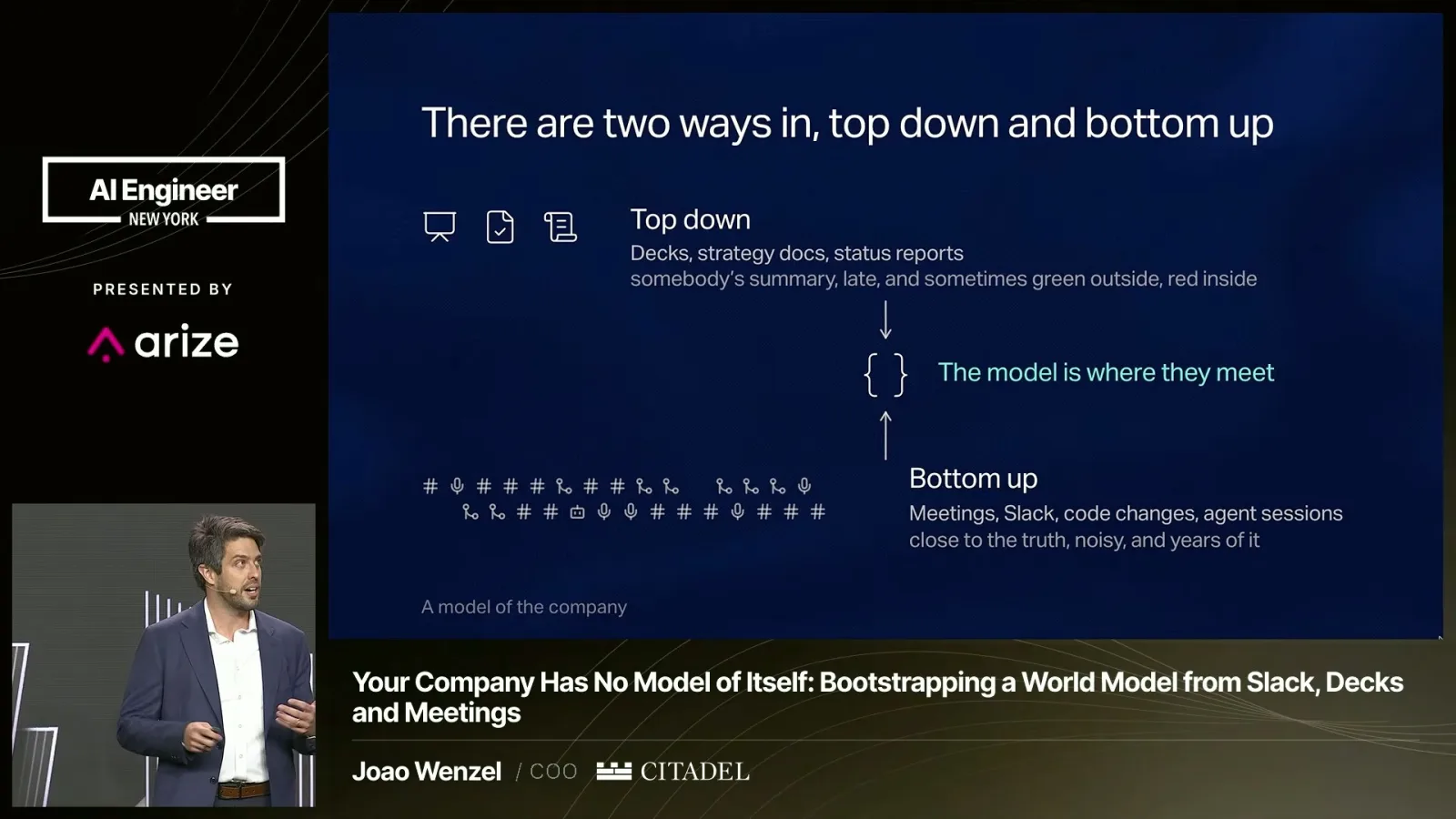
Formal reports can contain what he calls watermelon projects: green on the outside but red inside. Operational sources carry useful signals too, though they are noisy. The company model is where evidence from both directions is brought together.
Estimate the present from aging evidence
The proposed model tracks source quality, recency and agreement. Document structure and visual interpretation complement each other.
Wenzel borrows the idea of a state estimator from robotics. A belief becomes less certain as supporting evidence ages, and new observations update it. He says the system should consider how recent a signal is, whether its source is trustworthy and whether other sources agree.
Extracting even a status slide is difficult. Parsing PowerPoint XML may expose data but makes visual concepts such as color awkward; a vision model may struggle with a screenshot copied into the presentation. Combining the structured file with the vision model’s reading gives a fuller picture.
Projects also change names, so records must be linked over time. A five-day-old deck can disagree with a later Slack thread or a dashboard image; a longitudinal audit trail makes those changes and contradictions traceable.
Update records without erasing history
Agents propose changes while code and people control updates. Historical records help identify renamed projects and reported statuses that conflict with evidence.
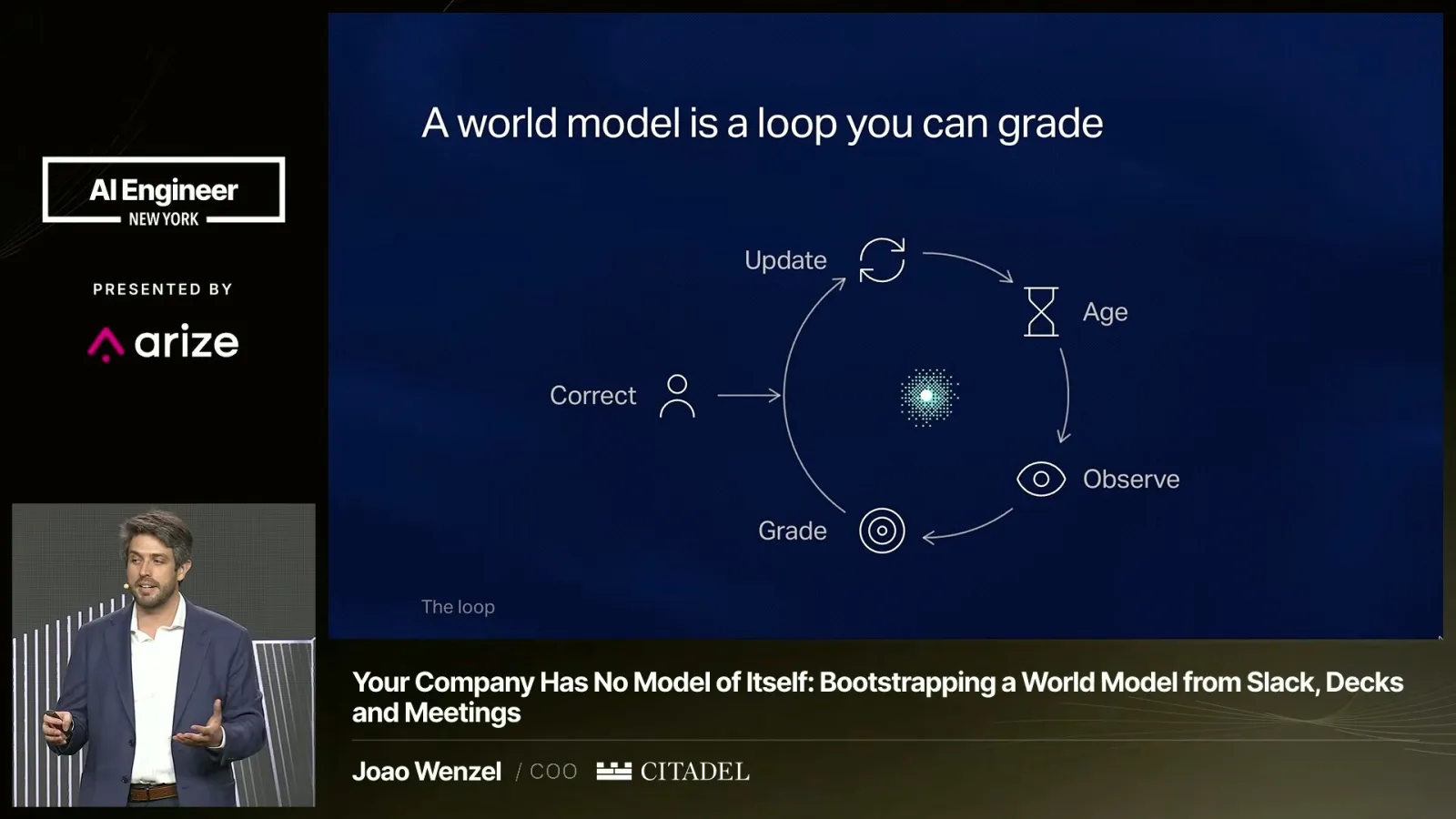
His proposed loop is update, age, observe, grade and correct. Grading compares observations with expectations, and correction brings stakeholder feedback back into the system. Agents participate throughout, but code and people decide how records are updated.
A retrieval system can find a few messages and slides and answer that a project is green while missing important context. Wenzel’s approach constructs an ongoing record instead of relying only on whatever documents a query retrieves.
Each month the system combines a prior record with the new status deck. The team has about three years of records. It can infer that a renamed initiative is the same project by comparing the people involved and the continuity of its goals.
An agent also separates a reported status from its evidence. A deck may label a project green, while a comment about an unresolved dependency supports a yellow flag. The update records what was reported, the evidence, the inferred status and the reason.
The system does not rewrite previous months. Corrections feed forward instead, preserving historical snapshots for evaluation. That history also shows how quickly different facts become stale.
Measure how facts age and warnings perform
Specialist agents collect evidence; historical snapshots allow the team to test whether flagged green projects later change status.
Delivery dates are one example: a launch scheduled for Q2 may move to Q3 and then October. Across three years of records, Wenzel says half the dates changed within two months, and 90% of those changes moved the date later.
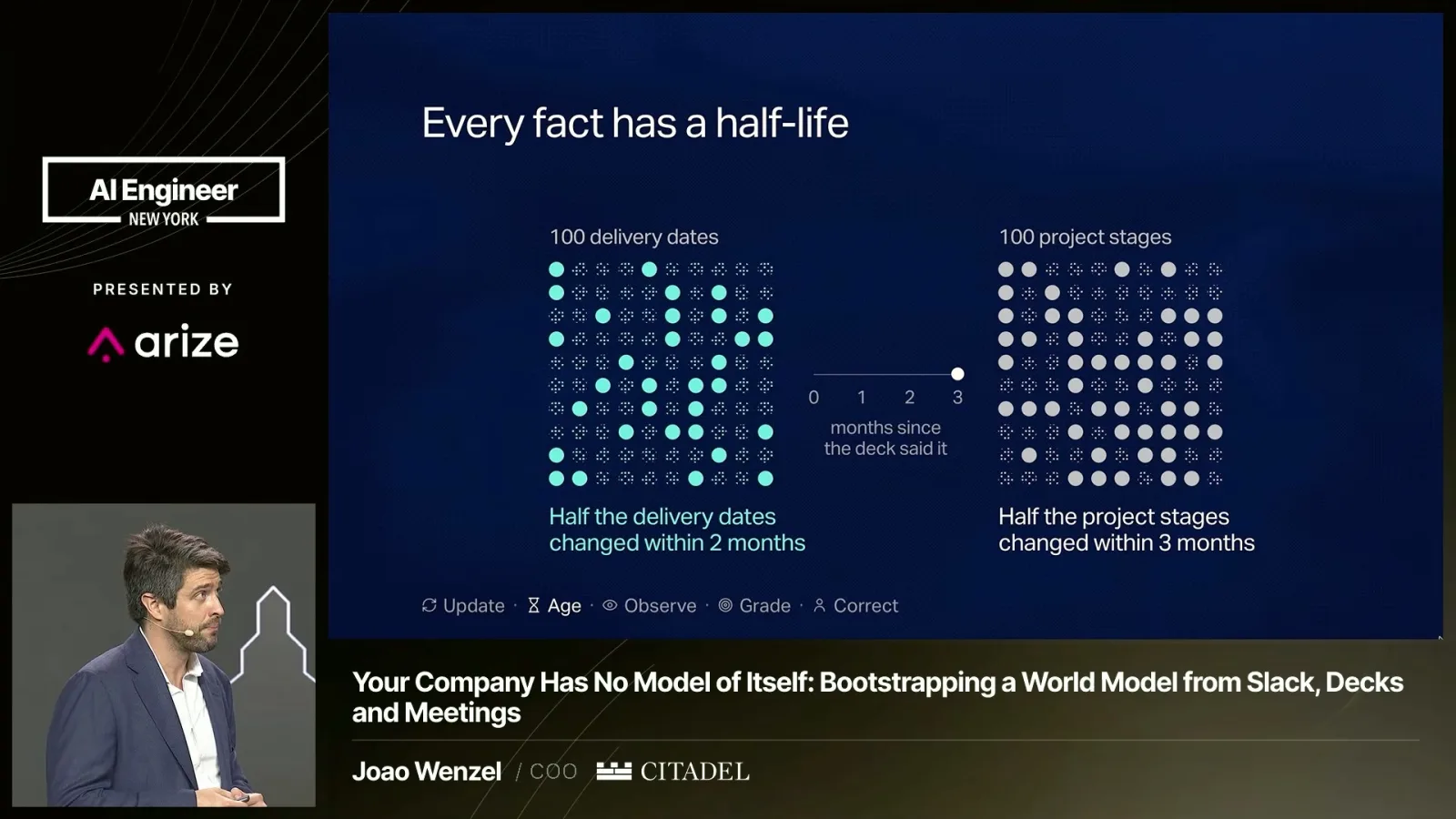
Associating a date with each claim lets an agent take recency into account when answering questions about a project, a person or the company’s intentions.
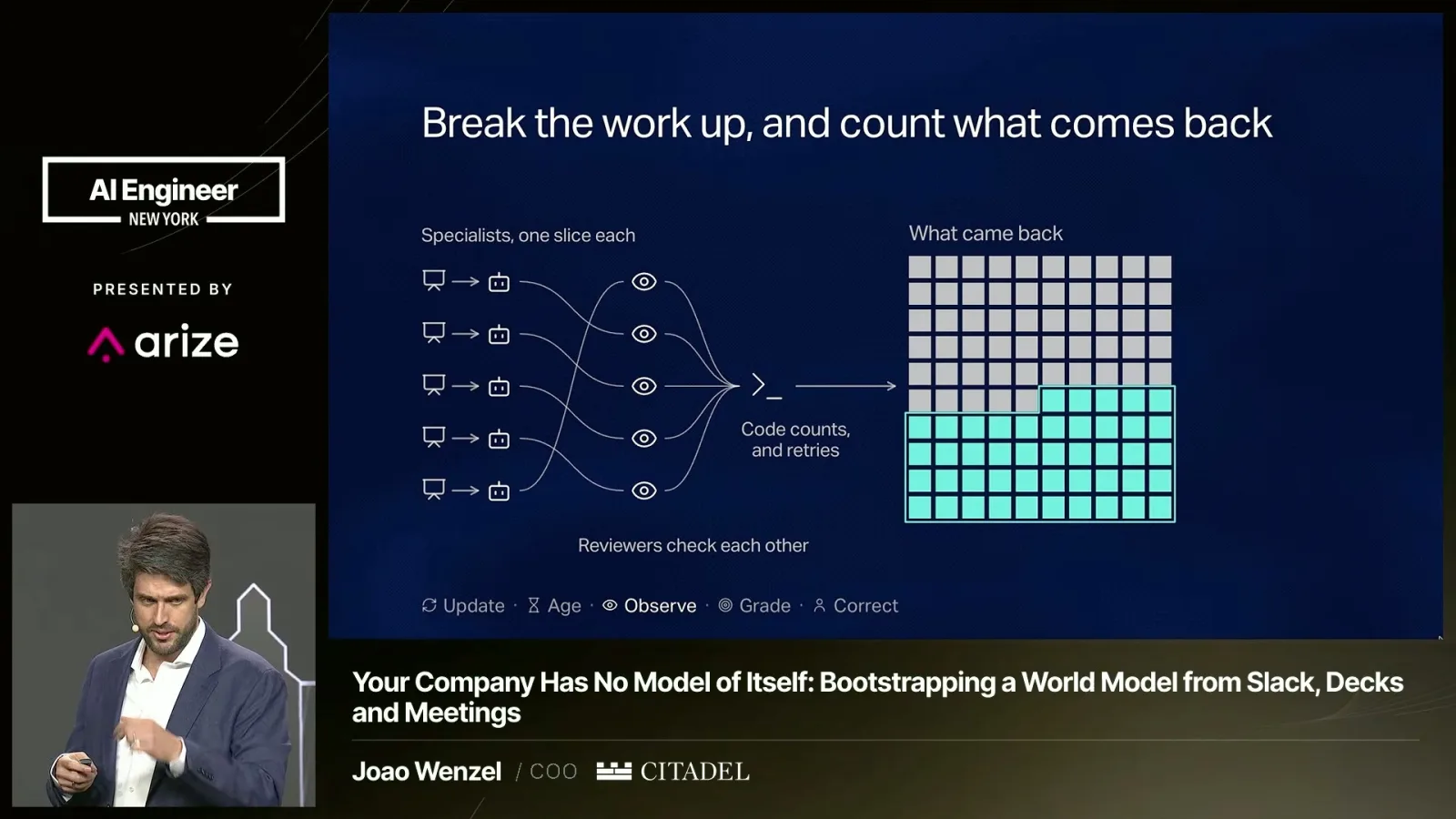
Initially the team tried asking one model to examine the whole corpus at once. Wenzel says it lost detail. The team instead divided materials among specialist agents, added agent review and measured what came back; in the example, insightful project updates more than doubled.
The next test asks whether the model can identify trouble before a project’s formal status changes. The team reconstructs a past snapshot, runs its analysis using information available then and compares its warnings with subsequent labels.
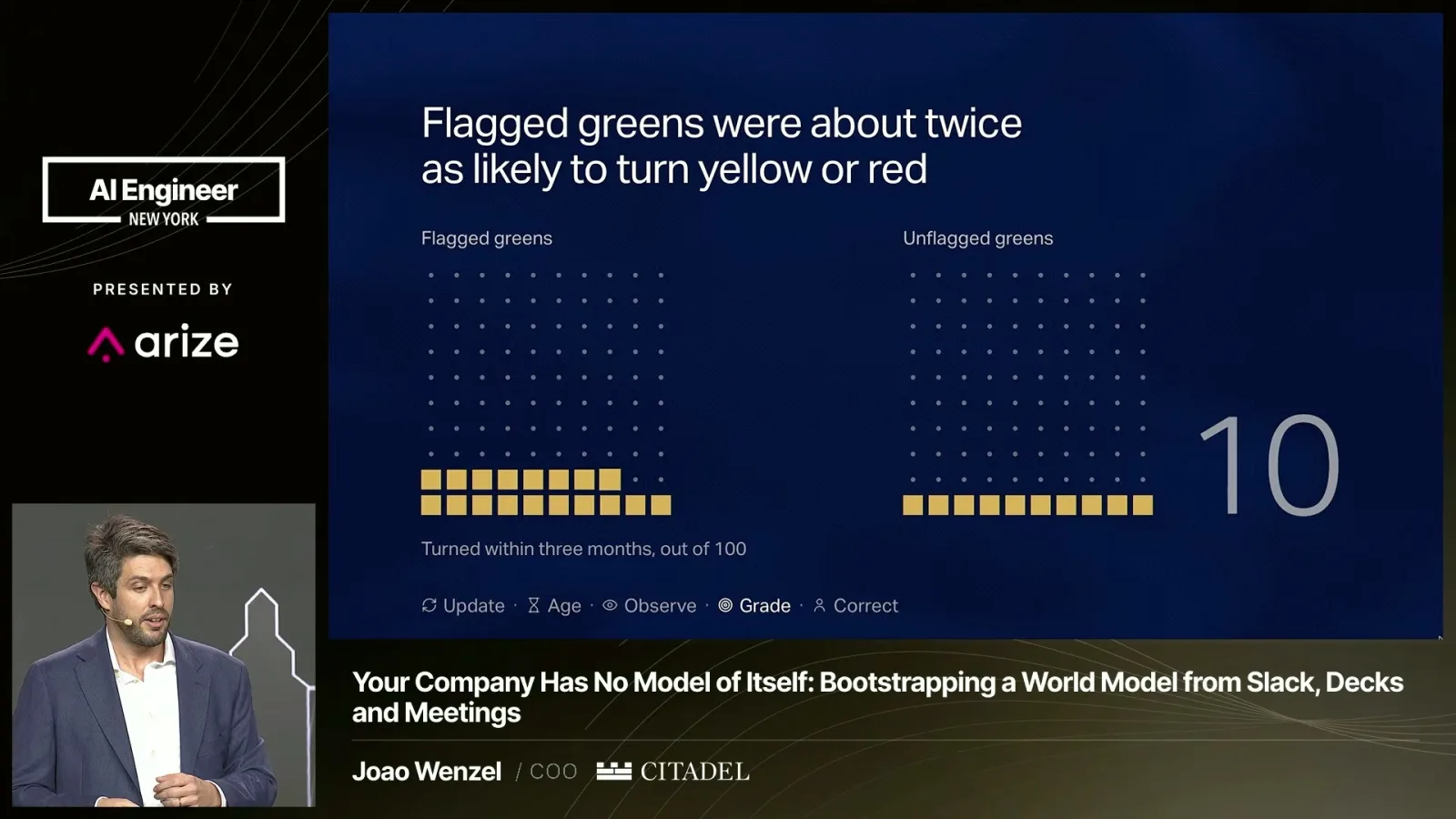
In that backtest, projects marked green but flagged by the agent were about twice as likely to turn yellow or red. Wenzel says this does not predict exactly what will go wrong; it can help people choose where to look.
Collect corrections and operational signals
Stakeholder feedback can teach reusable rules. Messages, pull requests and opted-in agent traces add context, but sources can fail.
Human feedback is another part of the loop. Wenzel recommends meeting stakeholders in the tools they already use, such as Slack or email, and making it easy to respond. A correction that expresses a rule can improve future outputs as well as the current one.
The record can distinguish something inferred by an agent from something a person has confirmed. That distinction preserves the origin of a claim when the system is used later.
Bottom-up evidence includes meetings, Slack, code changes and agent sessions. For a Slack thread, the system can extract the claim, date, participants, related project and link to evidence; pull requests show what changed.
For engineers who opt in, agent-session traces can add the history behind a pull request: how the request evolved, failed tests and decisions made along the way. Wenzel says combining those traces with other sources gives a fuller picture.
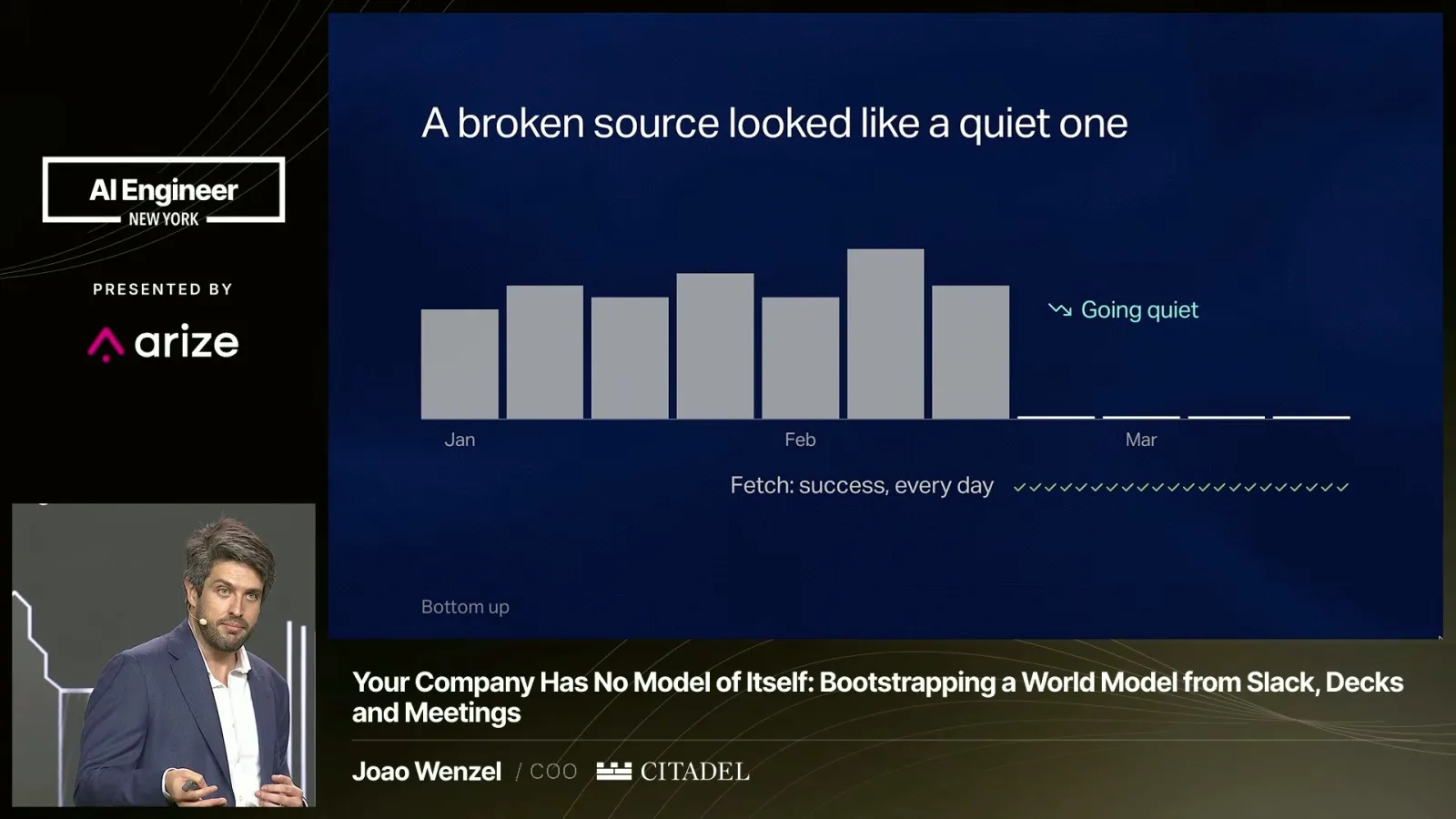
Signals can fail. A speedometer going blank does not mean a car has stopped; similarly, a broken data source can look like a quiet project. The team learned to track when it last attempted a fetch and when the source last worked.
The resulting record can say more than green: a launch date slipped twice, the evidence suggests yellow and people are discussing failing tests. Leaders can start conversations where the deck and the evidence disagree, and managers receive a weekly view of what advanced or went quiet.
Use discrepancies to guide leadership
The system highlights disagreements for management and may support client use cases. Identity matching and human feedback remain open challenges.
Wenzel says the same context-layer pattern could be extended to client information, combining internal and external sources to understand client interests and anticipate needs. One unresolved problem is matching records for the same client across systems without a shared identifier.
The right human intervention depends on confidence and stakes. For low-stakes changes the system can apply confident updates or wait for more evidence if uncertain; high-stakes cases require care over whom to ask, when and how.
Wenzel closes with the five-step loop: update, age, observe, grade and correct. He recommends evaluating against what happens next and designing how agents and stakeholders work together, instead of assuming that indexing every document captures the context between the lines.
Más de este canal
 19:41EN
 AI Engineer· 9 nov 2026A high-reliability automation starts by routing the hard cases awayMatthew Jewkes · Standard CyberneticsMatthew Jewkes describes separating critical errors, ambiguous decisions and unusual exceptions in a biopharma indexing workflow.
 22:01ENAI Engineer· 9 nov 2026Zach Lloyd: make the software factory measurable and editableZach Lloyd · WarpWarp’s CEO proposes recording agent runs, scoring failures and testing changes to the workflow on real tasks.
 27:35ENAI Engineer· 9 nov 2026Uber traded an always-green trunk for faster AI-scale mergesPreetam Dwivedi, Manjari Akella · UberIts merge queue now relaxes some conflicts and validates the combined state after landing, with a verified-good fallback.
 15:25ENAI Engineer· 9 nov 2026Hassan and Omar El Mghari: When an AI financial forecast is right for the wrong reasonsHassan El Mghari, Omar El Mghari · Together AIA Costco membership-fee model passed basic checks and landed close to reported results, but an audit uncovered offsetting assumptions.
 14:38ENAI Engineer· 9 nov 2026Jemima Abu: Give coding agents accessibility rules from the startJemima Abu · CAISA product engineer shows how semantic HTML, reusable components and explicit agent skills can help teams build more usable interfaces.
 21:12ENAI Engineer· 9 nov 2026Tom Moor: Give coding agents the product context that code cannot showTom Moor · LinearLinear’s workflow carries customer requests, past decisions, review history and human feedback from intake through implementation and review.