En 30 segundos
Jon Steinback joins Ellis Hamburger and Alex Heath to discuss Marker, an AI-assisted writing tool built around drafting, revision and discovery. They examine voice input, model feedback, the difference between ideas and expression, and the risk of relying too heavily on generated prose. Company metrics are attributed and their limitations noted.
- 1A blank page, not a promptMarker begins with a writing surface and aims to support the process rather than generate the whole piece.
- 2Questions from an editorThe editor asks about structure and intent instead of only replacing words.
- 3A journalist’s workflowHeath describes dictation, source material, an AI-generated first pass and his own revision.
- 4A company-reported metricSteinback reports more rewriting after Marker comments; the interview does not provide the study method.
- 5Ideas and expressionHamburger distinguishes retrieving or phrasing an idea from discovering a new one.
- 6The cost of dependenceHeath describes his discomfort when an AI tool was unavailable during a flight.
Conclusiones
- Steinback treats prewriting, drafting and rewriting as recurring parts of a process rather than a single output.
- Marker’s editor is designed to ask questions and offer suggestions that the writer must approve.
- The company reports more rewriting after its comments, but the interview does not establish the method or quality impact.
- Heath and Hamburger distinguish first-hand reporting and ideas from the mechanics of producing prose.
- Voice, typing and source material can play different roles for different writers.
- The hosts see value in protecting the experiences and judgment that make their work distinctive.
Lee el texto editado por capítulos
Foursquare and human connections
The group recalls Foursquare and discusses trusted recommendations, community and algorithmic feeds.
Jon Steinback, founder of the writing tool Marker, joins Ellis Hamburger and Alex Heath to ask whether AI can support thinking rather than simply generate prose. After the interview, the hosts discuss their own workflows, dependence on AI and the value of first-hand experience.
Hamburger and Steinback remember their earlier encounters during Foursquare’s heyday. Hamburger misses the service’s trusted recommendations; Heath recalls covering the company and the launch of Swarm. Steinback says it is disappointing that there is still no obvious replacement for exploring places with friends.
The group considers newer location products and the friction of asking people to check in. Hamburger describes a service that uses bank-linked transaction data to infer visits, while acknowledging the privacy tradeoff in sharing that access.
Steinback sees renewed interest in local communities and connections. He says a recommendation from a friend can matter because it gives people something to share and discuss, not merely because an algorithm ranks the place highly.
He recalls a definition of social media as media whose value depends on one’s connection to the person sharing it. In his view, algorithmic feeds have shifted attention away from that relationship. He hopes for new products that rebuild trust and connection.
Hamburger wonders whether people still want content from friends when engagement-driven feeds reward attention-grabbing material. Steinback believes they do, but says new models must compete with systems optimized to hold attention, even when users do not feel better after scrolling.
From DeepMind to Marker
Steinback describes his background and the middle ground he hopes to find between technological extremes.
Before founding Marker, Steinback worked on creative and marketing at Google DeepMind. He describes a long-standing interest in the intersection of new technology, creativity and people, and says the breadth of exploration at the lab drew him in.
Steinback recalls early research interests ranging from historical artifacts to intelligence and storytelling. He remembers asking Demis Hassabis what was on his mind and hearing a question about the nature of time. He contrasts that exploratory atmosphere with the later, more focused AI race.
The conversation turns to questions about AI’s effects on society and jobs. Steinback says he wanted to work on a specific problem, writing, and pursue a middle ground between rejecting technology and assuming the most sweeping technological future.
Writing as a process
Marker’s founder explains the blank writing surface, prewriting, drafting, revision and facilitative feedback.
Heath says Marker opens to a blank page rather than a prompt box. Having outsourced some work to AI, he finds the blank page daunting. Steinback says he and his co-founder Ryan started Marker because they love writing and wanted software that supports the process.
Steinback argues that word processors concentrate on transcription and formatting, while language models often treat writing as an output. His claim that writing tools have not changed meaningfully in 20 years is a product critique, not a complete history of writing software.
Marker removes much of the visible formatting interface and treats the page as a screen. Steinback describes a framework of prewriting, writing and rewriting, informed by academic work on writing. These phases need not occur in a fixed sequence.
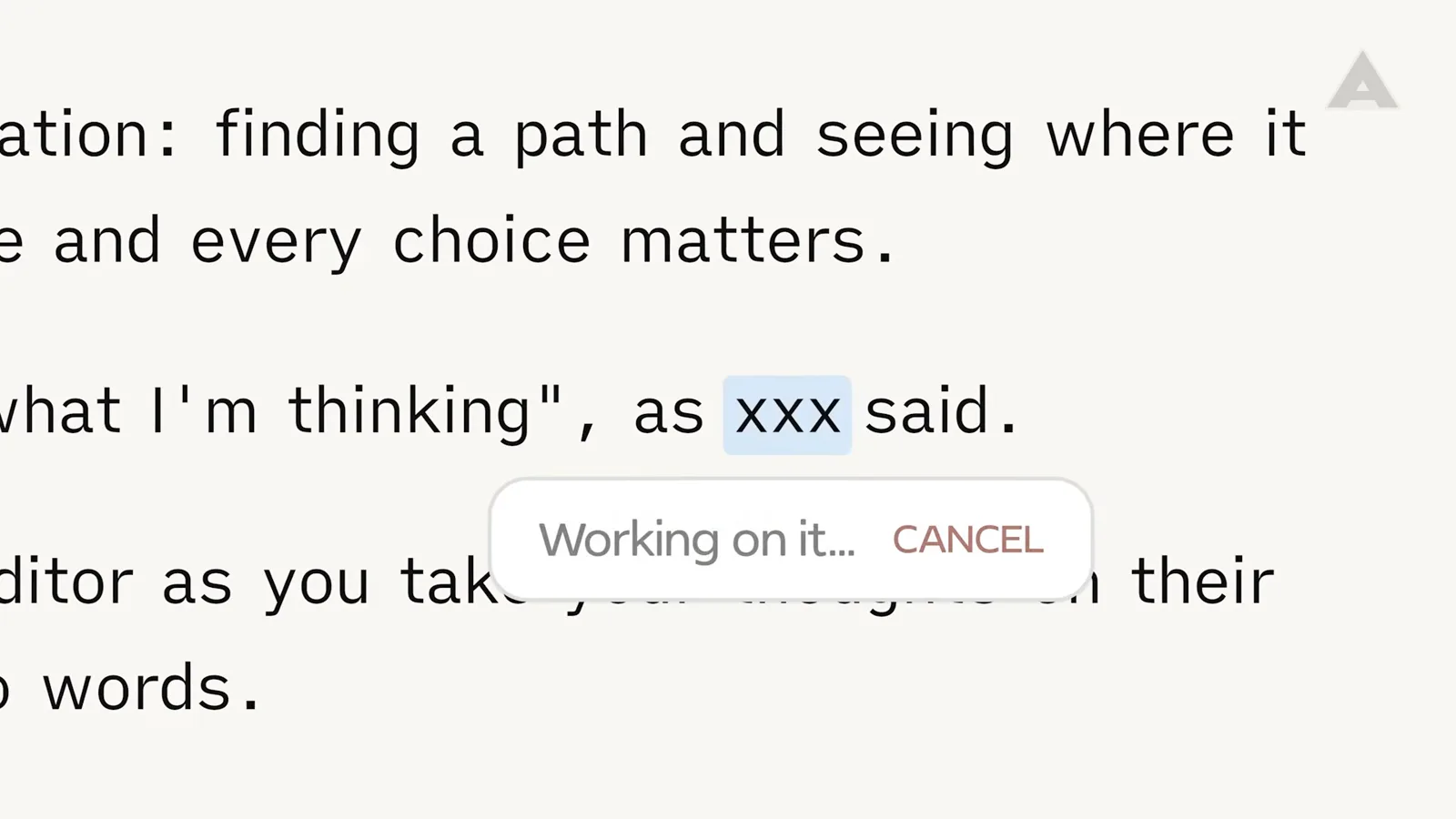
The product is intended to help people develop ideas, get words down and revise. Steinback says writers often spend much of their time rewriting. He describes features that let a writer mark a missing fact for lookup and see alternatives for a highlighted phrase in context.
Marker also has what Steinback calls a facilitative editor. Rather than only swapping words, it can observe that a paragraph contains several points or ask why an idea appears late, prompting the writer to decide what they intend to communicate.
Hamburger likes the idea of marking a missing fact without interrupting the flow. The speakers mention Steve Newman, a Google Docs founder and early Marker investor, as well as Slack co-founder Cal Henderson; their endorsements are presented as the founders’ and investors’ views.
Steinback says the team remains focused on writing, even though people write in many places: messages to family, workplace memos, journalism and client work. He hopes eventually to support those surfaces after developing an end-to-end composition experience.
He describes learning from the writing process itself, including revisions and collaboration, to understand how to help. The hosts ask about dictation: Hamburger says speaking without seeing words appear can feel disorienting.
Voice and an AI-assisted workflow
The speakers compare dictation and typing. Heath describes his own source-connected workflow and asks about integrations.
Steinback says his eight-year-old daughter uses Whisper with Marker to write stories before she knows how to type. He prefers seeing words emerge as he types, while other people use voice naturally. The example prompts discussion of how input habits might change across generations.
Steinback stresses that writing methods vary widely: people may use notebooks, Obsidian, Apple Notes and Google Docs in different combinations. Prewriting, drafting and revision can alternate even within a paragraph; voice and keyboard can also serve different stages.
Heath explains his own workflow. He says he dictates roughly 60–70% of what appears to be typing, uses Cowork with transcripts and a skill based on his previous writing, supplies a detailed prompt, then edits the first pass. He asks whether Marker would fit or require changing the process.
Steinback jokes that Heath should use Marker end to end, then says the existing setup appears to work for him. Heath suggests dictating into Marker and asks about connecting sources such as Granola through MCP. Steinback says the team is testing MCP and wants integrations without sacrificing simplicity.
Hamburger complains that interfaces crowded with AI promotions can feel disrespectful and distracting. Steinback says Marker’s stripped-back interface is deliberate because a mass writing product needs to make its basic workflow understandable.
Steinback says conversations with publishers, agents and writers have changed. In his experience, earlier discussions were often hostile because of concerns about training data; more people are now asking how to use tools without handing over the entire writing process. This is his observation, not a resolution of copyright disputes.
Feedback, voice and ideas
Steinback explains the editor and reports a company metric. The group distinguishes past writing, personal context and new ideas.
Hamburger compares AI assistance to an idea thesaurus: a way to find alternatives and move forward rather than receive a fixed story formula. He asks how Marker’s model and editor are designed to avoid merely repeating familiar structures.
Steinback says the team does not want to act as style police or make everyone sound alike. Marker aims to write with people rather than for them: suggestions are not inserted into the central text unless the user approves them.
He says the system considers dimensions such as rhetorical strategy, inferred audience and stylistic choices. It then offers observations about the writer’s apparent intent, broader feedback and a discussion of tensions between what appears on the page and what it inferred.
The product uses a mix of models, including smaller fast models for tasks such as fact-checking, Steinback says. Model-generated checks can still be wrong and require verification. He says the team deliberately avoids generating prose in the user’s voice.
Steinback reports that Marker comments are 50% more likely to lead to rewriting than comments from another person. The interview does not specify the sample, comparison or research method; the figure describes a company-reported behavior, not a proven improvement in writing quality.
Heath asks whether Marker can ingest all his past writing and learn his style. Steinback says it cannot currently do that and questions whether style transfer captures a writer’s voice well. A model can produce something resembling an author, he argues, without reproducing the full communicative context.
Heath worries that a tool drawing on his past work might gradually produce a stale version of himself, even if he adds some new material. Steinback adds that a model may lack shared social context: a wedding speech, for example, depends on memories and relationships.
Hamburger distinguishes ideas from their expression. He thinks AI might retrieve a memory or help a writer draw out an idea, but the genuinely new thought and its relation to lived experience remain central to the writer’s task.
Steinback recalls an investor predicting that writing would disappear in five years. He disagrees: he values the messy process through which a writer discovers something and wants the author to own the space where ideas are developed and shared.
Writing, originality and discovery
The speakers debate generic content, other writing tools and the role of discovery. Steinback describes Marker’s materials view.
Hamburger argues that generic generated material may provide a short-term advantage but struggles with novelty. For Heath’s reporting, he suggests, new information is a major source of value; Heath agrees that people primarily read him for what he knows rather than literary style.
Steinback says writing ranges from scheduling an appointment to communicating something deeply personal. When the relationship with an audience matters, he argues, word choices carry nuance that generic prose can miss. These are the participants’ judgments about writing, not universal rules.
Asked about other tools, Steinback praises products that put writers at the center, including Sudowrite and Ellipsus, and mentions more focused tools such as Hemingway. He hopes this category grows, whether or not Marker becomes the company that leads it.
Steinback believes a large number of people regularly create and share written material and sees a substantial market. His estimate of 500 million people writing roughly a page a week is an estimate made in conversation, without supporting data supplied in the episode.
Hamburger asks how a mass product fits changing reading habits and limited attention. Steinback says he does not know the full answer, points to independent publishing and bookshops, and believes people and machines are both producing more words.
Hamburger argues that a video, novel or short social post still begins with ideas expressed somewhere. Steinback agrees. They joke about em dashes and AI style, then Steinback names “the dissonance of discovery”: finding something during writing that one did not know when starting.
The materials tab places notes and source documents beside the draft. Steinback says writers move repeatedly between source material and revision; the interface groups the editor, materials, observations and sharing as core parts of the experience.
The group jokes about Jon Steinback sharing a name with a famous writer. He says his mother did not name him after the author and recalls the confusion when teachers asked about Steinbeck at school. The interview ends with thanks.
After the interview: protecting the human work
The hosts reflect on AI dependence, reporting and Hamburger’s client workflow. They close with a discussion of Cannes and Hivemind.
In the post-interview discussion, Hamburger says his own work depends on knowing the context of technology stories, past campaigns and what has already been done. He feels that context may distinguish his work, though he does not claim certainty about how AI will change the market.
Heath worries about becoming over-reliant on AI. He recalls trying to work on a newsletter during a flight when Claude was unavailable and feeling uneasy about having to write without it. He wants to avoid gradually becoming an unintentional, generic version of himself.
Hamburger says Heath’s reporting value lies heavily in his network and access, not only the mechanics of prose. Heath agrees that information is central to his work, while recognizing that some writers’ distinctive prose is the primary value they provide.
Heath says he has never been especially precious about his writing and would likely have used similar tools a decade ago. Some stories arrive almost fully formed when he has deep knowledge or is racing on a scoop; more often, he finds the blank page difficult.
He reflects on writing school papers before these tools: he enjoyed learning and connecting ideas but disliked starting from a blank page. He imagines AI might have made college more enjoyable, while acknowledging uncertainty about what it would have meant for learning.
Hamburger says AI could free Heath to have more conversations and gather more information, but urges him not to automate away the first-hand account of attending an event. Heath agrees that the value of communicating human experience may increase.
Asked about his own process, Hamburger says he could collect a client’s answers through voice notes or an AI interviewer, but generally conducts interviews himself. Heath argues that interviewing is part of Hamburger’s creative process and should not casually be handed off.
Hamburger says he takes his own notes even when an AI meeting recorder runs because it may not know what he finds interesting. He then writes a canonical document describing a company’s beliefs, customer problems and differentiators before shaping the final expression.
For him, the hard work is getting the outline of the ideas right: the problem, the solution and what distinguishes it. Style changes over time. The hosts joke about limiting em dashes, which both associate with contemporary AI-generated writing.
Hamburger says Heath’s value also comes from continuing to go out into the world, meet people and gather new information. They joke about Heath being away with his AIs, then turn to his recent trip to Cannes.
Heath describes the event as a gathering of creators, marketers and media people. Being together in an unfamiliar place can lead to chance conversations, he says, although many attendees are people he also sees in US technology circles.
The hosts return to Hivemind, a product discussed in an earlier episode, and its slower process of asking people for answers. They consider whether it could help reporting, while noting the sensitivity of sharing information with such a system.
They close the post-interview conversation, invite listeners to follow ACCESS and mention Heath’s newsletter and Hamburger’s studio. The episode ends with credits.
Más de este canal
 51:38EN
 Sources Podcast· 16 jul 2026Pódcast · 2 vocesTolan Founder Quinten Farmer on AI Guides, Real Relationships and Building a Calm CompanyInvitado: Quinten Farmer · Presenta: Ellis HamburgerFarmer explains the alien character’s design, user-reported outcomes and premium pricing—and why he wants it to challenge users as well as listen.
 49:05ENSources Podcast· 24 jun 2026Pódcast · 2 vocesJason Yuan on Hivemind, Social AI and the Risks of Sharing Between FriendsInvitado: Jason Yuan · Presenta: Ellis HamburgerThe founder describes an AI that asks people in a network for answers, creates opportunities for connection and must navigate imperfect privacy safeguards.