En 30 segundos
Elon Musk announced Tesla would move its headquarters to Austin while continuing to expand in California. At the 2021 shareholder meeting, investors also debated director elections and workplace and human-rights reporting; a proposal to shorten director terms to two years missed the required threshold. Musk discussed battery supply, new factories and the production targets he held at the time.
- 1Shareholders sought annual director electionsMcRitchie argues more frequent elections improve accountability.
- 2The two-year director-term change missed its thresholdViecha says it did not receive support from the required share of all outstanding stock.
- 3Tesla planned to buy supplier cells while making its ownMusk expected demand from both cars and stationary storage.
- 4Tesla announced a move of its headquarters to AustinMusk also said the company planned to expand its California operations.
- 5Musk viewed manufacturing flow as a long-term advantageHe compares shorter production cycles and closer operations with improving a chip.
Conclusiones
- Tesla announced an Austin headquarters move while planning continued California expansion.
- The board-backed proposal for two-year director terms did not meet the required threshold.
- Shareholder proposals sought more reporting on diversity, arbitration and human rights.
- Musk said Tesla would use both supplier and in-house battery cells.
- His Cybertruck and factory timelines were forecasts made in 2021.
Lee el texto editado por capítulos
Opening and sustainability goals
The chair reviews deliveries, factory construction and long-term ambitions.
The video begins with a waiting period; Tesla’s 2021 shareholder meeting starts at approximately 14:13.
Investor relations director Martin Viecha welcomes shareholders and says nine voting items will precede Elon Musk’s company update.
Board chair Robyn Denholm says Tesla delivered more than 800,000 vehicles in the prior twelve months, began pilot battery-cell production and built factories in Texas and Germany.
She repeats a 2030 ambition of selling 20 million electric vehicles and deploying 1,500 gigawatt-hours of energy storage annually.
Denholm thanks employees, shareholders and departing director Antonio Gracias for their contributions.
Shareholder proposals and voting
Proponents seek changes to director elections and more reporting on workplace and human-rights risks.
Viecha opens the polls and confirms a quorum. He lists the director elections, proposals to shorten director terms and remove supermajority requirements, and the auditor appointment.
The board opposes five shareholder proposals. James McRitchie presents the first, asking for annual director elections and arguing that more frequent votes improve accountability.
Calvert Research and Management asks for more reporting on diversity and inclusion. Its representative says investors need comparable workforce data and information about the effectiveness of company programs.
Nia Impact Capital founder Kristin Hull asks for a report on mandatory employee arbitration. She argues confidential proceedings can limit visibility into workplace discrimination allegations and outcomes.
A New York City pension-fund representative proposes assigning independent board oversight of workforce management, citing labor-related rulings and workplace allegations as concerns.
A Sisters of the Good Shepherd representative seeks an independent human-rights report, including responsible sourcing and conditions in cobalt-mining communities.
After the polls close, Viecha announces preliminary results: the management proposal for two-year director terms did not reach the required share of all outstanding stock, while two shareholder advisory proposals differed from the board’s recommendation.
He says certified results will be filed and closes the formal meeting.
Deliveries, batteries and factories
Musk discusses growth, supply constraints and energy storage.
Musk begins the business update by thanking the Tesla team and reviewing record deliveries. He says supply-chain constraints, particularly chips, affect growth.
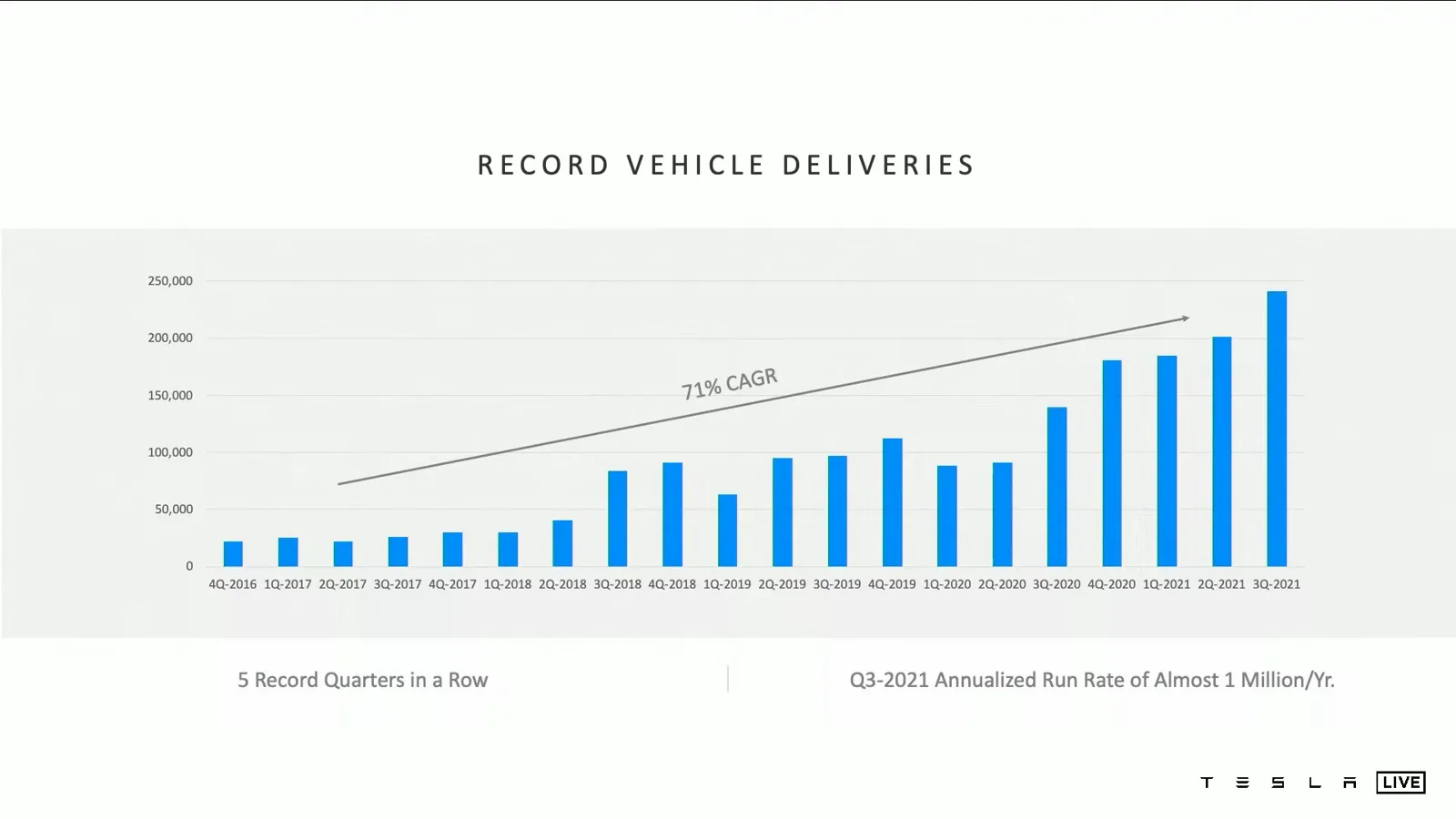
He says Model 3 had become a leading premium vehicle and predicts Model Y could become the highest-selling vehicle by unit volume in 2023, subject to factory ramps.
Musk reviews cash flow and argues that future factory efficiency and driving technology could support it. He says Tesla would be open to licensing its driving system.
He describes lower average selling prices after Model 3 and Model Y, but says supply-chain costs had prompted temporary price increases.
Musk says Tesla plans to buy as many affordable cells as suppliers can make while developing its own. He expects demand for stationary batteries to grow alongside vehicle demand.
He describes renewable generation, stationary storage and electric transport as three parts of the energy transition.
Musk praises the Shanghai team and says the factory had surpassed Fremont in production. He also discusses expanding Fremont and opening Texas and Berlin capacity.
He envisions new factories combining cell production and vehicle manufacturing, and points shareholders to Tesla’s impact report.
Energy, safety and the Austin headquarters
Musk discusses sustainability and announces the headquarters move.
Musk discusses life-cycle emissions and calls for a carbon tax. He argues that battery materials can be recovered and reused.
He recalls a Texas winter power outage and describes solar panels and batteries as a potential source of backup power.
Musk says Tesla has improved factory safety and wants to reduce injuries further as production lines mature.
He discusses AI Day and says Tesla designs both vehicle inference hardware and a training computer. He identifies AI safety as an ongoing concern.
Musk announces that Tesla will move its headquarters to Austin, Texas. He adds that the company intends to continue expanding operations in California.
He cites space and housing constraints around the Fremont factory and describes Austin’s location near the airport and downtown.
Questions on production and investment
He answers questions on Cybertruck, cells, factories and dividends.
Asked about Cybertruck, Musk says shortages of parts and battery cells constrained output. In 2021 he expected production to start the following year and reach volume in 2023.
He says Tesla had no immediate stock-split plan, though it might consider one later.
On 4680 cells, he describes a California pilot plant and expects the Texas factory to take time to ramp vehicle and cell production.
Asked about more factories, he says Tesla can expand in existing regions and might investigate additional locations later. He emphasizes the difficulty of scaling production.
Musk says Tesla did not then plan to pay dividends because it still had many opportunities to invest in the business.
He says chip shortages forced the company to prioritize vehicles over stationary energy products and hopes to provide clearer energy updates once supply improves.
On factory design, Musk compares improving manufacturing flow to making a chip more efficient: bring operations closer and reduce cycle times. He sees manufacturing as a potential long-term advantage.
He says hiring more engineers alone does not guarantee progress and asks recruiters to look for evidence of exceptional ability rather than relying only on school credentials.
Solar, batteries and insurance
The audience asks about home energy, battery materials, grid storage and insurance.
Musk says Model 3 production previously diverted resources from solar products. He discusses working with homebuilders to install solar roofs during new construction rather than retrofitting later.
He argues that rooftop solar and home batteries can help manage demand as transport and heating become electrified, alongside investment by utilities.
Musk describes a limited FSD beta rollout based on a driving safety score. Tesla states that FSD (Supervised) requires an attentive driver who is ready to take over.
Asked when battery mining might no longer be necessary, he says replacing the global vehicle fleet takes time and recycling volumes will grow gradually.
He discusses lithium, nickel and iron-based battery chemistries, expecting iron-based cells to become more common in standard-range vehicles and stationary storage.
Musk says the driving safety score was an early algorithm and would need substantial improvement.
He discusses a Texas battery project and says grid-scale storage can respond to changing electricity demand and support grid reliability.
Asked about Tesla insurance, he describes state-by-state regulation and says the company was preparing a Texas launch.
Musk discusses a possible electric ATV alongside Cybertruck and says lowering the center of gravity could help address rollover risk.
For the last question, he says battery energy density remains important for electric aircraft, but Tesla had other priorities to address first. He thanks viewers and closes the meeting.
Más de este canal
 24:44EN
 Tesla· 6 nov 2026Elon Musk Unveils the Cybertruck: Steel Body, Cracked Glass and a New Pickup DesignElon Musk · TeslaAt Tesla’s 2019 event, Musk introduced the electric pickup and demonstrated its body, glass, suspension and cargo bed.
 59:56ENTesla· 21 oct 2026Tesla Q3 2026: Cash Flow, FSD Demand and the Cost of Scaling RobotsElon Musk, Vaibhav Taneja, Travis Axelrod · TeslaExecutives discuss quarterly margins, capital spending and plans for Cybercab, Optimus and chip production.
 23:21ENTesla· 16 oct 2026Tesla’s Roadster Event: A Ramp Stunt, Aerodynamics and a 2028 Production TargetElon Musk, Franz von Holzhausen, Lars Moravy · TeslaElon Musk, Franz von Holzhausen and Lars Moravy demonstrate a prototype developed with SpaceX engineering.
 1:09:55ENTesla· 22 jul 2026Tesla’s Q2: Margins Narrow as Spending on Robots and AI RisesTravis Axelrod, Elon Musk, Vaibhav Taneja, Ashok Elluswamy, Lars Moravy · TeslaTesla reported higher energy deployment and negative free cash flow while executives outlined Robotaxi and Optimus plans.
 27:27ENTesla· 21 may 2026Tesla’s Final Model S and X Deliveries: How the Cars EvolvedElon Musk, Franz von Holzhausen, Lars Moravy · TeslaElon Musk and Tesla’s team recall a tent-based design studio, years of changes, and plans for the former production line.
 1:05:20ENTesla· 22 abr 2026Tesla Plans a $25 Billion Investment Year as It Prepares OptimusTravis Axelrod, Elon Musk, Vaibhav Taneja, Lars Moravy · TeslaOn Tesla’s Q1 2026 call, executives detail one-time margin gains, battery constraints and plans for robots and driving software.