En 30 segundos
At Tesla AI Day 2022, Elon Musk and Tesla engineers showed a development robot called Bumble C walking onstage without a tether, followed by a newer Optimus prototype that was not yet ready to walk. The team discussed a 2.3 kWh battery, actuators, perception networks and motion planning. Musk’s proposed high-volume production and sub-$20,000 price were goals, not demonstrated commercial availability.
- 1A development robot walks without a tetherTesla shows Bumble C onstage and prerecorded examples of tasks such as handling a watering can.
- 2A second prototype uses Tesla-designed hardwareMusk says the newer Optimus was not ready to walk at the event, while setting a goal for a future production design.
- 3Battery, computer and actuators are integratedEngineers describe a torso battery and computer, 28 actuators and a hand designed for several kinds of grasp.
- 4Perception and motion use several techniquesThe team discusses occupancy networks, visual tracking, human demonstrations and trajectory optimization.
Conclusiones
- Bumble C walked onstage; the newer Tesla-designed prototype was presented separately and was not yet walking at the event.
- Tesla described a 2.3 kWh battery, torso-mounted computer, custom actuators and hands designed for both power and precision grips.
- The team said it adapted perception networks and used human motion capture plus trajectory optimization for robot movement.
- Musk’s production scale, price and near-term walking timeline were 2022 projections.
Lee el texto editado por capítulos
Bumble C’s stage demonstration
Musk introduces an untethered walking prototype and the team shows recorded demonstrations.
At Tesla AI Day 2022, Elon Musk introduces Optimus and contrasts the development robot with the previous year’s presentation featuring a person in a robot suit. Tesla says this is the robot’s first untethered operation onstage.
The development prototype walks out and waves. Musk says it can perform more tasks than shown live, but the team chose a limited demonstration to reduce the risk of a fall.
Tesla shows prerecorded examples of the robot moving and handling objects, including a watering can. A team member says perception networks used for vehicle assistance were retrained using data collected for the robot.
The newer Optimus design
A second prototype appears; Musk outlines price and production ambitions and engineers describe its core systems.
Musk identifies the first prototype as Bumble C, a development robot using some commercially sourced actuators. He says a second Optimus prototype uses Tesla-designed actuators, battery and controls.
The newer prototype is brought onstage but is not yet ready to walk. Musk predicts it could walk within weeks and describes it as closer to a future production design; this was a 2022 projection.
Musk says the goal is a useful humanoid robot made in high volume and estimates an eventual price below $20,000. These are aspirations rather than demonstrated sales or a guaranteed price.
A Tesla engineer describes a 2.3 kWh battery in the torso and says the battery electronics are integrated within the pack. The team also places the central computer in the torso and discusses communications and security features.
Actuators, hands and perception
Tesla engineers discuss the robot’s joints, grasping design and visual perception.
Engineers explain that the robot uses multiple actuators and that tasks such as walking or carrying must be translated into joint requirements. They describe actuator components, sensors and gearing.
The team describes hands driven by metal tendons, designed for both wide power grasps and precise handling of small objects. It lists six actuators and 11 degrees of freedom for the hand design.
A presenter says the robot uses an occupancy network adapted from Tesla’s vehicle software and retrained with robot data. The team also discusses visual features and tracking to estimate the robot’s position and movement.
Motion planning and future work
The team describes human motion references, trajectory optimization and a proposed factory use case.
Tesla shows a simulation of walking control and says its motion-control approach has improved as more joints and balancing techniques were added. The simulation is presented separately from the live stage demonstration.
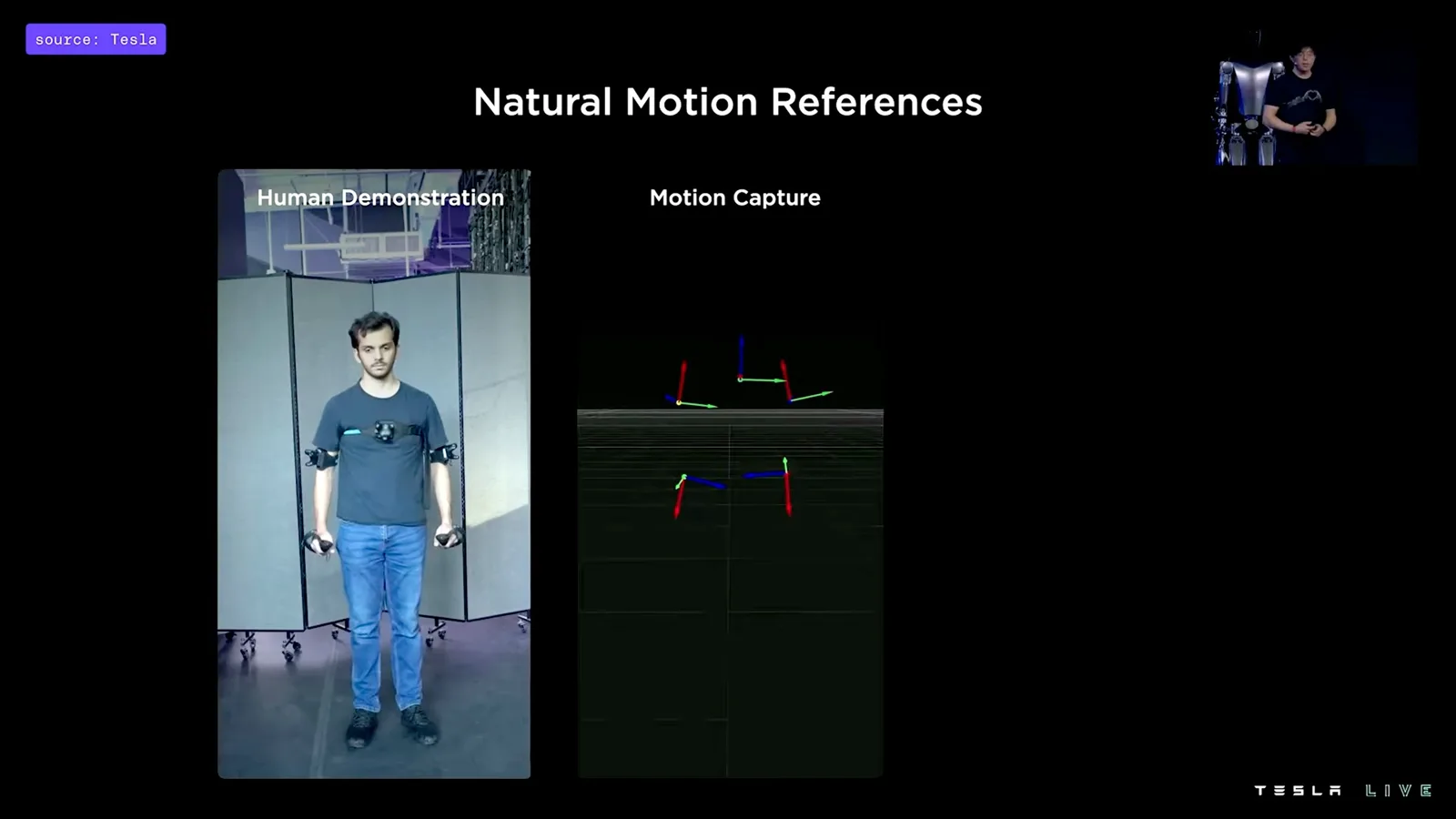
For manipulation, the team describes recording human demonstrations with motion capture and mapping those motions to the robot. It then uses trajectory optimization to adapt a reference movement to a different object position and maintain balance.
The team says its next goals are to bring the newer prototype to parity with Bumble C and explore a factory use case. The presenters close by crediting the work completed over the preceding months.