En 30 segundos
Theo - t3.gg reviews Anthropic’s August 2026 Claude Code limit announcement, the earlier temporary promotion and the separate Fable cap. He argues that subscribers needed a clearer explanation of the reduction from their current allowance and offers a hypothetical example of a better announcement.
- 1Two different baselinesThe new limit is 125% of the original baseline, compared with the temporary 150% allowance: a reduction of about 16.7% from the latter.
- 2How the promotion developedAnthropic previously doubled five-hour limits and later introduced a temporary 50% weekly increase that was extended.
- 3A separate Fable capFable 5 returned to certain plans with a separate 50% limit, affecting users who preferred that model.
- 4A proposed rewriteTheo’s example leads with the end of the promotion; its proposed removal of the Fable cap is fictional.
- 5A compute hypothesisTheo speculates that capacity constraints and enterprise demand help explain the change.
Conclusiones
- A permanent 25% increase over the original baseline is about 17% below a temporary 50% increase.
- The announcement covered Pro, Max, Team and seat-based Enterprise plans and took effect September 14, 2026.
- A separate Fable 5 cap limited how much of the overall allowance some subscribers could use on that model.
- Theo’s proposed removal of the Fable cap was a hypothetical suggestion, not an announced change.
- His explanation of compute economics is a hypothesis, not an established account of Anthropic’s decisions.
Lee el texto editado por capítulos
The arithmetic behind the announcement
The permanent increase is measured against an older baseline. Compared with the temporary allowance in effect, the change is a reduction.
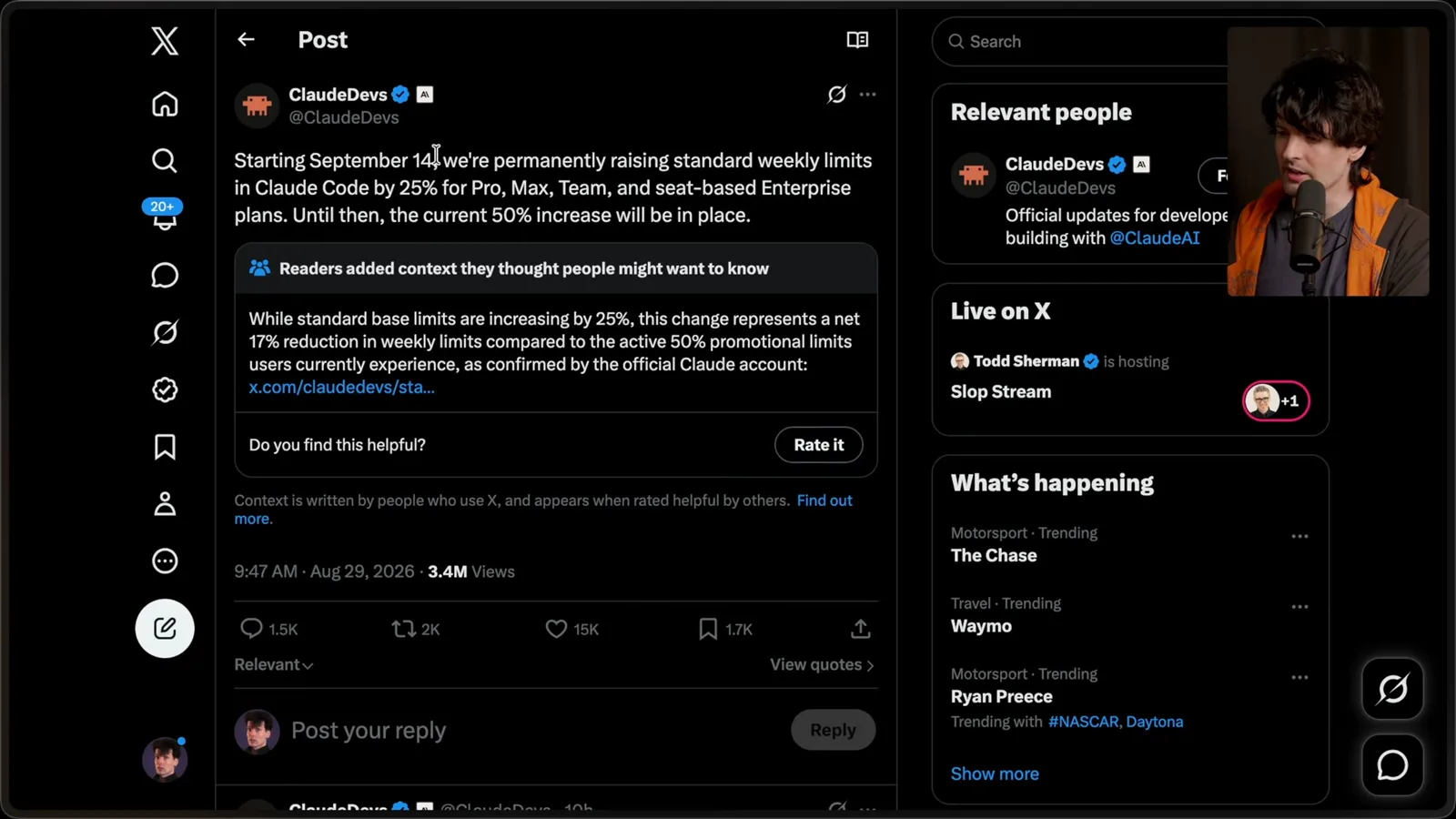
Anthropic says that starting September 14 it will permanently raise standard Claude Code weekly limits by 25% for Pro, Max, Team and seat-based Enterprise plans. That sounds like an increase, but the existing temporary 50% increase is ending. Compared with the limit people have actually been using, the new allowance is roughly 17% lower: 1.25 divided by 1.5 is about 0.833.
I have been watching these limits closely and even have five accounts. I have exhausted them in some weeks, so I have a lot of thoughts about how the changes affect heavy users and how Anthropic communicates them.
A history of changing limits
Theo reviews the compute partnership, five-hour limits and the extended weekly promotion. He explains why a separate Fable cap mattered to him.
I have heard positive things about the people on the Claude Code team, but I find the official communication baffling. Anthropic deleted its first announcement and posted a revised version, yet I still think the opening presents an effective reduction as an increase.
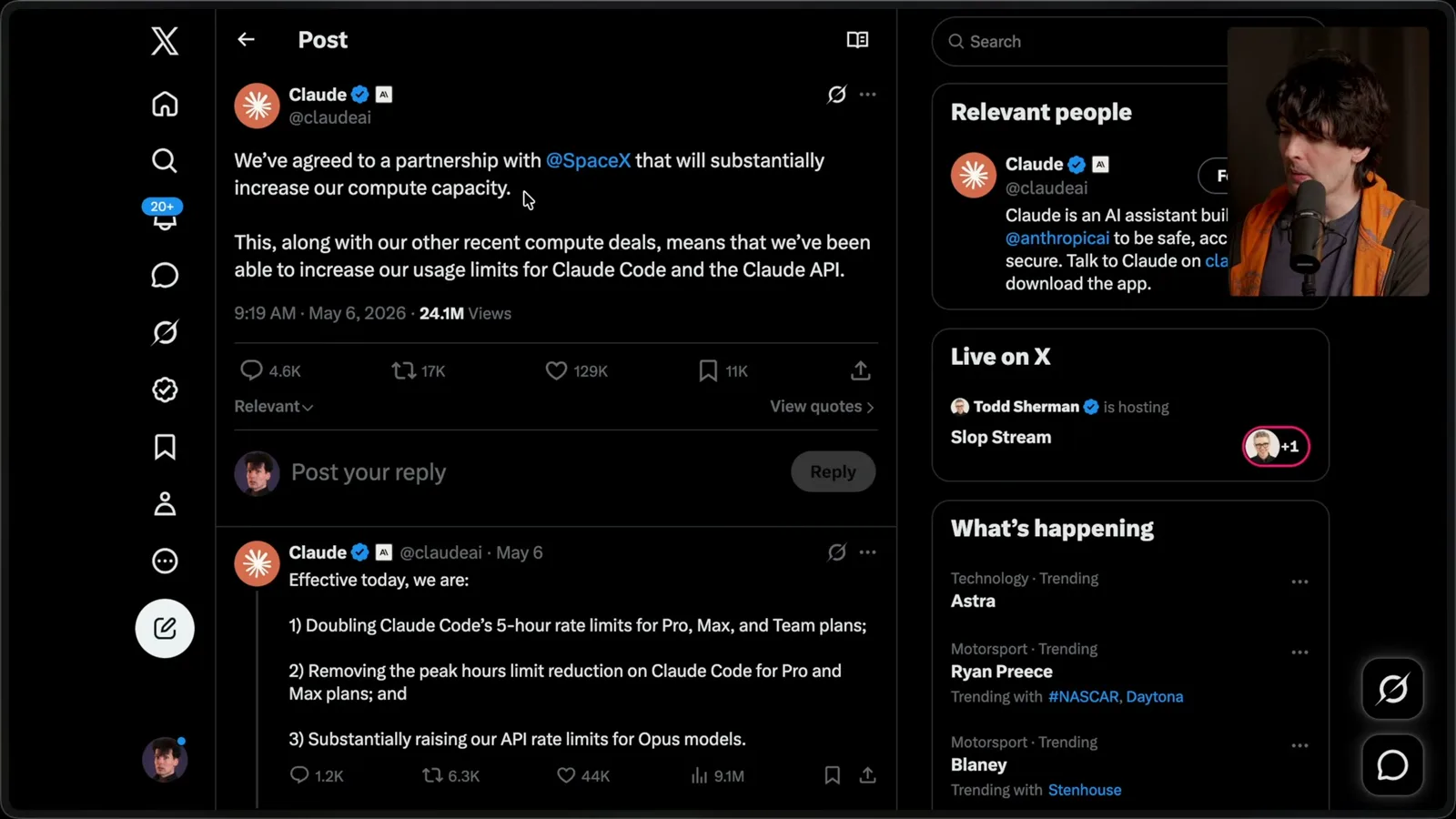
To understand the context, go back to May. Anthropic announced a SpaceX partnership and other compute deals, doubled Claude Code’s five-hour limit for Pro, Max and Team plans, removed peak-hour reductions for Pro and Max, and raised Opus API rate limits.
The five-hour increase was useful, but for people who could burn through a weekly allowance in a couple of sessions, it did not address the main constraint. At the time, Codex subscriptions did not have the same five-hour limit on the $100 plan, although that could change.
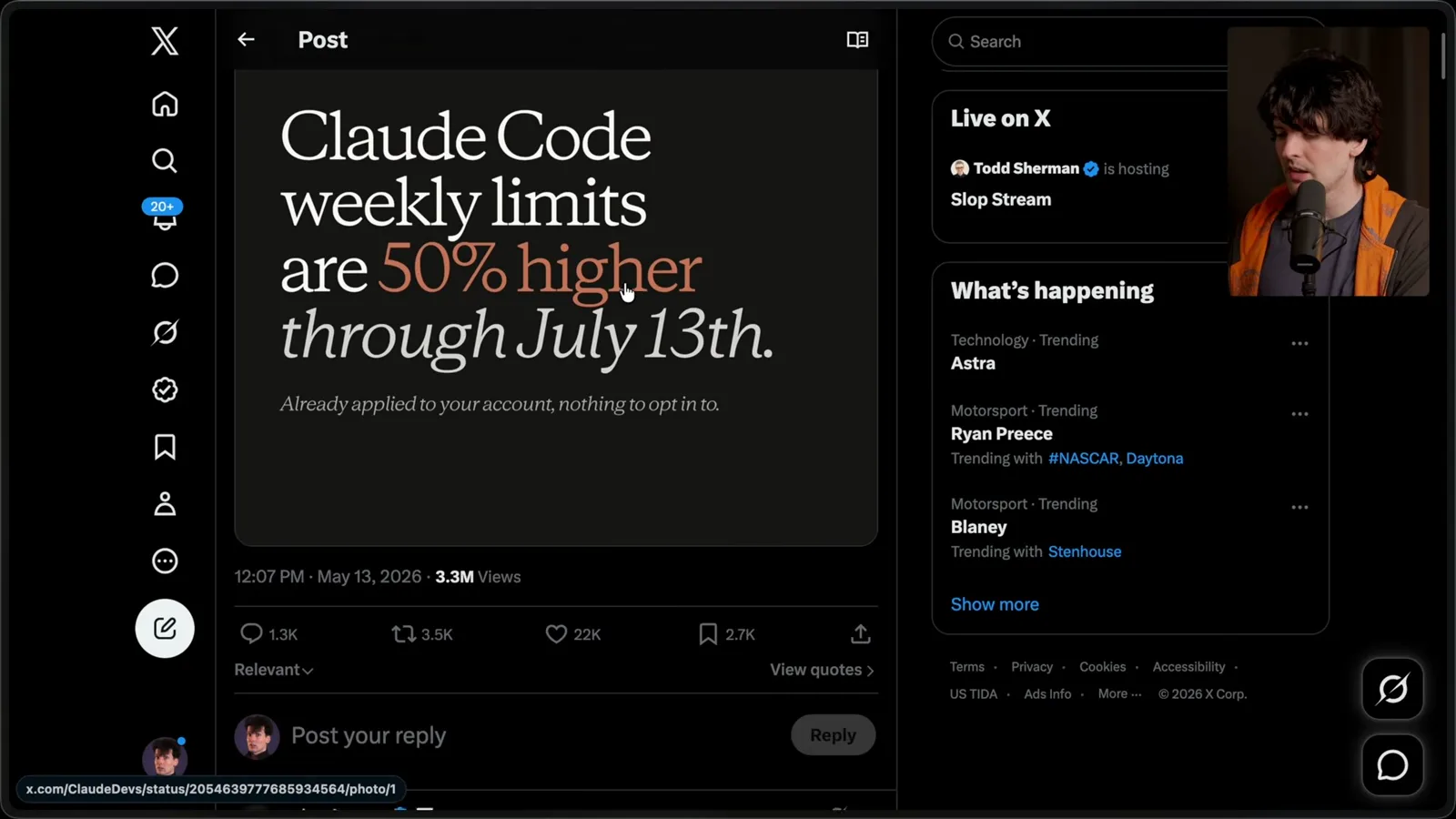
A week later, Anthropic announced a temporary 50% increase in Claude Code weekly limits through July 13. The promotion was subsequently extended, including after the disruption around Fable access, and eventually ran until the September change.
When Fable was removed, people who had subscribed for that model were understandably unhappy. I had signed up for one account specifically to use it, so losing access mattered to me. Anthropic extended the increased limits while access changed.
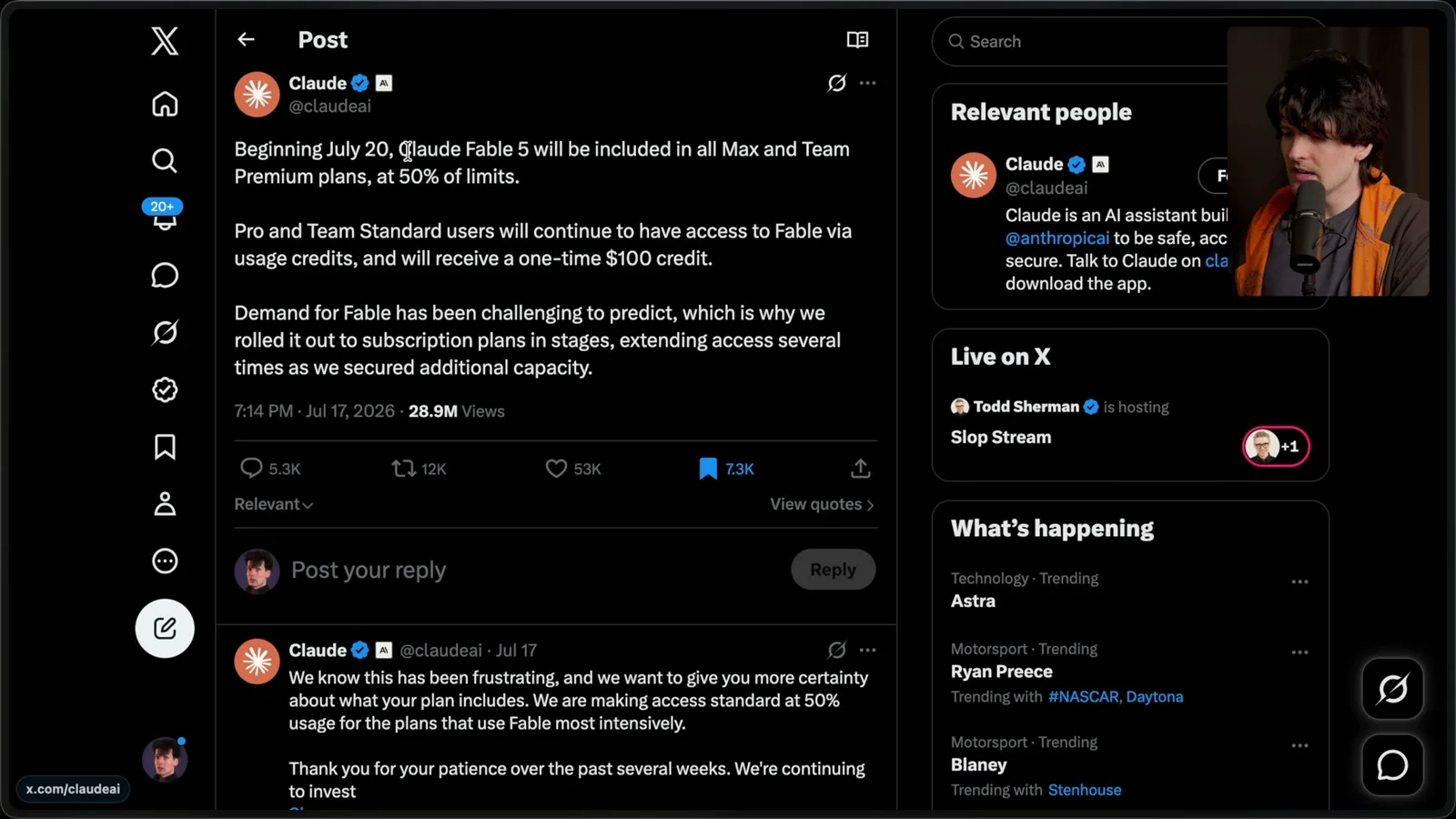
When Fable 5 returned to Max and Team Premium plans, it came with a separate cap at 50% of the allowance. The announcement on screen says Pro and Team Standard users would access Fable through usage credits and receive a one-time credit. The separate cap changes how much of the subscription can be spent on the model I prefer.
Imagine a subscription with a theoretical $1,000 of inference: under the example I am using, after $500 of Fable you would have to switch to another model for the rest of the window. Those dollar figures illustrate the restriction, not a published dollar entitlement.
That has been painful for me because I use Fable much more than Opus or Sonnet. I can have accounts with their Fable allowance exhausted while a substantial share of the overall weekly limit remains. I still value Fable enough to pay, but the separate limit reduces the usefulness of my subscriptions.
How to tell users about the change
Theo criticizes the announcement and presents his own example. His proposed Fable change is hypothetical.
The weekly promotion was extended again to September. The latest announcement gives users a permanent increase over the old baseline, but I think the important fact for someone using the service today is that their available weekly usage will fall.
Most Claude Code customers are not following every post on social media. Some started paying or upgraded during the extended promotion and may only know the higher limit. In my view, a clear direct notice should explain the experience they will have when the promotion ends.
I wrote a sample announcement to show what a more empathetic version might look like. It starts by explaining that the 50% promotion was extended several times and is ending, then spells out that a permanent 25% increase over the original base means an approximately 17% reduction from the current allowance.
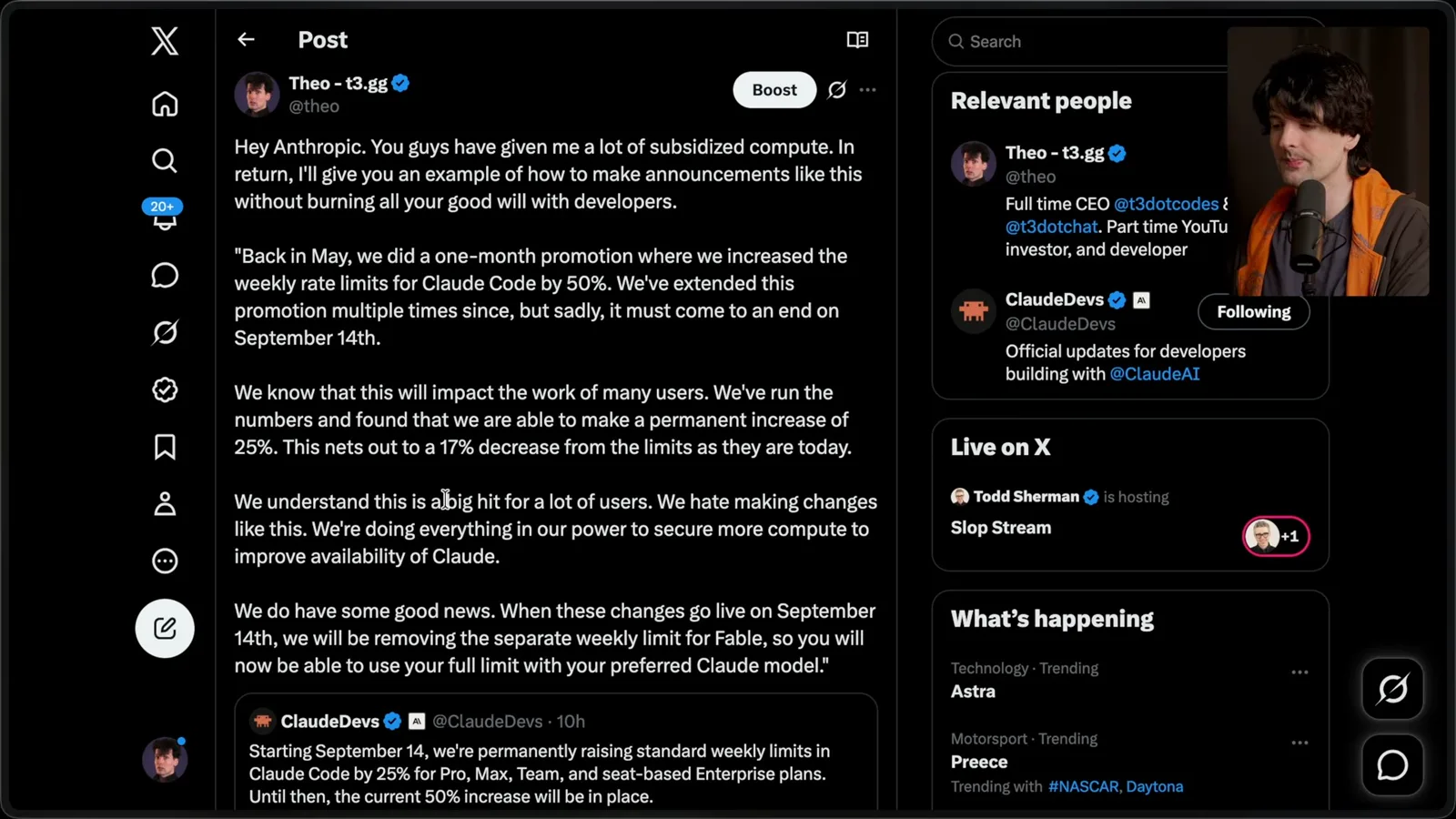
My example also includes a hypothetical goodwill gesture: removing Fable’s separate weekly cap. To be absolutely clear, that is my suggestion, not something Anthropic announced. I would like the company to make that change, but readers should not treat it as a real policy.
My general point is to lead with the difficult news, acknowledge the impact on users, and describe how the change will feel to them. Explaining an internal baseline alone does not help a customer who has built a workflow around the current allowance.
Partnerships, communication and compute
He compares public statements and offers a theory about compute economics. He distinguishes those opinions and predictions from announced policy.
Anthropic’s chief compute officer recently emphasized its support for Claude in Cursor and its relationship with SpaceX. I think the company can communicate clearly about partnerships when it chooses; I want the same care applied when its own users face a reduction.
I am frustrated enough to question how much weight Anthropic gives its customers. My account of its internal decision-making and how the announcement was written is speculation, not information I have established. What I can see is a message that does not adequately acknowledge the cost to users.
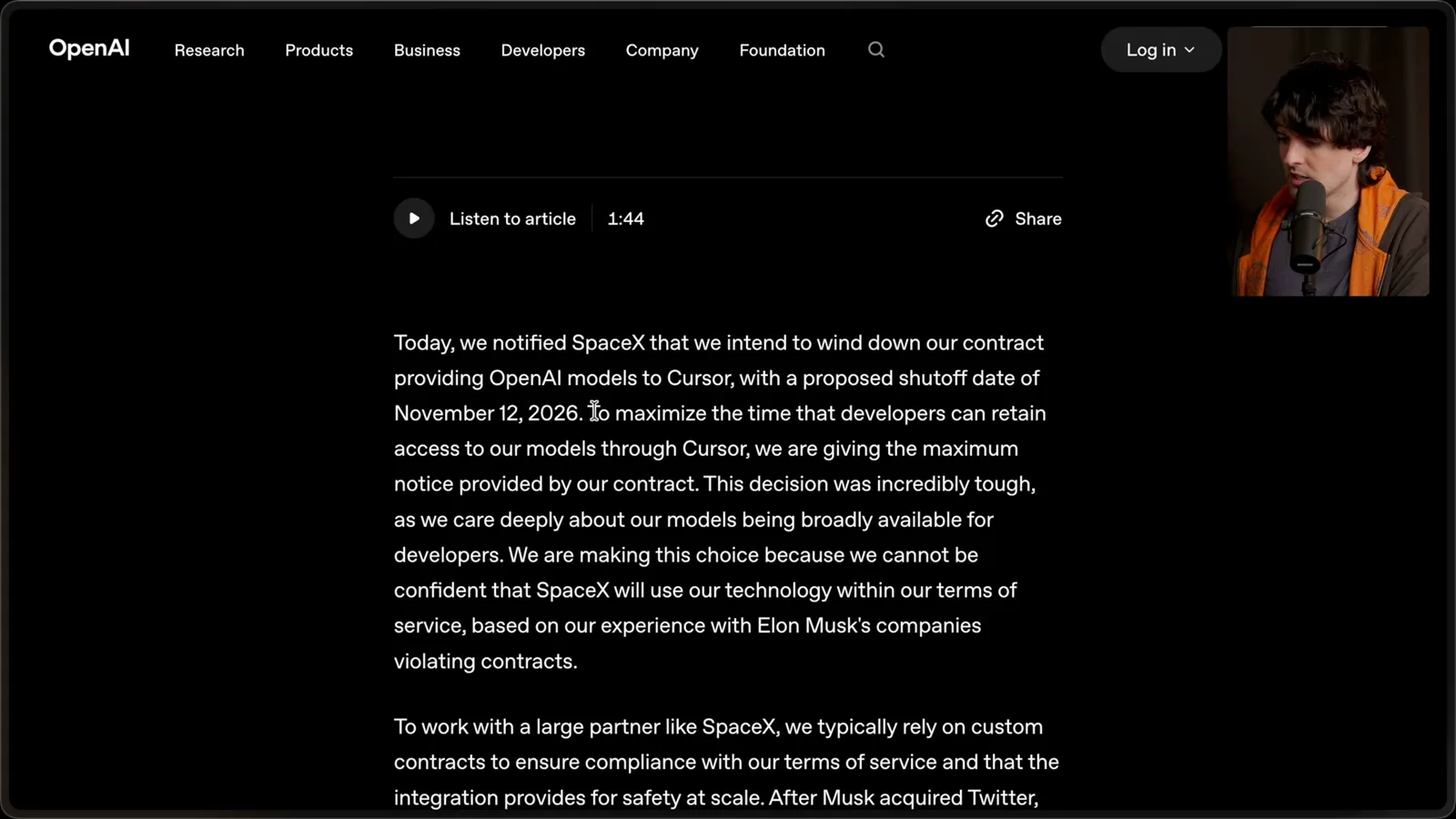
I compare that with OpenAI’s announcement about winding down its model contract for Cursor, which discusses notice and the effect on developers. Whatever one thinks of that decision, I find its wording more attentive to the people affected.
My theory is that compute availability and the economics of enterprise API usage are driving some of the pressure on subscriptions. Business-day demand could make subscriber usage compete with higher-priced API demand. That is my interpretation, not an explanation confirmed by Anthropic.
I would not be surprised if peak-hour restrictions returned, though that is a prediction rather than a policy announcement. Combining a smaller weekly allowance with Fable’s separate cap is especially frustrating while the next model I am hoping for has not arrived.
The user experience
Theo hopes for more capacity and flexible access. He closes by asking Anthropic to communicate more directly with its community.
I hope a future announcement brings a more efficient model and more flexibility, but that did not happen in this announcement. From the perspective of users who have been relying on the promotion, this is a downgrade, and the communication should say so plainly.
I still think Fable 5 is excellent for coding; my multiple subscriptions reflect how much I use it. But I dislike the restrictions around using an Anthropic subscription and contrast them with the flexibility I see in Codex. Those are my judgments and experiences, not guarantees about either service.
I want Anthropic to change how it communicates with its community. I like the model and want to defend it on its merits without also having to defend decisions that make the experience worse for users.
Más de este canal
 38:47EN
 Theo - t3․gg· 28 oct 2026Theo’s Long-Running Agent Experiments: Verification, Compute and CostTheo Browne · Ping LabsA skateboard game and two compiler projects show how repeated checks and flexible compute can sustain agent work—and how expensive those loops can become.
 36:07ENTheo - t3․gg· 27 oct 2026Theo on Token Costs, Coding Agents, and the Price of AI CapabilityTheo Browne · Ping LabsA viral estimate of Lauren's AI spending prompts a closer look at cache pricing, benchmarks, and the changing work of coding agents.
 30:37ENTheo - t3․gg· 26 oct 2026Theo’s Three Skills for Reviewing and Shipping with Coding AgentsTheo Browne · Ping LabsHow sol-loop, full-send and full-stop encode review, verification and different levels of merge authority.
 0:43ENTheo - t3․gg· 23 oct 2026Theo Distinguishes Security Vulnerabilities from Active AttacksTheo Browne · Ping LabsA short explanation of why disclosed software flaws and reported attacks are different kinds of security news.
 29:22ENTheo - t3․gg· 22 oct 2026Theo on Security Vulnerabilities, Stolen API Keys and AITheo Browne · Ping LabsA look at the gap between vulnerability disclosure and patching, and a speculative account of why stolen inference keys may be valuable.
 31:13ENTheo - t3․gg· 20 oct 2026Theo on Why Smarter Models Help More Than DevelopersTheo Browne · Ping LabsFrom game modifications to compiler experiments, Theo revisits his assumptions about who benefits from more capable AI.