En 30 segundos
Altimeter partner Jamin Ball joins Latent Space host swyx to interpret Anthropic's S-1 and discuss why a frontier lab might go public, how compute spending relates to revenue, and what the filing's large net loss means. Ball says these are his personal views and discloses that Altimeter holds a substantial Anthropic position. The conversation also explores the cost of staying at the frontier, competition from specialized models, data-center lending and the uncertainty around future demand. It was recorded October 29, 2026, before the amended filing mentioned in the video description.
- 1Why go public?Ball says disclosure and credit ratings may make it easier for lenders to assess the company and infrastructure providers to finance capacity.
- 2Revenue versus serving computeBall compares 14-fold revenue growth with 2.3-fold growth in serving-compute spend and interprets the ratio as a large improvement in monetization efficiency.
- 3The newest models drive revenueBall cites the filing in saying more than 80% of revenue in a recent quarter came from models released in the previous six months.
- 4A multiyear compute billAn Altimeter chart spreads estimated fixed and less certain commitments over time; the yearly allocations are estimates rather than a disclosed payment schedule.
- 5Convertible notes and net lossBall distinguishes the original cash raised from the later marked value of convertible instruments and explains how revaluation can create noncash charges.
- 6Debt providers look through to the customerInfrastructure lenders may face concentrated exposure to the same AI labs even when their direct borrowers are different cloud providers.
Conclusiones
- Public financial reporting could help lenders assess a lab whose future payments support data-center financing.
- Ball reads revenue growth alongside serving and total compute costs, while warning that future investment can change margins.
- The value of convertible instruments can rise with company valuation and generate noncash losses in reported net income.
- Strong recent model revenue makes repeatable research and successive releases central to Ball's frontier investment thesis.
- Debt availability depends on concentrated customer exposure, project execution, interest rates and lenders' appetite for risk.
- Estimates of AI infrastructure spending depend heavily on assumptions about capacity, cost and timing.
Lee el texto editado por capítulos
Opening and disclosure
Swyx introduces Jamin Ball and the purpose of the discussion. Ball discloses Altimeter’s position and says he is speaking personally.
Swyx welcomes Jamin Ball, an Altimeter partner and author of Clouded Judgement. Ball says the newsletter began as a way to use public software-company metrics and valuation multiples to give founders a sense of what public markets look like; it has grown into a weekly forum for his thoughts on markets and AI.
The discussion turns to Anthropic's first public S-1, which gives a much fuller picture than the revenue figures that had periodically leaked. Ball emphasizes that his comments are his personal views, and discloses that Altimeter has a substantial position in Anthropic.
How an IPO works and why a lab might list
The speakers explain filings, roadshows, pricing and liquidity. Ball proposes that access to credit could be another important motivation.
Ball explains the usual IPO sequence: after the S-1 is filed and a waiting period passes, management meets prospective investors on a roadshow before shares start trading. He speculates about a November window, while Swyx notes that filing does not guarantee a listing and that the holidays can complicate timing.
The size and pricing of the offering were not established in their discussion. Ball describes an IPO as a large financing: selling a given share of the company at a given price determines dilution. A big first-day price jump can be celebrated by investors yet also suggest the company could have raised money at a higher price.
Why go public at all? Ball lists employee and investor liquidity after lockups and the value of public shares as acquisition currency. Private companies can already raise enormous sums and run employee tender offers, although tenders restrict how much people can sell.
His less obvious explanation is access to credit. A lender financing a data center for a customer such as Anthropic needs to assess that customer's ability to pay, and syndicate members need financial information too. Companies have historically hesitated to make that information widely available while private.
Public reporting and a credit rating can help companies and their infrastructure suppliers tap debt markets more efficiently, Ball argues. The rating affects borrowing costs, though he presents this as one possible reason for going public, alongside liquidity and the chance for ordinary investors to participate.
Swyx notes that equity sits below debt in the capital structure and asks about data-center borrowing costs. Ball says rates have risen and that some data-center debt deals were being done above 10%; he is cautious about attributing the timing of an IPO to that fact alone.
Cash, margins and compute efficiency
Ball reviews the reported margins and cash position. He compares revenue growth with the growth in compute used to serve models.
The S-1 also allows a closer look at economics than leaked annualized revenue figures did. Ball cites 85% gross margin, more than 20% free-cash-flow margin and an 8% GAAP operating margin in the figures under discussion. He later distinguishes these operating metrics from a very large reported net loss.
Ball says Anthropic had raised $141 billion in equity, convertibles and SAFEs and held $134 billion in cash and equivalents. He treats the roughly $7 billion difference as a rough measure of cumulative cash consumed and compares it with a separately reported $16.8 billion in quarterly revenue; that quarterly figure was not in the original S-1 discussed.
Ball breaks compute spending into inference that serves customers and internal work such as training, research and safety. On his reading, only about 27% was going toward serving models at the time, with the rest used for activities that do not directly generate current inference revenue.
He compares periods in which serving-compute spending rose about 2.3 times while revenue rose about 14 times, interpreting the ratio as roughly a sevenfold improvement in revenue per unit of serving spend. This is his comparison of aggregate financial figures, not a controlled measurement of the efficiency of an individual model.
The improvement shows up in a chart of free-cash-flow margins, which were deeply negative in earlier periods and reached 21% in the recent quarter Ball highlights. He argues that Anthropic's ability to monetize compute improved so quickly that the business became cash-flow positive while still growing rapidly.
Ball expects that margin could fall again if the company commits more money to compute and infrastructure. Swyx stresses that an analyst looking at changing margins should distinguish deterioration in the existing business from a conscious increase in investment, rather than treating every lower margin as the same event.
Cash flow has limits as a measure of economic profit: stock-based compensation is a noncash cost and is added back to free cash flow, despite diluting owners. Ball says that even after treating equity compensation as a cost, the adjusted margin he calculates remains positive, at about 8%.
Enterprise demand and new models
They consider AI spending as a share of corporate expenses. Ball argues that recent models have accounted for a striking share of revenue.
Ball contrasts broad enterprise adoption with the depth of spending. He says the filing reports that half the Fortune 500 uses Anthropic, but that cohort's spending with it is only around 0.1% of its expenses. That suggests room to grow, although an increase is a hypothesis rather than a guaranteed outcome.
As a forward-looking example, Ball cites a Stripe discussion in which token spending could grow sharply as a share of expenses. He cautions that Stripe is more technologically forward-leaning than an average Fortune 500 company, while arguing that even a smaller shift across large enterprises would matter.
Swyx suggests comparing token spending with spending on knowledge workers, from engineers to operations and legal staff. The ratio began near zero and could rise substantially, though its eventual level depends on the business and the work models can usefully perform.
Ball reduces the investment debate to three questions: can Anthropic stay at the frontier, can a durable business be built there, and what will it cost? The final two are linked because revenue needs to support the expense of research and infrastructure.
He says that over 80% of revenue in the three months ending in September came from models released within the preceding six months. In his view, this indicates that customers place substantial economic value on the latest models, even if cheaper and open-weight models ultimately account for more tokens by volume.
Compute obligations and capacity
An estimated schedule separates fixed and less certain future commitments. The speakers discuss compute margins and constraints on data-center construction.
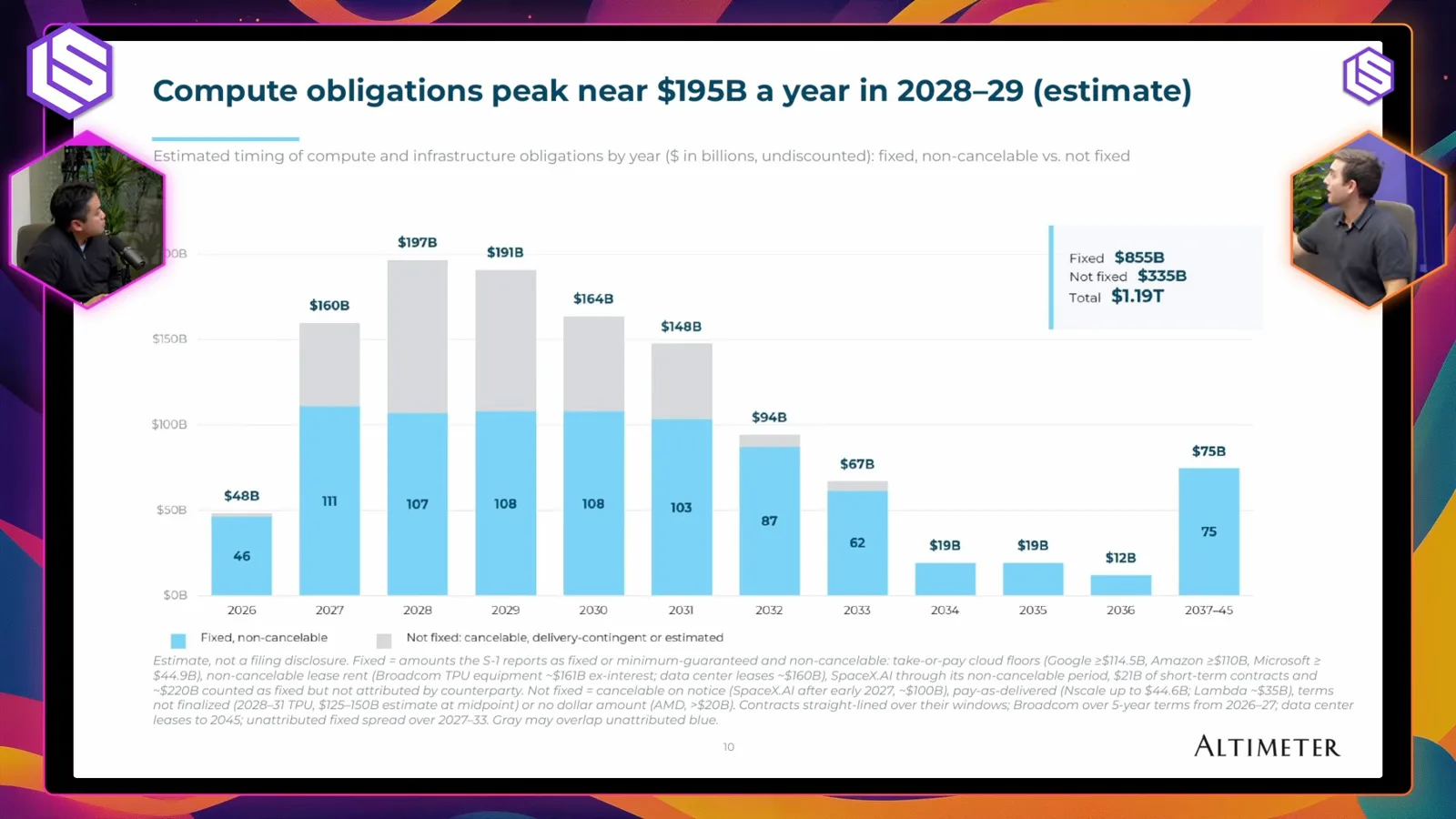
Ball turns to compute commitments often summarized as roughly $855 billion. His chart estimates the timing of fixed obligations separately from less certain commitments. It allocates contracts across their terms and is an analyst estimate, not an annual schedule disclosed in the filing.
The question is whether revenue and financing can support the annual obligations as they come due, not whether the entire multiyear sum must be paid in one year. Ball is optimistic about revenue growth and notes that shifting a larger share of existing compute to serving could expand capacity, but that remains a scenario rather than a promise.
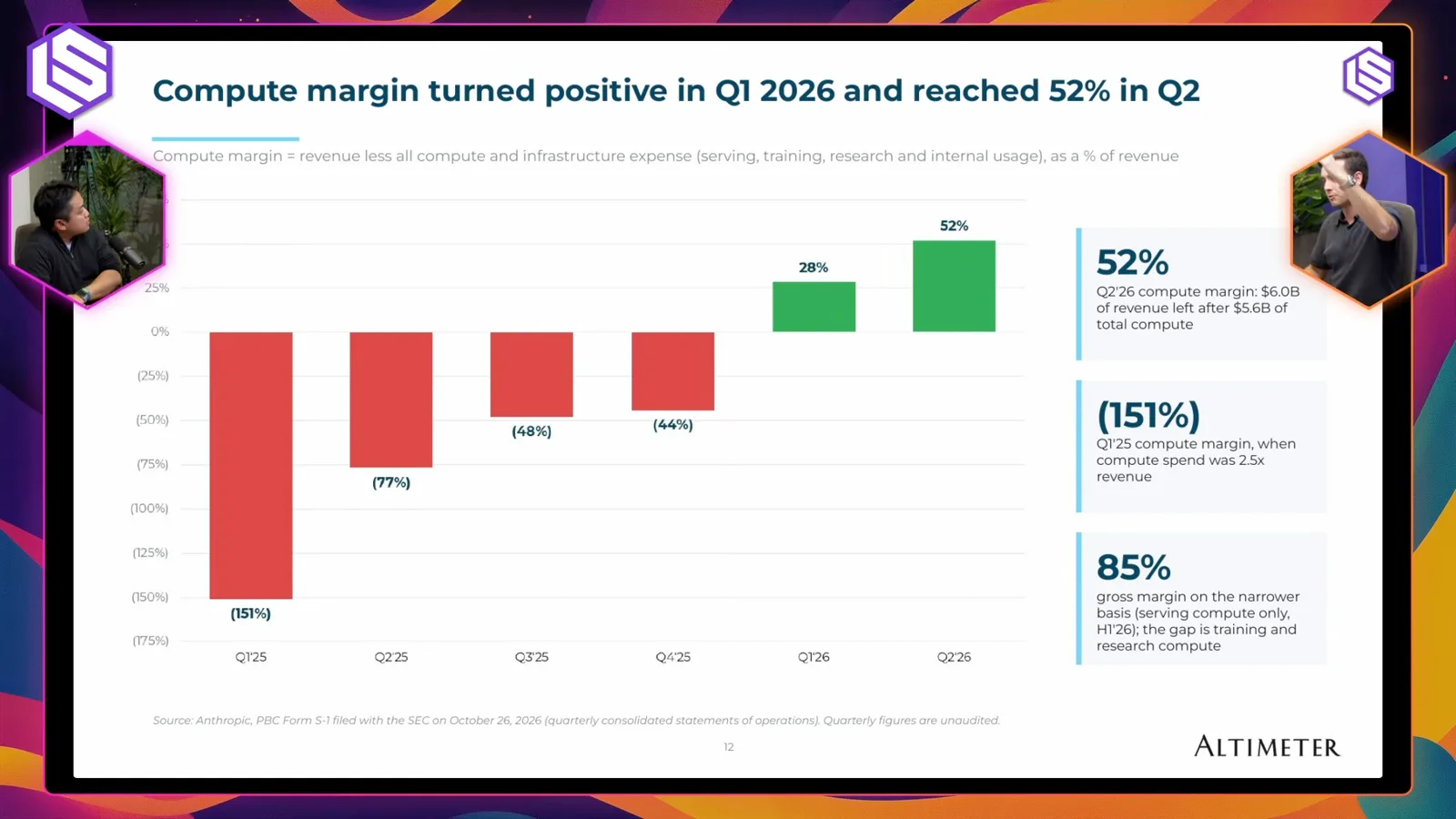
His compute-margin chart subtracts all compute and infrastructure expense, including training and internal use, from revenue. It shows the measure moving into positive territory in early 2026 and reaching 52% in the second quarter; Ball uses it to illustrate the speed with which revenue outgrew total compute costs.
Both speakers argue that strong demand has made access to compute a central constraint. Ball adds that safety, alignment and verification could consume a growing share of capacity, including at inference time. These are his expectations about future use, not categories the company necessarily reports separately.
They discuss opposition to data centers over local impacts and AI risks. Ball thinks permitting and construction constraints slow expansion, potentially reducing the chance of a rapid supply glut, but also delaying capacity the industry wants. Swyx adds that operators need to address effects on host communities.
Efficiency gains and competitive position
Swyx questions how much additional optimization is possible. Ball discusses unreleased frontier models, falling task costs and potential demand growth.
Swyx asks how much of the sevenfold improvement is a one-time optimization and whether future gains have physical limits. Ball responds that technological plateaus have repeatedly been followed by new approaches, but the question of how much additional efficiency can be extracted remains open.
The conversation shifts to the gap between open-weight and frontier models. Ball argues that released models do not show the entire frontier, citing an OpenAI chart comparing an internal research model with a public model. He treats unreleased capabilities and the size of the gap as reasons for caution when extrapolating from public benchmarks.
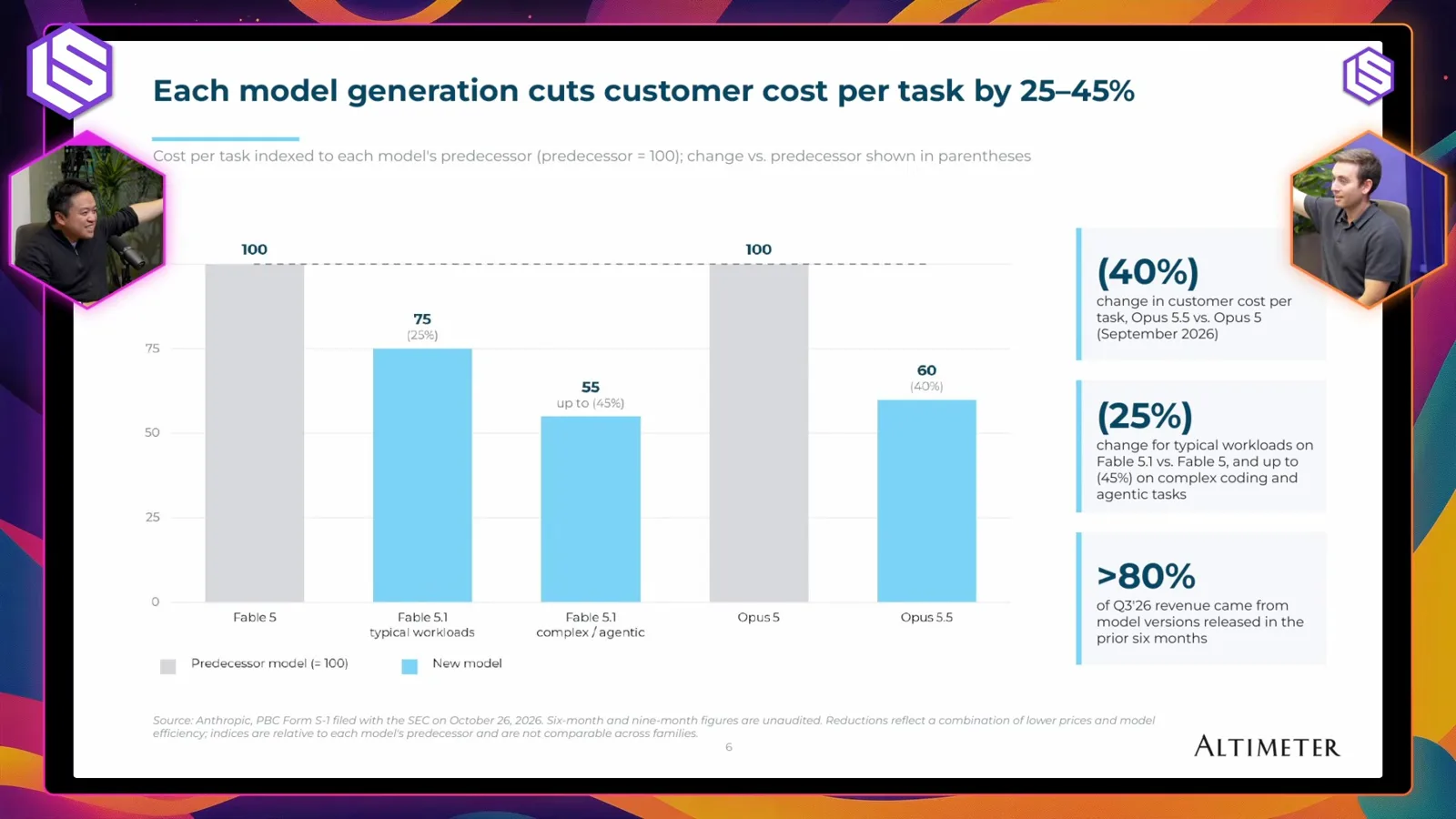
A slide compares successive model generations and task costs: the examples shown indicate reductions of roughly 25% to 45%, depending on the task and model family. The chart attributes these reductions to a combination of lower prices and improved efficiency, and the speakers distinguish that from a promise that the same improvement will repeat indefinitely.
Ball invokes a familiar demand effect: when a useful service becomes cheaper, people may consume much more of it. He compares model usage with storage and cloud computing, where unit prices fell dramatically while the overall market expanded. Whether AI follows the same path remains his forecast.
Frontier leadership, pricing and security
They separate the quality of a business from the price paid for its shares. The conversation turns to competitive model releases and vulnerability discovery.
For Ball, the critical long-term question is whether Anthropic remains competitive at the frontier. Swyx adds a separate valuation question: even a successful business can be priced too high. Ball agrees that the prospective IPO price was not known and that a stock can move for market-wide reasons as well as company-specific ones.
Ball points to third-party spending data as a possible sign of renewed demand after recent releases, while acknowledging that such data is a partial proxy. The hosts discuss how quickly customers can move to a stronger competing model and why a temporary lead should not be mistaken for a permanent one.
Swyx observes that some labs appear to retain unreleased models, whereas at other times competition seems to push them to release quickly. Ball notes safety and alignment as possible reasons for holding a model back; the speakers also speculate about the strategic value of a reserve.
They discuss AI-assisted vulnerability discovery and the race between defenders and attackers. Ball argues that faster discovery makes it more important to prepare patches quickly; Swyx notes that wider access to discovery tools may also change the advantage previously held by sophisticated actors.
The model factory
The speakers consider whether a model rapidly loses economic value after a successor arrives. Ball compares repeatable model development with the process of designing successive generations of chips.
Swyx asks whether a frontier model is a rapidly depreciating asset if most customers shift to the next release within months. The economics work only if the company can keep producing a more capable successor; a failed training run could leave a gap that affects both demand and the return on research spending.
Ball compares this with semiconductor design. Producing one competitive chip is different from building the organization and process to produce competitive chips generation after generation. In his analogy, the durable advantage is the factory that produces new designs, not merely the chip that leads today.
For a new lab, he argues, the real question is whether it can keep attracting the compute and talent needed to compete repeatedly. He expects opportunities in specialized models even if matching the largest general-purpose labs becomes difficult. The established labs face their own treadmill: stop improving while rivals continue and customers may leave.
Ball says Anthropic's revenue has risen much faster than its compute spend and expects stronger models to perform longer and more economically valuable tasks. He identifies himself as an optimist and acknowledges that this view may be too optimistic; the future relationship between model capability and revenue is uncertain.
They compare the labs' product choices. Swyx describes Anthropic as particularly focused on enterprise and coding, while OpenAI and Google have explored a wider set of modalities and products. Different approaches expose the companies to different demands on research, product teams and infrastructure.
Competing uses for compute
Ball describes the tradeoffs among coding, video and other products when capacity is scarce. Specialized businesses may find openings the largest labs do not prioritize.
Ball describes a compute version of the innovator's dilemma: if demand for a video product surges, should a lab divert scarce capacity away from coding? He argues that coding has attracted resources because it has shown high economic value, leaving openings for specialized companies in other areas.
The size of a successful opportunity also depends on who is pursuing it. A domain-specific model or product can produce an excellent outcome for a startup while being too small to move a frontier lab focused on much larger markets. Coding tools may nevertheless generalize to workflows beyond writing code.
The speakers mention scientific and life-science applications as possible areas of expansion. Ball expects a range of specialized models, including visual reasoning and decision models; customers do not always need the most expensive general model to accomplish a narrowly defined task.
Ball describes Altimeter as a lifecycle investor that backs companies at early and late stages and in public markets. He says young companies now scale and raise capital so quickly that relationships, executive hiring and organizational systems may be needed unusually early.
That pace makes building a durable company difficult, even if a product can gain users rapidly. Ball asks how founders can hire ahead of growth without building an organization too early; six months of preparation can be a very long time in a fast-moving market.
Applications and research organizations
The discussion covers vertical products and in-house models. Ball argues that product and research teams need a productive feedback loop.
Swyx asks whether Anthropic's relatively focused set of products will expand into distinct vertical applications. Ball recalls an earlier hypothesis that labs might retain their best models for their own applications, giving those applications an advantage over independent developers.
That possibility is one reason application companies may build models in-house, Ball argues. His investment preference is for a strong product organization paired with research that improves the product, rather than a research group operating in isolation from customer needs.
Swyx distinguishes model labs, which may treat products as a way to deliver general intelligence, from agent companies that begin with a customer problem and integrate models as needed. Ball expects major labs to push further into vertical products, while Swyx questions how extensive that push has actually been so far.
Ball notes that a successful existing product can create organizational inertia: sales teams tend to sell what they already know. The speakers also credit Anthropic's focus, comparing it with the challenge of competing against multiple large incumbents across chips, consumer products and models at once.
Convertible notes and reported net loss
Ball explains how earlier financing instruments can appreciate in value and generate noncash charges. The speakers distinguish this accounting from cash raised and operating results.
The conversation turns to convertibles and the reported net loss. Ball says the balance sheet includes a large liability associated with convertible instruments and that the income statement includes a large loss below operating income. He argues that the two figures are linked and must be read together.
A startup can raise capital using equity, convertible notes and SAFEs. Ball says strategic investors, including Amazon and Google, supplied money through instruments that convert into shares; he speculates about possible motivations for choosing that structure and explicitly does not claim to know each party's reasons.
Ball explains his understanding of the liability: the company received cash and promised shares at earlier valuations. As Anthropic's valuation rose, the estimated value of those instruments rose too. He says roughly $6 billion of original funding remained outstanding while the marked value was about $108 billion; those are distinct measures.
In Ball's account, the original funding was already included in the $141 billion of capital raised. He rejects the interpretation that the company had newly borrowed an additional $108 billion in cash. The instrument's legal terms and the filing's accounting treatment matter, so its balance-sheet classification should not be confused with a fresh cash inflow.
He then connects the balance sheet to the income statement. Increases in the fair value of the convertible liabilities produce noncash charges in the period, which reduce reported net income and flow through retained earnings. He says the filing's large first-half net loss was principally explained by those revaluations.
Ball separates that GAAP net loss from the company's operating and cash-flow performance. He argues that a rising valuation can produce a larger accounting charge even when the underlying business improves, and that the accounting dynamic changes as the relevant instruments convert. The dilution associated with conversion remains economically relevant.
What the margins do and do not show
They discuss cost classification and how future investment could change profitability. Ball declines to make a precise short-term forecast.
The two return to gross, operating and free-cash-flow margins. Swyx asks where payments to cloud partners appear; Ball says some revenue-sharing costs may be recorded below gross profit and agrees that the accounting presentation affects comparisons. His broader argument is that the reported margin trend improved substantially.
Ball expects the profitability profile to change as infrastructure spending increases, potentially reducing near-term margins. He views current revenue and cash generation as encouraging for the broader AI supply chain, but emphasizes that future outcomes depend on continued growth and the ability to meet commitments.
Asked for a 2027 forecast, Ball declines to give a specific number: the range of outcomes is too wide. Swyx suggests building forecasts from physical constraints instead of simply extrapolating past growth: available chips and power, secured supply, inference efficiency, competitive pricing and demand all set limits.
Financing the data-center buildout
Lenders assess end-customer exposure, execution and concentration risk. The speakers use an explicitly hypothetical capacity calculation to show the potential scale of spending.
Ball says demand for large GPU-backed debt deals has encountered a difficult market. Lenders financing a cloud provider look through to the ultimate customer, and repeated exposure to a small number of AI labs can make credit providers unwilling to add yet more of the same risk.
Construction delays add another layer of risk. A project can have an offtake agreement, equipment orders and financing in place yet be held up by permitting, supply-chain issues or local opposition. Someone still has to manage interest costs and contractual obligations while revenue is delayed.
Credit hedges can become more expensive as concentrated exposure rises. Ball frames the problem as lender appetite and pricing rather than proof that the entire debt market has run out of money: financing may still be available at a rate or on terms a borrower does not like.
Swyx asks why equity investors may commit vast sums while debt is harder to obtain. Ball cautions that the labs' willingness to borrow is also a question: infrastructure providers can take on balance-sheet risk that the model companies might prefer not to hold themselves.
A balance-sheet-heavy business can do well in favorable conditions and become vulnerable when the cycle turns. Ball does not rule out direct borrowing or owned infrastructure by the labs, but says the choice shifts construction, leverage and timing risks between the lab and its suppliers.
To illustrate the scale rather than make a forecast, Ball performs a rough thought experiment: if an industry added 100 gigawatts over five years at $50 billion per gigawatt, the implied total would be $5 trillion. The assumed capacity and cost are illustrative, and he acknowledges uncertainty in both.
They distinguish announced or constructed data-center capacity from capacity actually online and producing tokens. Ball says forecasts vary widely, while supply-chain contacts report demand exceeding available capacity. Land, grid connections, power, memory and chip supply can all constrain the pace.
Investing beyond the labs
Ball discusses infrastructure, compute utilization and applications. His thesis rests on growing demand for the inputs needed to deliver AI.
Ball says his investment work starts with several convictions: demand for models, power, computing, networking, storage and data centers will increase. He looks for companies exposed to those needs, while acknowledging that particular investments and technologies are uncertain.
Swyx raises compute trading and utilization. If existing hardware spends more time doing useful work, more effective compute can be delivered without procuring the same number of additional devices. Both see room for innovation in infrastructure as well as products and financing.
Ball offers a market-cycle analogy: early in a technology buildout, infrastructure can represent the largest immediate opportunity; in a mature market, applications may eventually become the larger category. He expects agents and applications to matter, while acknowledging his own preference for infrastructure investing.
Investment accounts and closing
Ball describes Gerstner’s work on children’s investment accounts. Swyx raises the needs of families facing immediate hardship.
Asked about Altimeter founder Brad Gerstner, Ball highlights his work on investment accounts for children. Ball describes a proposal for public and private contributions to give more families a stake in long-term investment returns, and praises the years of work behind it.
Ball argues that direct contributions could help children participate in investment growth, comparing the effort with tax-advantaged education savings that tend to be used more by affluent households. His description of eligibility, funding and donations is his account in the interview, not individualized guidance on the program.
Swyx challenges the approach by asking how an inaccessible long-term account helps a family facing immediate hardship. Ball acknowledges the concern and says the immediate operational challenge is getting eligible families to claim accounts and understand available contributions.
The discussion closes with a suggestion to check for unclaimed property and a plan to revisit Anthropic after the prospective IPO. The interview was recorded on October 29, 2026, before the later amended filing mentioned in the video description.
Más de este canal
 50:37EN
 Latent Space· 6 nov 2026Pódcast · 2 vocesAdit Abraham on Why Document Parsing Still Breaks AIInvitado: Adit Abraham · Presenta: Allen ParkThe Reducto co-founder discusses missing table rows, production evaluation, document editing and growing a company while making a steak sandwich.
 50:50ENLatent Space· 6 nov 2026Pódcast · 3 vocesFabian Theis on Virtual Cells, Organoids and Closing the Lab LoopInvitado: Fabian Theis · Presenta: RJ Honicky, Brandon AndersonThe Helmholtz Munich researcher explains perturbation models, biological benchmarks and the work required to connect prediction with experiments.
 1:12:24ENLatent Space· 4 nov 2026Pódcast · 2 vocesBehind Latent Space: swyx and Galen Gao on AI Engineers, SaaS, and ShanghaiInvitado: Shawn Wang (swyx) · Presenta: Galen GaoShawn Wang and Galen Gao trace the growth of the AI Engineer community and discuss what coding agents mean for small businesses.
 34:48ENLatent Space· 3 nov 2026Pódcast · 2 vocesZach Lloyd on the Infrastructure Behind a Software FactoryInvitado: Zach Lloyd · Presenta: Shawn Wang (swyx)Warp’s founder explains how teams can define, observe and improve agentic development workflows—and when the additional infrastructure may be excessive.
 1:07:22ENLatent Space· 2 nov 2026Pódcast · 3 vocesBuilding Legal AI Agents Without Seeing Client Data: Legora's Jacob LauritzenInvitado: Jacob Lauritzen · Presenta: swyx, Basil ChathaLegora's CTO explains how its team evaluates legal agents, designs review workflows and builds around the confidentiality of client matters.
 27:34ENLatent Space· 31 oct 2026Pódcast · 3 vocesJoseph Kim on Building AI Tools for Financial WorkInvitado: Joseph Kim · Presenta: swyx, RichardOpenAI’s Joseph Kim discusses data, human review, taste and evaluations in building a financial-services product.