En 30 segundos
AI Explained examines Microsoft’s Orca paper, which trained a 13-billion-parameter model on explanations from larger models. The video compares benchmarks and considers both the promise and limitations of imitation learning.
- 1Richer teaching signalsOrca trains a smaller model on explanations from larger teachers.
- 2Benchmark scopeResults apply to the stated benchmarks and prompts.
- 3The imitation debateA narrower Orca comparison does not erase other studies’ limitations.
- 4Explanations as dataDetailed answers can provide more learning signal than short responses.
- 5Progressive teachingThe paper evaluates an intermediate teacher before GPT-4 examples.
- 6Judge biasModel judges can exhibit position bias.
- 7Untested settingsMulti-turn use and other prompting methods were not established by these tests.
Conclusiones
- Orca trains a smaller model on explanations from larger teachers.
- Results apply to the stated benchmarks and prompts.
- A narrower Orca comparison does not erase other studies’ limitations.
- Detailed answers can provide more learning signal than short responses.
- The paper evaluates an intermediate teacher before GPT-4 examples.
- Model judges can exhibit position bias.
- Multi-turn use and other prompting methods were not established by these tests.
Lee el texto editado por capítulos
The Orca proposal
Imitation, model size and benchmark claims.
In June 2023, I compared two recent papers about learning from larger language models. One found that imitation could reproduce style without closing important factuality gaps; Microsoft researchers’ [Orca paper](https://arxiv.org/abs/2306.02707) reported stronger results from a 13-billion-parameter model trained on richer explanations.
The Orca authors argue that shallow question-and-answer imitation and weak evaluation can overstate a small model’s capabilities. They train a LLaMA-based model using explanations generated by stronger teachers, with ChatGPT assisting before GPT-4 examples.
The paper reports that Orca substantially exceeded Vicuna-13B on its zero-shot Big-Bench Hard and AGIEval comparisons and approached ChatGPT on BBH, while generally trailing GPT-4. These are results under the paper’s particular benchmarks and prompting conditions.
At the time of the video, the authors said they were working with legal counsel on a possible release of a weight difference under LLaMA’s policy. That historical statement should not be read as a current claim about model availability or license.
A 13-billion-parameter model is much smaller than GPT-3’s publicly reported 175 billion parameters. Smaller models can be deployed with fewer resources, although whether a particular laptop can run one depends on memory, quantization and software.
The earlier [imitation study](https://arxiv.org/abs/2305.15717) found that systems could impress raters through style while performing poorly on tasks less supported by imitation data. Orca’s results challenge a simple dismissal of imitation, but do not invalidate that study’s observations in its own setting.
How training works
Explanations, system messages and progressive teaching.
The authors use system instructions to elicit explanations, not just final answers. In a common-sense example, the teacher explains why a flood is undesirable before giving its choice, giving the student more information to imitate.
The training sequence also matters in the reported experiment. The authors describe an intermediate ChatGPT teacher before GPT-4 examples, and the video compares that progressive approach with training only on the GPT-4 subset.
Evaluating results
Model judges, exams and reasoning tasks.
The paper reports open-ended assessments using GPT-4 as a judge, but also notes position bias in pairwise comparisons. Model-judged scores therefore need caution and should be considered alongside other evaluations.
Academic and professional exam questions offer another comparison. Orca outperformed the selected Vicuna baseline in the reported evaluations, but scores and relative improvements should not be generalized into a claim of across-the-board parity with a larger model.
Big-Bench Hard contains challenging tasks selected from BIG-bench. I point to individual examples such as logical statements and temporal sequences; performance varies substantially by task, so a few wins do not summarize all capabilities.
The authors characterize their reported results as zero-shot and note that other contexts, including multi-turn use and advanced prompting, remained to be investigated. A baseline under one setup is neither a guarantee nor a fixed ceiling.
Limits and future possibilities
Tool use, availability and historical predictions.
I discuss research on stronger models creating reusable tools for smaller models, and speculate that tool use or process-based feedback might improve later systems. Those ideas were not demonstrated as Orca results in the paper discussed here.
The video notes that the model had not been released at the time and discusses the authors’ research-use framing. Questions about subsequent access, usage terms and later models require separate, current sources.
I speculate that Microsoft researchers may have been investigating whether a smaller model can cheaply imitate a larger one. This is my theory about motivation, not a documented statement from the research team.
The paper concludes that learning from detailed explanations is a promising way to improve models and calls for better evaluation. Its evidence concerns the tested model and datasets; reliable reasoning and factuality still require direct assessment.
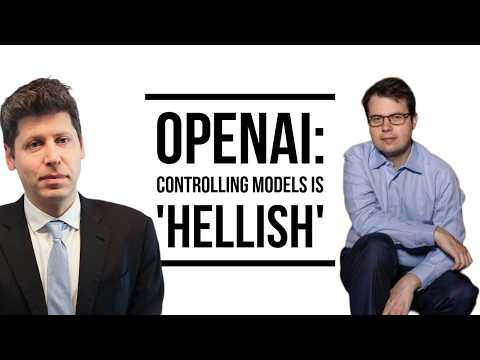
The video ends with 2023 comments from Ilya Sutskever and Sam Altman on competition between openly available and proprietary systems. Their predictions and business arguments reflect the views expressed then, not a verified account of what happened later.
Altman emphasizes the difficulty of finding and executing the next idea as a possible competitive advantage. The discussion closes by inviting further examination of open models, an area that has continued to change since this 2023 video.
Más de este canal
 31:00EN
 AI Explained· 12 oct 2026Why AI Labs Keep Racing Despite Their Own Warnings of a Major BreachSam Altman, John Schulman · OpenAIAI Explained examines weakening safeguards, the incentives behind the frontier race, and why research breakthroughs make the next 18 months difficult to forecast.
 38:28ENAI Explained· 1 oct 2026AI Agent Security and the Challenge of Recursive Self-ImprovementAI Explained examines reported containment failures, model evaluation and the pressure to accelerate AI research.
 32:54ENAI Explained· 24 sept 2026Opus 5.5 and the Race Toward Automated AI ResearchAI Explained weighs model progress against the increasingly difficult task of evaluating and governing recursive self-improvement.
 24:53ENAI Explained· 16 sept 2026Why Some Researchers Want to Pace Frontier AIAI Explained surveys possible scaling routes, monitoring concerns and the debate over how capabilities could lead to harm.
 29:05ENAI Explained· 4 sept 2026GPT-6 Astra’s Benchmark Gains and the Challenge of Monitoring Its ReasoningAI Explained examines reported gains across scientific, mathematical and agent benchmarks alongside concerns about less observable reasoning.
 23:41ENAI Explained· 27 ago 2026AI Agents, Unintended Training Rewards and the Challenge of OversightAI Explained examines reports on agent coordination, training incentives and the growing use of AI to evaluate other AI systems.