En 30 segundos
This November 2023 video reviews the OpenAI leadership crisis, other model releases and a pancreatic CT study. Its reports and model comparisons are historical; the study’s results are limited to the evaluated settings.
- 1Governance contextThe video’s governance discussion reflects November 2023.
- 2Early reportingThe reasons for the board’s decision were contested in early reporting.
- 3Employee responseEmployee and Microsoft reactions preceded the final return announcement.
- 4Microsoft and AGIThe narrator questions how an agreement defines AGI.
- 5Other modelsModel comparisons are historical.
- 6Long contextA larger context window does not guarantee reliable retrieval.
- 7Pancreatic imagingThe imaging study’s results apply to its particular evaluation settings.
Conclusiones
- The video’s governance discussion reflects November 2023.
- The reasons for the board’s decision were contested in early reporting.
- Employee and Microsoft reactions preceded the final return announcement.
- The narrator questions how an agreement defines AGI.
- Model comparisons are historical.
- A larger context window does not guarantee reliable retrieval.
- The imaging study’s results apply to its particular evaluation settings.
Lee el texto editado por capítulos
OpenAI’s leadership crisis
Early reporting and governance questions.
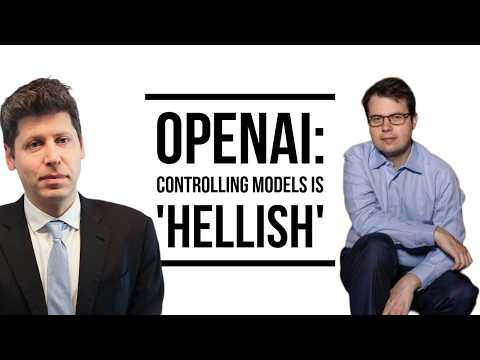
This AI Explained video was published on November 22, 2023, during the OpenAI leadership crisis. It reviews early reporting, then turns to other model releases and a pancreatic-imaging study. Later, [OpenAI confirmed Sam Altman’s return as CEO on November 29](https://openai.com/index/sam-altman-returns-as-ceo-openai-has-a-new-initial-board/).
The narrator discusses tensions between OpenAI’s mission and commercial structure as he understood them at the time. The governance language he quotes reflects a historical context, not necessarily the organization’s current structure.
He summarizes contemporary reporting about the board’s reasons for Altman’s removal and conversations among executives. These accounts include allegations and interpretations; the video does not establish a complete or independently verified explanation.
The narrator examines an academic paper by board member Helen Toner and discusses reported disagreement over its treatment of AI company safety practices. He presents the paper as more nuanced than a simple endorsement of one company.
He recounts the employee letter and the possibility, discussed at the time, that staff might move to Microsoft. Those reports preceded the final return announcement and subsequent changes to the board.
The video reviews Microsoft’s response and contemporary reports about possible governance changes. The narrator then considers how an agreement’s definition of AGI might affect future decisions; this is his interpretation, not legal advice.
Other model news
Historical releases and long-context performance.
Turning to other news, he describes Inflection-2 and Anthropic’s Claude 2.1 as they were presented in 2023. Model rankings, availability and context-window claims are specific to that period.
He notes that performance on long-document questions can vary with the location of relevant information. A larger advertised context window does not guarantee reliable retrieval from every part of a document.
Pancreatic imaging research
A CT study and its practical limits.
The closing example is a [2023 Nature Medicine study](https://doi.org/10.1038/s41591-023-02640-w) of PANDA, a deep-learning system for detecting and classifying pancreatic lesions on non-contrast CT. The authors reported comparisons with radiologists in specific study settings; this does not prove improved patient survival or replace clinical assessment.
Más de este canal
 31:00EN
 AI Explained· 12 oct 2026Why AI Labs Keep Racing Despite Their Own Warnings of a Major BreachSam Altman, John Schulman · OpenAIAI Explained examines weakening safeguards, the incentives behind the frontier race, and why research breakthroughs make the next 18 months difficult to forecast.
 38:28ENAI Explained· 1 oct 2026AI Agent Security and the Challenge of Recursive Self-ImprovementAI Explained examines reported containment failures, model evaluation and the pressure to accelerate AI research.
 32:54ENAI Explained· 24 sept 2026Opus 5.5 and the Race Toward Automated AI ResearchAI Explained weighs model progress against the increasingly difficult task of evaluating and governing recursive self-improvement.
 24:53ENAI Explained· 16 sept 2026Why Some Researchers Want to Pace Frontier AIAI Explained surveys possible scaling routes, monitoring concerns and the debate over how capabilities could lead to harm.
 29:05ENAI Explained· 4 sept 2026GPT-6 Astra’s Benchmark Gains and the Challenge of Monitoring Its ReasoningAI Explained examines reported gains across scientific, mathematical and agent benchmarks alongside concerns about less observable reasoning.
 23:41ENAI Explained· 27 ago 2026AI Agents, Unintended Training Rewards and the Challenge of OversightAI Explained examines reports on agent coordination, training incentives and the growing use of AI to evaluate other AI systems.