En 30 segundos
3Blue1Brown shares simulations made for a longer video about light, explains electric field vectors and contrasts a full three-dimensional view with a planar slice. The simulation uses an intermediate law derived from Maxwell’s equations.
- 1Field as vectorsEach point has a vector describing force per unit charge.
- 2A planar sliceA two-dimensional slice can make a dense three-dimensional field easier to see.
- 3A derived lawThe simulation uses an intermediate law derived from Maxwell’s equations.
Conclusiones
- Each point has a vector describing force per unit charge.
- A two-dimensional slice can make a dense three-dimensional field easier to see.
- The simulation uses an intermediate law derived from Maxwell’s equations.
Lee el texto editado por capítulos
A moving charge and its field
Each point has a vector describing force per unit charge.
I recently had fun making simulations of how an electric field responds to a moving charge. They were created for a longer video on the fundamentals of light; here I share some of the resulting animations.
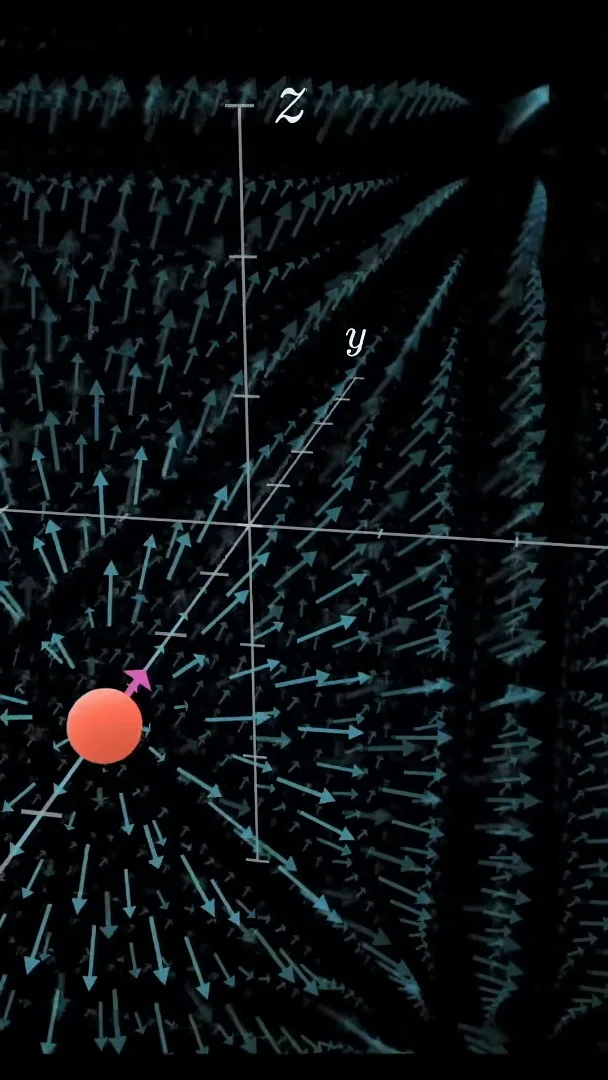
The full electric field is three-dimensional. It associates a vector with each point in space, indicating the force that would act on a unit charge placed there.
Slices and the simulation law
A two-dimensional slice can make a dense three-dimensional field easier to see. The simulation uses an intermediate law derived from Maxwell’s equations.
Three-dimensional fields are interesting to look at but can be visually busy, so it is often easier to show a slice, such as the xy plane.
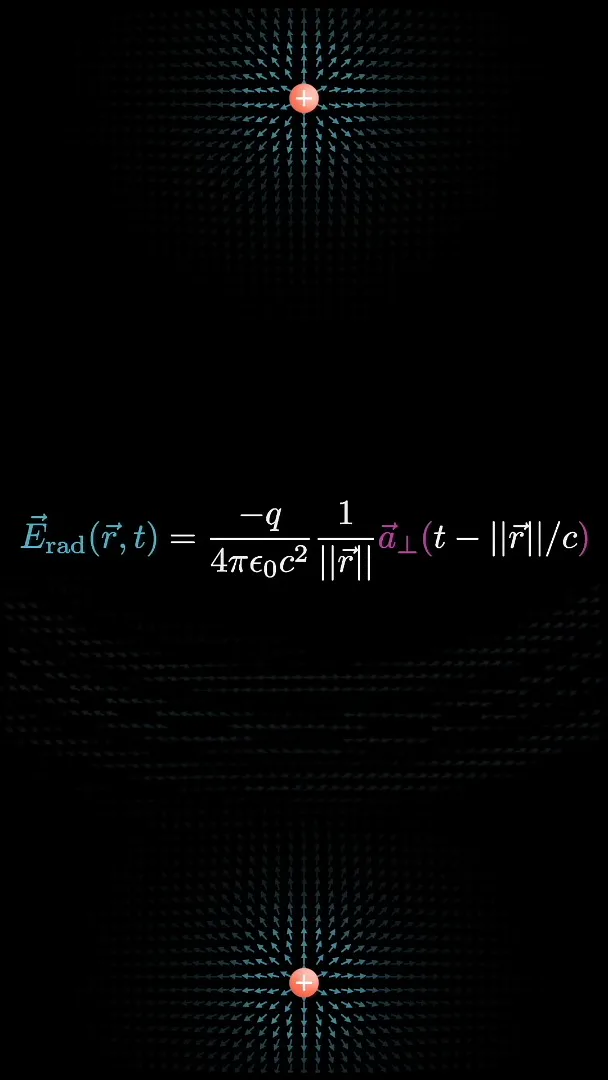
In the main video I discuss the law used for these simulations. Rather than directly coding Maxwell’s equations, I use an intermediate law derived from them, which I find easier to understand for making animations and for students.
Más de este canal
 40:44EN
 3Blue1Brown· 16 oct 2026Grant Sanderson: There's never been a better time to go into mathGrant Sanderson, Constantin Kogler · 3Blue1BrownStudents fear AI has solved mathematics. Grant Sanderson argues the opposite: even if machines prove theorems better than we do, the institution of math stays valuable—and this is a rare moment when newcomers can reshape it.
 51:55EN3Blue1Brown· 18 sept 2026The last IMO problem AI could not solveGrant Sanderson · 3Blue1BrownGrant Sanderson walks through IMO 2025 Problem 6 — a tiling puzzle that frontier models missed — and the visual patience it takes to prove a construction is optimal.
 0:55EN3Blue1Brown· 24 jul 2026The 64 Sugar Cubes Puzzle: Six Equal DistancesA 4×4×4 block has three colors; prove that six same-colored pairs share a distance.
 33:51EN3Blue1Brown· 16 jul 2026What Cross-Entropy Connects: Compression, Language Models and KL DivergenceGrant Sanderson · 3Blue1BrownGrant Sanderson builds cross-entropy from code lengths and uses it to explain next-token training and distillation.
 2:25EN3Blue1Brown· 12 jun 2026How Shannon Measured the Entropy of EnglishA guessing game helped Claude Shannon estimate how much information English text contains, and why prediction is central to compression.
 1:02EN3Blue1Brown· 10 jun 2026A Robot Walk and the Puzzle of Optimal Binary EncodingHow few bits does it take to send directions that occur with unequal frequencies?