En 30 segundos
In a June 2025 roundup, Berman discusses Magistral, ElevenLabs and OpenAI voice updates, Gemini and Veo, then covers reported Meta investment, the Dia browser and FLUX.1 Kontext. He separates his impressions from vendor-reported results; the video’s initial open-source claim about Kontext [Max] is corrected.
- 1Magistral benchmarksMistral’s reported scores include both single-sample and majority-vote results.
- 2Voice modeBerman tests an updated OpenAI voice response and comments on its natural delivery.
- 3Meta and Scale AIHe discusses reports about investment and leadership while offering unverified interpretations.
- 4FLUX licensing correctionKontext [Max] was not open weight; the separate [Dev] version was planned as open weight.
Conclusiones
- Mistral reported AIME results for its Magistral models under both single-sample and 64-sample voting conditions.
- The side-by-side speed clip lacks enough details for a controlled comparison.
- The Meta investment and compensation discussion mixes reporting with unverified claims and speculation.
- Berman had not tried Dia when he commented on its features.
- FLUX.1 Kontext [Max] was not open weight; the separate [Dev] model was planned for open-weight release.
- Model rankings and pricing describe June 2025, not current conditions.
Lee el texto editado por capítulos
Magistral and voice models
Berman discusses Mistral’s reasoning models and reports their benchmark results. He listens to ElevenLabs v3 and tests an OpenAI voice update.
In this June 12, 2025 roundup, I review Mistral’s Magistral reasoning models, voice and video updates, reports about Meta and Scale AI, the Dia browser, and image generation from Black Forest Labs. The releases, pricing and availability discussed reflect that time.
Mistral announced Magistral Small, a 24-billion-parameter open-weight model, and the more capable enterprise-oriented Magistral Medium. I am impressed by its apparent speed and expect quantization to make the smaller model easier to run locally, although practical requirements vary by hardware.
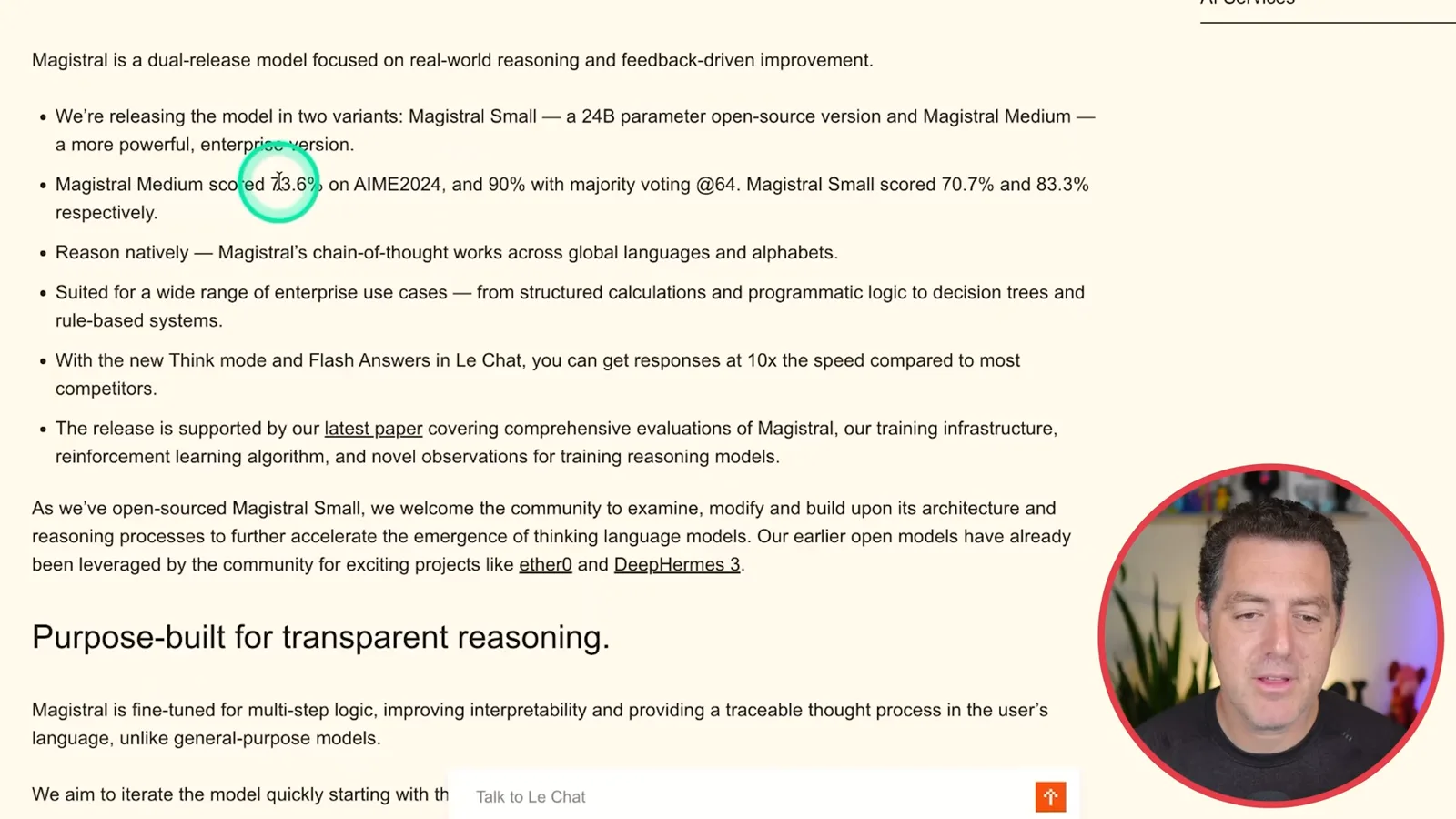
Mistral reports AIME 2024 results of 73.6% for Medium and 70.7% for Small, rising to 90% and 83.3% respectively with majority voting over 64 samples. These are company-reported results under specific conditions; a multi-sample result is not equivalent to a single attempt.
Mistral says Magistral can reason across languages and advertises faster responses through Le Chat. I show a side-by-side clip against an unspecified OpenAI model and observe a faster response, but the missing model and test details prevent a controlled speed comparison.
ElevenLabs released an alpha version of its v3 text-to-speech model. A sample demonstrates expressive speech, whispers, theatrical delivery and laughter; I like most of the sample but find the laugh unsettling. One selected audio example is not a broad evaluation.
I say the voice interface offers controls such as tags for excitement, interruption or surprise. I am also struck by how natural synthetic speech has become and note that, personally, I do not always want every hesitation to sound human.
I test OpenAI’s updated voice mode with a question about semiconductors. The response includes pauses and filler words that sound realistic to me, and I describe using voice conversations as a way to learn while driving.
Google updates and Meta reports
He reviews the Gemini 2.5 Pro preview and a faster Veo 3 option. He then discusses reported investment and hiring at Meta.
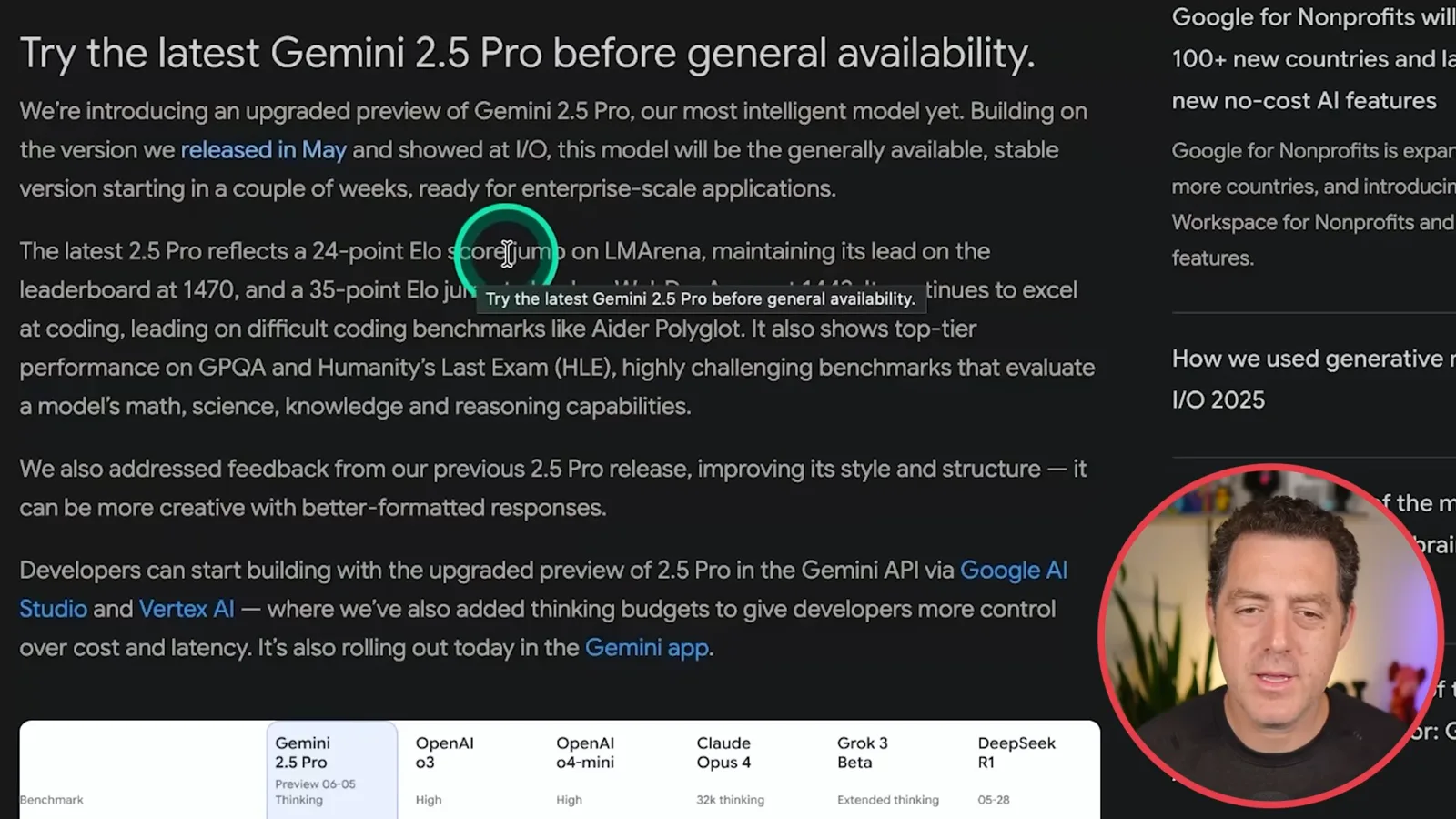
Google released a new Gemini 2.5 Pro preview. I cite Google’s reported 24-point LM Arena and 35-point WebDev Arena improvements and say it was my preferred direct coding model at the time; these scores and my preference are time-bound.
I also mention a faster Veo 3 option, described in the video as costing one-fifth as much as the original version. This is a historical price comparison from June 2025, not current pricing advice.
I discuss reports that Meta was investing roughly $14 billion for a 49% stake in Scale AI and that its CEO, Alexandr Wang, would join a new Meta AI effort. The segment combines reporting with my interpretation of Meta’s goals; the deal terms and organizational details are reported claims at that point.
I speculate that a minority stake could avoid some regulatory burdens of an outright acquisition and that Meta may be dissatisfied with its AI progress. Those proposed motives are my conjecture, not facts established by the report.
Scale AI is known for data labeling and annotation, which can support model development. I also repeat an unverified social-media claim about unusually high compensation for recruits; the video supplies no independent evidence for that figure.
Dia and image generation
Berman considers Dia’s proposed browser features and reviews FLUX.1 Kontext comparisons. He corrects the distinction between Max and the planned open-weight Dev model.
The Browser Company introduced Dia, an AI-focused browser that can work with open tabs. I have not tried it and am unsure how distinctive the feature is, so I plan to test it before reaching a conclusion.
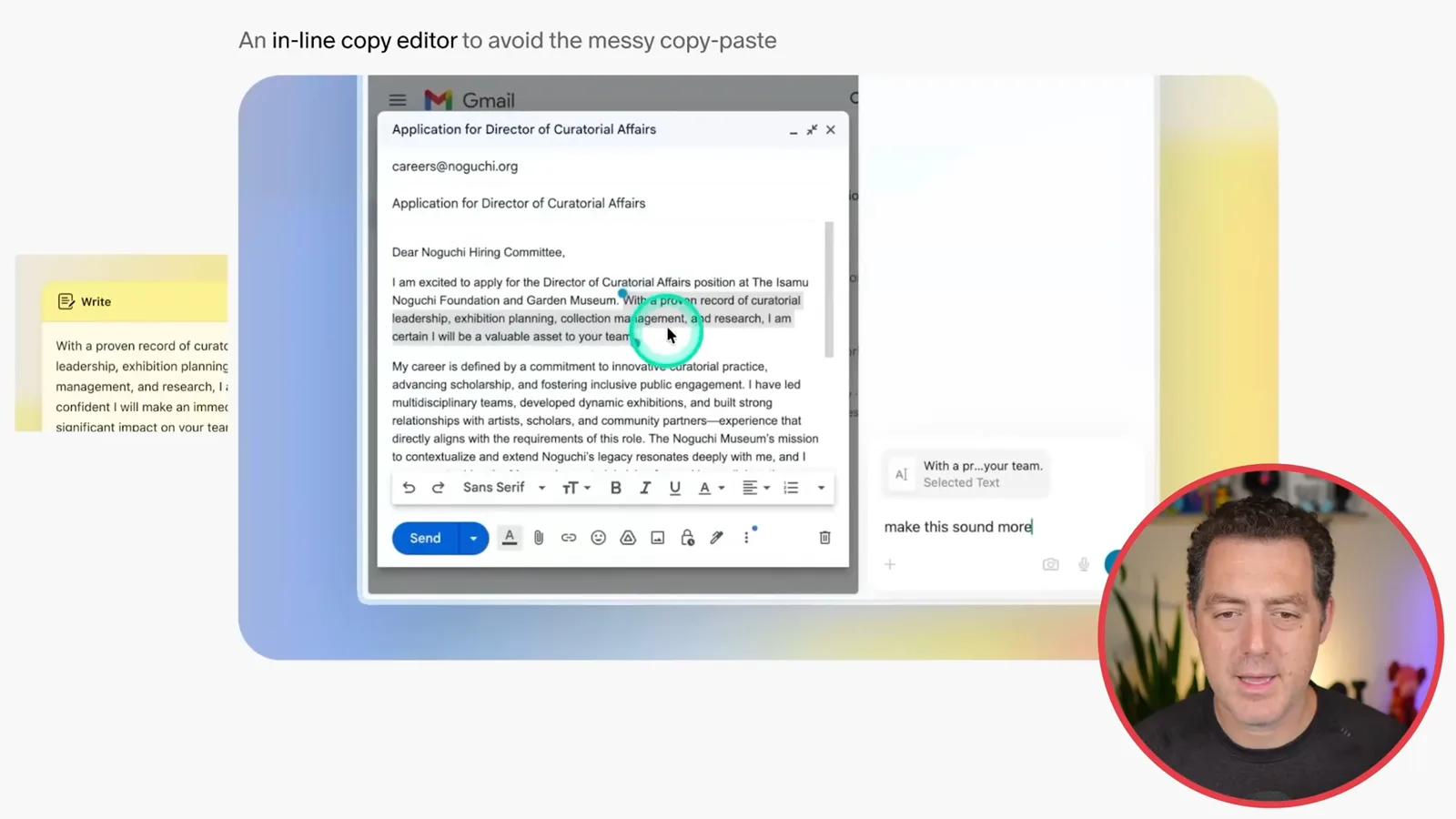
The examples show inline editing in email and document summarization for Slack. Similar functions already exist in some of those applications, I observe; a browser that brings them together could still be convenient, but that is a possibility rather than a tested finding.
Artificial Analysis ranked FLUX.1 Kontext [Max] highly among contemporary text-to-image systems. I initially call it open source, then clarify that the Max and Pro versions are not open weight and are offered through an API or partners; the separate Kontext [Dev] was planned as an open-weight model.
At the time, Black Forest Labs said the 12-billion-parameter Kontext [Dev] model was in private beta and planned for open-weight release. The video description also corrects the initial Max licensing claim, and the status described is historical.
I read the then-current Artificial Analysis image-arena rankings, with GPT-4o above several competitors and Kontext [Max] among the higher-ranked entries. Arena positions and model names are specific to that snapshot, not a permanent ranking.
I inspect examples generated from an Antarctic research-base prompt and an anime-style rainy Tokyo alley. I like several outputs and prefer the detail in one Flux 1.1 Pro image; the comparison is a subjective look at selected images, not a controlled benchmark.
A cartoon pirate example reveals imperfections: I see an irregular eye patch in Kontext [Max], odd-looking water in another Flux image and an overlapping leg in the GPT-4o example. I do not notice a flaw in the Seedream sample, though that does not prove it is error-free.
Más de este canal
 25:50EN
 32:20EN
 0:22EN
 45:08EN
 0:32EN
 1:02EN