En 30 segundos
Matthew Berman reviews Cognition’s Windsurf agreement, Meta’s announced compute plans and reported model strategy discussions, controversies around Grok, OpenPipe’s RULER and Mistral’s Voxtral. He discloses prior Windsurf sponsorship, and this video is sponsored by Amazon Bedrock. Reports and benchmark claims are attributed to their sources and time.
- 1Windsurf’s split outcomeGoogle hired a group of staff and Cognition announced an agreement covering the remaining product and business.
- 2Meta’s infrastructure plansZuckerberg described future compute clusters; the stated capacity and schedule were plans at the time.
- 3Grok and prompt changesBerman questions whether prompt changes alone resolve the reported behavior; the underlying causes need evaluation.
- 4RULER’s model judgeThe method ranks candidate solutions and reports selected-task results; its universal applicability is not established.
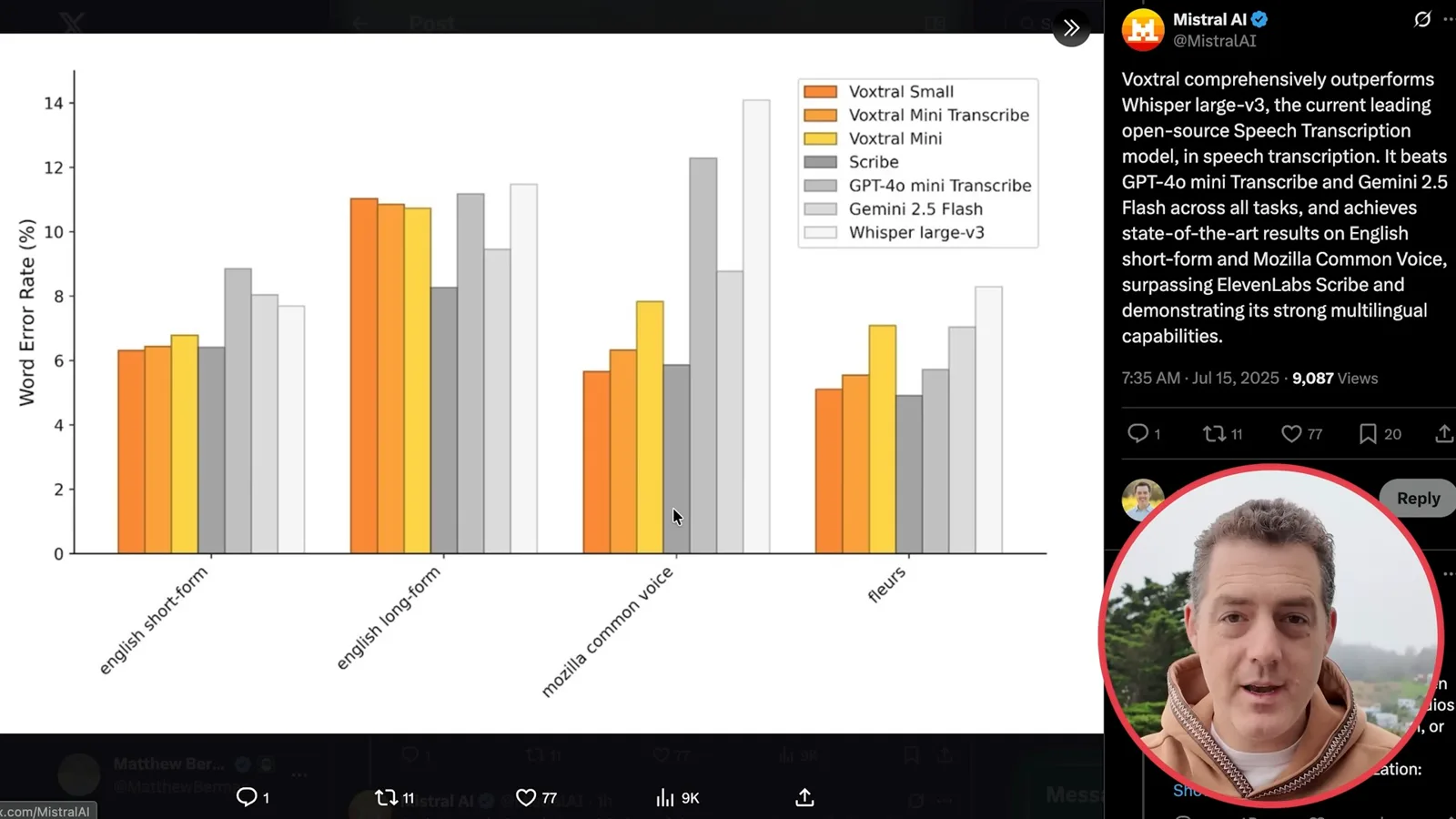
- 5Voxtral benchmark contextWord error rates differ by dataset, and the chart does not show the same winner in every category.
Conclusiones
- Google hired Windsurf staff, while Cognition announced an agreement for the remaining product and business.
- Meta’s Prometheus and Hyperion figures were announced plans; the reported closed-model strategy was under discussion.
- Grok’s controversial outputs raised questions about prompts, model behavior and evaluation.
- RULER uses model-judged relative rankings; its reported results cover selected tasks, not every possible agent.
- Voxtral’s word-error-rate chart should be read by dataset and model rather than as a universal ranking.
Lee el texto editado por capítulos
Windsurf and Meta
Berman reviews the team moves, Cognition agreement and Meta’s announced compute investment. He distinguishes a reported strategy discussion from a final decision.
In this July 2025 news roundup, I discuss Windsurf, Meta’s compute plans, Grok controversies, a reinforcement-learning method and Mistral’s Voxtral. Windsurf previously sponsored my channel, and this video is sponsored by Amazon Bedrock.
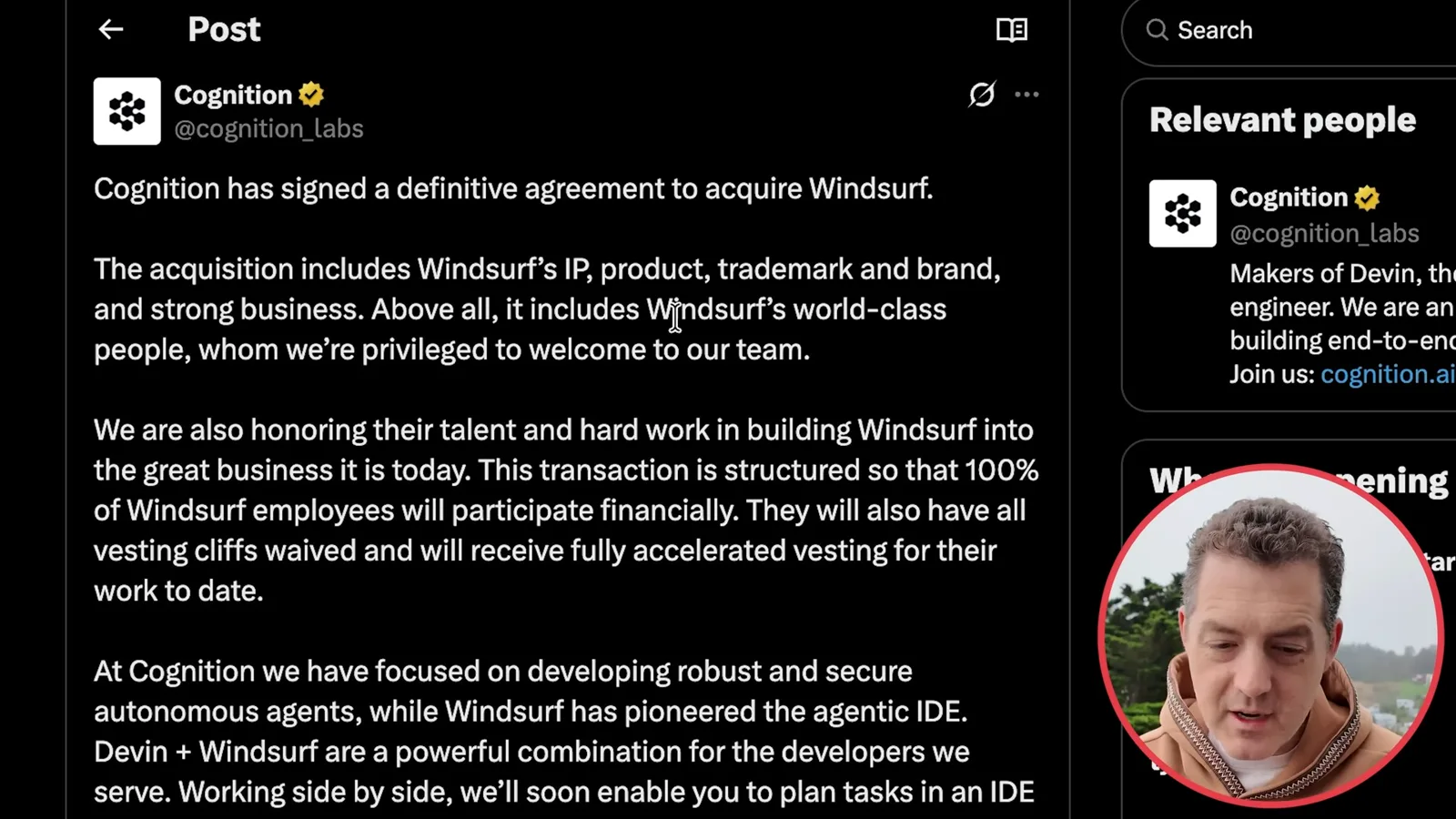
A reported OpenAI acquisition of Windsurf did not proceed. Google hired a group of Windsurf staff, including its founders, rather than acquiring the entire company. Cognition subsequently announced a definitive agreement to acquire Windsurf’s product, intellectual property, brand and remaining business.
Cognition said the transaction was structured so that all Windsurf employees would participate financially, with vesting provisions addressed. I welcome that announcement, though individual outcomes and deal terms should not be inferred beyond what was disclosed.
Berman compares the situation with Meta’s investment in Scale AI and the move of Alexandr Wang and other staff to Meta. He raises concerns about customer relationships and conflicts of interest; the video’s broad characterization of contracts is a contemporary claim, not a verified complete accounting.
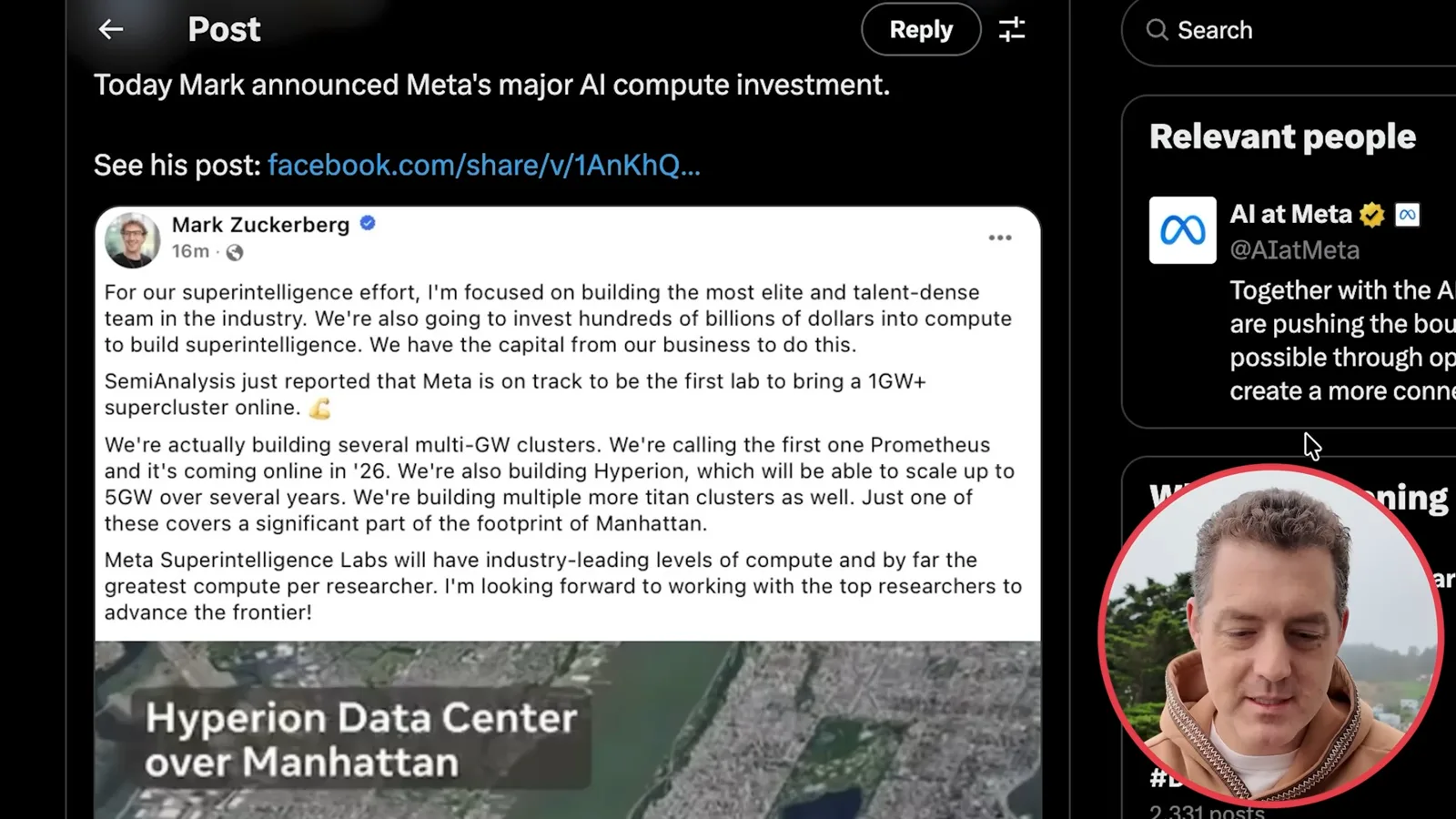
Mark Zuckerberg announced plans for major AI compute investment. He described Prometheus as expected online in 2026 and Hyperion as a project intended to scale to five gigawatts over several years. These were announced plans, not proof that the capacity was already operating.
A New York Times report said Meta’s superintelligence team had discussed developing a closed model instead of its most powerful open model. I would find a retreat from open releases disappointing, but a discussion reported at that time was not a confirmed company-wide decision.
Sponsored segment and Grok
The video includes an Amazon Bedrock sponsorship. Berman discusses companions and controversial Grok outputs.
Amazon Bedrock sponsors the video. The sponsor segment describes AgentCore services for runtime, tool access, memory, identity and observability. These are provider descriptions; their capabilities, pricing and security depend on the actual deployment and product terms.
xAI introduced Grok companions, including animated characters. Berman then discusses reports of offensive Grok outputs and cases in which the assistant looked for Elon Musk’s views on political questions.
xAI said it adjusted prompts and shared details publicly. Berman questions whether prompt changes alone are a sufficient way to address these problems. The specific causes and effectiveness of mitigations require independent evaluation rather than conclusions from one prompt excerpt.
Reward methods, government and speech
He introduces OpenPipe’s RULER, xAI’s government announcement and Mistral’s Voxtral benchmark.
OpenPipe’s Kyle Corbitt described RULER, a reward method using a language model to compare candidate answers within a group. The team claimed it could support reinforcement learning without task-specific labels, hand-written rewards or human feedback for the tasks tested.
The reported results compare smaller models with o3 and hand-crafted rewards on four tasks and include an estimated cost advantage. These are the developers’ results for their chosen evaluations, not proof of a universal reward function or that every agent task can be judged reliably.
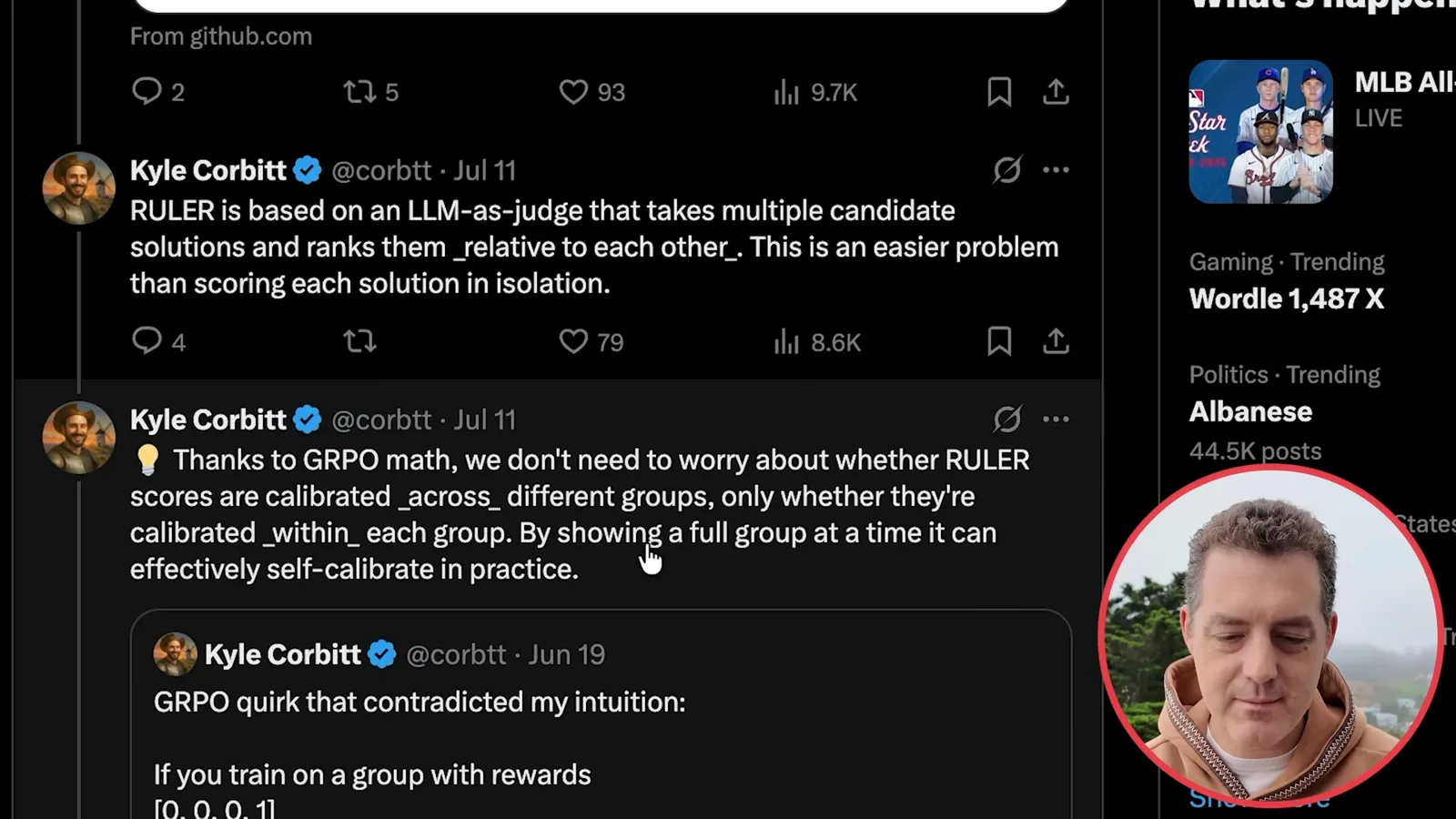
RULER asks a model judge to rank candidate solutions relative to one another. The approach uses group-relative optimization; its quality still depends on the judge, candidate diversity and evaluation design, including the possibility of systematic judging errors.
xAI also announced government offerings and a Department of Defense contract. Berman discusses access for US government customers as an emerging part of AI deployment, without assessing the eventual use or outcome of the contract.
Mistral announced Voxtral speech models and published a word-error-rate comparison with other transcription systems. Lower word error rate is better. The displayed chart shows different leaders by dataset—for example, Scribe is lower on English long-form and FLEURS—so the results should be interpreted per task and setting.
Berman welcomes the model release and closes the roundup. The announcements, reported plans and benchmarks reflect July 2025 rather than a current product comparison.
Más de este canal
 25:50EN
 32:20EN
 0:22EN
 45:08EN
 0:32EN
 12:14EN