En 30 segundos
Theo Browne examines Anthropic’s announced SpaceX compute agreement and historical Claude limit increases, then offers an investor’s interpretation of competition among AI labs and Cursor. He distinguishes the companies’ announcements from his hypotheses about internal data, routing and utilization.
- 1Demand and capacityTheo attributes usage constraints partly to insufficient compute; the cited 80-times figure was an annualized first-quarter growth rate.
- 2What changed for Claude CodeThe announced five-hour limits doubled for specified plans and peak-hour reductions were removed for Pro and Max.
- 3Higher Opus API limitsAnthropic’s table showed substantial increases in input and output tokens per minute across tiers.
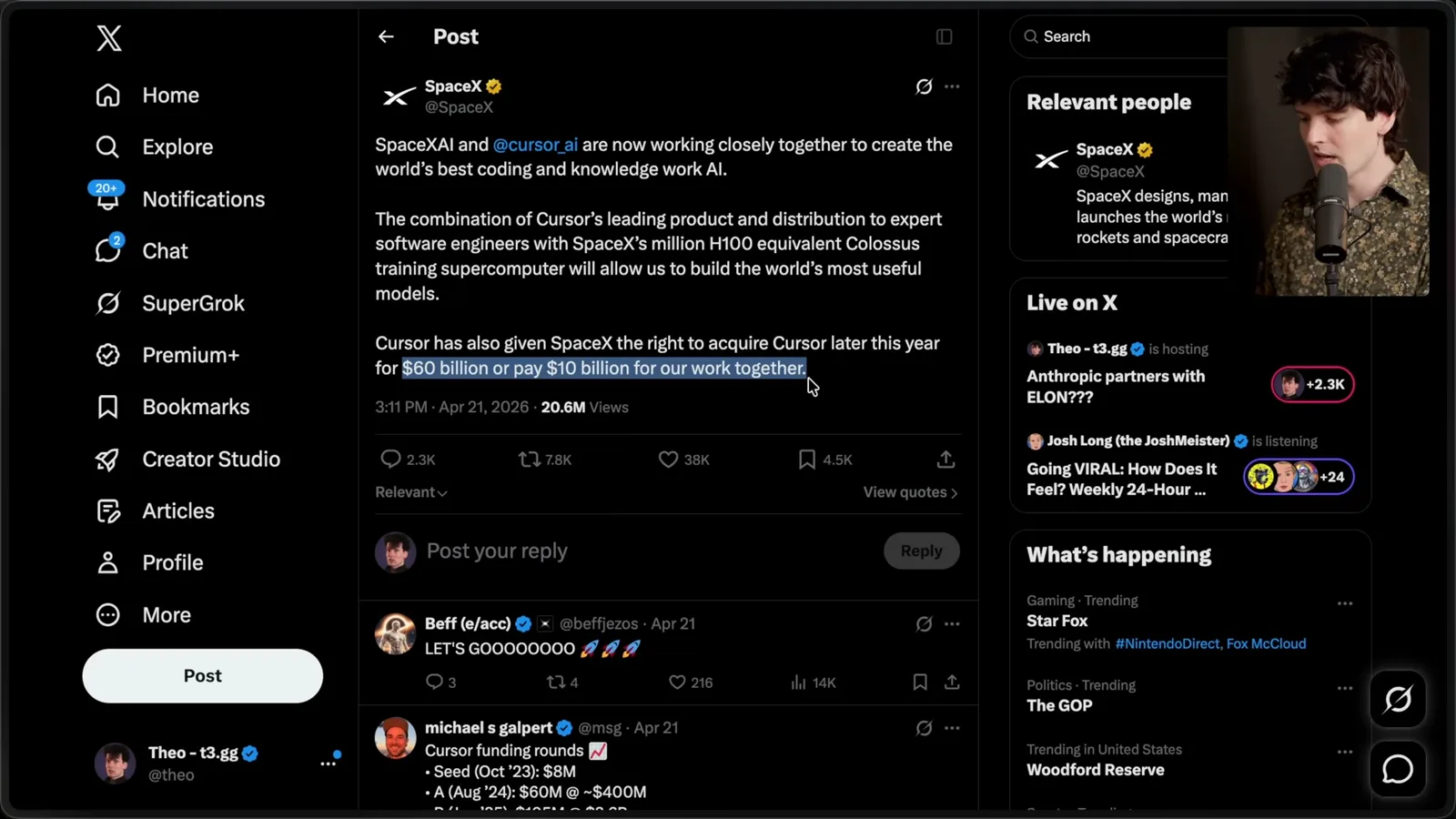
- 4SpaceX and CursorThe contemporary announcement described an acquisition option or a payment for joint work, not a completed acquisition.
- 5Colossus 1 capacityAnthropic announced access to more than 300 megawatts and over 220,000 GPUs within the month; that is not a report of previous utilization.
Conclusiones
- Anthropic announced access to Colossus 1 capacity and higher Claude Code and Opus API limits in May 2026.
- A higher five-hour limit does not by itself imply an increase to every other usage cap.
- Compute capacity, data and researchers are useful lenses for analyzing AI competition, but not complete company audits.
- Similar performance charts cannot prove where a provider routes requests.
- Public partnership terms do not establish access to customer conversations.
Lee el texto editado por capítulos
An unexpected compute agreement
Theo introduces the partnership and discloses his interest as an early Cursor investor. His discussion mixes announcements with hypotheses.
Anthropic’s new agreement with SpaceX surprised me. I have argued that compute capacity, not just pricing strategy, was constraining Claude’s usage limits. The partnership brings additional capacity despite a history of public friction between the companies and their leaders. The analysis here reflects what was known when this video was recorded in May 2026.
Elon Musk said he had met Anthropic’s senior team and was comfortable leasing Colossus 1 after SpaceX moved training to Colossus 2. I want to unpack what that might mean for Claude users, Anthropic’s capacity constraints and xAI’s strategy. Much of the strategic explanation that follows is my interpretation, not inside knowledge.
The key questions are practical as well as competitive: what changes for Claude Code users, why did Anthropic need more compute, and what does SpaceX gain? I am also an early investor in Cursor, so account for that interest when considering my interpretation of its partnership.
Why capacity matters
He considers demand growth, infrastructure planning and the tradeoffs involved in serving subscription users.
My view is that Anthropic underestimated demand and restricted usage partly to manage scarce capacity. That does not rule out commercial pricing motives; the company has not disclosed every reason for every product decision. At its conference, CEO Dario Amodei said first-quarter growth in revenue and usage would amount to around 80 times annually if extrapolated.
That 80-times figure is an annualized extrapolation of a quarter, not a claim that annual revenue actually increased 80-fold or that users grew 80 times more than forecast. Amodei contrasted it with planning for 10-times annual growth. I sympathize with the difficulty of planning infrastructure for an unexpectedly steep demand curve.
Anthropic has announced capacity arrangements with Amazon, Google and Broadcom, Microsoft and NVIDIA, and Fluidstack. Its announcement says Claude is trained and served on AWS Trainium, Google TPUs and NVIDIA GPUs. These are different hardware ecosystems, so building and operating across them is a substantial engineering task.
I speculate that the team may prefer to reserve more NVIDIA capacity for researchers while using other hardware for inference. That is a hypothesis about allocation, not a confirmed description of Anthropic’s internal workloads. The company explicitly says it uses several hardware types for both training and serving.
A subscription provider has to balance peak demand against expensive idle capacity. Imagine 10,000 servers: if only 6,000 are busy off peak, unused capacity still costs money; if demand exceeds 10,000, users can encounter limits. Anthropic’s May announcement ties its higher limits to added capacity and other compute deals.
Claude Code and API limits
Theo explains the historical five-hour and API changes and distinguishes them from other possible limits.
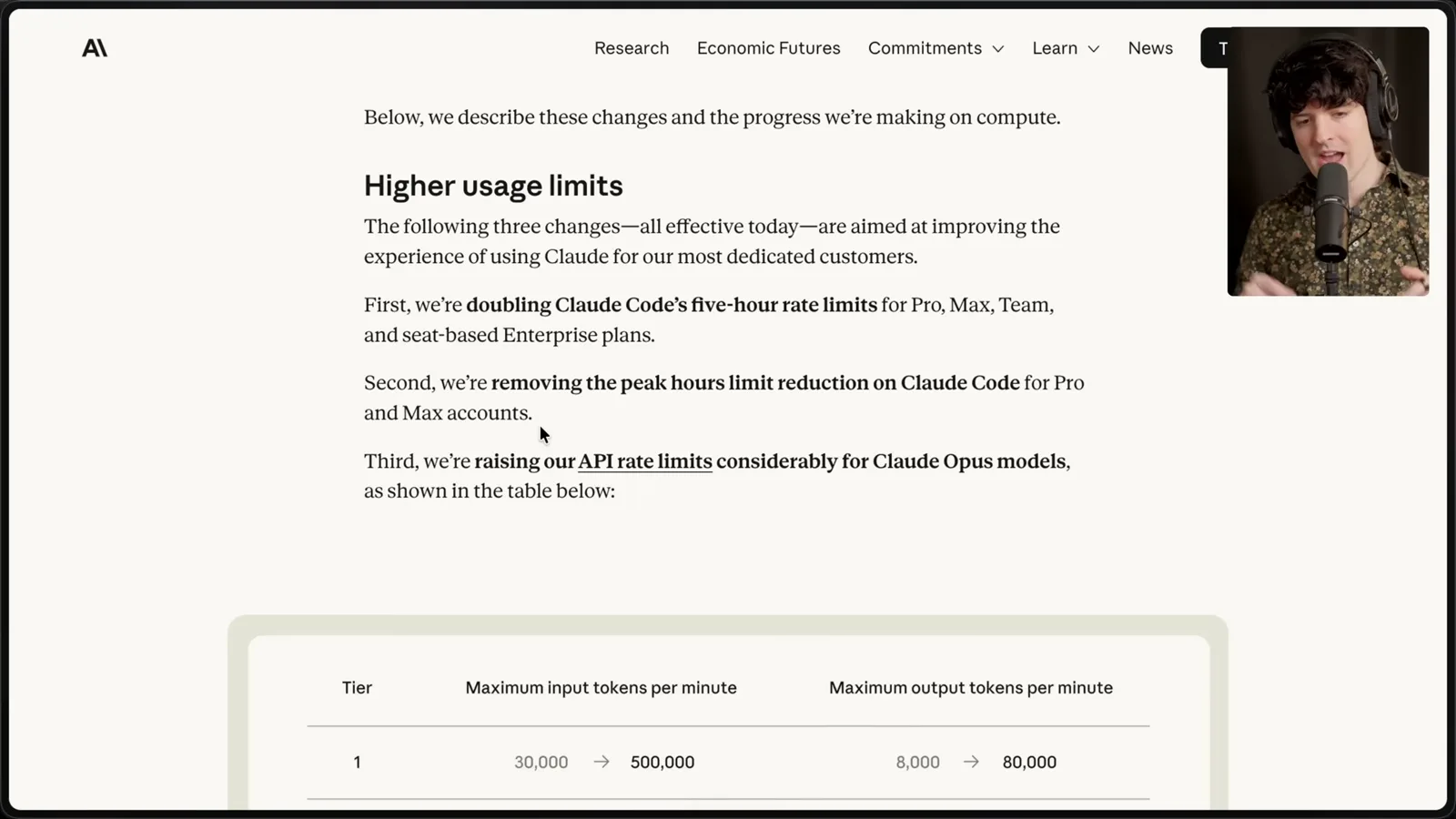
At the time, Anthropic doubled Claude Code’s five-hour limits for Pro, Max, Team and seat-based Enterprise plans and removed peak-hour reductions for Pro and Max. Those changes applied to the short window. As I understood it, a separate weekly limit could still constrain people who used the product heavily throughout the week.
That difference matters. Someone who works intensely for a few hours and then takes a break may benefit more than someone continuously running several agents every day. A larger short-term allowance does not automatically imply that every other quota increased. These limits describe the May 2026 announcement, not today’s subscription terms.
The Claude API’s Opus rate limits also rose. In the table shown, tier 1 input increased from 30,000 to 500,000 tokens per minute, and output from 8,000 to 80,000. This matters to developers hosting applications: a low per-minute ceiling can throttle multiple users even when an individual request seems small.
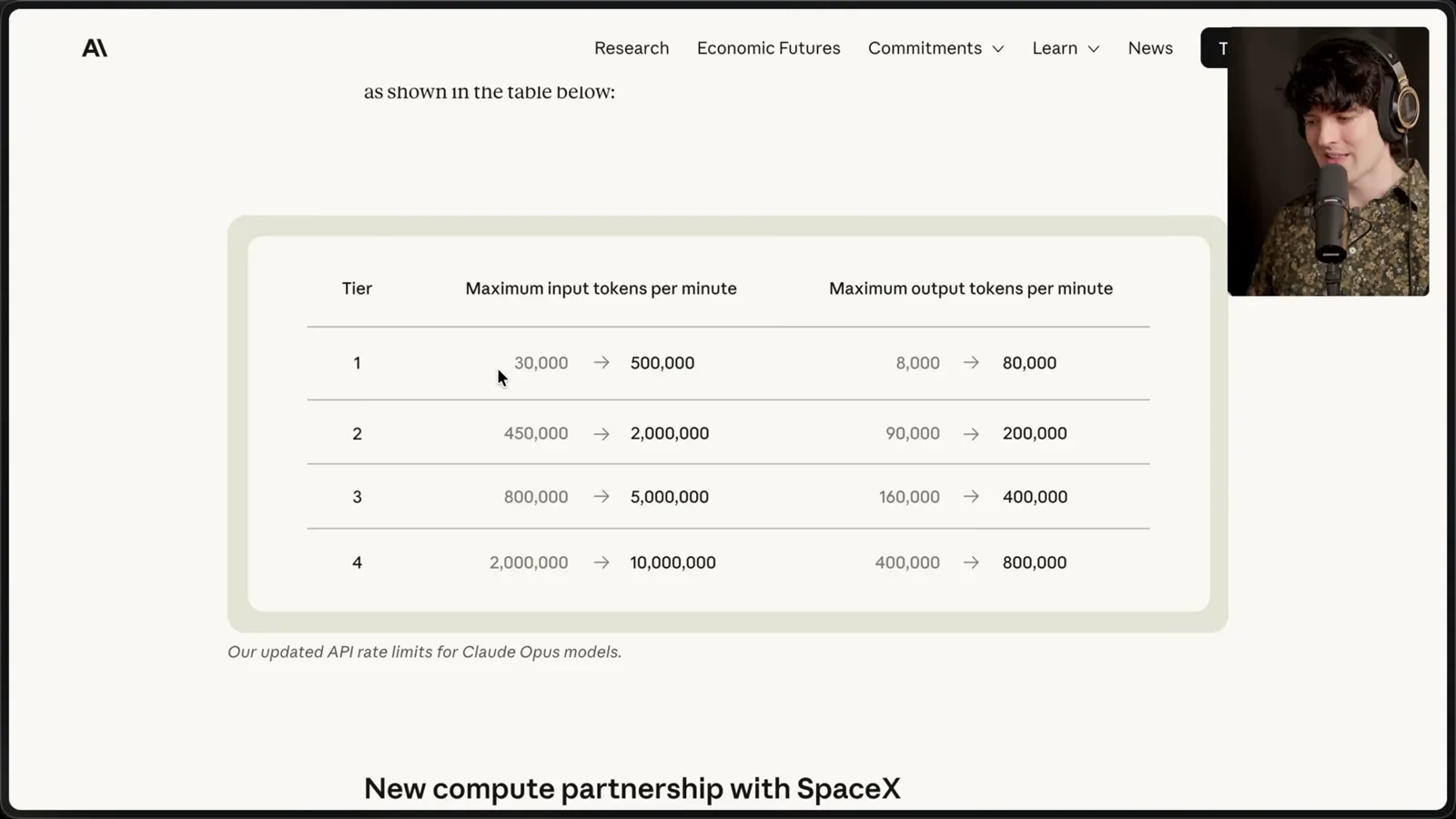
The displayed tier 2 input limit rose from 450,000 to two million tokens per minute; tier 3 from 800,000 to five million; and tier 4 from two million to ten million. I have hit restrictive new-model quotas running T3 Chat, so I see these increases as useful for builders.
Cloud providers and performance
He compares a speed chart and considers a routing hypothesis. The measurements cannot confirm the underlying architecture.
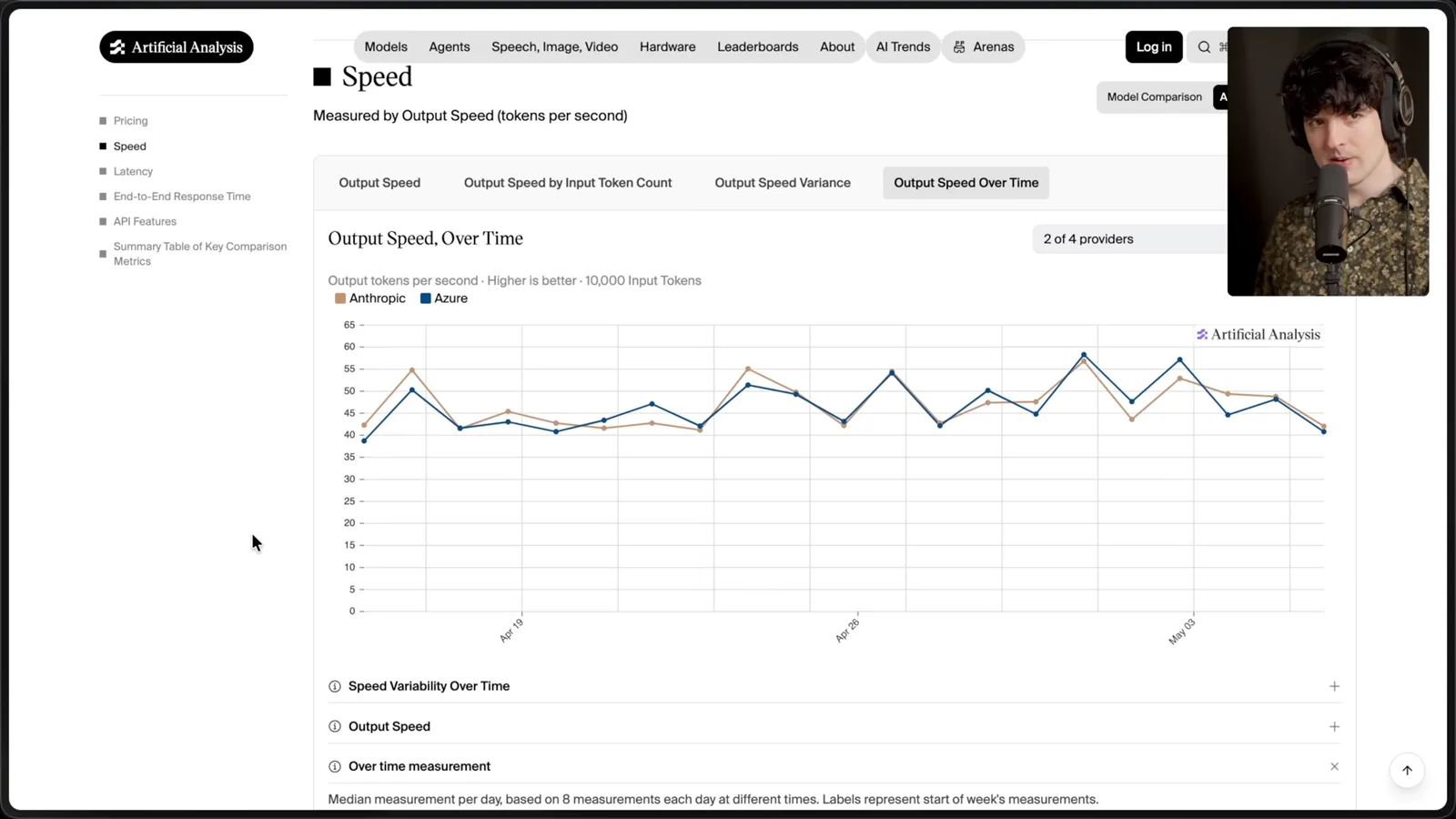
Claude’s availability across major cloud providers has also helped Anthropic reach enterprise customers already using those platforms. Hosting and routing details can differ by provider. That makes direct comparison of speed and latency interesting, but a chart of output speed cannot by itself establish where requests are processed.
In the chart I examined, Amazon appeared faster than Anthropic’s direct service, while Azure and Anthropic showed similar patterns. I wondered whether Azure requests might be routed through Anthropic, but I could be wrong: similar speeds have other possible explanations. Treat this as an unverified hypothesis, not a finding about Azure’s architecture.
Research, data and compute
The SpaceX–Cursor agreement leads to a framework for understanding model competition and the possible value of workflow data.
The SpaceX–Cursor announcement provides another piece of context. At the time, SpaceX said it had the right to acquire Cursor later in the year for $60 billion or pay $10 billion for their work together. The announcement described a partnership and an option; it did not say that SpaceX had already bought Cursor.
I use a simple framework for model competition: research talent, useful data and compute. A company may be strong in one and weak in another. This is an analytical model, not an audited inventory of any lab’s resources, and the companies’ capabilities are much more complicated than three checkboxes.
Data quality matters as well as volume. I mention a researcher’s account of training loss spikes disappearing after data cleanup, and an anecdote about repetitive web text. These are illustrations of why cleaning matters, not evidence that a particular model’s current behavior was caused by a particular scraped page.
There is also a market for curated, labeled and generated data. Some examples can capture how people build software over a sequence of steps, rather than just the final repository. I think that kind of process data may be useful for teaching coding agents to plan, notice mistakes and revise.
Consider a coding chat: a user requests a feature, asks for part one, corrects a mistake and requests part two. That sequence contains information about both the task and the feedback. It is different from a snapshot of the finished code, although how useful it is depends on the quality, rights and preparation of the data.
I sketch an idea for transforming such a dialogue into an example where the agent takes more of the intermediate steps itself. This is a conceptual illustration of how feedback might inform training, not evidence of a specific lab’s actual training recipe. Reinforcement learning and other training methods require more than rearranging text.
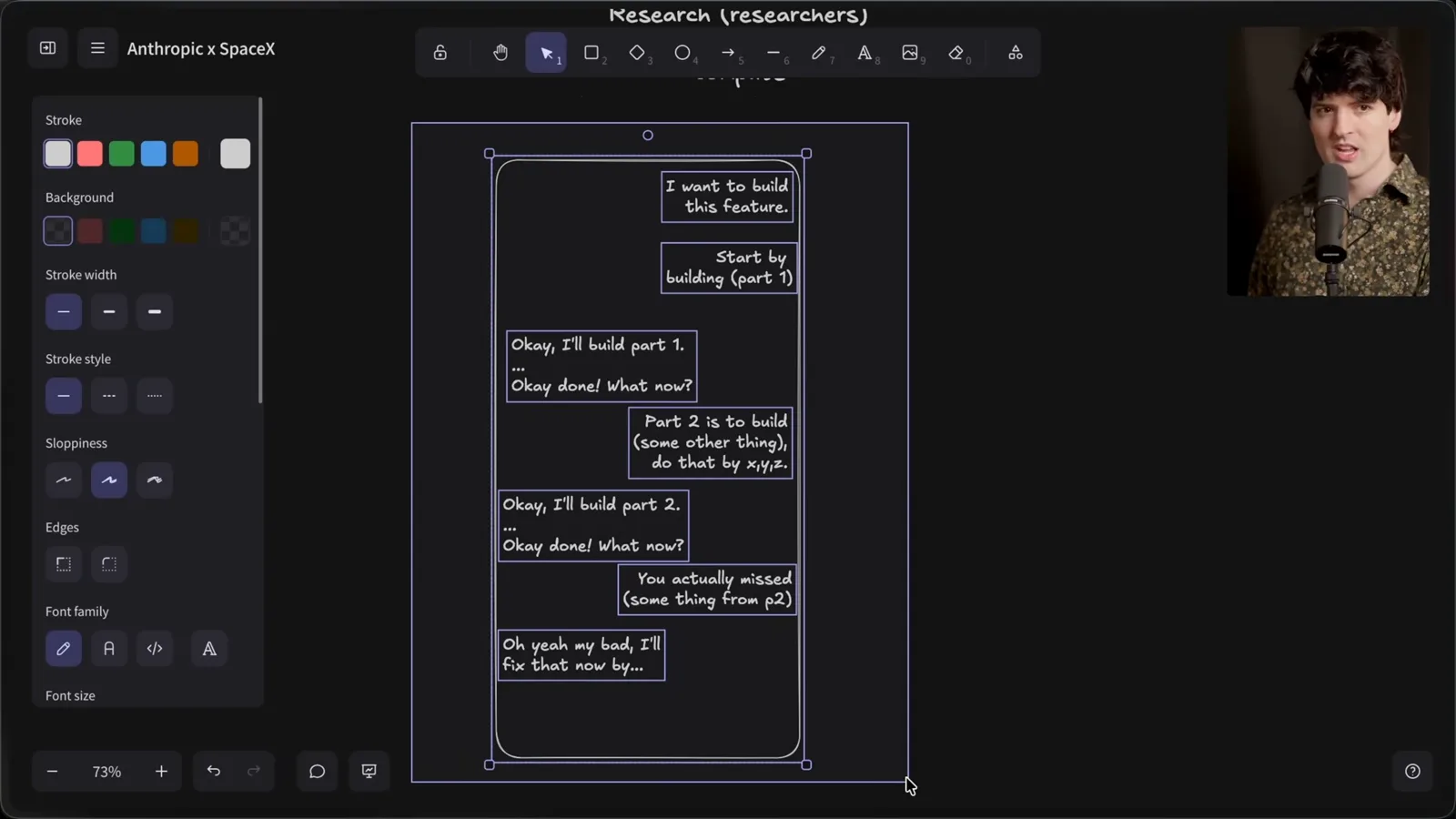
In my view, a coding product can have valuable experience data because it sees real workflows across different models. I think that could help explain why SpaceX values its relationship with Cursor. The companies have not publicly established the precise data access, permissions or use that I speculate about here.
I argue that xAI’s compute and Cursor’s product and engineering experience could complement one another. I also suggest that model providers are protective of data generated through their systems. These are competitive interpretations; access to customer conversations cannot be assumed, and product privacy settings and contract terms matter.
Partnership terms and speculation
Theo offers interpretations of the deal and industry rivalry. The companies did not publicly confirm his claims about customer data or private motives.
The announced alternatives were a $60 billion acquisition option or a $10 billion payment for working together. My suggestion that the latter was effectively a price for data is speculation, not a disclosed contract term. The public statement describes work together; it does not say the payment buys users’ chat histories.
I connect this to earlier restrictions on xAI personnel’s access to Anthropic models and speculate that competitive concerns over model-generated data played a part. I cannot establish the companies’ private motivations or prove that the restriction caused the SpaceX–Cursor deal; the chronology alone does not show causation.
My three-part diagram portrays xAI as strong in compute, Anthropic as strong in research, and Cursor as strong in product data. I place OpenAI strongly across the categories. These labels are my opinionated simplification, not verified measurements of research quality, available datasets or compute capacity.
I also discuss competition among coding models and cloud distribution. In my assessment, better coding tools and broader cloud availability can challenge an incumbent’s advantage. Product quality and market positions change quickly, so the rankings I describe are views from the recording, not permanent facts.
What Colossus capacity can tell us
Training and inference are distinct workloads. Announced capacity does not disclose prior utilization.
Musk’s statement distinguished training from inference: he said training had moved to Colossus 2. Training builds or updates a model; inference uses compute to answer users’ requests. Moving one workload does not, on its own, reveal exactly where all inference ran or how much capacity was idle.
I cite estimates for Colossus facilities and compare them with Anthropic’s announced access. Anthropic said it had agreed to use all Colossus 1 capacity, giving it access to more than 300 megawatts and over 220,000 NVIDIA GPUs within the month. Megawatts and GPU counts measure different things, and the numbers are not a utilization report.
I speculate that xAI had capacity available because it had moved training and that Grok inference required less of the original facility. The announcement does not quantify Grok demand, past utilization or the exact transition between customers, so my stronger claims about unused capacity should be understood as conjecture.
My overall interpretation is that the parties have complementary needs: Anthropic wants more capacity, and SpaceX has infrastructure to offer. The other announced cloud agreements also have long lead times. I see competitive pressure as part of the backdrop, but the private motives I attribute to executives remain my own speculation.
The lesson I take from the arrangement is that compute, data and research are all strategic resources, and a shortage in one can shape surprising partnerships. We can observe the published agreement and limits; claims about private negotiations, data access and competitors’ exact utilization need independent evidence.
Más de este canal
 38:47EN
 Theo - t3․gg· 28 oct 2026Theo’s Long-Running Agent Experiments: Verification, Compute and CostTheo Browne · Ping LabsA skateboard game and two compiler projects show how repeated checks and flexible compute can sustain agent work—and how expensive those loops can become.
 36:07ENTheo - t3․gg· 27 oct 2026Theo on Token Costs, Coding Agents, and the Price of AI CapabilityTheo Browne · Ping LabsA viral estimate of Lauren's AI spending prompts a closer look at cache pricing, benchmarks, and the changing work of coding agents.
 30:37ENTheo - t3․gg· 26 oct 2026Theo’s Three Skills for Reviewing and Shipping with Coding AgentsTheo Browne · Ping LabsHow sol-loop, full-send and full-stop encode review, verification and different levels of merge authority.
 0:43ENTheo - t3․gg· 23 oct 2026Theo Distinguishes Security Vulnerabilities from Active AttacksTheo Browne · Ping LabsA short explanation of why disclosed software flaws and reported attacks are different kinds of security news.
 29:22ENTheo - t3․gg· 22 oct 2026Theo on Security Vulnerabilities, Stolen API Keys and AITheo Browne · Ping LabsA look at the gap between vulnerability disclosure and patching, and a speculative account of why stolen inference keys may be valuable.
 31:13ENTheo - t3․gg· 20 oct 2026Theo on Why Smarter Models Help More Than DevelopersTheo Browne · Ping LabsFrom game modifications to compiler experiments, Theo revisits his assumptions about who benefits from more capable AI.