En 30 segundos
Y Combinator's internal teams use an always-on AI assistant in Slack, coding and administrative work. YC Labs engineers Josh France and Regan Bell say they open-sourced QM so organizations can host it, control their data and choose models. Shared projects and skills let colleagues collaborate with the same agent. To counter a tendency to fix each task in isolation, the team gives agents a master specification describing the larger product. They also demonstrate setting a minimum work budget, while stressing that people still need to review the result.
- 1One assistant serves the whole organizationQM is an always-on assistant with access to computer tools; personal and shared project spaces let colleagues collaborate and reuse skills.
- 2Self-hosting keeps company data and model choices under its controlThe YC Labs engineers open-sourced QM so others can adapt and operate the system rather than rely entirely on a single provider.
- 3A work budget can push an agent past its first answerThe team compares a quick attempt at cleaning stale tests with one asked to work for at least 30 minutes. The longer run produced more changes, which still require review.
- 4Non-engineers can build tools that act on company systemsAn example application screens hackathon candidates and can send messages through a connected email account; the shown data is dummy data.
- 5A master spec counters a pile of short-term fixesThe team's specification states the product vision and how components should fit together, giving agents context beyond the immediate task.
Conclusiones
- Give coding agents a shared product specification so individual fixes serve a longer-term design.
- A minimum time budget can prompt an agent to work longer on a task, but its changes still need human review.
- Start background tasks with a capable model, then test how much cheaper a model can be while still completing the work.
- Shared workspaces and reusable skills let an organization's teams work with the same persistent assistant.
Lee el texto editado por capítulos
From local coding tools to an always-on assistant
YC Labs describes a persistent agent that colleagues can reach through shared tools. QM is an open-source version teams can customize and host.
YC Labs engineers Josh France and Regan Bell use agents to get work done at Y Combinator. They say models have become more capable over the past six months, changing the range of work the team can assign to them.
Engineers still use local coding agents such as Claude Code and Conductor. Alongside those tools, the team has seen a more persistent agent pattern: an assistant that colleagues can contact on the web or in Slack rather than a tool confined to one person's computer.
QM is YC's attempt at an open-source, customizable framework for that kind of assistant. Its name stands for quartermaster, the person who keeps a ship running below decks. It can use a computer and tools inside YC, and everyone in the organization can interact with the shared system.
The team says QM learns from use across the organization. People can create skills that are shared across teams, so the system becomes more useful as colleagues contribute to it.
YC Labs made QM open source partly to give back to the community whose software it uses. The engineers also want companies to host their own systems: an agent may hold important business information and connect to important services, making control over data and model providers significant.
They want the framework to be hackable. A company can start with QM and adapt it to its own operations rather than reaching the limits of a system built entirely on one large provider.
Shared projects and model choice in practice
A Slack request becomes work in a shared project. QM's own interface lets the team select among model providers.
In a Slack demonstration, Josh flags a problem for Regan, who asks QM to investigate. The team says it makes similar requests repeatedly as user feedback comes in, bringing the assistant into an existing work conversation much as it would another colleague.
QM organizes work by scope: each employee has a personal workspace, while colleagues can also join shared projects. In the demonstration, both engineers can see work in a joint project. Because YC controls the framework, it can switch between models from different providers.
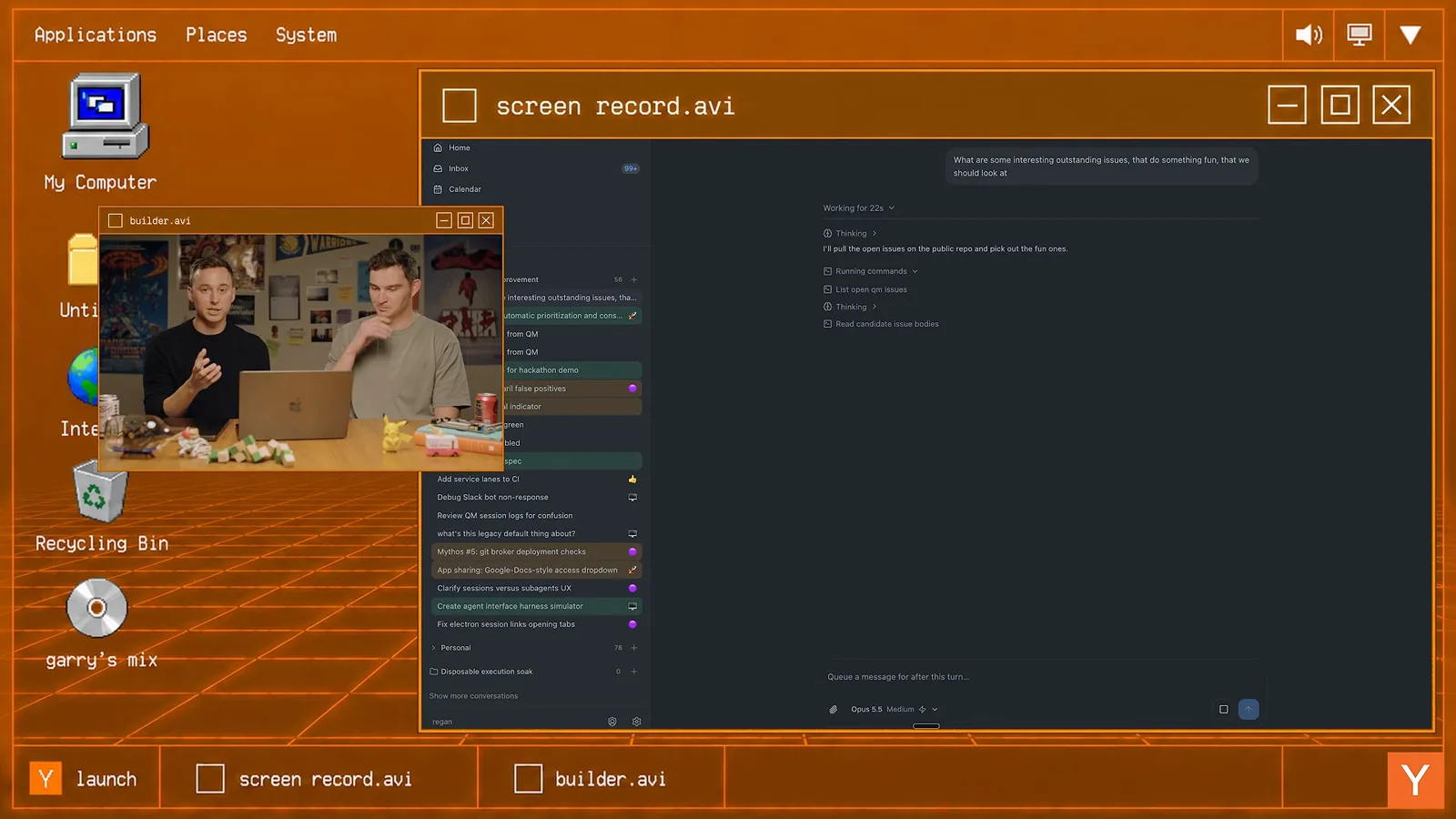
The team shows the system moving between providers when one declines an example request. They say choice can matter for frontier research and cybersecurity work, where a provider may refuse some tasks.
Budgeting effort and model costs
A minimum work period encourages a longer attempt, though the output still needs review. For recurring jobs, the team tests cheaper models after establishing the task.
To keep an agent working beyond its first answer, the team uses goals and a work budget. For example, a user can ask QM to spend at least 30 minutes on a task, allocating more computation before it declares itself finished or stuck.
One comparison asks QM to remove stale tasks in its own open-source repository. A regular attempt produces a change of about 180 lines, while an attempt given at least half an hour produces about 700 lines. The engineers emphasize that a person would still have to review whether those changes are valid.
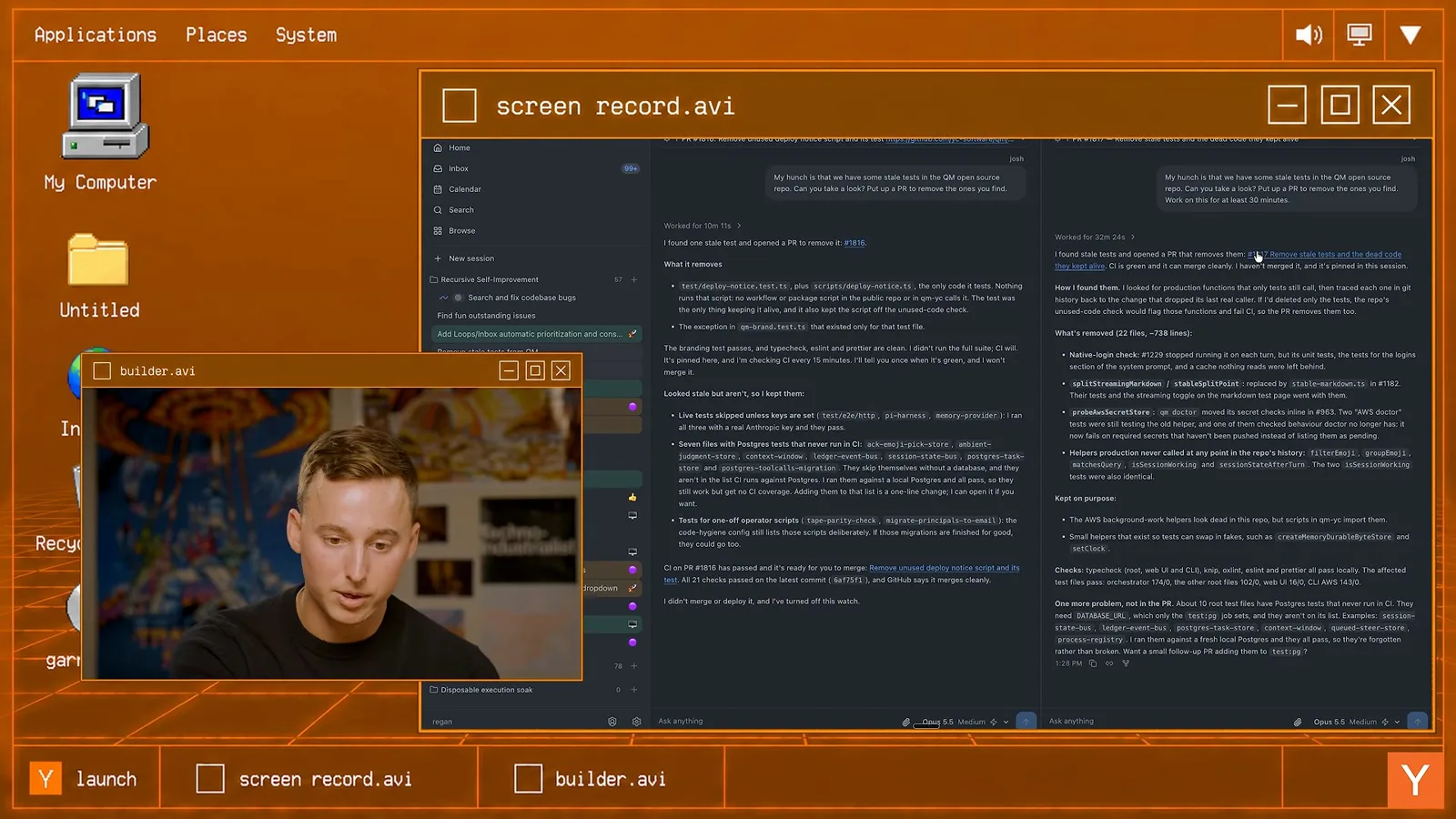
The team says it experiments with spending more on model usage to explore new workflows, then looks for ways to lower the cost. For scheduled or background jobs, it may begin with a more capable, expensive model and step down to find the least expensive one that still completes the task.
Internal applications and a master spec
Nontechnical staff use the assistant for operations and custom applications. A shared specification helps prevent isolated fixes from accumulating into a brittle product.
QM supports software development, but YC's legal and finance teams use it too. Staff use it for event planning and administrative work that might otherwise involve repeated clicks across websites and software services.
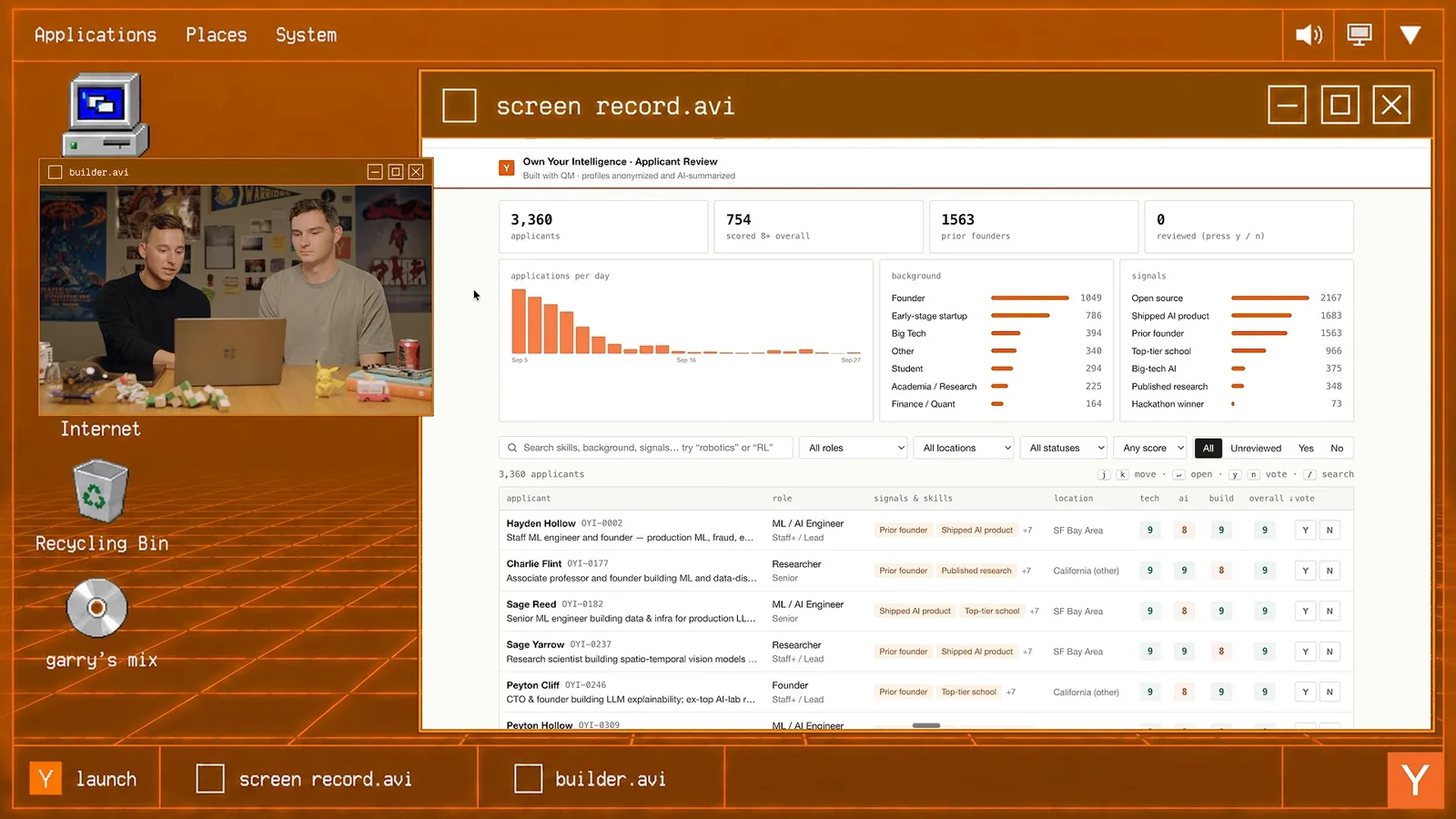
Nontechnical colleagues also build small applications with QM. The engineers show a demonstration app for reviewing hackathon applications: it can use internal data and send email through a connected account. The displayed site uses placeholder data, but they say such apps can connect to production systems without an engineer writing the code.
The engineers see a recurring failure mode: an agent may fix exactly the immediate problem without considering how the choice will affect the product months later. Over time, those narrow fixes can accumulate like a pile of bandages.
Their countermeasure is a master specification that explains the product's high-level vision, direction and how its parts should fit together. One speaker compares this to a manager reminding a person how their individual project relates to the larger mission.
The team says changes that look good at first can contribute to a production bug months later as other parts of the code change. In their experience, a human engineer's memory of past failures and attention to the whole system can help prevent that.
Engineers increasingly direct and inspect agents
The speakers still value the ability to inspect underlying code. Their daily work also involves setting goals, finding blockers and steering multiple agents.
The job of an engineer is changing, they say, though the ability to inspect code and verify what an agent is telling you remains important. Instead of concentrating on a single feature, an engineer may set broad goals, find the current blocker, investigate what went wrong and guide several agents toward a result.
Más de este canal
 15:52EN
 Y Combinator· 24 nov 2026Boom wants its supersonic engine to power data centers firstBlake Scholl, Jared Friedman · Boom SupersonicBlake Scholl says a shared gas-turbine core could fund aircraft development while generating operating data.
 1:05:32ENY Combinator· 19 nov 2026Should governments slow AI? Coxon and Hanson dispute the risksVivian Midha Shen, Jacob Coxon, Robin Hanson · Y CombinatorJacob Coxon expects rapid automation and wants a slowdown; Robin Hanson favors liability and warns against broad global regulation.
 54:19ENY Combinator· 18 nov 2026Eric Glyman: Give AI the Context and Authority to Do Useful WorkGarry Tan, Eric Glyman · Y CombinatorRamp’s co-CEO describes connecting agents to company workflows and judging AI spending by the value it creates.
 1:00:06ENY Combinator· 14 nov 2026AI coworkers need earned trust, reliable checks and clear goalsLauren Tan, Roman Ugarte · SpaceXSIGrok Bot builders Lauren Tan and Roman Ugarte explain how shared bots work alongside teams and why product direction still matters.
 1:00:06ENY Combinator· 14 nov 2026Grok Bot’s team: give agents checks before giving them autonomyLauren Tan, Roman Ugarte · Grok BotLauren Tan and Roman Ugarte explain how shared bots, codebase guardrails and human product judgment fit into their workflow.
 1:21:42ENY Combinator· 8 nov 2026What AI biology can do now, from cancer data to DNA designAlfredo Gonzalez, Yusuf Roohani, Garyk Brixi, Divya NoriFour researchers explain patient-specific cancer analysis, virtual cells and genome models, separating early experiments from proposed clinical applications.