En 30 segundos
Jordan Nanos speaks with SemiAnalysis analysts Max Kan and Andrew Megalaa about their October 2026 tests of AI subscription limits. They explain how token types and workload mixes change API-equivalent value, discuss estimated provider margins, and consider the limits of comparing model quality and token efficiency.
- 1A conditional comparisonA $200 subscription’s modeled API-equivalent value depends on a specific model and workload.
- 2Different token typesFresh inputs, cache writes, cache reads and output can consume plan limits at different rates.
- 3Measuring usage limitsThe researchers isolated token categories with controlled requests and observed the usage meters.
- 4Uncertain utilizationAverage usage and gross margins are inferred rather than observed directly.
- 5Tokens are not task valueQuality, follow-up work and user behavior complicate efficiency comparisons.
Conclusiones
- A subscription’s API-equivalent value depends on the model, token mix and limits in force at the time.
- Cache reads dominate the team’s modeled agentic workload and can strongly affect comparisons.
- The team measured how controlled requests changed usage meters, then modeled different workloads.
- Their provider utilization and margin figures are estimates, not confirmed financial disclosures.
- Token counts alone do not establish how much useful work a model completes.
Lee el texto editado por capítulos
Subscriptions and assumptions
The researchers introduce their comparison and margin estimates. They explain why API-equivalent value depends on workload.
SemiAnalysis host Jordan Nanos welcomes Max Kan and Andrew Megalaa to discuss their October 2026 comparison of AI subscriptions. They say they tested plans from OpenAI, Anthropic and other providers by measuring how different token types consume usage limits.
Kan says a $200 Claude plan could yield the equivalent of about $12,000 at Opus 5.5 API list prices under their tested assumptions. API-equivalent value is a hypothetical comparison, not cash the subscriber receives or a guarantee for every workload.
He argues that a subscription can be a good deal relative to API prices without necessarily having negative gross margins. His estimate assumes API margins above 90% and average subscription utilization around 10%, yielding an estimated 50% to 60% subscription gross margin; these inputs and margins are not verified company disclosures.
Megalaa says their representative agentic workload contains roughly 96% cache reads, with smaller shares of fresh input, cache writes and output. The researchers emphasize that a different mix can change the comparison substantially.
Kan describes subscription limits as an allocation of credits: different models and token types draw down the allowance at different rates. Because those rates need not match API price ratios, there is no single API-equivalent value that applies to every subscriber.
Token types and caching
Fresh input, cache writes, cache reads and output have different costs. Cache routing and expiration matter to providers.
Megalaa explains fresh input tokens, cache writes, cache reads and output tokens. Cached context can be reused instead of recomputed on each turn; pricing varies by provider, but cache reads are usually much cheaper than generating output.
He gives illustrative ratios: input at 1×, cache writes around 1.25× and cache reads around 0.1× or less, with output often more expensive. These are examples from the conversation, not universal prices.
Cache reads can dominate a long agentic session because prior context is reused repeatedly. Nanos says the cache hit rate therefore makes a large difference to the effective cost of an inference provider.
Serving cached context at scale is a systems problem. A provider must store or offload a conversation’s cache, route later requests to the right deployment, and balance GPU utilization across many users.
A cache also has a time to live. If it expires before a user returns, the provider may need to process the context again; Nanos notes that this can turn cheap cache reads into more expensive fresh processing.
Kan says recent price cuts have concentrated on cache reads. He speculates that this category previously carried especially high margins; his figures are estimates, not provider-confirmed costs.
Comparing plans
The group discusses model-specific token allowances and the limits of benchmark comparisons. Preferences for model quality differ.
The speakers compare specific flagship models using the prices and limits in force at the time. They say a cheaper cache-read price can make a plan deliver more tokens even when its API-equivalent dollar value appears lower.
In their particular $200-plan comparison, the researchers estimate roughly 1.9 billion GPT-6 Astra tokens versus 3.1 billion Claude Fable 5.1 tokens under the modeled agentic mix. They say Fable had a separate cap at half of the Claude plan’s allowance, leaving additional allowance for other models.
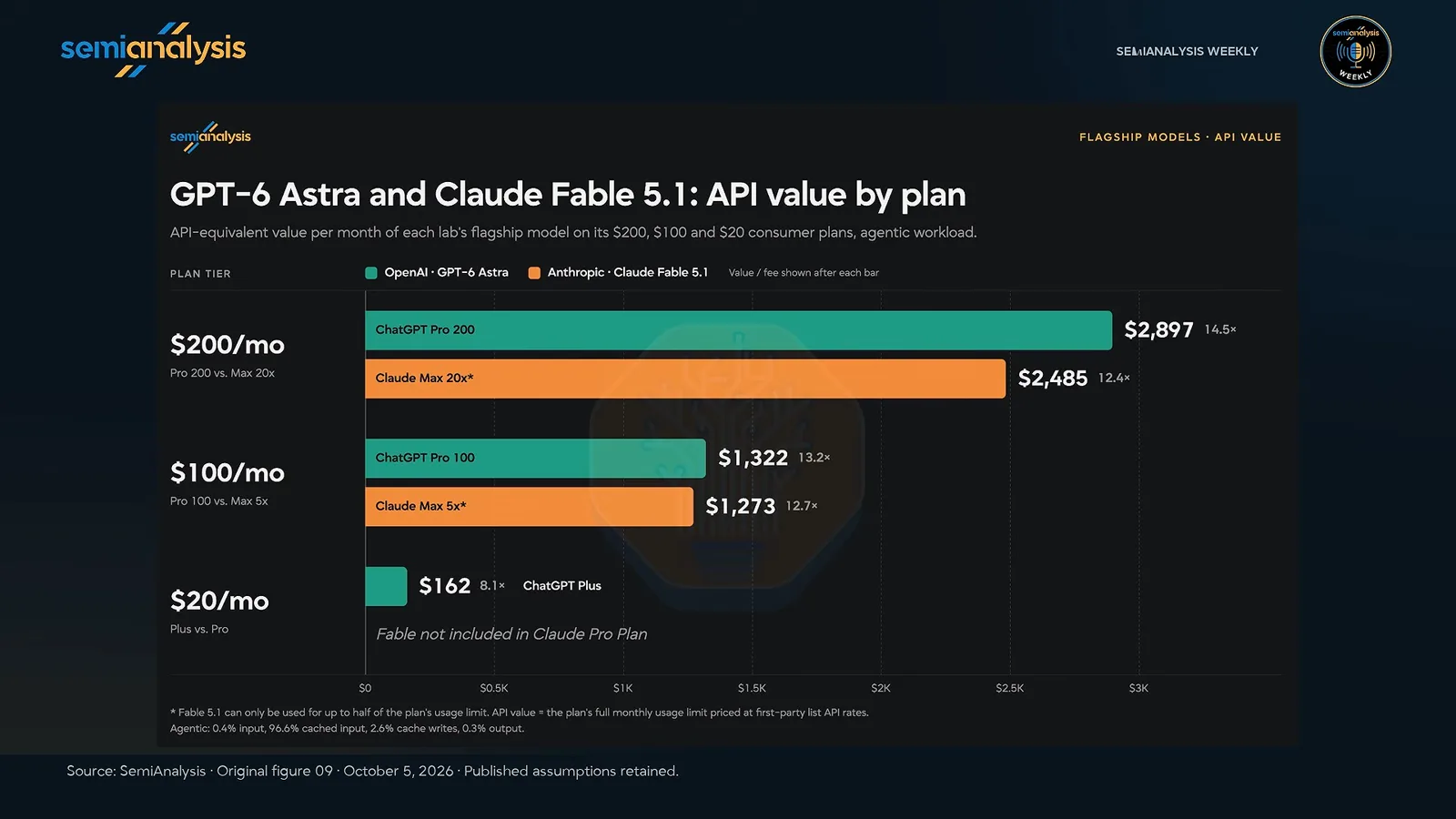
The more controversial comparison pits GPT-6.1 Sol against Opus 5.5. Megalaa says critics argued Sol could use fewer tokens per task, while the team disputes whether the cited benchmarks provide a reliable measure of real-world token efficiency.
Kan compares selected benchmark settings and argues that the subscription advantage persists even after accounting for the benchmark’s measured cost difference. This conclusion depends on the chosen model settings, tasks and quality comparison.
Megalaa expresses a strong personal preference for Anthropic models and considers Opus 5.5 competitive with higher-tier alternatives. Nanos notes that model choice is highly personal; the participants do not claim their preferences are a controlled evaluation.
Test methodology
Controlled prompts isolate token categories and reveal how plan meters move. The team models agentic and chat workloads separately.
To measure limits, the researchers say they simulated how popular command-line clients call model APIs and designed prompts to isolate each token category. They compared the response token counts with the movement of each plan’s usage meter.
For input and cache tests, they used a long block of text with a short question. They varied whether caching was requested and whether the prompt prefix changed, then checked the returned accounting to distinguish fresh input, writes and reads.
For output, they requested long essays and observed how generated tokens affected the meter. Repeating these controlled requests allowed them to estimate the rate for each token type and model different mixes of work.
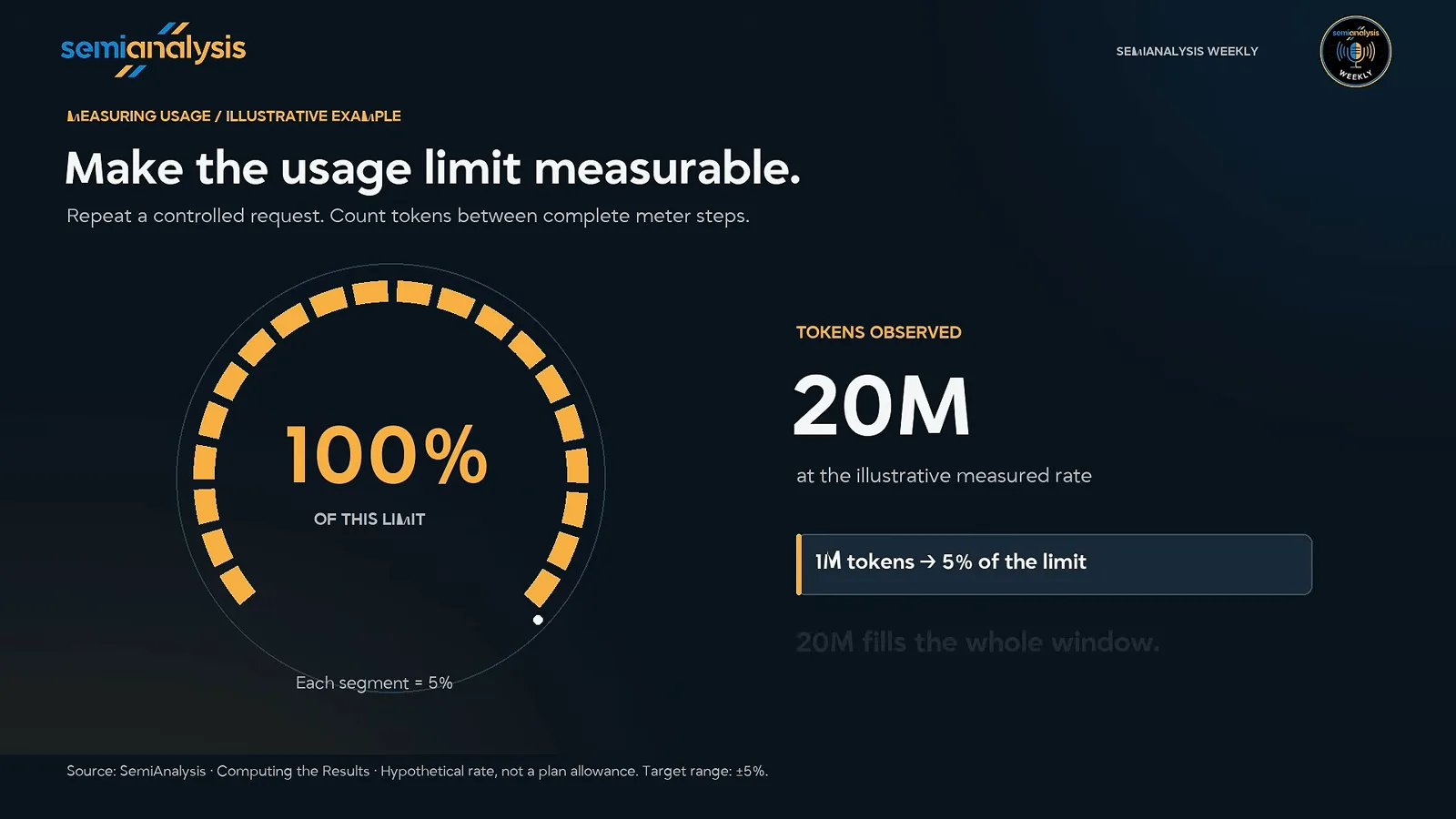
Their agentic token mix came from SemiAnalysis’s own enterprise usage in September. For chat, where direct measurement was harder, they estimated a mix using assumptions about shared system prompts, short user prompts and how often people return to a conversation.
Other providers and utilization
The discussion covers additional plans, resellers and uncertain average usage. Results are a point-in-time snapshot.
The team also tested plans from Moonshot, Z.ai, MiniMax, Meta and others. Kan says some offered substantial API-equivalent value despite lower API prices; these comparisons again depend on the chosen workload and reference prices.
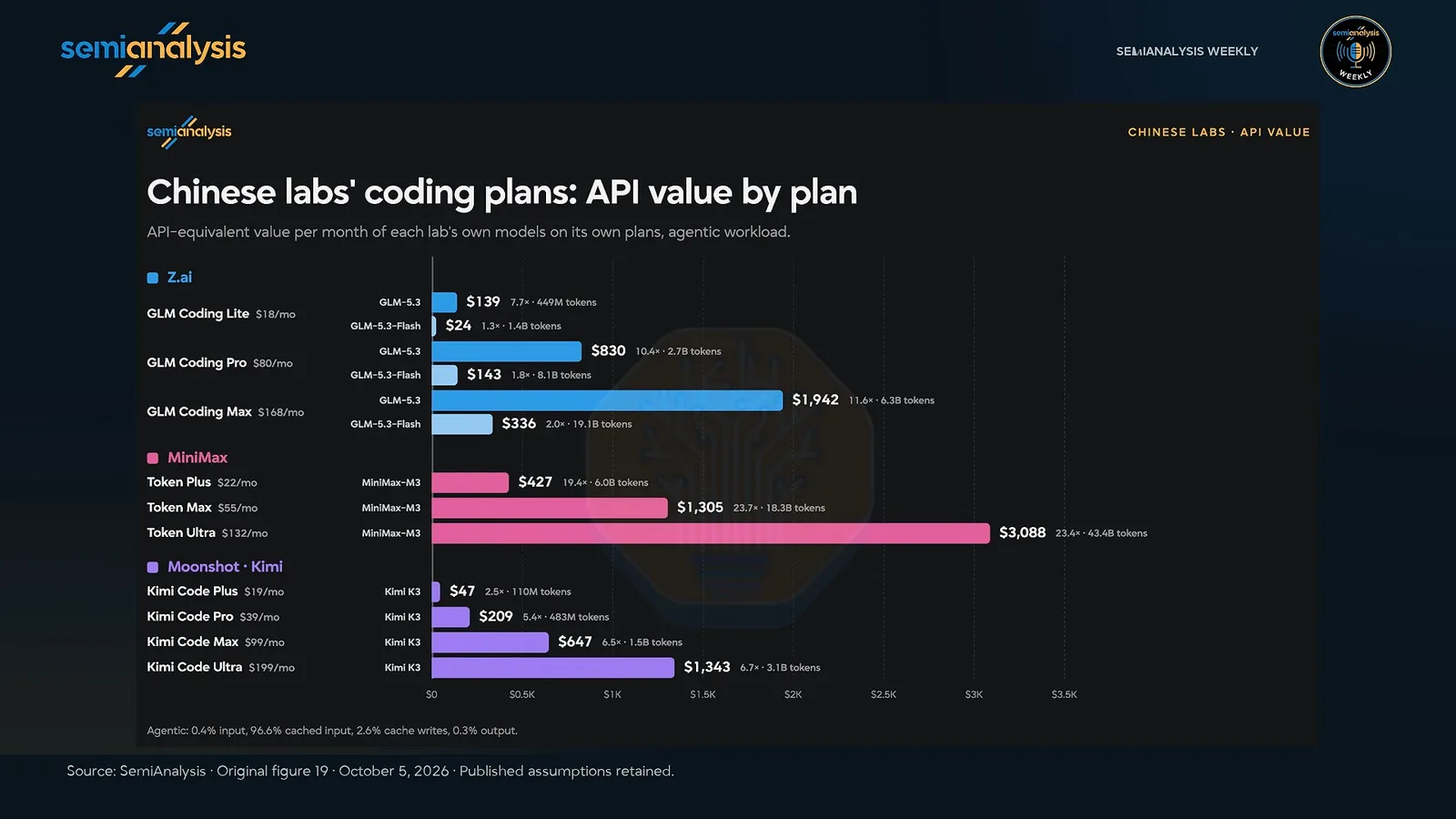
Nanos says he did not see a subscription price war so dramatic that it would obviously make users switch away from their preferred models. Lower entry prices can still matter, and individual plans offer different amounts of use.
Kan argues that model owners may have an advantage over resellers because a third-party application must pay for access. He says limits for Anthropic models through some third-party plans were lower in their test; his margin and discount assumptions are estimates.
The group also highlights the API-equivalent token allowance they measured for a Meta plan, while joking about the number of reservation requests it might support. The figures reflect that specific plan and time.
Nanos asks how much of a subscription’s limit the average customer actually uses. Kan says the team lacks direct visibility and estimates Anthropic utilization around 10% by interpreting available financial information, with substantial uncertainty.
Power users who report hitting every limit may not represent the typical subscriber. Kan also discusses a then-announced OpenAI limit change and a grace period for existing subscribers; such details can change after the episode.
Efficiency and open models
The panel considers useful work per token, routing and open-weight models. Personal experiences and future market predictions remain opinions.
The researchers stress that their study is a snapshot: model releases, subscription tiers, usage limits, fast modes and provider pricing can all change. They intend to keep tracking the comparisons.
Measuring useful work per token is harder than measuring token volume. Benchmark tasks may not reflect real workflows, while comparing employees introduces differences in the person, task and review standards.
Megalaa says his personal experience suggests some models finish an immediate task with fewer tokens but leave follow-up work that another model might have included. He acknowledges this is his judgment about output quality rather than a quantified result.
Discussing third-party tools and routers, Megalaa says he generally prefers choosing a model he knows and trusts. He has not personally evaluated every alternative and notes that understanding a model’s strengths and failure modes matters when designing a system.
The discussion turns to open-weight models. Nanos says router token-share data alone does not establish a complete market-wide shift, though he sees meaningful growth in use on those platforms.
Kan argues that the choice often depends on how much capability a task actually requires. Businesses may move easier work to cheaper open models; the future of frontier providers also depends on whether demand for new, harder tasks grows fast enough.
Security and closing discussion
Nanos describes his experience with security work. The speakers discuss uncertainty around model capabilities and end with an unverified reaction to research news.
Nanos describes switching to GLM 5.3 for cybersecurity work after encountering refusals from other models, then continuing with the same chat for a small dashboard change. He presents this as his own experience, not proof of general superiority.
Megalaa reports hearing that other models with security capabilities enabled can outperform GLM 5.3 on some real tasks. The group discusses possible genuine security concerns as well as arguments about regulation; neither proposition is established by this exchange.
The conversation ends with an offhand reaction to newly released mathematical research. The speakers do not verify their immediate speculation, and close by saying they will revisit subscription limits and token efficiency.
Más de este canal
 55:06EN
 SemiAnalysis· 27 oct 2026Pódcast · 4 vocesAnthropic's S-1: Revenue, Compute Costs and the Race to ScaleThe SemiAnalysis panel examines Anthropic’s filing, from improving compute economics to customer concentration and competition.
 34:35ENSemiAnalysis· 23 oct 2026Pódcast · 3 vocesSemiAnalysis on ASML's Hybrid-Bonding Patents, HBM Economics and the Next Tool EcosystemInvitado: Sherry Zhang, Howie · Presenta: Jordan NanosJordan Nanos, Sherry Zhang and Howie examine a track-based bonding design that brings the wafer to the die, then explain why adoption depends on precision, cleanliness, economics and a changing supply chain.
 34:47ENSemiAnalysis· 20 oct 2026Pódcast · 3 vocesWhy SemiAnalysis Raised Its 2027 Data Center ForecastInvitado: Jeremie Ontiveros, Reyk Knuhtsen · Presenta: Jordan NanosJeremie Ontiveros and Reyk Knuhtsen explain their project-level model, construction risks and the possibility of a future capacity imbalance.
 44:12ENSemiAnalysis· 14 oct 2026Pódcast · 3 vocesGLM 5.3, Sparse Attention and the Cost of InferenceInvitado: Kimbo Chen, Wenyao Gao · Presenta: Jordan NanosSemiAnalysis examines memory bottlenecks, AMD and NVIDIA serving results, post-training and support for Chinese chips.
 1:23:18ENSemiAnalysis· 9 oct 2026Pódcast · 2 vocesWho Will Finance the AI Infrastructure Build-Out?Invitado: Daniel Nishball · Presenta: Jordan NanosSemiAnalysis examines projected capital needs, GPU rental economics and the guarantees supporting data center financing.