En 30 segundos
Matthew Berman explores World Labs’ Marble, a tool for generating and editing navigable 3D worlds. He discusses potential creative and robotics applications, demonstrates sample scenes and tests the limits of reconstructing an office from a single screenshot.
- 1Spatial environmentsWorld models can provide interactive settings for creative work and, potentially, agent training.
- 2Multimodal workflowMarble takes several kinds of input and supports editing, expansion and export.
- 3Editing a worldText instructions can replace objects or restructure portions of a scene.
- 4Finite scenesThe live demonstration becomes blurry at greater distances and reaches the edge of the generated area.
- 5Invented detailsThe office reconstruction resembles the source image but invents unseen features.
Conclusiones
- Marble creates navigable 3D scenes from text, images, video or coarse 3D layouts.
- Generated worlds can be edited, expanded and exported in multiple formats.
- Multiple photos can guide the creation of a scene inspired by a real space.
- A single input image leaves unseen parts to be inferred, so generated details may be inaccurate.
- The demonstrated worlds have finite boundaries and can become blurry farther from the starting area.
Lee el texto editado por capítulos
Marble and spatial intelligence
Berman introduces World Labs’ navigable 3D generation tool and its potential uses. He describes why world models matter to the company’s vision.
World Labs has made Marble available: a multimodal world model that generates navigable 3D environments. The company, co-founded by Fei-Fei Li, calls its approach spatial intelligence. I am excited because the resulting scenes can be explored and edited, rather than viewed only as a flat image.
World models aim to reconstruct, generate and simulate 3D spaces for people or agents to interact with. I can imagine applications in games, film and practice environments. A simulated factory floor could also offer a place to train embodied agents, although transferring that training to a real robot remains a separate challenge.
Inputs, outputs and editing
Marble accepts text, imagery, video and coarse layouts. Examples show multi-image reconstruction and changes to generated scenes.
Marble can generate a world from text, images, video or a coarse 3D layout. It can then export the result as Gaussian splats, meshes or video. The ability to edit a generated scene and maintain a coherent world is as interesting to me as the initial generation.
Fei-Fei Li and other researchers, including Yann LeCun, argue that understanding the world may require approaches beyond language alone. Human experience combines sight, sound, touch and language; world models seek to represent environments in ways that support reasoning and action.
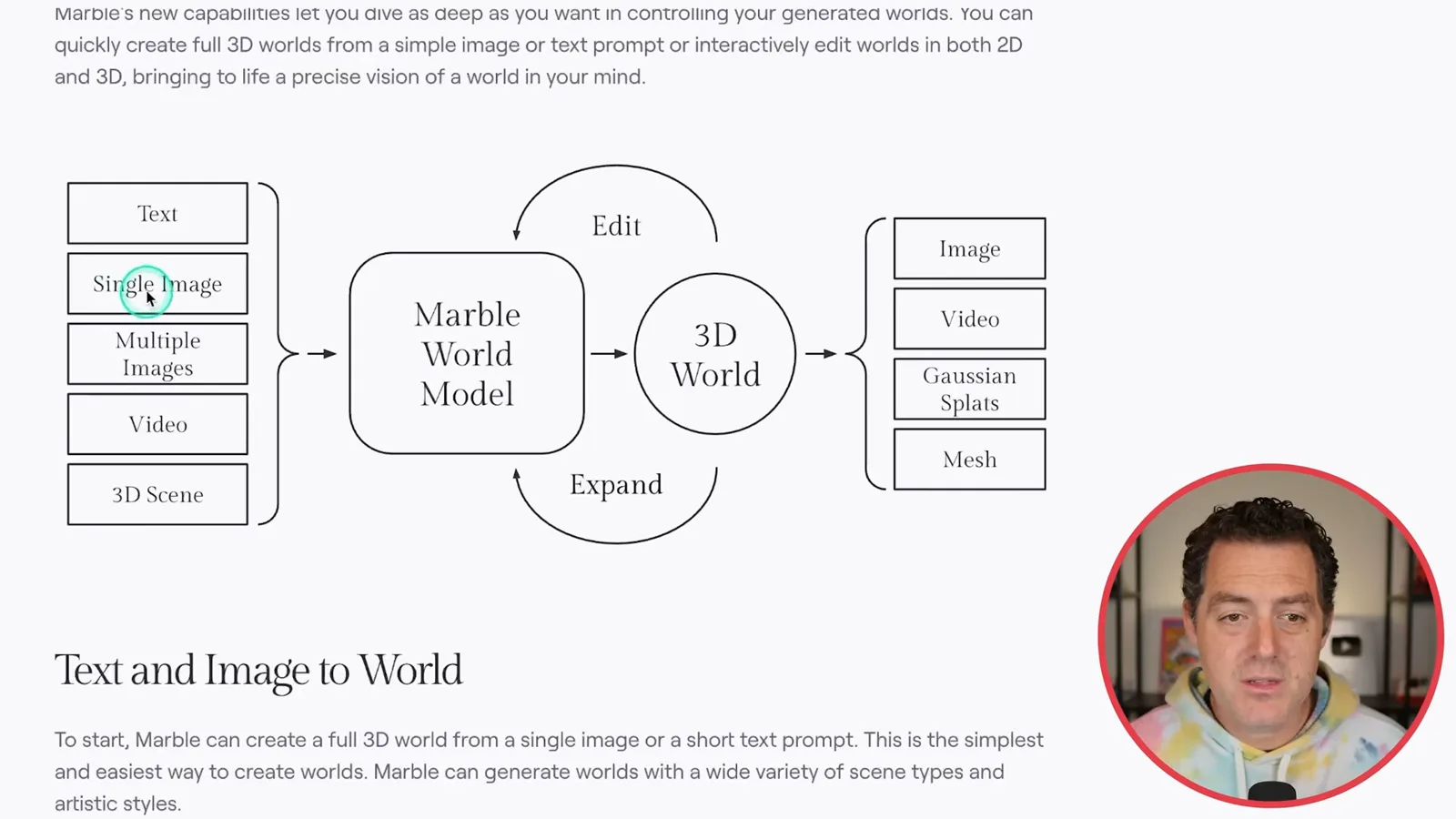
The Marble workflow takes text, one or more images, video or a 3D scene and produces a 3D world. The user can edit or expand it, then export images, video, Gaussian splats or meshes. The generated representation is distinct from the conventional meshes used in tools such as Blender or Unreal Engine.
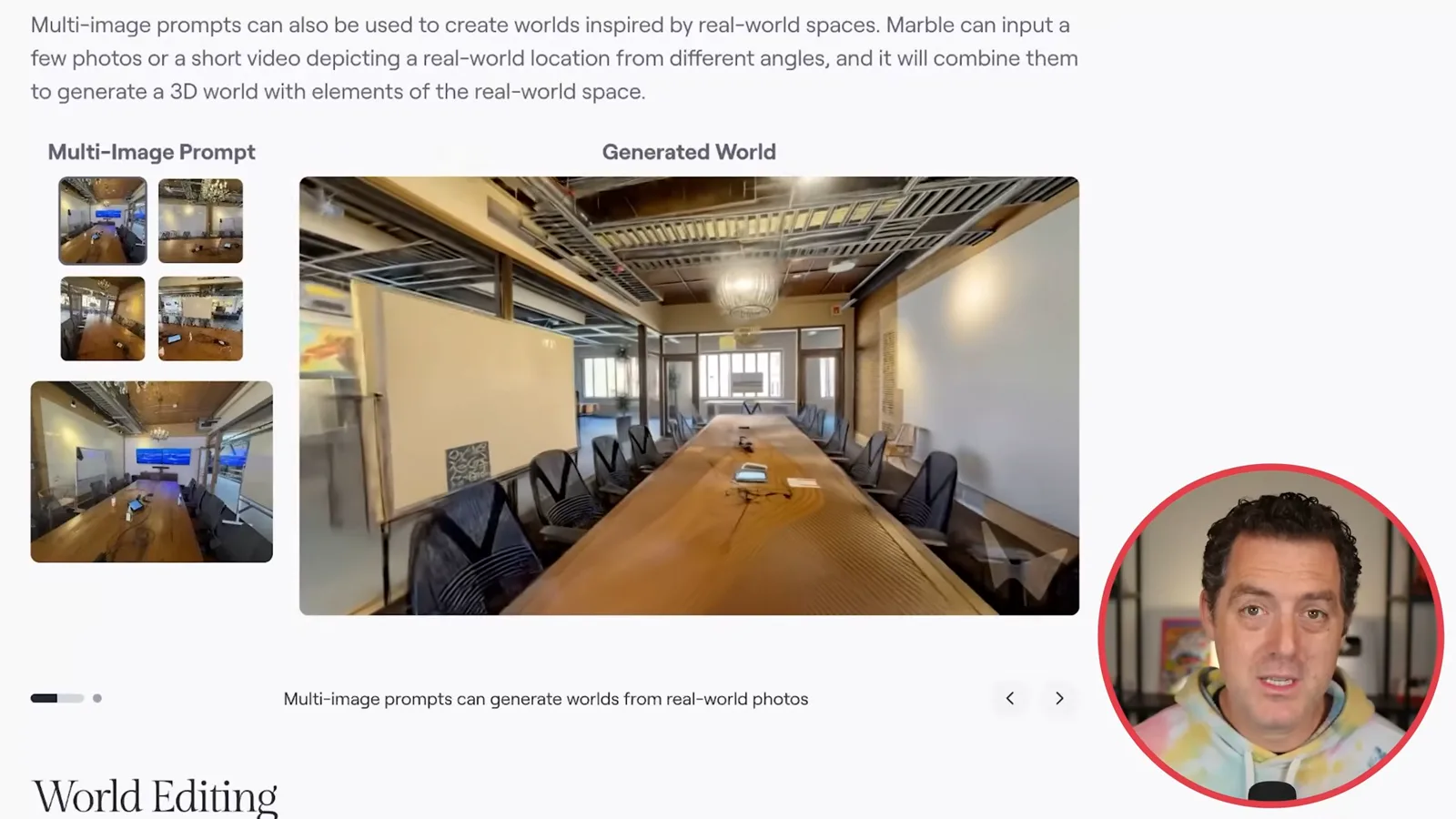
A single image can become a scene that you move through. A text prompt can instead describe, for example, a space-station kitchen with mid-century diner details. Multiple images can supply different perspectives: World Labs shows photos of an office combined into one navigable 3D space.
The editing examples change an existing room: one prompt turns a back wall into a stage and replaces tables with benches. Another changes turtles into tigers and tall plants into French fries. These examples demonstrate how a user can request changes to objects and larger parts of a scene.
I can also imagine visualizing a kitchen remodel: upload a photo, create a 3D environment and ask for black countertops. A coarse 3D layout can serve as another starting point; the demonstrations turn simple geometry and text into scenes such as an art museum or a guest bedroom.
Exploring sample worlds
Berman navigates sample environments and notes their finite boundaries. He then starts an office reconstruction from a screenshot.
In the live demo I open Marble and navigate a neon-lit hallway. The detail looks impressive, but the scene becomes blurrier as I move farther in, and I eventually reach the edge of the generated area. The longer-term vision is to generate more of a world as the user moves through it.
You can also move outside the generated section to inspect it from another perspective. In another sample, I look around a space capsule and out toward a planet. These examples show the appeal of being able to change viewpoint within a generated scene.
I upload a screenshot from one of my videos and ask Marble to recreate my office. The system can only see what is in the image, so it has to invent unseen areas. While it processes the image, I explore a social-style feed, a studio for more detailed control and the paid tiers alongside the free plan.
An office generated from one image
The generated scene captures some visible details while inventing unseen features. The studio offers controls to transform and expand the result.
Marble automatically writes a descriptive prompt from the office image, including the furniture and a possible YouTube award plaque. The resulting world resembles the visible background, but it also invents a large television and parts of a house that are not in my actual office. The demo makes both the possibilities and limits of single-image reconstruction visible.
In the studio, I can move around, transform the scene, make it public and use tools for controlling or expanding the environment. Marble already feels like a powerful creative product, even though the generated scene is not a faithful reconstruction of every unseen detail.
Más de este canal
 25:50EN
 32:20EN
 45:08EN
 12:14EN
 10:36EN
 17:37EN