In 30 seconds
Jason Liu walks through pinned work conversations, a Markdown vault, recurring summaries and personalized writing skills. He also explains the goal, plan and work log behind a drum-practice app developed over roughly a week, emphasizing specific feedback and verifiable outcomes.
- 1A vault for durable contextLiu keeps projects, people, notes and preferences in a Markdown-based vault.
- 2A chief-of-staff summaryScheduled checks combine connected sources and evolved to include links and prepared drafts.
- 3Goal, plan and work logThe goal defines verifiable success; the plan and log capture implementation and progress.
- 4Specific feedback improves the resultLiu identifies concrete problems such as flicker or missing shortcuts and iterates on them.
Takeaways
- Keep durable project context in notes and refine recurring summaries over time.
- Use examples and feedback to improve personal writing skills and periodically review unused ones.
- Separate a verifiable goal from implementation plans and progress logs for longer projects.
- Give concrete feedback about the experience you want to change rather than asking vaguely for improvement.
- Treat product descriptions and cloud plans as a snapshot of the interview.
Read the edited text by chapter
Organizing work and context
Liu explains his pinned conversations and Markdown vault.
Jason Liu of OpenAI's Codex team shows Peter Yang how he organizes work, maintains skills and builds a personal drum-practice app. The discussion reflects his workflow and product experience at the time of recording. The episode is sponsored by Google AI Studio.
Liu describes ChatGPT Work as a work-oriented view of a similar agent experience, while Codex exposes more coding details such as changes and pull requests. For routine organization he chooses a moderate effort level; for more complicated application work he says he may choose a higher one. These are personal preferences rather than permanent product recommendations.
He organizes ongoing work around pinned conversations and a Markdown-based Obsidian vault. The vault contains projects, people, notes and preferences; he asks the agent to save important information there. He describes it as a starting point from which he can access other repositories and projects.
Summaries and personalized skills
A recurring chief-of-staff workflow and writing skills improve through feedback.
His daily chief-of-staff automation summarizes information from sources such as Slack, email and a task board at scheduled times. He says he added capabilities gradually, including links to sources and prepared drafts. Some actions can be automated in his setup, but he distinguishes broad summaries from situations where he chooses a more specific instruction.
A simple starting instruction, Liu suggests, is to ask for a recurring check of selected sources and a list of priorities. Then refine the result: request links, clarify which tasks matter and adjust how drafts are prepared. He says his own workflow developed over time rather than appearing fully configured from the start.
His writing skills use examples of his own messages to capture voice, with differences for teammates, external users and executives. He periodically reviews and consolidates skills, sometimes asking the agent to examine prior sessions for repeated feedback. Those changes are iterative and depend on having relevant material available.
Browser work and a practice app
He discusses browser research and demonstrates a drum-learning tool.
For browser work, Liu describes using a signed-in browser and multiple tabs for research. In one shopping example, the agent opens candidate products and he compares them and checks out himself. He also uses computer interaction for forms and testing apps; the available integrations and interfaces can change over time.
Liu's drum-practice app grew over roughly a week as he learned what he wanted. It includes practice patterns and adjustable tempo; he demonstrates a four-limb grid. He describes further ambitions for breaking a drum solo into practice sections, which should be read as a goal rather than a completed capability.
Goals, plans and useful feedback
The interview closes with a practical approach to longer projects and iteration.
For long-running work, he distinguishes a goal file defining verifiable success, a plan describing implementation choices and a work log recording progress and obstacles. In one example, success requires opening the app, supplying a specific video and checking the resulting data. He discusses refining goals as the project evolves.
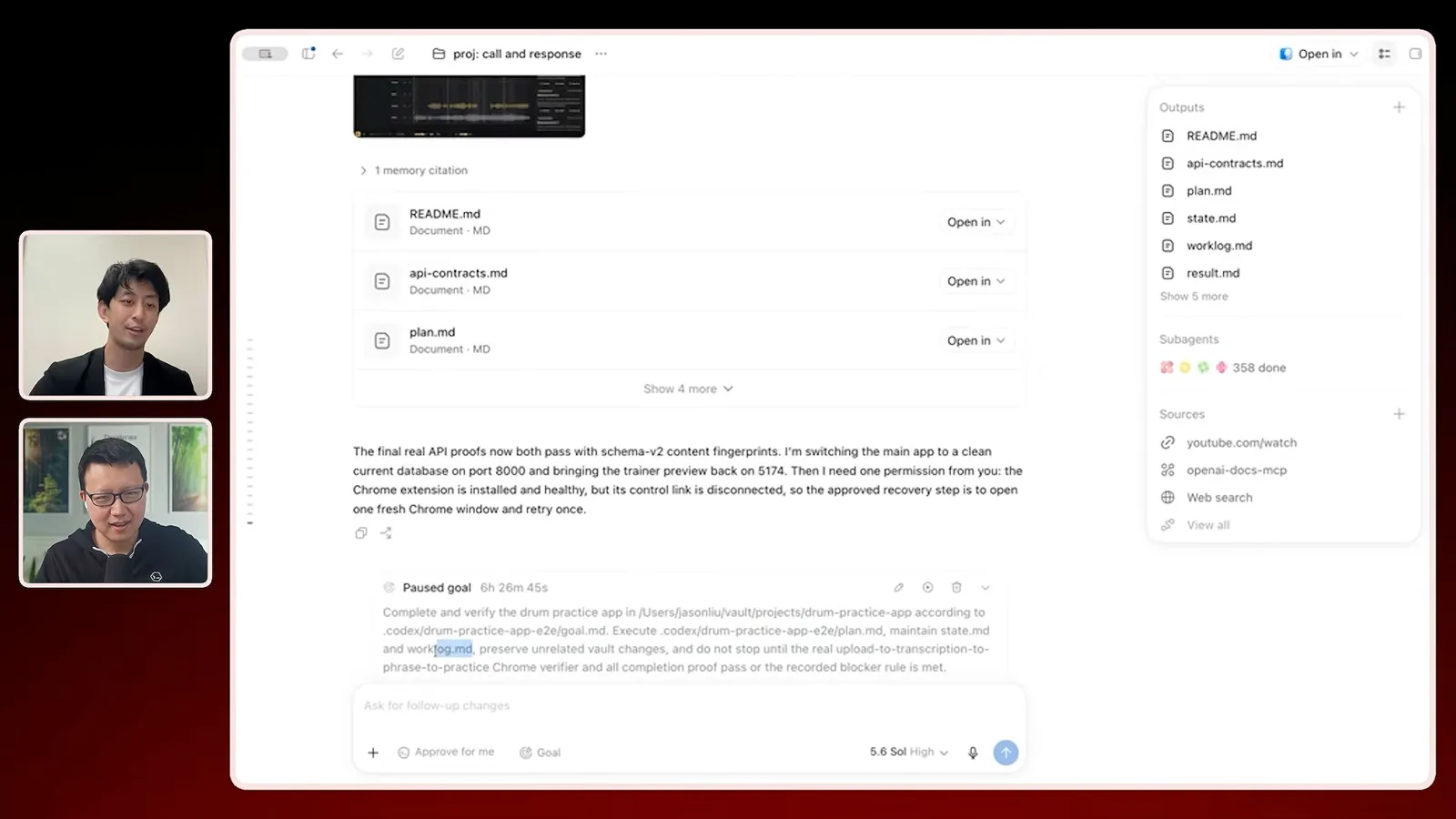
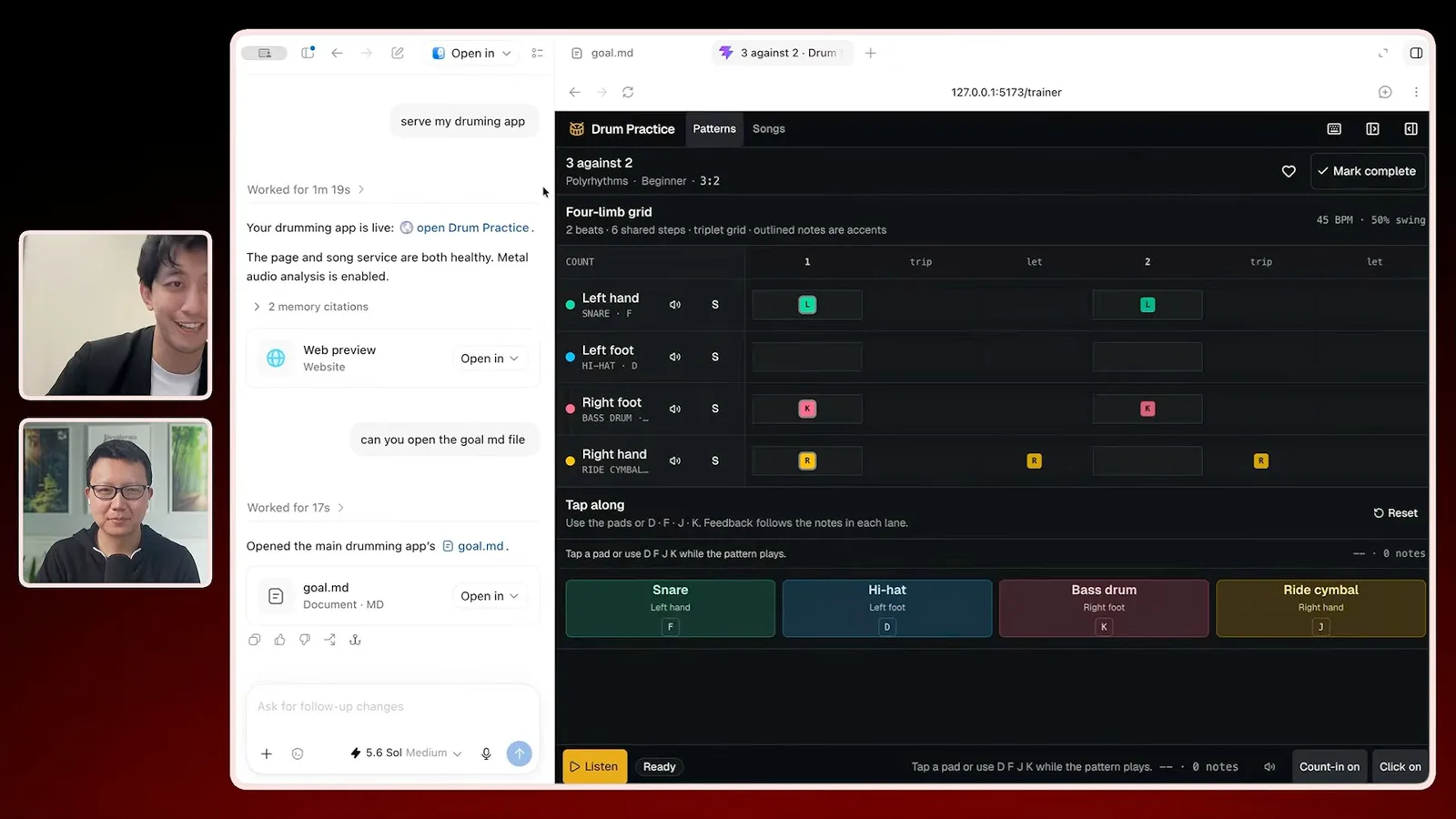
Liu argues that a builder can learn while making a tool: notice a specific problem, such as flickering panels or missing keyboard shortcuts, describe it and iterate. He contrasts actionable feedback with repeatedly asking an agent to make something better without explaining what is wrong.
He judges the drum app by whether it helps him learn and can be shared with others. He also expresses interest in cloud-based work that can continue after a laptop is closed. That is the direction he discusses, not a guarantee about every scheduled workflow or product configuration.
More from this channel
 46:40EN
 Peter Yang· Nov 8, 2026Podcast · 2 speakersAshley Alexander: How AI Helps Me Care for My Parents With CancerGuest Ashley Alexander · Host Peter YangA caregiver uses AI to prepare for appointments, organize records and ask better questions—while keeping doctors at the center of treatment.
 17:50ENPeter Yang· Nov 4, 2026PodcastPeter Yang’s Five Steps for Using AI to Help Care for His MotherYang uses a shared care brief and organized records to navigate appointments, while making time for family.
 15:03ENPeter Yang· Nov 3, 2026PodcastHow Peter Yang Used an AI Phone Agent to Negotiate His Internet BillAn AI call negotiated a lower price and faster service, but Yang still had to approve the change himself.
 33:09ENPeter Yang· Nov 1, 2026Podcast · 2 speakersJaclyn Konzelmann: When AI Can Build More, Choose What Deserves to ExistGuest Jaclyn Konzelmann · Host Peter YangGoogle Labs pairs short strategy documents with prototypes, user co-creation and lessons from experiments that end.
 13:05ENPeter Yang· Oct 28, 2026PodcastPeter Yang Tests Genie 4: Convincing Worlds, Unfinished GameplayFive live demonstrations show scenes that respond to prompts and sound, alongside inconsistent actions and limited game mechanics.
 1:06ENPeter Yang· Oct 26, 2026PodcastPeter Yang on Setting Up Payroll for a One-Person BusinessIn a paid partnership, Yang describes the paperwork he encountered and a payroll product integrated with a business account.