In 30 seconds
At Tesla’s 2022 annual meeting, shareholders pressed for proxy access and more reporting on workplace practices, labor rights and environmental risks. Two board-backed changes to director terms and voting thresholds fell short of the required share of all outstanding stock. Elon Musk then described factory expansion, large vehicle castings and proposed products, and acknowledged he had no easy answer to a succession question.
- 1Shareholders sought more influence over director nominationsThe proxy-access proposal was one of eight shareholder proposals opposed by the board.
- 2Two board-backed governance changes missed the required thresholdViecha says the proposals needed two-thirds of all outstanding shares, not just high support among those present.
- 3Large castings replace many individual body partsThe 2022 comparison highlights 171 Model 3 pieces versus two Model Y sections.
- 4Cybertruck’s original pricing would changeMusk says inflation and other changes affected the 2019 specifications and price.
- 5Musk had no easy answer on successionAsked about leadership continuity, he says he intends to remain while useful and points to the team.
Takeaways
- Two governance changes backed by the board missed the required threshold of all outstanding shares.
- Shareholder proposals sought greater transparency on workplace, labor, supply-chain and water risks.
- Musk highlighted large castings and factory layout as ways to simplify manufacturing.
- Musk said Cybertruck’s originally announced pricing and specifications would change.
- On succession, Musk said he intended to stay while useful but had no easy answer.
Read the edited text by chapter
Opening remarks and sustainability goals
Tesla’s chair discusses energy products, factories and long-term sales ambitions.
Music plays before Tesla’s 2022 annual shareholder meeting begins at approximately 13:29.
Investor relations vice president Martin Viecha welcomes shareholders and explains that the meeting will address thirteen voting items before Elon Musk’s presentation.
Board chair Robyn Denholm thanks shareholders and employees and describes Tesla’s mission of accelerating sustainable energy. She cites the company’s estimate of emissions avoided by customers.
Denholm reiterates a 2030 ambition to sell 20 million electric vehicles annually and describes production growth despite supply disruptions.
She discusses energy storage and solar products, saying deployments have grown and the company aims to lower costs to support adoption.
Denholm outlines goals for more sustainable factories, including energy efficiency, renewable electricity and lower water use through process changes and reuse.
She says the board supports long-term decisions on manufacturing, stores, service and charging, and introduces a shareholder platform for communicating with management.
Denholm thanks departing director Larry Ellison. Viecha then opens the formal meeting and describes how shareholders can submit or change votes.
Shareholders present governance proposals
The meeting hears proposals on nominations, workplace practices, labor rights and environmental risk.
Viecha confirms a quorum and lists management proposals: two director elections, shorter director terms, removal of supermajority requirements, more authorized shares and auditor ratification.
The board recommends approval of its proposals and opposition to eight shareholder proposals. The meeting gives each proponent an opportunity to present.
James McRitchie presents a proposal for proxy access, which would let eligible long-term shareholders nominate directors through company proxy materials. He argues existing arrangements give investors too little direct influence.
A New York State Common Retirement Fund representative requests reporting on how effectively Tesla prevents harassment and discrimination. She cites allegations and litigation as reasons investors need more information.
Arjuna Capital’s representative presents a proposal for reporting on board racial and gender diversity. She argues that the board should better reflect employees and customers.
Nia Impact Capital founder Kristin Hull asks the board to report on mandatory employee arbitration. She argues private proceedings can limit visibility into workplace disputes and outcomes.
The Nathan Cummings Foundation’s representative asks for a report on lobbying and whether it aligns with limiting global warming. She says existing disclosures leave investors unable to evaluate indirect advocacy.
A shareholder proponent asks Tesla to adopt an explicit policy on freedom of association and collective bargaining. She cites labor-board findings and seeks clarity on how the company manages labor rights.
A representative of the Sisters of the Good Shepherd requests a report on eliminating child labor in the battery supply chain. She describes conditions in cobalt-mining communities in the Democratic Republic of Congo.
A shareholder representative asks for location-specific water-risk reporting, arguing that factory and supply-chain risks depend on local scarcity and competition for water.
Preliminary voting results
Viecha explains the preliminary outcome and closes the formal meeting.
After voting closes, Viecha announces preliminary results. He says proposals to shorten director terms and remove supermajority requirements did not reach the required share of all outstanding shares, despite high support among votes present.
He says the board’s recommendation prevailed on most items, with the nonbinding proxy-access proposal passing against the board’s recommendation, and that certified results would be filed. The formal meeting then adjourns.
Production growth and driving software
Musk reviews output, cash flow and development of the driving beta.
Musk begins the company update by thanking the Tesla team and says the company is aiming for an annualized production rate of two million vehicles by the end of 2022.
He says Tesla had reached an annualized rate of 1.5 million vehicles and recently made its three-millionth car. He compares that with fewer than 3,000 cars produced a decade earlier.
Musk reviews cumulative profitability and free cash flow, saying the company has generated more cash than it spent over its history.
He describes work on the Full Self-Driving beta, including difficult left turns, and says the AI team is improving its approach. Tesla’s FSD (Supervised) requires an attentive driver ready to take over.
Musk explains Tesla’s camera-and-neural-network approach as an attempt to build AI that can operate in the physical world. He presents safer future driving as the goal.
He recalls skepticism about electric cars and describes Tesla as a company combining hardware, software and manufacturing. He says better factory software helps coordinate people and machines.
Electric vehicles and energy at scale
He discusses new factories, solar generation and battery recycling.
Musk welcomes other manufacturers’ electric vehicles and says Tesla aimed to demonstrate that consumers would buy compelling electric cars.
In 2022 he forecasts Model Y could become the highest-selling vehicle by revenue that year and by unit volume the next, while emphasizing that new factories still needed to ramp up.
He says ramping factories entails solving thousands of individual supply and production problems and discusses possible additional factory locations.
Musk argues that electric cars have lower lifetime emissions than gasoline vehicles and presents Tesla’s cumulative solar-generation comparison.
He describes three elements of a sustainable energy system: renewable generation, stationary batteries to store intermittent power and electric transport.
On battery recycling, Musk says Tesla was already recycling packs in Nevada. He expects the volume to increase as more batteries reach the end of their useful lives.
He says the planned Master Plan Part 3 will map the materials and scale needed for a sustainable global economy, from lithium and battery components to electronics.
Simplifying the factory
Musk presents larger castings and the role of manufacturing in Tesla’s strategy.
Musk presents large castings as a way to simplify vehicle structures, comparing 171 highlighted pieces in a Model 3 body with two large sections in the Austin-made Model Y.
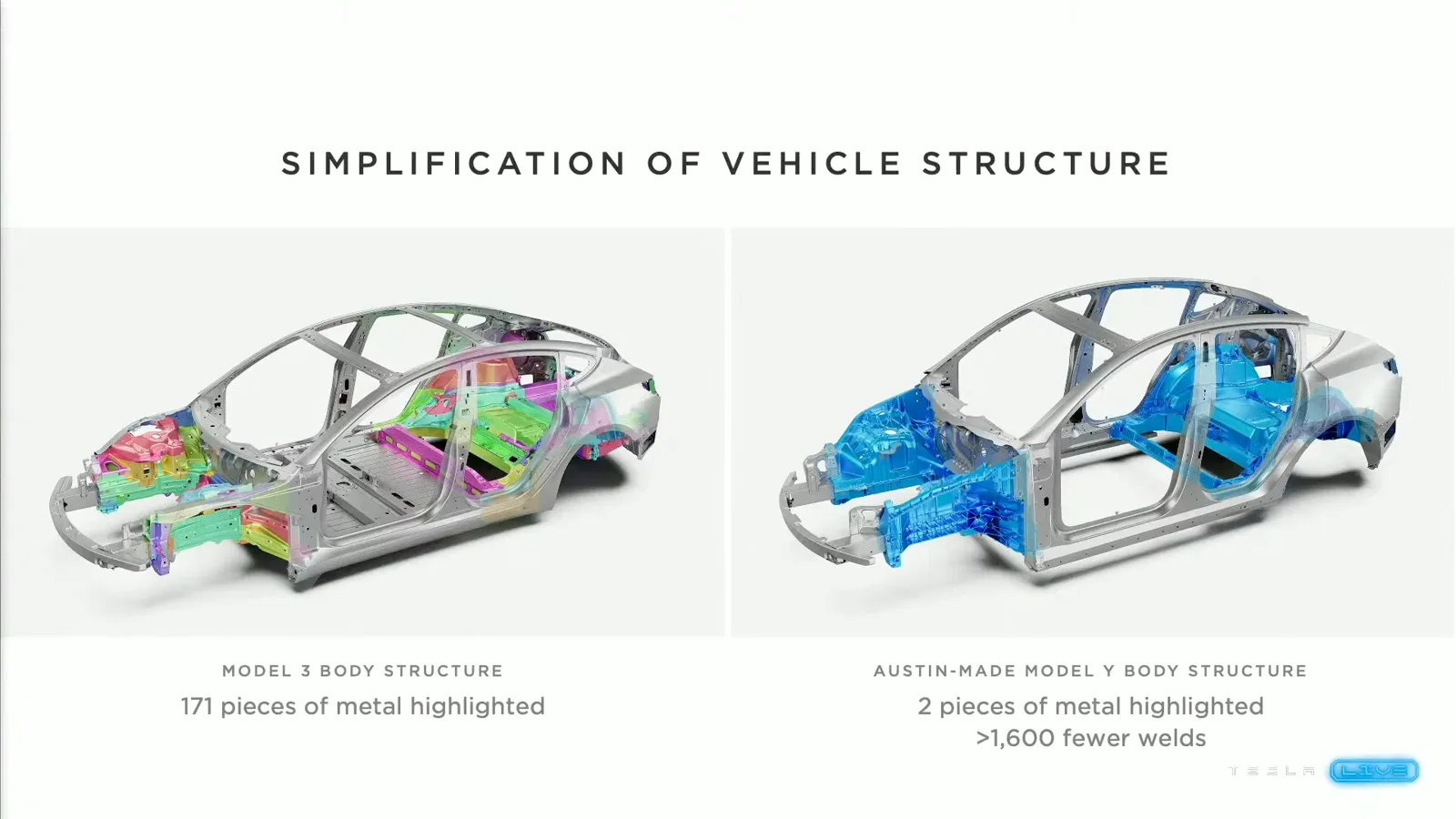
He argues that manufacturing know-how and a straightforward factory layout can be durable advantages, even as other manufacturers develop electric vehicles.
Musk says attracting skilled engineers matters for technology companies and notes that people can move between Tesla and SpaceX.
He discusses factory safety and says employee suggestions help identify improvements.
Musk discusses Supercharger reliability and expansion, saying connected chargers provide feedback that can help the company respond to faults.
He describes using crash data and software updates to improve vehicle safety, including seat-belt and airbag behavior.
Musk says FSD beta mileage had grown and forecasts wider access in North America during 2022. He also previews the next AI Day and discusses Optimus as a long-term project.
Cash, Cybertruck and inflation
Shareholder questions cover investment plans, cell production and 2022 forecasts.
Taking online questions, he says Tesla prefers organic growth but would consider acquisitions in manufacturing, automation and AI. He describes a share buyback as possible depending on future conditions.
Asked about Cybertruck pricing, Musk says 2019 prices and specifications will change because conditions, including inflation, had changed. He targets volume production in 2023.
On charging, he says Tesla prioritizes sites by observed need and considers an online poll. He describes a proposed Los Angeles charging site with food and screens.
For 4680 cells, Musk says volume production is difficult to forecast, but expects a higher rate by the end of 2022. He says supplier cells support the current vehicle-production plan.
Asked about inflation, he says Tesla sees some future commodity prices trending down. He speculates that a recession could be relatively mild and last around eighteen months.
Autonomy, succession and future products
Musk answers audience questions on shared cars, leadership and other ventures.
An audience member asks how autonomous cars might be shared. Musk imagines a network where owners can choose when to add or remove their vehicles and riders can request trips.
A shareholder offers suggestions about driving modes and user experience. Musk thanks him; another asks what investors overlook, prompting Musk to emphasize useful products and long-term performance.
A shareholder suggests recovering waste heat from factory equipment. Musk agrees it could be useful and compares it with managing heat among a car’s battery, motors and cabin.
Asked where a robotaxi pilot might start, Musk says Tesla is pursuing a general driving system, while acknowledging that regulatory requirements vary by location.
Investor Gary Black asks about succession and Musk’s time commitments. Musk says he intends to stay while useful, praises the team and says he does not have an easy succession answer.
Musk discusses his pending Twitter transaction cautiously and says the service could accelerate a broader product idea he had associated with X.com.
Asked about the Boring Company and robotaxis, he describes tunnels as a possible way to add transport capacity and mentions the operating Las Vegas tunnel.
A shareholder asks whether Tesla vehicles could communicate and whether Dojo could coordinate traffic. Musk says the immediate Dojo goal is efficient neural-network training and suggests vehicles could share road-closure information.
For the final question, Musk encourages support for sustainable energy and thanks customers and shareholders. He closes with an optimistic message about working toward sustainable transport.
The presentation ends and music plays for the remainder of the broadcast.
More from this channel
 3:35:00EN
 CNET Highlights· Mar 2, 2023Tesla’s 2023 Investor Day: the plan to scale clean energy and carsElon Musk, Zach Kirkhorn, Drew Baglino, Franz von Holzhausen, Lars Moravy, Colin Campbell, Pete Bannon, David Lau, Ashok Elluswamy, Rebecca Tinucci, Karn Budhiraj, Roshan Thomas, Tom Zhu, Mike Snyder, Laurie Shelby, Brandon Ehrhart · TeslaTesla leaders outline a global electrification scenario, a lower-cost vehicle platform and the factories and supply chains needed to scale.
 41:04ENCNET Highlights· Mar 2, 2023Tesla’s 2023 investor Q&A puts battery supply and costs in focusElon Musk · TeslaExecutives explain refining, factory localization and dry-electrode scaling, while Musk discusses affordability and a future autonomous fleet.
 8:15ENCNET Highlights· Mar 1, 2023Tesla’s 2023 plan estimates the scale of a fully electrified energy systemElon Musk, Drew Baglino · TeslaMusk and Drew Baglino describe a proposed energy transition requiring batteries, renewable generation and manufacturing investment.
 53:25ENCNET Highlights· Dec 1, 2022Neuralink researchers on implant durability, safety and wireless dataElon Musk · NeuralinkAt a 2022 Q&A, the team explained animal results, device-removal concerns and ways to compress brain signals.
 7:20ENCNET Highlights· Dec 1, 2022Neuralink’s 2022 monkey demo selected highlighted keysElon Musk · NeuralinkMusk showed cursor control with an implant, while stressing the monkey was following prompts rather than spelling independently.
 3:39:05ENCNET Highlights· Dec 1, 2022Neuralink’s 2022 update: from neural signals to a working interfaceElon Musk, DJ Seo · NeuralinkEngineers explain cursor decoding, implants and robot-assisted insertion, while separating animal demonstrations from clinical ambitions.