In 30 seconds
GitHub is trying to serve coding agents as well as 225 million developers, while preserving context across tools and devices. Microsoft CoreAI executive Jay Parikh says its Copilot system should select models for a task based on quality, speed and cost. He also cautions that replacing open-source dependencies leaves teams responsible for maintaining the replacement code. As AI spending rises, he wants companies to measure it against completed work and outcomes.
- 1GitHub reported 34.3 billion commits across 225 million developersParikh says its annual report also counted 17.9 billion pushes and 1.3 billion pull requests. A developer joined every second for a second consecutive year.
- 2Pull requests should be configurable, Parikh saysHe skips them in some personal repositories and argues that a platform serving students and enterprises needs to support different workflows.
- 3Copilot Fusion aims to choose models for quality, speed and costParikh describes a multi-model harness that coordinates tools while model selection reduces the choices a developer must make.
- 4One coding session can continue across devicesParikh says GitHub's surfaces share a harness so the repository and other task context can follow a user from phone to desktop.
- 5Fewer dependencies still mean more code to maintainParikh says rewriting external software is not a universal security fix because the replacement becomes the team's responsibility.
- 6Judge token spending by the work and outcomes it producesParikh suggests measures such as cost savings, engagement and retention; swyx notes that an individual developer may not directly own revenue.
Takeaways
- Evaluate AI spending against completed work and outcomes, not token cost alone.
- Replacing dependencies also creates code your own team must maintain, Parikh says.
- Keep a coding task's repository and conversation context available across devices and models.
- GitHub reported 225 million developers and 34.3 billion commits in its annual figures.
Read the edited text by chapter
Why GitHub must scale for people and agents
swyx introduces GitHub's changing workload and its role as shared infrastructure. He frames the conversation around growth, reliability and the shift toward coding agents.
GitHub must support a growing mix of people and coding agents, says host swyx. Its reliability has drawn criticism, but he argues that the scale and changes behind the service deserve attention too.
Microsoft CoreAI executive Jay Parikh joins after GitHub Universe. swyx says the platform reported rapid growth in agent-created pull requests alongside growth in human users, while moving infrastructure to Azure.
GitHub has reached 225 million developers, swyx says, and is adding roughly one per second. He notes Parikh's experience running engineering at Facebook and leading security company Lacework as context for the infrastructure challenge.
GitHub is also a social network where developers maintain open-source software and identify security problems together. swyx wants to understand how that shared platform evolves as coding changes.
After the keynote, Parikh says the event's workshops let developers try the security and other features that could not all fit on stage. The interview begins with the scale figures from GitHub's Octoverse report.
A developer joins every second
Parikh shares GitHub's user and activity figures. He expects coding agents to let more people participate in building software together.
Parikh puts the community at 225 million developers across every country. A new developer joined every second for a second consecutive year, he says; the report counted 17.9 billion pushes, 34.3 billion commits and 1.3 billion pull requests.
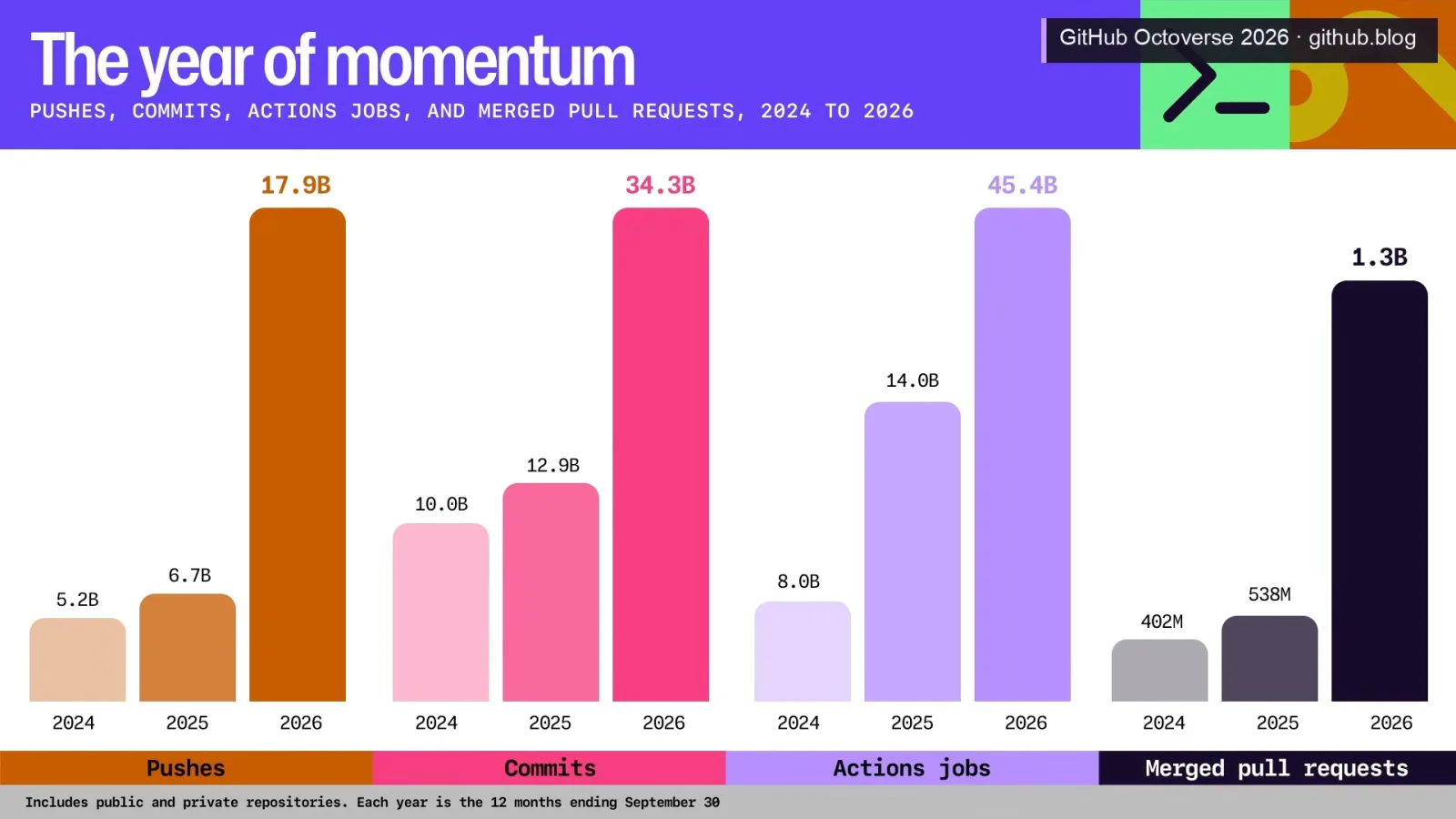
Open-source contributions also grew substantially, Parikh says. swyx observes that behind each activity are database, file and metadata operations; running a developer community has infrastructure demands as well as social ones.
Parikh sees AI as a way to broaden participation. Someone who is not a trained software engineer can use a coding agent to make an idea, share a repository and ask others for feedback, rather than building alone.
Workflows and repositories need room to change
Parikh says pull requests need not be mandatory for every project. Repositories must support both instructions for agents and long-lived business code.
swyx asks whether agents could bring an end to the pull request, the proposed change developers commonly submit for review. Parikh says GitHub should adapt its conventions and allow teams to configure which ones they need.
Different users need different processes, from students to large enterprises. Parikh says that in some personal repositories he skips issues and pull requests entirely because he wants to experiment and keep building.
A repository of Markdown instructions by developer Matt Pocock leads swyx to ask what counts as code when an agent can use instructions as well as executable files. Parikh says repositories must accommodate varied content and workflows.
Decades-old Java and .NET systems still run important businesses and need security fixes, modernization and performance work, Parikh adds. Developers also value being able to choose tools that fit their own craft.
Model selection and shared coding context
Copilot's harness coordinates models and tools, while Fusion aims to select models for a task. Parikh wants task context to travel across devices.
swyx describes a coding assistant's harness as the surrounding system that helps make use of a model, including routing work. He asks why GitHub's Copilot Fusion model selection matters.
Parikh says the Copilot harness supports multiple models, tools and integrations, and its software development kit can be used to build other applications. It needs to adapt as models and tool protocols change.
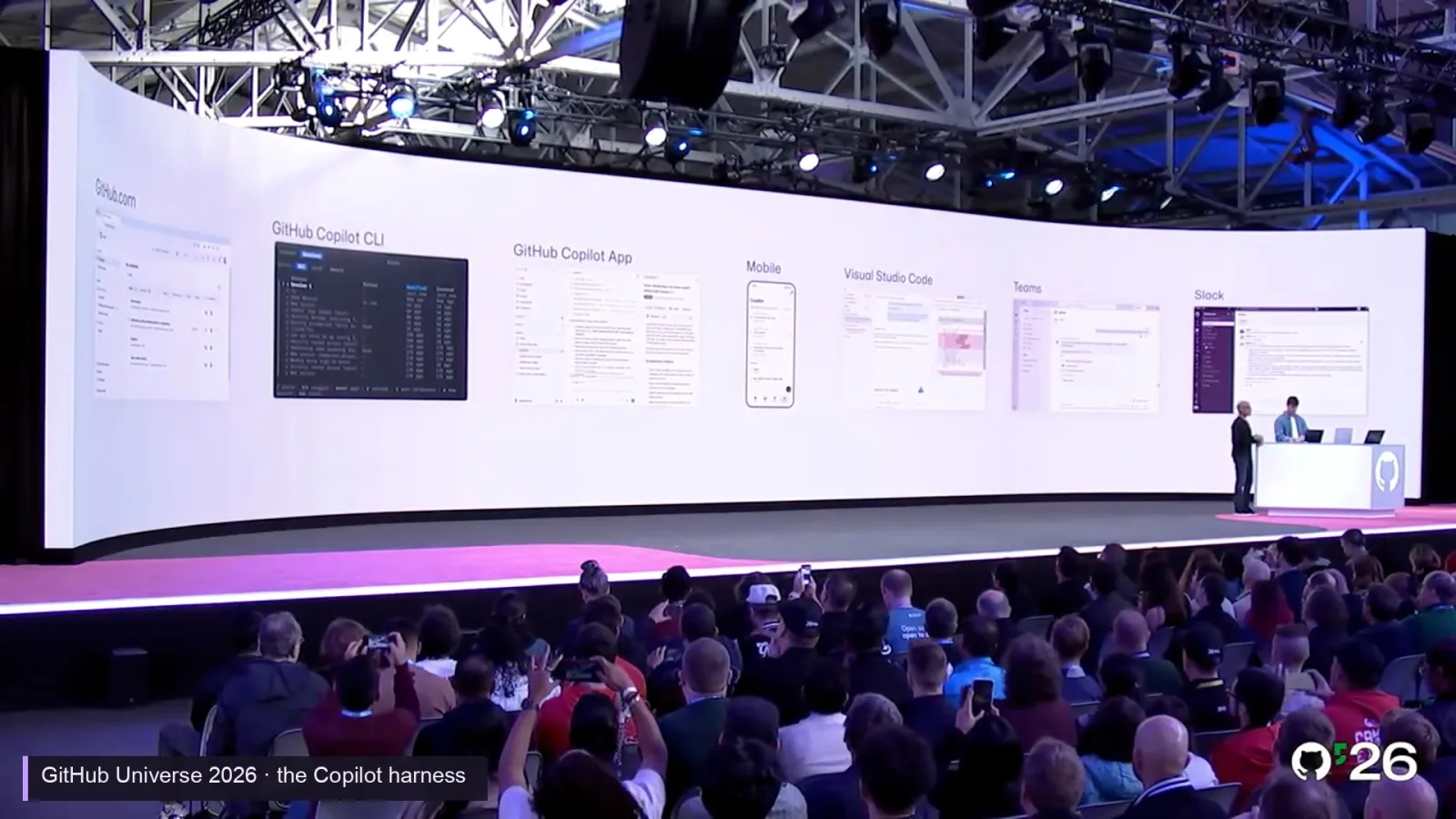
Fusion is intended to take the work of choosing among models off the developer. Parikh says the aim is to balance quality, speed and price for a task, while the surrounding harness coordinates the tools and workflow.
Asked whether GitHub must innovate in its interface as well as its models, Parikh says the company needs to improve infrastructure, platform services and user workflows together. Storage, compute, networking and security all support the experience.
The phone app, desktop and VS Code can use the same harness, Parikh says. A user can start work on one device and continue elsewhere while keeping the repository, issues, security findings and other context together.
Parikh wants that accumulated context, preferences and memory to help future work, even when the user changes models. He contrasts this with separate providers' tools, which do not automatically combine what they have learned about a user's work.
Security and the cost of replacing dependencies
GitHub is adding code review and scanning capabilities. Parikh says replacing open-source dependencies transfers maintenance work to the team that rewrites them.
On security, Parikh says GitHub needs to maintain quality as more code is generated. He points to AI-assisted code review intended to find serious or less obvious bugs, and to additional scanning capabilities.
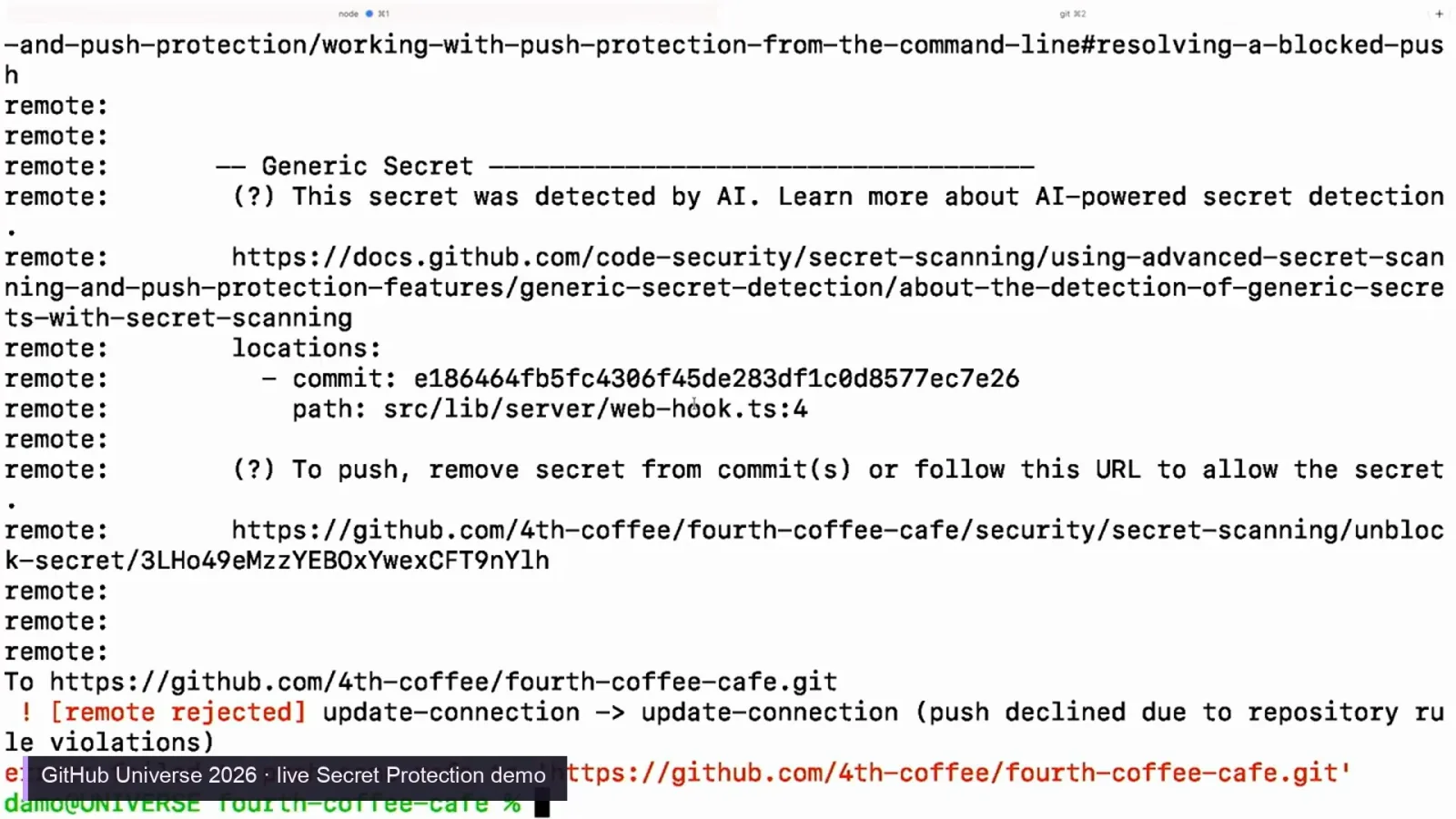
In a keynote demonstration, a push containing a secret was blocked before it reached the repository. Parikh also describes work with Microsoft security teams and open-source maintainers on compromised repositories and package-manager risks.
swyx asks whether cheap AI-generated code could make it safer to replace most external dependencies. A project might try to reduce thousands of dependencies to a small core, limiting the external software it trusts.
Parikh says that approach is not a cure-all: the code replacing the discarded dependencies still has to be maintained. Teams must decide where to spend money and time; he prefers making open source more secure and expects its value to keep growing.
Azure, agent scale and measuring AI spending
Parikh says GitHub aims to complete its Azure move the following year and keep adapting to changing agent workloads. He wants spending controls tied to useful outcomes.
Looking toward the following year, Parikh says GitHub plans to keep improving every layer from infrastructure upward. Asked about its Azure move, he says completing it the next year is the goal, not a guarantee.
The number of agents people manage could be very different in a year, Parikh says, but he does not know whether teams will oversee thousands rather than dozens or hundreds. GitHub therefore needs building blocks users can assemble for different workflows.
AI spending and security will be prominent concerns, he predicts. GitHub aims to show organizations where money goes, recommend less expensive models where appropriate and give larger companies spending limits and governance controls.
Parikh says leaders need to connect token spending to completed work and business results. swyx notes that an individual programmer may not own revenue; Parikh agrees that cost savings, engagement, retention and customer satisfaction can also be measured.
To close, swyx praises the GitHub Universe badge, a programmable device resembling a small game console. The pair discuss using Copilot to make it and the appeal of experimenting at the boundary between hardware and software.
More from this channel
 1:42:28EN
 Latent Space· Nov 7, 2026Podcast · 2 speakersJamin Ball on Anthropic's S-1, Compute Economics and the Frontier Model RaceGuest Jamin Ball · Host swyxAn investor examines Anthropic's filing, from cash flow and convertible notes to the financing and competitive pressures facing frontier AI labs.
 50:37ENLatent Space· Nov 6, 2026Podcast · 2 speakersAdit Abraham on Why Document Parsing Still Breaks AIGuest Adit Abraham · Host Allen ParkThe Reducto co-founder discusses missing table rows, production evaluation, document editing and growing a company while making a steak sandwich.
 50:50ENLatent Space· Nov 6, 2026Podcast · 3 speakersFabian Theis on Virtual Cells, Organoids and Closing the Lab LoopGuest Fabian Theis · Host RJ Honicky, Brandon AndersonThe Helmholtz Munich researcher explains perturbation models, biological benchmarks and the work required to connect prediction with experiments.
 1:12:24ENLatent Space· Nov 4, 2026Podcast · 2 speakersBehind Latent Space: swyx and Galen Gao on AI Engineers, SaaS, and ShanghaiGuest Shawn Wang (swyx) · Host Galen GaoShawn Wang and Galen Gao trace the growth of the AI Engineer community and discuss what coding agents mean for small businesses.
 34:48ENLatent Space· Nov 3, 2026Podcast · 2 speakersZach Lloyd on the Infrastructure Behind a Software FactoryGuest Zach Lloyd · Host Shawn Wang (swyx)Warp’s founder explains how teams can define, observe and improve agentic development workflows—and when the additional infrastructure may be excessive.
 1:07:22ENLatent Space· Nov 2, 2026Podcast · 3 speakersBuilding Legal AI Agents Without Seeing Client Data: Legora's Jacob LauritzenGuest Jacob Lauritzen · Host swyx, Basil ChathaLegora's CTO explains how its team evaluates legal agents, designs review workflows and builds around the confidentiality of client matters.