In 30 seconds
Jensen Huang’s departure raises questions beyond Nvidia’s next CEO: the company has financed AI infrastructure as well as supplying its chips. The All-In hosts disagree over who benefits if Nvidia slows, but see risks to the pace of investment. They also debate how export rules and chip tracking could concentrate control over computing. Turning to Anthropic’s proposed IPO, they weigh its rapid growth against market conditions and argue over its ambitions in enterprise software and AI safety.
- 1Nvidia’s position rests on decades of workSacks argues that the company’s long investment in graphics processors gave it an advantage that now extends to AI computing.
- 2Competitors still have hard engineering work to doPalihapitiya says a leadership change does not eliminate their software, manufacturing and memory constraints.
- 3The “Bank of Nvidia” may face a slower decision processThe panel asks whether the company will maintain Huang’s pace of investment in startups and data centers.
- 4Chinese state policy and developers can want different thingsSacks argues that government support for local suppliers can coexist with developers’ demand for Nvidia chips.
- 5Anthropic’s IPO depends on the wider AI marketPalihapitiya expects the economy and investors’ appetite for AI infrastructure to shape the eventual price.
- 6Better biology tools do not give a cure timetableFriedberg says AI is accelerating research, but he cannot translate that progress into a reliable date for curing specific diseases.
Takeaways
- Palihapitiya says Nvidia’s competitors still face software, manufacturing and networking bottlenecks.
- A change in leadership could slow Nvidia’s investments across the AI ecosystem, the hosts argue.
- Sacks distinguishes Chinese developers’ demand for chips from Beijing’s interest in domestic suppliers.
- Friedberg sees rapid AI-driven advances in biology but cannot predict when specific diseases will be cured.
Read the edited text by chapter
The departure and unanswered questions
The hosts recap Nvidia’s leadership change and discuss what is known from public reporting. Sacks asks for investigations into both the reported customer relationship and the disclosure of intelligence.
Jason Calacanis says Jensen Huang has stepped down as Nvidia CEO after a week of reports about a relationship and alleged Chinese intelligence interest. CFO Colette Kress is interim CEO, and the board is looking for a successor.
Calacanis summarizes the reported timeline: a New York Times account described an intelligence assessment concerning a businesswoman connected to an Nvidia customer. Huang subsequently told employees of a personal relationship, and the board began looking into the matter.
Calacanis says reporting on the business relationship and chip shipments predates the latest news. The hosts stress that the story is still developing and that the available information is incomplete.
David Sacks calls the situation a loss for Huang, Nvidia and its employees. He argues that Nvidia’s decades of work on graphics processors gave the United States an important advantage in AI computing.
Sacks separates questions about the customer and possible chip diversion from questions about how an intelligence assessment became public. He calls for investigations and says the facts about both remain to be established.
He asks who disclosed the intelligence assessment and why, while acknowledging that the identity and motivation are unknown. He also questions whether Huang should have received a security briefing before the story became public.
Sacks asks what confidential information Huang might have possessed and what evidence supports the allegation against the businesswoman. He argues that owning an export-controlled chip and possessing secret chip designs are different things.
The panel discusses possible motives for the disclosures. Calacanis suggests that disagreements over the sale and tracking of chips could be relevant, but explicitly presents that as speculation.
Corporate governance and control of AI
Friedberg and Palihapitiya consider board obligations and the possibility that computing access becomes more centralized. They distinguish general governance mechanisms from the facts still being investigated.
David Friedberg describes two possible directions for AI: broadly available models and computing capacity, or control concentrated among a few institutions. He worries that control of chips could become a lever over who gets access to AI.
Friedberg turns to corporate governance. He speculates that disclosures about personal relationships and conflicts of interest could matter to a public-company board, independently of the public intelligence allegations.
He explains that executives make regular attestations about conflicts and business conduct. A misrepresentation could have consequences for auditors, the board and its insurance, although he does not know what happened in Nvidia’s case.
Friedberg recalls Nvidia’s long stretch of work before the recent AI boom and says its current position was built over decades. He says he does not want to rush to judgment about the events behind Huang’s departure.
Chamath Palihapitiya agrees that corporate reporting obligations can drive a board’s decisions. He describes directors-and-officers insurance and the agreements surrounding it as practical constraints on directors.
Asked who benefits, Palihapitiya considers two scenarios: whether restricted chips reached Chinese buyers or did not. In his view neither scenario immediately gives China the software, manufacturing capacity and systems experience needed to reproduce Nvidia’s position.
He makes a similar distinction for Nvidia’s competitors. They still need to make their hardware work at scale, secure manufacturing and memory capacity, and support the software used by customers.
Palihapitiya believes the clearer potential beneficiaries are advocates of more centralized control over computing. He worries that proposals for monitoring or remotely disabling chips could expand the government’s role.
Calacanis argues that shareholders should have a say in leadership once the investigation is complete. He questions whether directors under legal pressure will reach the same conclusion that long-term owners would.
Could Nvidia’s investment engine slow?
The hosts debate the company’s role in funding AI infrastructure and whether leadership change could slow capital deployment. They disagree about who gains from a loss of momentum.
The discussion moves to Nvidia’s role as a funder of AI infrastructure and startups. Calacanis asks whether the investment activity sometimes called the “Bank of Nvidia” will continue at the same pace without Huang.
Palihapitiya says Huang’s relationships and understanding of the whole industry helped him make investments across it. He expects a more conventional decision process could slow such deals, though he does not know what the company will do.
Sacks argues that China could benefit if Nvidia loses momentum. Palihapitiya disagrees that a setback to Nvidia automatically makes a rival’s chips better, though he agrees that slower investment could hurt the wider economy.
Palihapitiya says slower AI investment could reduce economic growth, but treats the size of the effect as a risk rather than a known outcome. The panel links the question to data-center construction and capital spending.
Sacks says the advantage is not just a single chip generation but the ability to produce better systems repeatedly. If that cadence slows while competitors improve, he argues, the gap can narrow.
The hosts discuss Chinese efforts to build AI systems from less powerful individual chips, including the use of networking to combine them. They differ over how quickly those efforts can close the gap.
Friedberg says technological velocity matters because each generation builds on the one before it. He fears that disruption at a central supplier would slow customers and the broader ecosystem as well.
Palihapitiya returns to the bottlenecks facing alternative suppliers: software, networking, advanced memory and manufacturing. Slowing one company, he argues, does not instantly remove those constraints for others.
Calacanis compares a leadership transition at Nvidia with the change from Steve Jobs to Tim Cook at Apple. Sacks replies that chip development is unusually dynamic and a successor would have to maintain its pace.
Chip controls and the balance of power
The panel discusses proposed tracking and export restrictions. Sacks argues that Chinese state policy and Chinese developers can have different interests in access to American chips.
Friedberg worries that future legislation could give a central authority power to monitor or disable AI chips. The hosts distinguish between controls administered by companies and direct government access, and discuss the privacy consequences of each.
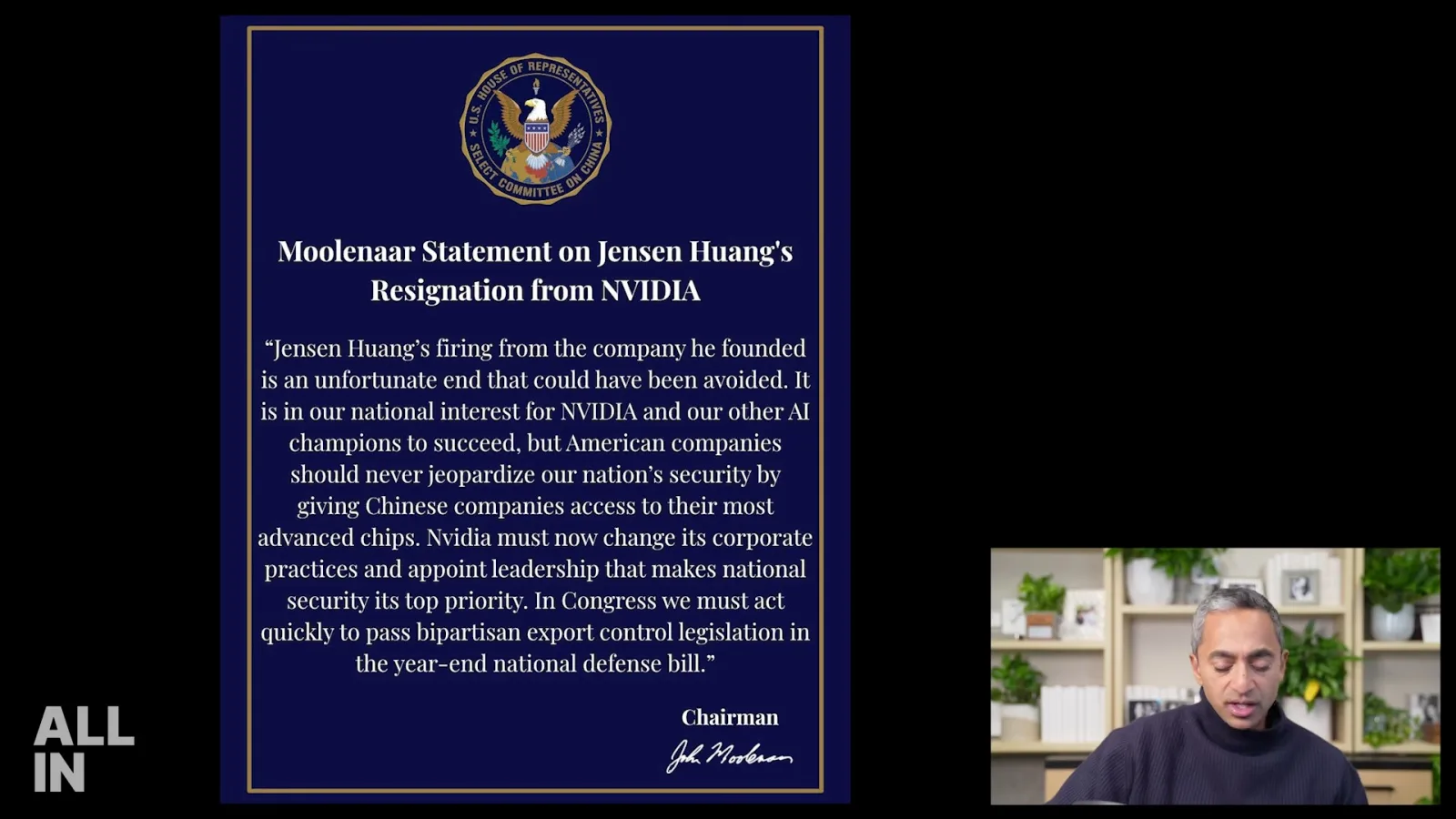
Calacanis describes proposals to track advanced chips and asks who would hold the ability to disable them. He says enforcement design matters: the same stated objective could leave very different responsibilities with vendors and government.
Sacks describes the evolution of US export controls as he understands it: restrictions on the most advanced chips, with different rules for less capable products. He argues that the political debate has obscured those distinctions.
He says there was a strategic argument for allowing some less capable chips to be sold: keep customers on American technology and limit the scale available to competitors. If Congress chooses a complete ban instead, he says, it should state that policy plainly.
Sacks argues that the Chinese government also has reasons to favor domestic suppliers, while individual Chinese developers may want access to Nvidia products. Calacanis says those two interests can coexist.
Friedberg asks whether Huang might have known about chips reaching restricted users. The others treat this as a question for investigators; Sacks notes Nvidia’s denial and says the facts should be established before drawing conclusions.
Who can lead Nvidia next?
Palihapitiya names potential successors, while others say Huang could be considered for a return if the facts warrant it. The group separates legal questions from board and shareholder concerns.
The hosts consider a successor. Palihapitiya names Nvidia executive Ian Buck, Arm CEO Rene Haas and Palo Alto Networks CEO Nikesh Arora as possible candidates, favoring someone willing to invest and take product risks.
Friedberg says shareholders could consider bringing Huang back if an investigation finds no violation of law. Calacanis also hopes for a return; both frame that as a conditional judgment, not an announced plan.
Sacks says he met Huang through his government work rather than a long prior relationship. He says the investigation should proceed and that Huang’s contribution as a founder should be considered in any assessment.
The panel distinguishes possible criminal questions from potential civil claims and shareholder losses. Palihapitiya expects disclosure issues and the fall in market value to generate substantial legal scrutiny.
Anthropic’s offering and the AI investment cycle
The hosts examine reported IPO terms, cash needs and dependence on broader market sentiment. Their valuation expectations differ.
Calacanis turns to Anthropic’s planned IPO and cites a reported offering range, a roughly $1.4 trillion valuation and additional private investment. These are proposed terms discussed during the roadshow, not a completed offering.
He says Anthropic’s reported revenue growth and enterprise sales have supported its valuation, while its founders plan to sell some shares and have made a charitable pledge. The hosts consider how much of the future is already reflected in the price.
Palihapitiya sees a large cash reserve as useful protection against a volatile economy. He thinks the market’s appetite for the offering will depend heavily on broader AI investment sentiment and developments around Nvidia.
Friedberg says he has not analyzed the valuation. He describes what some investors appear to believe: that improvements to AI development and falling costs per useful unit of intelligence could make this an unusually large opportunity.
Bundled software, safety and medical predictions
The panel considers Anthropic’s expanding products, potential market concentration and safety. Friedberg sees real progress in biology but declines to give a firm timetable for curing diseases.
Calacanis argues that Anthropic is expanding Claude into a broad suite of business tools. In his view, bundling meetings, documents and other workflows could challenge established software vendors if the products keep improving.
Sacks says a winner-take-all outcome would create a highly concentrated market. He praises Anthropic’s business execution while questioning its approach to AI safety and the incentives around rapid development.
The hosts discuss a prediction by Anthropic CEO Dario Amodei that major diseases could become relics within a decade. Friedberg says AI tools are already changing biological research, but he cannot infer a reliable timetable for cures.
Friedberg says his own biology work uses both open models and Anthropic’s tools. He reports seeing frequent research advances, while separating those observations from claims about when particular diseases will be solved.
Palihapitiya forecasts a recession by 2028 and the others challenge his pessimism. The panel returns to whether the AI investment cycle and the wider economy can support current expectations.
Sacks argues that supporters of AI safety should scrutinize the rapid development of highly capable closed models as well as access to chips. He favors open models and worries about power becoming concentrated.
The hosts close by debating the relationship among AI safety advocacy, private companies and government control. Their interpretations differ, but they agree that decisions about access to computing will shape the industry.
More from this channel
 1:33:03EN
 All-In Podcast· Nov 7, 2026Podcast · 4 speakersThe All-In Hosts Debate the Midterms and the AI Infrastructure BacklashHost Jason Calacanis, Chamath Palihapitiya, David Sacks, David FriedbergThe panel disagrees over the election’s causes, the future of data centers and who will control AI capacity.
 1:25:46ENAll-In Podcast· Oct 30, 2026Podcast · 4 speakersAll-In on Anthropic’s IPO, AI Infrastructure and the Midterm ElectionsHost Jason Calacanis, Chamath Palihapitiya, David Sacks, David FriedbergThe hosts analyze Anthropic’s filing, debate the costs of an AI infrastructure boom, discuss Alphabet and offer competing midterm forecasts.
 55:39ENAll-In Podcast· Oct 29, 2026Podcast · 2 speakersWill Ahmed on WHOOP’s Subscription Model, Health Data and Wearable StrategyGuest Will Ahmed · Host Jason CalacanisThe WHOOP CEO discusses the company’s business model, physiological data, AI features and its account of interactions with the FDA.
 1:43:22ENAll-In Podcast· Oct 23, 2026Podcast · 4 speakersAI Security, Investment and the Debate Over France’s FutureGuest Nikesh Arora · Host Jason Calacanis, Chamath Palihapitiya, David FriedbergThe All-In hosts and Nikesh Arora discuss cybersecurity and AI spending, then debate France’s unrest, public services and US policy.
 40:00ENAll-In Podcast· Oct 21, 2026Podcast · 3 speakersArvind Krishna and Nikesh Arora on Quantum Risk, AI Models and Software ConsolidationGuest Arvind Krishna, Nikesh AroraThe executives discuss post-quantum preparation, the economics of open-weight models and the changing shape of enterprise cybersecurity.
 40:33ENAll-In Podcast· Oct 19, 2026Podcast · 2 speakersDylan Field on Figma, AI and Why Design Still MattersGuest Dylan FieldThe Figma CEO discusses the failed Adobe acquisition, competition from AI model providers and the role of human intention in creative work.