In 30 seconds
At Tesla AI Day 2022, engineers demonstrated an early walking robot and described plans for Optimus hardware and software. They then explained the company’s camera-based driving stack, data pipeline and Dojo training infrastructure before a long audience Q&A. The event mixed demonstrations with future goals; Tesla’s supervised driving features still require an attentive driver.
- 1The first robot walked on stage without a tetherThe company distinguished this development platform from the newer Optimus prototype.
- 2Optimus concentrated power and computing in the torsoThe design included a 2.3 kWh battery and an adapted vehicle computer.
- 3The driving stack combined perception, planning and training infrastructureThe team described camera-based occupancy networks, simulation and auto-labeling.
- 4Dojo was designed to train large neural networksEngineers described its computing hardware, interconnect and software.
Takeaways
- Tesla demonstrated an early walking robot and a separate, not-yet-walking Optimus prototype.
- The robot team adapted perception tools from the vehicle program while developing walking and manipulation controls.
- The driving team described occupancy, lane, planning and auto-labeling systems.
- Dojo was presented as custom infrastructure for training neural networks.
Read the edited text by chapter
Optimus prototypes and ambitions
Musk and the team introduce two robot prototypes and discuss their goals.
Elon Musk opens Tesla AI Day 2022 by introducing work on the Optimus robot, driving AI and the Dojo training system. He says the event will conclude with an extended audience Q&A.
Musk recalls that the previous year’s robot announcement featured a person in a suit. He says this year’s event will show a development prototype and discuss how vehicle AI might be applied to a humanoid robot.
The team brings a development robot onto the stage. The presenters say it is the first time this unit has operated without a crane or tether; they keep its live demonstration limited to reduce the risk of a fall.
A video shows the robot performing additional tasks, including handling objects. The team describes adapting visual networks and data collection from Tesla’s vehicle program to the robot.
Presenters call the walking development robot Bumble C and say it uses partly off-the-shelf actuators. A second Optimus prototype uses Tesla-designed actuators, a battery pack and controls, but was not yet ready to walk.
Musk describes the intended robot hands and emphasizes designing for manufacturing, reliability and volume. He estimates a future price below $20,000; this is a 2022 goal, not an announced retail price for the demonstrated prototype.
He says substantial engineering work remains and frames the event in part as a recruiting effort. He speculates that capable robots could significantly increase economic output, while emphasizing the need for safety.
Robot hardware and controls
Engineers discuss structure, actuators, hands, locomotion and manipulation.
The robotics team compares the two prototypes: the first provided a platform for software integration, while the second was designed in parallel using the company’s vehicle-development experience.
The presenter explains the design choice to retain a human-like form while limiting the initial body to 28 fundamental degrees of freedom, plus the hands. The goal is enough mobility for useful work without reproducing every human joint.
The engineering team discusses reducing idle power, part count, wiring and mass at the extremities. It places power distribution and the central computer in the torso.
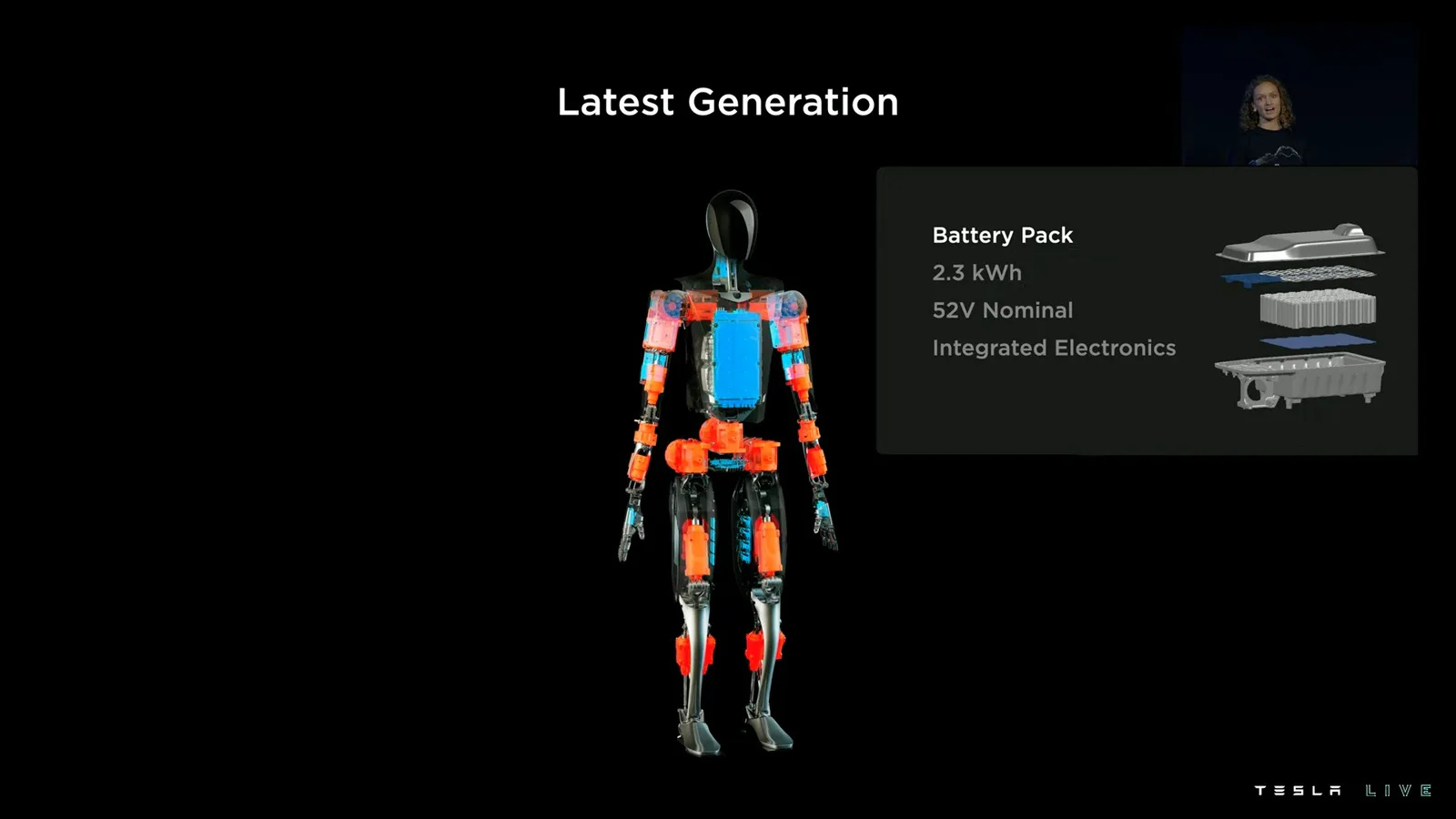
The proposed battery pack stores 2.3 kWh and integrates sensing, protection, charging management and power distribution. The team describes an ambition to support a workday, not a demonstrated runtime in the presentation.
The team says it adapted the vehicle’s full self-driving computer and software for the robot, with changes to form factor, communications and safety. It describes vision processing and decision-making as intended functions.
Engineers describe using structural simulation methods from vehicle engineering to evaluate robot falls. The goal is to limit expensive internal damage and help a robot continue work after an accident.
Simulated task motions such as walking, lifting and climbing provide load estimates for component design. The team also considers vibration modes and the trade-off between stiffness, weight, materials and control complexity.
A knee example uses a linkage chosen to match changing mechanical advantage as the joint bends. The engineers say this can reduce actuator force requirements across a range of tasks.
The actuator team describes converting whole-body activities into joint-level torque and speed requirements. They evaluate candidate actuator designs for energy use, mass and cost.
Instead of a unique actuator for each joint, the team seeks designs that satisfy several joints at once. The resulting 2022 portfolio has three rotary and three linear actuator types.
A demonstration shows a linear actuator lifting a grand piano to illustrate force capability. The team distinguishes the actuator’s direct force from the motion and mechanical advantage of a complete limb.
The hand team describes five fingers, an opposable thumb, metal tendons and a design for both strong and delicate grasps. It says each hand has six actuators and eleven degrees of freedom.
The presenters explain that a clutch-like mechanism can hold an object without continuously powering the hand motors. The hand includes a controller and sensors to support positioning and grasp feedback.
The autonomy team says it reused perception components from the vehicle program for the robot, retraining them on robot-specific data. It also describes mapping indoor spaces without GPS using camera features tracked over time.
Engineers use the vehicle simulator with added robot locomotion code to develop walking. They show how motion changed as more joints and techniques were introduced.
A robotics engineer breaks walking into a model of body geometry and dynamics, footstep planning, balance and coordinated limb motion. The planner produces a desired whole-body trajectory.
The team says a controller must correct the plan against real measurements. A planned motion can fail because physical compliance, vibrations and sensor noise differ from the simplified model.
State estimation uses sensor data to estimate posture and center of mass. The controller compares the estimated state with the intended motion and corrects the robot when disturbances occur.
For manipulation, engineers capture human demonstrations and map hand, elbow and torso motion onto the robot. They then adjust the reference trajectory for the actual location of an object.
The team describes factory tasks, indoor navigation and safe handling of falls as future work. A presenter explicitly says the prototype was still far from useful deployment.
Driving AI and data infrastructure
The Autopilot team presents planning, perception, labeling, simulation and inference.
The Autopilot team begins its presentation. Its lead says the FSD beta had reached about 160,000 customers in 2022 and describes improvements to neural networks, planning and infrastructure.
Camera streams are processed on the vehicle to form a representation of the surrounding world. A planning system then evaluates paths using geometry, lanes, objects and their predicted motion.
The team describes an occupancy network that estimates which parts of 3D space are occupied, plus semantic layers for lane connections and the movement of other road users.
For training, engineers describe automatic labeling, synthetic images and a data loop: identify difficult cases, find related fleet examples, correct labels and retrain models.
They say their training clusters used approximately 14,000 GPUs at the time. A compiler and inference engine distribute work across the two chips in the vehicle computer while managing latency.
The planning presentation uses a crossing scenario with both a pedestrian and vehicles. The system considers whether to yield or proceed and weighs not only collision avoidance but the effect on others.
The planner cannot exhaustively optimize every combination of possible road-user behavior within its time budget. The team describes an interaction search that branches over candidate maneuvers and goals.
Candidate trajectories combine classical optimization and a learned network. A search tree expands promising interactions while incorporating additional constraints.
Engineers say lightweight networks trained on human driving and offline solutions speed up evaluation. Other scoring networks estimate the likelihood of driver intervention and similarity to a human-driven path.
The planner can also account for obscured areas. The team describes hypothetical or “ghost” objects in regions hidden from the cameras, with behavior conditioned on estimated likelihood.
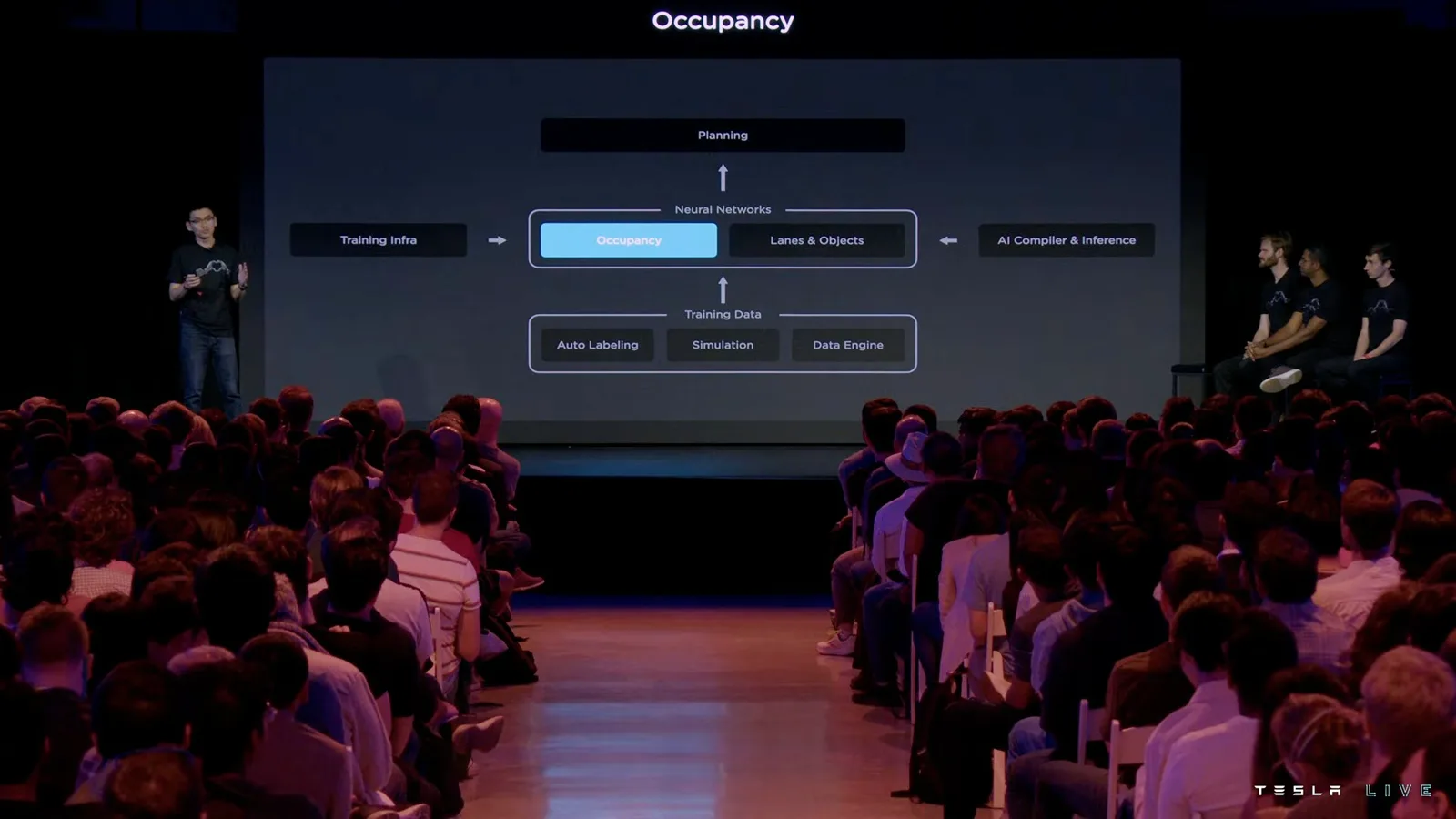
The occupancy team explains its 3D model: video from eight cameras is used to estimate the probability that positions around the car are occupied, along with object categories and motion.
Camera images are calibrated and processed by a network that combines visual features over time. Vehicle motion estimates help align the temporal information.
The team uses an articulated bus to illustrate why a volumetric representation can model a changing shape without forcing it into a single rectangular box.
The network also predicts drivable surface geometry, which can inform planning on hills and curves. The team discusses early experiments with neural radiance fields for 3D reconstruction.
Training such networks requires large data sets and parallel compute. Engineers describe multiple GPU clusters, a distributed video cache and the need to keep data flowing fast enough to use the accelerators.
They describe balancing storage bandwidth, CPU processing, machine-learning software and the network between accelerators. A fast chip alone cannot compensate for a data-loading bottleneck.
The lane team presents a network that predicts lane geometry and connectivity. It treats the output as a sequence of points and relationships, drawing on ideas from language models.
The model predicts an approximate location, refines it and assigns a type such as the beginning, continuation or fork of a lane. Forks can refer to previously generated points.
The engineers contrast this sequential representation with a simple segmentation approach, which can produce ambiguous lane shapes or miss connectivity at intersections.
Object predictions add information such as whether a vehicle is parked or waiting for a signal and possible near-term trajectories. The team illustrates why these distinctions matter to a planner.
An inference engineer describes mapping the lane network onto Tesla’s in-car accelerator. The team restructures operations and caches intermediate results to fit the hardware.
The compiler divides neural networks into smaller pieces, schedules them across available compute and memory, and coordinates execution across two chips. The goal is lower latency and higher throughput.
For lane labels, the team combines observations of the same area from multiple trips. Camera and motion estimates align the data into a shared reconstruction, with human verification at a later stage.
Once a scene is reconstructed, new trips can be aligned against it to produce labels more quickly. The team says other tasks, including some object and occupancy labels, use more automated pipelines.
The simulation team describes procedurally generating a road scene from labels and map data. Road geometry, lane markings, buildings, traffic lights and other objects become a synthetic environment.
By changing materials, object locations, traffic and road layouts, engineers create variations around a reconstructed scene. The resulting synthetic data can target examples that are hard to collect or label.
The data-engine team walks through a parked-car error: the model treated a parked vehicle as one stopped in traffic. Engineers collect and relabel related examples, then retrain and evaluate the model.
The team says it applies the same loop to many recurring challenge cases rather than changing architecture for every problem. It presents this as an internal development process, not proof that all edge cases are solved.
Dojo hardware and software
The team describes its custom training system.
Pete Bannon and Ganesh Venkataramanan introduce Dojo, Tesla’s custom neural-network training platform. They say the aim is to reduce training time for large models while controlling energy and cost.
Bannon describes a major architectural choice: use embedded SRAM for low-latency, high-bandwidth access rather than rely on DRAM as the primary storage for compute. The choice constrained capacity and shaped the rest of the system.
The team says the accelerator relies on compiler scheduling and model parallelism. Its goal is to combine many compute nodes into a scalable system rather than expose each boundary to the model developer.
Engineers describe integrating power, cooling and system management across the data center. They say early integration with Autopilot software helped expose scaling problems.
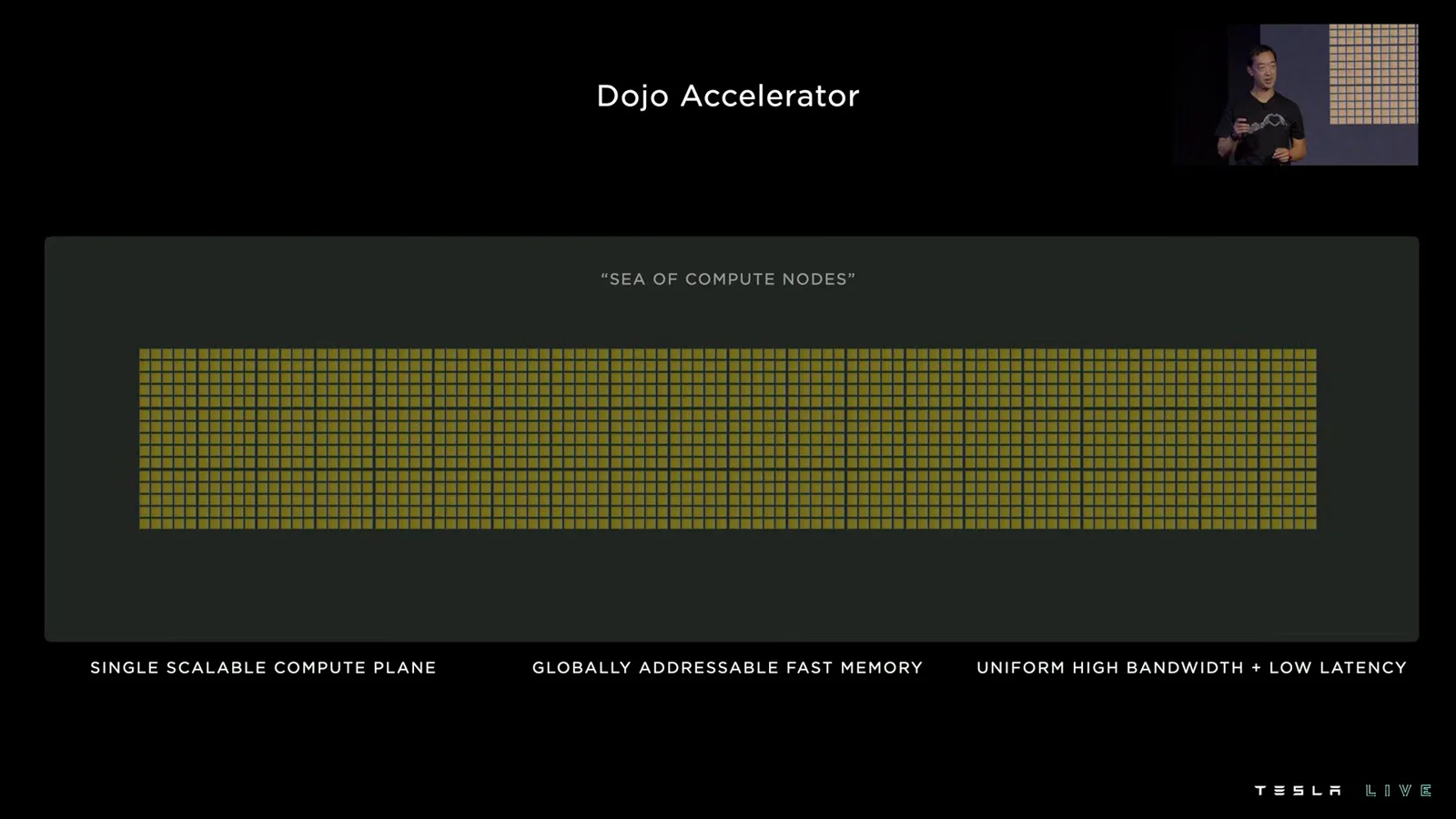
The hardware presentation depicts a unified compute plane with fast memory and high-bandwidth connections. A training tile combines 25 dies; multiple tiles can be connected to make a larger system.
High density creates practical problems in power delivery, cooling and mechanical design. The team explains that different materials expand at different rates, so the stack must accommodate thermal stress.
The team describes interface processors, external high-bandwidth memory and host computers for feeding data into the training system. The host exposes a familiar Linux environment to applications.
The hardware is arranged into trays, cabinets and a planned larger installation. The team’s performance figures describe design specifications and internal benchmarks, not an independent comparison.
The software team says its stack starts with a PyTorch extension and compiler. It argues that keeping accelerators busy depends on both efficient execution and a data pipeline that can supply enough input.
Engineers contrast models that scale easily with models whose large intermediate states and synchronization needs create communication bottlenecks across accelerators.
The proposed Dojo abstraction presents a sufficiently large partition as one accelerator, leaving the compiler to distribute computation, manage memory and overlap transfers with useful work.
The team demonstrates a Stable Diffusion model on Dojo and shows a cross-chip synchronization operation. It reports internal timing comparisons and emphasizes the importance of communication efficiency.
On selected internal workloads, the team reports measured and projected throughput comparisons with GPU systems. Some figures depend on planned production hardware or compiler improvements, so they should not be treated as independent results.
Engineers describe a data-loading bottleneck that initially left much of the accelerator idle. After distributing loading over more hosts and networking, they report much higher utilization.
The team presents a plan for an initial Dojo installation and a larger eventual build-out. The deployment dates and performance goals are the company’s 2022 projections.
Audience questions
Tesla engineers and Musk answer questions on robots, driving and AI.
Musk brings the engineering teams back for audience questions. He says the event is meant to show the breadth of Tesla’s robotics, AI and computing work and to attract engineers.
An audience member asks why the robot hand uses tendons and springs. Engineers say metal cables reduce parts and backlash, while springs allow passive finger extension.
Musk says Tesla intends to test simple robot tasks in its own factories and expects the design to evolve through multiple versions. He distinguishes a useful prototype from eventual large-scale production.
Asked about robot personality and human intervention, the team discusses remote operation, stopping unsafe motions and learning from intervention data. These are proposed safety and training approaches.
Musk says a conversational robot is a future goal and discusses a local stop mechanism that could not be modified remotely. The presentation does not establish that a finished safety system has been validated.
Asked whether Dojo could be sold or offered as a service, Musk suggests remote access may make more sense than selling the large power- and cooling-intensive machine. He presents this as a possible direction.
On creativity, Musk speculates about AI-generated art, movies and physical performances. An engineer discusses a future robot receiving text or voice instructions to perform movements.
The driving team returns to lane modeling, explaining that sequence-based predictions can represent intersections and multiple plausible lane geometries more coherently than simple dense segmentation.
An audience member asks how neural networks are tested. The team describes curated examples of past failures, shadow-mode evaluation and a staged quality-assurance process before deployment.
On larger foundation models, engineers describe using expensive offline models to produce labels that train smaller in-car networks. They say larger data sets and pretraining helped some tasks.
Asked about AGI safety, Musk says he supports a government regulator and would invest in safety if Tesla made a significant contribution. His claims about future data scale and AGI remain predictions.
A question about the Tesla Semi prompts Musk to argue that a camera-based system could in principle handle different vehicle types. This is an engineering expectation, not a demonstrated safety result.
Asked about FSD availability outside North America, Musk predicts broader technical readiness by the end of 2022 while noting regulatory constraints. The team discusses unifying city and highway software stacks and testing in adverse weather.
Musk says he would advise his younger self to spend time with capable people and enjoy the moment more. He recalls working on early rockets without taking time to enjoy the beach nearby.
Asked what could speed up humanoid progress, Musk points to advances in AI as well as actuators, sensors and their controls. He predicts faster progress but gives no verified timetable.
On factory use, Musk says the team would start with simple part-handling tasks. He estimates customer deliveries in three to five years from 2022; this is a forecast, not a confirmed schedule.
An audience member asks about open-sourcing robot tools. Musk emphasizes misuse risks and describes a desire for restrictions on harmful instructions instead of committing to open-source the system.
Engineers say control bandwidth depends on the task and its motion requirements. Musk discusses improving dexterity and reducing latency over time.
Musk describes his view of Tesla’s engineering culture and argues that talented engineers should be given difficult problems and room to produce useful work.
The team answers questions about remaining driving challenges and finding similar failures in fleet data. Engineers mention triggers based on inconsistent predictions and differences between a driver’s action and a shadow model.
Asked to define AGI, Musk says Tesla was not directly targeting it but speculates it could emerge from systems processing large amounts of real-world data. The event provides no evidence that this outcome follows from data scale alone.
The team notes a gradual shift toward neural networks taking on more of the driving stack. It discusses end-to-end learning as a possible direction while saying the system was not there yet.
An audience member asks how the company sets safety thresholds and whether more outside oversight is needed. Musk describes Tesla’s safety priorities and argues for deployment when a system reduces harm; the exchange does not independently establish comparative safety.
The final question asks why a humanoid robot needs symmetry and whether future versions could have unusual capabilities. Musk says the immediate goal is a useful basic robot, with possible attachments and variants later.
Musk thanks the team and audience and closes the event, inviting viewers to revisit the detailed technical presentations.
More from this channel
 24:44EN
 Tesla· Nov 6, 2026Elon Musk Unveils the Cybertruck: Steel Body, Cracked Glass and a New Pickup DesignElon Musk · TeslaAt Tesla’s 2019 event, Musk introduced the electric pickup and demonstrated its body, glass, suspension and cargo bed.
 59:56ENTesla· Oct 21, 2026Tesla Q3 2026: Cash Flow, FSD Demand and the Cost of Scaling RobotsElon Musk, Vaibhav Taneja, Travis Axelrod · TeslaExecutives discuss quarterly margins, capital spending and plans for Cybercab, Optimus and chip production.
 23:21ENTesla· Oct 16, 2026Tesla’s Roadster Event: A Ramp Stunt, Aerodynamics and a 2028 Production TargetElon Musk, Franz von Holzhausen, Lars Moravy · TeslaElon Musk, Franz von Holzhausen and Lars Moravy demonstrate a prototype developed with SpaceX engineering.
 1:09:55ENTesla· Jul 22, 2026Tesla’s Q2: Margins Narrow as Spending on Robots and AI RisesTravis Axelrod, Elon Musk, Vaibhav Taneja, Ashok Elluswamy, Lars Moravy · TeslaTesla reported higher energy deployment and negative free cash flow while executives outlined Robotaxi and Optimus plans.
 27:27ENTesla· May 21, 2026Tesla’s Final Model S and X Deliveries: How the Cars EvolvedElon Musk, Franz von Holzhausen, Lars Moravy · TeslaElon Musk and Tesla’s team recall a tent-based design studio, years of changes, and plans for the former production line.
 1:05:20ENTesla· Apr 22, 2026Tesla Plans a $25 Billion Investment Year as It Prepares OptimusTravis Axelrod, Elon Musk, Vaibhav Taneja, Lars Moravy · TeslaOn Tesla’s Q1 2026 call, executives detail one-time margin gains, battery constraints and plans for robots and driving software.