In 30 seconds
Brilliant co-founder Sue Khim discusses her approach to AI tutoring with Peter Yang. She demonstrates a student working through fractions, explains why her team has humans design lessons while AI assists implementation, and describes human review, simulated learners and assessments. Her claims about education and AI are presented as her views, not independently established findings. The episode lists Linear, Riverside and Wispr Flow as sponsors.
- 1Protect the learner’s workKhim says Koji is designed to prompt students to think instead of simply supplying answers.
- 2Balance challenge and supportA tutor must decide whether a student needs a hint or more time; either too much or too little help can undermine the session.
- 3Keep human lesson designKhim says human learning designers set the teaching sequence while AI implements it using structured components.
- 4Use multiple quality checksThe team combines human review and automated evaluations with simulated students, then learns from real usage.
- 5Assess what students can doKhim favors assessing performance and retention over measuring only completion or time spent.
- 6Make persistence feel possibleHer Mario analogy describes a challenge that is hard but still feels achievable with repeated effort.
Takeaways
- Khim wants AI tutors to support students’ own reasoning rather than simply supply answers.
- The amount and timing of help matter: frustration and excessive assistance can both interrupt learning.
- Brilliant’s described workflow has humans design educational sequences and AI implement them with reusable components.
- Simulated students can catch problems, but Khim says real learner data and human reviewers remain important.
- She says assessment performance and retention matter more than completion alone.
Read the edited text by chapter
Education and the role of teachers
Khim shares her views on schools, classroom interaction and personalization.
Brilliant co-founder and CEO Sue Khim joins Peter Yang to discuss education, AI tutoring and how children learn to persist through difficult problems. Khim argues that an AI tutor should support a student’s own thinking. The episode lists Linear, Riverside and Wispr Flow as sponsors.
Khim describes the US education system as allowing experimentation but expresses concern about student performance, grading and standards. These are her interpretations and broad claims, not findings established by this interview. Yang and Khim compare their own experiences in different school systems.
Khim sees classroom time as valuable for peer learning and encouragement from teachers. She argues that personalized practice can also benefit from software, which can provide feedback and let students retry without the same fear of embarrassment. These are proposed design advantages rather than proof that software always outperforms a human tutor.
A tutor that prompts thinking
A fraction example illustrates Koji’s approach and the balance between help and struggle.
She describes Brilliant’s tutor Koji as intended to help students think rather than simply provide answers. She compares skipping the work of learning to using a robotic arm to lift weights at a gym. Her statement about how students generally use AI is an opinion in the conversation, not a measured result shown here.
Khim shows a tutoring-session playback involving fractions and shapes. A learner shades pieces without accounting for their differing sizes. She says the tutor aims to guide the learner toward the underlying insight through questions rather than immediately giving an answer or a full explanation.

A tutor must judge when to give a hint, simplify the problem or let a learner continue working. Khim says this is a balance: too much help can bypass thinking, while too little can leave the student frustrated enough to quit. She describes the product as early and still improving.
Humans design; AI helps implement
Learning designers use structured components and agent interfaces.
Khim shows how Brilliant creates interactive lessons. In her account, human learning designers decide the sequence and educational approach; AI helps implement their designs. She says the team found fully model-generated lesson design insufficiently reliable for its standards.
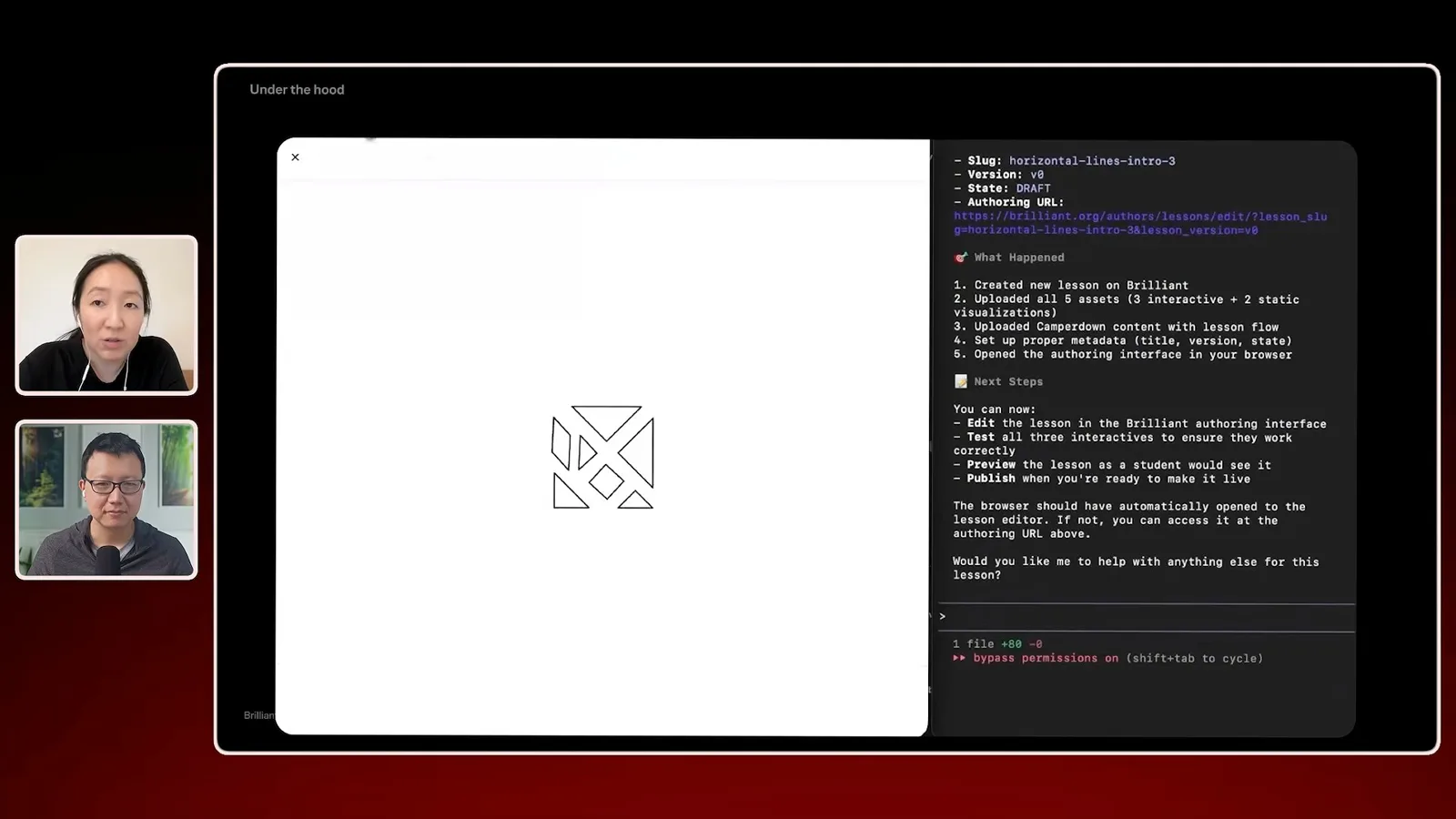
The company also designs an interface for agents: a library of reusable interactive components with APIs for creating, annotating and highlighting problems. Khim says this structure helps the model work with known building blocks rather than inventing an entire interaction from scratch.
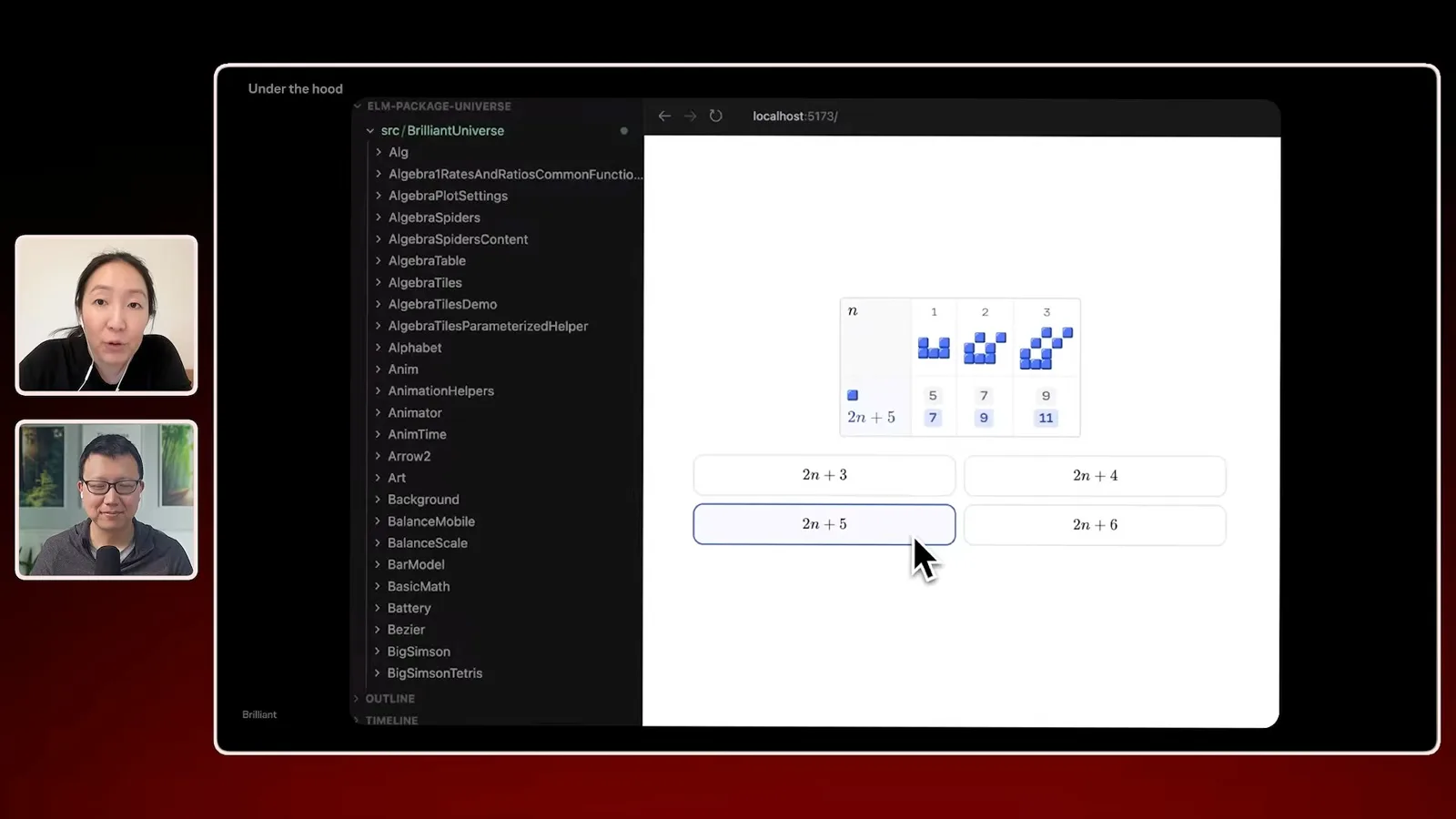
For employees, Khim wants tools and documentation to make existing expertise usable by a person working with an agent. She says the team aims to have new technical staff and learning designers make a user-facing contribution early, while acknowledging that onboarding is imperfect.
Testing quality and measuring learning
Human reviewers, simulations and assessments serve different purposes.
Quality checks include automated evaluations, multiple human reviewers, simulated learners and gradual rollout. Synthetic students explore different paths and can catch serious problems, Khim says, but they are substantially less informative than real student data.
Khim says the company focuses on assessment performance and retention rather than treating lesson completion or time spent as the goal. The team works backward from what a learner should be able to do and experiments with assessment design. She distinguishes practicing a lesson from demonstrating that the skill lasts.
Data, incentives and raising curious learners
Khim discusses product strategy, homework incentives and persistence.
On product strategy, Khim argues that data about real learners’ misconceptions and outcomes can make a tutoring product more defensible. This is her business thesis; the interview does not independently establish the effectiveness of the product or its advantage over competitors.
The speakers discuss homework incentives and the temptation to use AI to obtain answers. Khim argues that assessment should reflect whether a student actually understands the material. Their discussion of school practices is a perspective on incentives, not a universal description of every school.
As a parent, Khim says she values concentration, curiosity and the willingness to work on hard things. She gives examples ranging from building and chess to playground activities. She compares a well-paced challenge to a difficult Mario jump that feels achievable after more attempts.
Khim says the product demonstrated is aimed at middle- and high-school students, while the team is working on broader coverage. The conversation closes with her hope that learning helps children see effort and persistence as satisfying parts of mastery.
More from this channel
 46:40EN
 Peter Yang· Nov 8, 2026Podcast · 2 speakersAshley Alexander: How AI Helps Me Care for My Parents With CancerGuest Ashley Alexander · Host Peter YangA caregiver uses AI to prepare for appointments, organize records and ask better questions—while keeping doctors at the center of treatment.
 17:50ENPeter Yang· Nov 4, 2026PodcastPeter Yang’s Five Steps for Using AI to Help Care for His MotherYang uses a shared care brief and organized records to navigate appointments, while making time for family.
 15:03ENPeter Yang· Nov 3, 2026PodcastHow Peter Yang Used an AI Phone Agent to Negotiate His Internet BillAn AI call negotiated a lower price and faster service, but Yang still had to approve the change himself.
 33:09ENPeter Yang· Nov 1, 2026Podcast · 2 speakersJaclyn Konzelmann: When AI Can Build More, Choose What Deserves to ExistGuest Jaclyn Konzelmann · Host Peter YangGoogle Labs pairs short strategy documents with prototypes, user co-creation and lessons from experiments that end.
 13:05ENPeter Yang· Oct 28, 2026PodcastPeter Yang Tests Genie 4: Convincing Worlds, Unfinished GameplayFive live demonstrations show scenes that respond to prompts and sound, alongside inconsistent actions and limited game mechanics.
 1:06ENPeter Yang· Oct 26, 2026PodcastPeter Yang on Setting Up Payroll for a One-Person BusinessIn a paid partnership, Yang describes the paperwork he encountered and a payroll product integrated with a business account.