In 30 seconds
At SpaceX’s Texas facility in January 2026, Elon Musk described his ambition for crewed journeys beyond Earth. Defense Secretary Pete Hegseth then announced that xAI’s Grok would join the department’s GenAI.mil platform. He outlined seven AI projects with accountable leaders, monthly reports and operational experiments, alongside a wider reorganization intended to speed defense procurement. His plan puts CTO Emil Michael in charge of innovation coordination, changes the roles of defense innovation offices and seeks broader access to military data.
- 1Musk wants SpaceX to make crewed spaceflight commonplaceHe describes Starbase as a rocket manufacturing system and says his long-term goal is for people to travel to other planets and star systems.
- 2A single CTO is tasked with coordinating innovationHegseth names Emil Michael to set technical direction and hold the department to measurable results.
- 3Grok is announced for the military’s AI platformHegseth says xAI’s model will join GenAI.mil later in January, following the rollout of Google’s Gemini.
- 4Seven AI projects will have named owners and monthly reportsThe strategy calls for measurable outcomes, military-user feedback and repeated experiments.
- 5Data-sharing directives set reporting deadlinesServices must catalog data assets within 30 days; denied access requests are to be reported to the CTO within seven days.
- 6Innovation councils give way to a CTO action groupHegseth announces organizational changes and reassigns responsibilities to the Defense Innovation Unit and Strategic Capabilities Office.
Takeaways
- Hegseth said Grok would join GenAI.mil later in January 2026.
- Seven AI projects were to have individual leaders, measurable outcomes and monthly reporting.
- Emil Michael was designated the department’s single CTO to coordinate technology direction.
- Hegseth directed military services to catalog data within 30 days and report access denials within seven days.
- He described the $1.5 trillion fiscal 2027 budget as a presidential proposal.
Read the edited text by chapter
Musk’s space ambitions and faster defense innovation
Musk introduces Starbase and his vision for human space travel. Hegseth then criticizes a risk-averse procurement culture and gives the department’s CTO a central role.
Elon Musk welcomes the audience to Starbase, Texas, and describes it as a city built around large-scale rocket manufacturing. He says visitors can see the facility from the public road and welcomes Defense Secretary Pete Hegseth and Pentagon leaders after a factory tour.
Musk says SpaceX aims to turn science fiction into reality: large spacecraft carrying people to the Moon, other planets and eventually other star systems. He wonders whether explorers might encounter extraterrestrial life or find traces of ancient civilizations, then introduces Hegseth.
At SpaceX’s Starbase in Texas, Pete Hegseth thanks Elon Musk and the SpaceX team and introduces plans to accelerate technological innovation in the US defense department. He invokes the wartime secretaries who called for continued scientific research after World War II, arguing that the pace of technology development can decide future conflicts.
Hegseth contrasts open societies with regimes he says could use technology for coercion. He argues that the department needs urgency in adopting new technologies and that changes in its culture and acquisition system are already underway.
He says consolidation among defense contractors has made it difficult for new innovators to win department business. Hegseth identifies AI, autonomous systems, hypersonics, drones, space, directed energy and biotechnology as areas of competition.
The traditional model, he says, assumes technology moves predictably from laboratory to prototype and procurement over decades. Layers of committees and projects without clear owners have slowed delivery, in his view, and the department must accept innovation from a wider range of sources.
Hegseth calls America’s open research culture an advantage and says the department can no longer wait years for an expensive finished system. He cites Musk’s approach of questioning requirements, removing unnecessary ones and moving faster.
He names Under Secretary Emil Michael the department’s single chief technology officer, responsible for technical direction and measurable outcomes. Hegseth says Congress has expanded the role’s authority and that the CTO will align the department’s innovation efforts.
Hegseth promises support for innovators as well as military personnel, arguing that taxpayers expect useful capabilities sooner. He describes rapid iteration as essential to modern warfare and says the department must move beyond a peacetime approach to research.
Grok and seven military AI projects
Hegseth announces a model rollout, project ownership and operational experiments.
Turning to AI, he says President Trump’s policy calls for US leadership in defense applications. He describes the rollout of Google’s Gemini to the department and announces that xAI’s Grok will join the GenAI.mil platform later in January 2026.
The new AI acceleration strategy, Hegseth says, will encourage experimentation and concentrate investment. Seven projects spanning operational, intelligence and enterprise missions will each have a single accountable leader, a timetable and measurable results.
Each project leader will report progress monthly and work with military users and transition partners. Hegseth calls for frequent iteration and quarterly combat experiments involving AI-coordinated swarms, cyber defense and distributed command.
Hegseth announces Cameron Stanley as chief digital and artificial intelligence officer, leading a team recruited from technology companies. He says the department will measure deployment speed and require regular reports from the seven projects.
Computing, responsible AI and data access
The plan addresses barriers, computing infrastructure, staffing and access to military data.
He says barriers to data sharing, authorization, testing and contracting should be treated as operational risks. A barrier-removal team under the research and engineering office will waive nonstatutory requirements where appropriate and escalate other obstacles.
Hegseth calls for investment in computing capacity, including data centers on military land, and collaboration with technology and energy partners. He also says the department will use hiring and pay authorities to recruit technical talent.
On responsible AI, Hegseth says the department will seek systems that are factually accurate, secure, relevant to missions and lawful. He rejects diversity and social-justice constraints that he argues would limit military applications.
Hegseth argues military data is fragmented across separate systems and directs the digital and AI office to make appropriate data accessible across the department. Service leaders are to catalog assets within 30 days, and access denials must be reported to the CTO within seven days.
He says persistent data-access barriers can be escalated to the deputy secretary, with personnel or funding consequences within statutory limits. He then turns to the broader problem of accelerating technologies beyond AI.
Reorganizing defense innovation
Hegseth outlines changes to councils, innovation offices, military-service plans and funding.
Hegseth attributes rising costs and slow delivery partly to consolidation among major defense contractors. He says the administration wants contractors to invest in production and infrastructure and wants startups backed by private capital to have more opportunities.
The CTO and acquisition leadership, he says, will reorganize a fragmented innovation ecosystem around three outcomes: new technology, scalable products and new ways of fighting. Work that does not deliver those outcomes quickly will be realigned or ended.
He links this effort to changes in requirements and acquisition, then announces the abolition of three innovation councils. A CTO action group will replace them to help make decisions, remove barriers and hold leaders accountable.
Hegseth designates the Defense Innovation Unit a department field activity providing technology scouting and rapid contracting. Its director will continue to report directly to him; he says Owen West will become director in March.
The Strategic Capabilities Office will also become a field activity aligned operationally under the CTO, while retaining its direct reporting relationship to the deputy secretary. Its remit includes prototyping new applications of existing and emerging systems.
Hegseth describes founders navigating a maze of Pentagon offices. He says mission engineering will tell industry which problems need solving, while the Defense Innovation Unit will help program offices adopt existing commercial products.
He directs military departments to brief the CTO within 90 days on plans to streamline research labs and innovation offices. Beginning with the fiscal 2028 budget, he says acquisition portfolios will fund an innovation insertion increment for integration, testing and rapid deployment.
Hegseth gives an example of an Army captain who sent a proposal for using AI in his unit, saying useful ideas should come from the bottom up. The services, he says, must fund the final integration of improvements into weapons programs.
He cites President Trump’s proposed $1.5 trillion fiscal 2027 department budget as a way to combine greater resources with faster processes and new defense-industry entrants. He presents the figure as a proposal, not an enacted appropriation.
Private capital and the wider acquisition overhaul
He describes critical-minerals financing and assigns roles to the innovation organizations.
Hegseth says the department should work more closely with private capital. He cites the Office of Strategic Capital’s critical-minerals commitments and says the deals also brought in private investors, with an aim of reducing dependence on competitors.
He describes the AI strategy and innovation reforms as the third part of a wider acquisition overhaul. In his account, DARPA supplies breakthrough technology, DIU scalable products, the Strategic Capabilities Office new applications, and the digital and capital offices data and funding.
Hegseth closes by arguing that entrepreneurship, capital, operational data and military experience give the United States advantages that bureaucracy can undermine. He urges the department and industry to deliver capabilities faster and thanks the SpaceX team.
More from this channel
 8:23EN
 LiveNOW from FOX· Aug 5, 2026SpaceX Revenue Grows as Investors Weigh Heavy SpendingMike Pache, Lauren Simonetti · LiveNOW from FOXA Fox Business discussion examines the first public earnings report, Starlink growth and the cost of SpaceX’s AI and rocket plans.
 2:02:46ENLiveNOW from FOX· Apr 30, 2025Trump cabinet reviews its first 100 days and defends DOGE cutsDonald Trump, Elon Musk, Pete Hegseth, Howard Lutnick, Sean Duffy, Doug Collins, Jamieson Greer, Mike Waltz, John Ratcliffe, Russell Vought, Susie Wiles, Scott Turner, Brooke Rollins, Scott Bessent, JD Vance, Pam Bondi, Lori Chavez-DeRemer, Chris Wright, Kristi Noem, Kelly Loeffler, Tulsi Gabbard, Lee Zeldin, Linda McMahon, Robert F. Kennedy Jr., Doug Burgum, Marco RubioCabinet members report on tariffs, agency changes and immigration, while Musk and Trump cite a contested savings figure.
 1:13:21ENLiveNOW from FOX· Apr 10, 2025Trump cabinet meeting puts tariffs and Musk’s savings forecast in focusDonald Trump, Elon Musk, Pete Hegseth, Howard Lutnick, Linda McMahon, Susie Wiles, Lee Zeldin, Sean Duffy, Brooke Rollins, Scott Bessent, Pam Bondi, Lori Chavez-DeRemer, Kristi Noem, Jamieson Greer, Tulsi Gabbard, Kelly Loeffler, Robert F. Kennedy Jr., Doug Burgum, Marco RubioAfter a tariff pause, officials discuss trade, government spending and health policy; Musk projects $150 billion in fiscal 2026 savings.
 31:26ENLiveNOW from FOX· Mar 28, 2025Musk’s DOGE Team Explains Its Cuts and Computer-System PlansBret Baier, Elon Musk · Fox NewsIn a March 2025 Fox News interview, DOGE members describe proposed savings, retirement processing and Social Security changes.
 47:00ENLiveNOW from FOX· Mar 24, 2025Trump’s March 2025 Cabinet Meeting: Cuts, Tariffs and Foreign PolicyDonald Trump, Elon MuskCabinet officials discuss federal spending, trade and agency changes as reporters ask about Greenland, Ukraine and the economy.
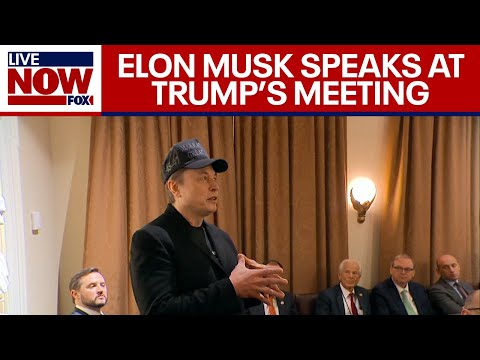 9:50ENLiveNOW from FOX· Feb 26, 2025Musk Defends DOGE Savings Target and Federal Worker EmailsDonald Trump, Elon MuskAt a February 2025 cabinet meeting, Musk discusses a $1 trillion savings goal and a disputed request for federal employees to report their work.