In 30 seconds
AI judges can assess work that fixed tests cannot, but a judge can reward an answer for its position or length rather than its quality. Stanford’s John Yang recommends checking model judgments against human ratings and testing whether preferences survive reordered answers. An agent can also inspect a website or game, though Yang says judging a sequence of actions remains difficult. For repeated agent runs, pass@k measures whether any attempt succeeds, while pass^k measures whether all do.
- 1A partial test suite can pass an incorrect solutionYang cites work on SWE-bench in which passing selected tests did not guarantee passing a repository’s full suite. A grader can also reject a valid solution it did not anticipate.
- 2One success and reliable success need different scoresPass@k measures at least one success across attempts; pass^k asks that all attempts succeed. Customer service and a difficult one-off research problem therefore call for different measures.
- 3Check observable behavior to leave more room for implementationsProgramBench tests an executable’s outputs rather than demanding a particular internal function. That opens the solution space, although expected inputs and flags still constrain it.
- 4A judge can change its preference when answers are swappedPosition and length can influence model judges even when the answer content does not change. Reordering candidates and controlling length help expose these biases.
- 5A judging agent can interact with the artifact it gradesInstead of evaluating all source code in a prompt, an agent can navigate a generated game or website. Yang cautions that judging the success of an action trajectory remains difficult.
Takeaways
- Test the verifier for both false passes and valid solutions it rejects.
- Swap answer order to measure position bias, and control for length when verbosity can skew grades.
- Use pass@k when one successful attempt matters; use pass^k when every attempt must succeed.
- Choose the artifacts a judging agent sees, such as screenshots, tool results and the trajectory.
- Compare model judges with human ratings and measure consistency across repeated runs.
Read the edited text by chapter
Why a verifier can misread success
Tests are reusable and precise, yet a partial suite can miss errors or reject a valid solution. Changing environments and open-ended work are harder to reduce to one expected answer.
Evaluating an AI agent means checking more than the final score. A benchmark combines an environment, a task and a way to verify the result; today I want to focus on the verification itself.
The choices include deterministic tests, human judgment and language models acting as judges.
A model can apply a rubric, compare two answers or act as an agent that inspects a generated website.
Judges also need checking: models can reproduce human preferences imperfectly and exhibit biases.
Repeated runs can produce different outcomes, so the metric used to report performance matters too.
Coding benchmarks such as HumanEval, SWE-bench and Terminal-Bench commonly use tests.
A test is deterministic, cheap to rerun and can check much more than source code.
In a customer-service simulation, for example, a test can inspect the database to see whether an order ended up canceled. A factual answer with one correct result can be checked by exact match.
The limitation is that many tasks have no single canonical solution. Whether an instruction-following answer is good can depend on the person or population making the judgment.
The correct answer can also change over time. A web search made today and the same search four years ago return different material; freezing the environment may be difficult, so grading needs to handle such changes.
A verifier must mark actually correct answers as correct and incorrect ones as wrong. It must also match the problem statement rather than rewarding an unintended shortcut.
The SWE-bench Illusion paper examined solutions that passed selected tests but failed when the entire repository test suite was run. Full suites may be slow or flaky, so restricting tests can let incorrect changes pass.
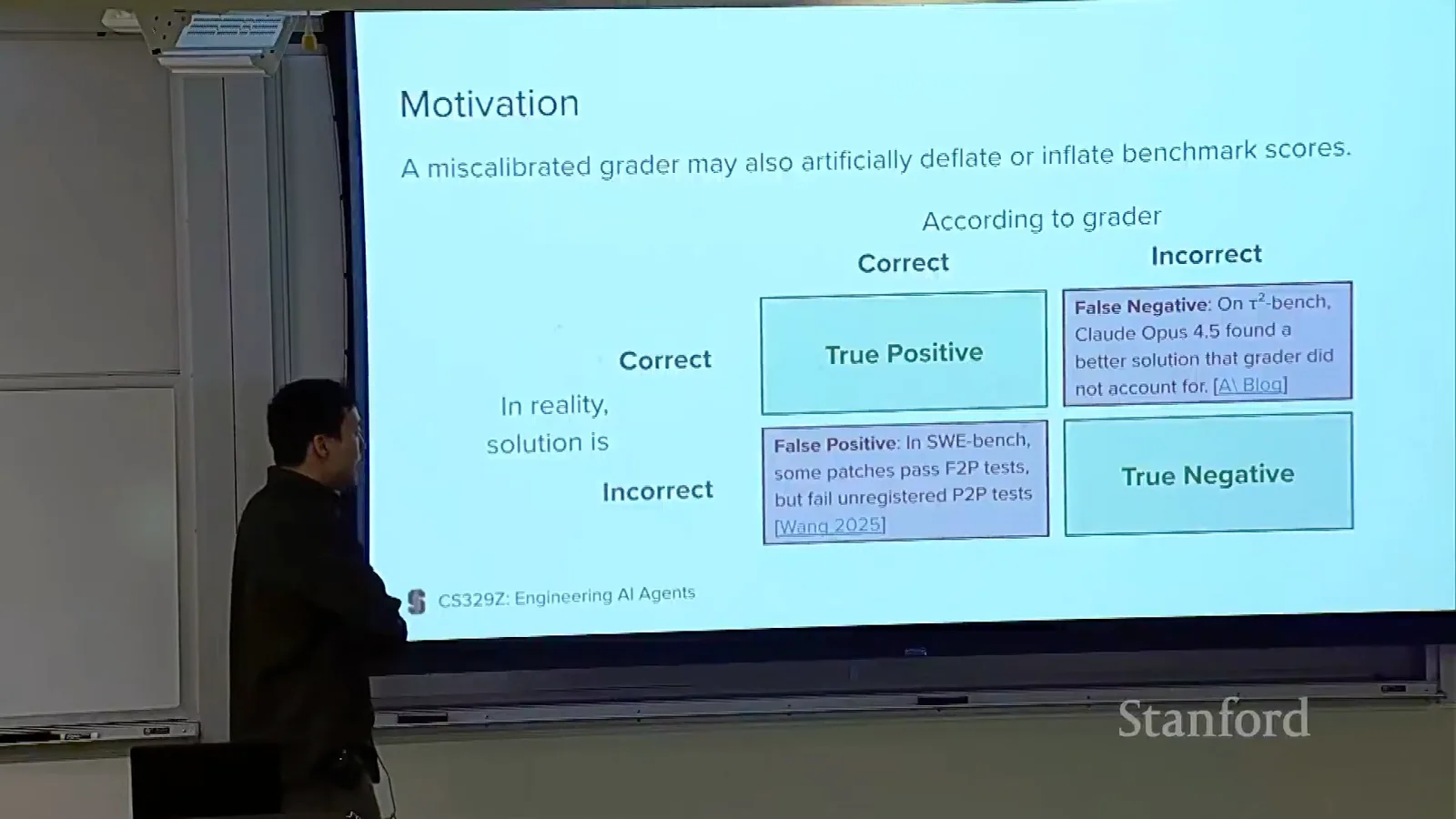
The reverse error also occurs: an Anthropic report described a good solution on τ²-bench that the benchmark's verification did not anticipate. Good graders need to account for more than one valid path.
Choose a score for the kind of reliability needed
Repeated agent runs vary. Pass@k rewards at least one success, whereas pass^k asks for success across all attempts.
Repeated runs of an agent can vary even at temperature zero, particularly across long, multi-turn tasks.
Suppose five runs yield two successes and three failures: the average alone does not explain the distribution.
For an exceptionally hard problem, one successful solution can be valuable even if other attempts fail. A metric such as pass@k asks whether at least one of k runs succeeds.
In customer service, succeeding only once is not enough.
Pass^k instead asks whether all k runs succeed; the first metric tends to rise with more attempts while the second can fall.
What code, people and model graders each offer
Tests are cheap but fixed; humans handle flexible work but are costly and can disagree. Models can apply rubrics or compare candidate answers.
I group graders into code-based tests, human annotators and model judges. The right choice depends on cost, speed and what can be expressed faithfully as a check.
A biology task with a precise output sequence can be tested for equality, or for a repeated pattern when some variance is allowed.
Those are illustrative examples rather than claims about a real biology benchmark.
Tests are inexpensive and fast once created, and models can help generate them.
But a fixed test suite can saturate: once models pass it reliably, it no longer separates stronger models or provides useful training signal.
A test can prescribe implementation details, such as a specific function signature.
Alternatively, ProgramBench asks for an executable and checks its observable outputs, leaving the implementation more open.
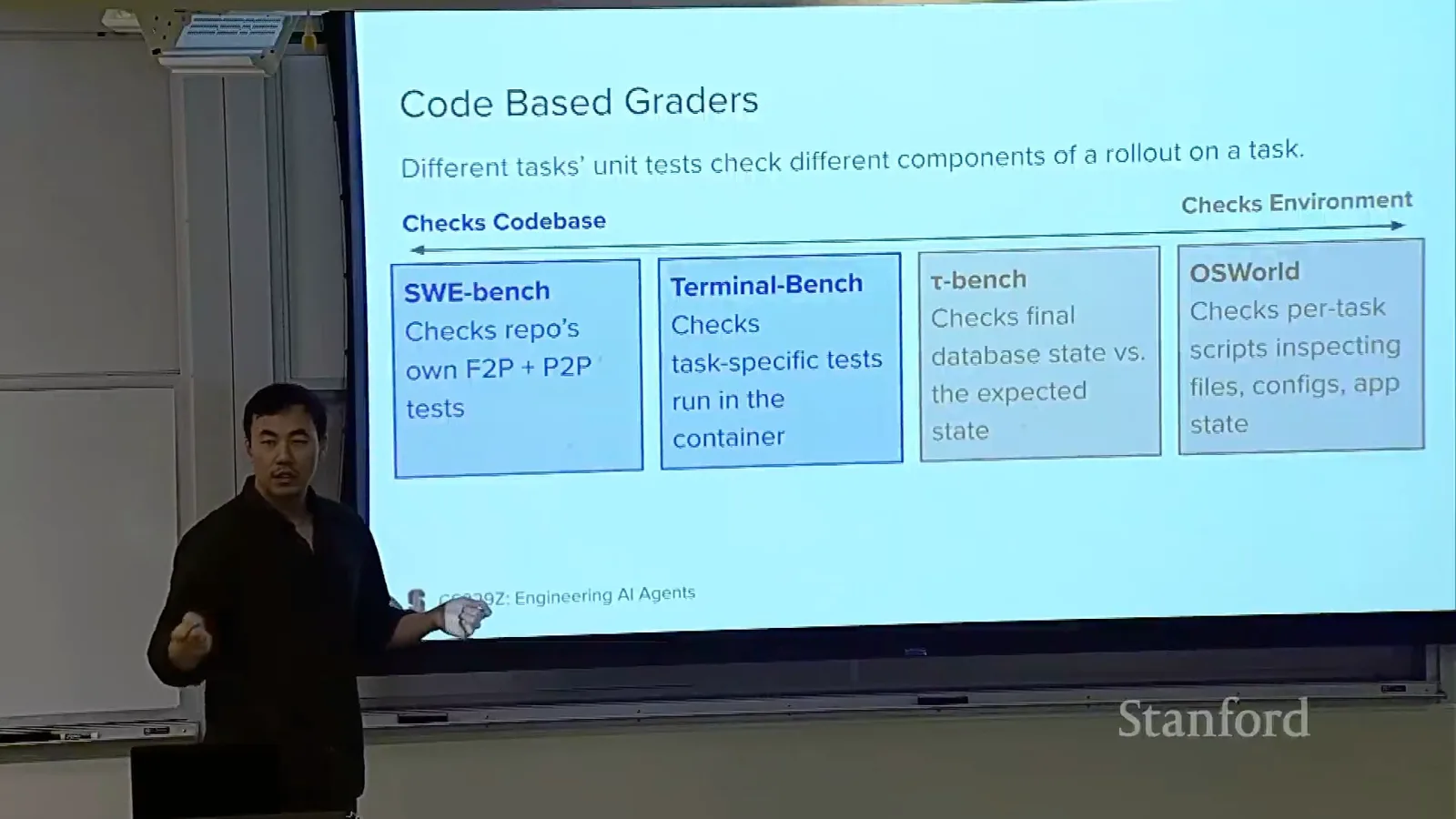
Moving verification up one level of abstraction can admit more solutions, but it does not eliminate constraints.
A reimplementation of FFmpeg must still accept the expected input and flags if those are how it is tested.
Tests are static and can be reductive: checking the first thousand Fibonacci values does not prove the next one works. The challenge is whether the test suite covers the solution space well enough.
Humans can judge open-ended work that resists exact tests.
Chatbot Arena collects preferences, while GDPval uses experts to evaluate work products such as spreadsheets and office documents.
Making every detail of a spreadsheet's file name and column layout part of the prompt would make the task unnecessarily prescriptive. Human graders can judge whether the underlying objective was achieved across different valid presentations.
Human judgment is expensive and can disagree, even when the same person sees the same work twice.
Confidence intervals and statistical tests can help establish reliability, but they also add cost.
A model judge can apply a rubric or checklist to a single solution, compare an answer with a reference, or choose between two candidate answers. Pairwise comparison can itself include a rubric.
Model grading spans exact checks and more open-ended preferences.
Before choosing it, weigh the strengths and costs of code, people and models against the specific task.
From word overlap to learned text judges
G-Eval and related work compare model ratings with human judgments rather than relying on word overlap alone. Reliability and model preferences remain open questions.
The history of model judges moves from replacing text-overlap metrics, to predicting human preferences, to agents that inspect artifacts. The question throughout is how well the grading matches what people care about.
Traditional summary evaluation compares a generated summary with a reference through overlapping word sequences.
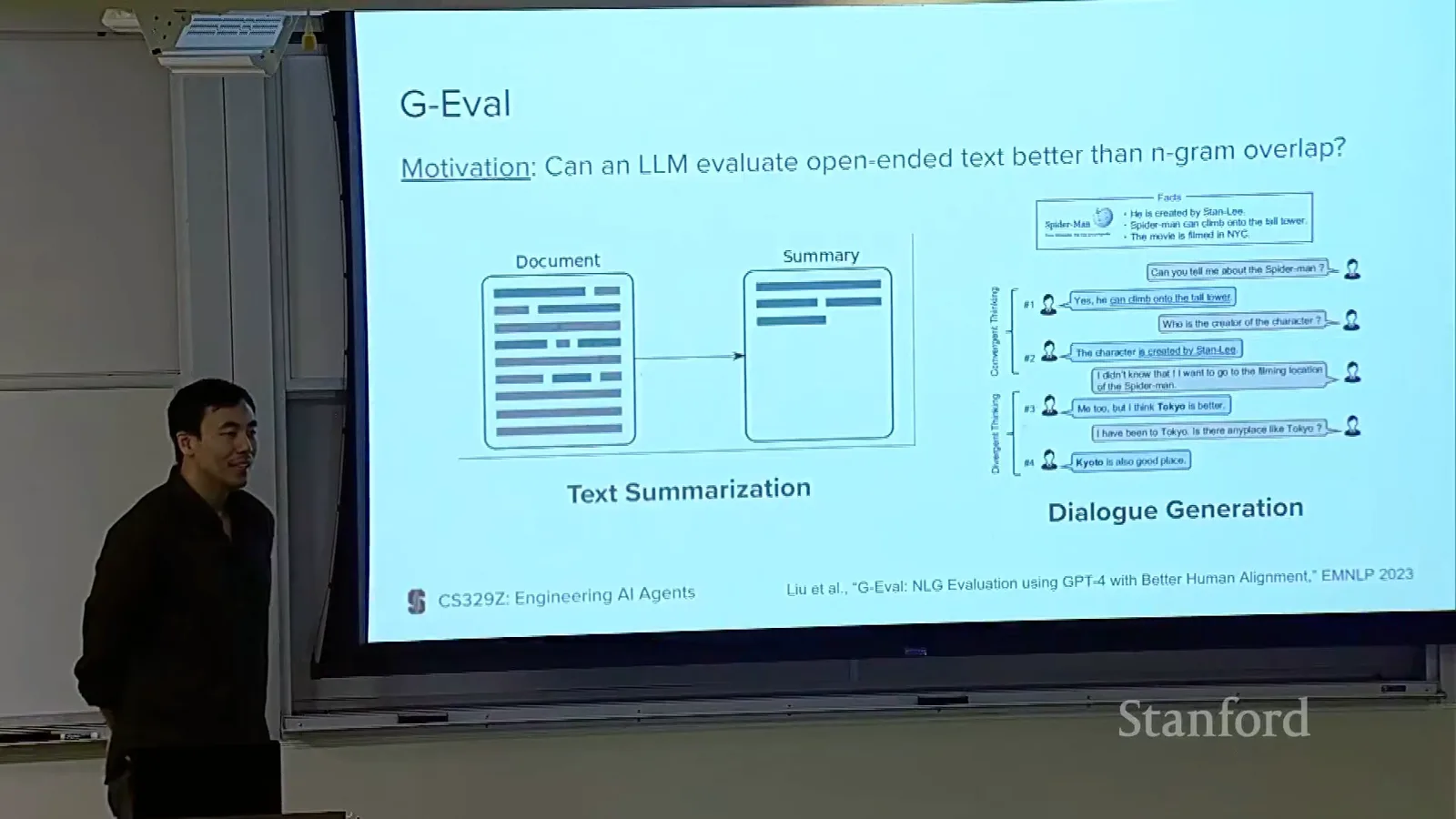
That misses expressions with similar meaning but different words, much as literal keyword matching can miss a synonym.
G-Eval instead asks a language model to grade a summary, potentially against a reference, on a scale. Its scores vary across runs, so the paper considers multiple samples and their distribution.
The comparison is not just whether the model produces a number: researchers compare that number with ratings from people on the same qualities.
Correlation with human scores becomes evidence for the metric.
GPTScore expands the idea across tasks such as summarization, dialogue and translation, and across many dimensions of quality.
The paper evaluates different model sizes and asks whether their scores track human judgments.
Earlier work often listed detailed quality dimensions separately for each text task.
Later preference-based methods can ask a person or model to make a more holistic judgment instead.
Another study gives models and experts the same open-ended story evaluation instructions and checks both agreement and consistency.
The models align with experts in the study but are more lenient on unnatural text.
One robustness question is whether a model favors its own generations when judging outputs from several models.
Yang says prior work has found tendencies toward such preferences.
Train preference models and test their biases
Human comparisons can train a reward model for evaluation and post-training. Position and length can influence the resulting judge.
An audience member asks what unnatural text means.
One example is a summary repeating a sentence: if the judge prefers repetition to a concise equivalent, the system can exploit that bias as a reward hack.
The next step is to model human preference directly.
Rather than simply compare a generated score to a metric, a reward model can be trained to predict which of two answers people prefer.
For each prompt, collect two outputs and a human preference between them.
A model trained on many such examples learns to rank new answers in a way that approximates those annotations.
The trained reward model can then provide feedback during language-model training.
This avoids requiring a human annotator to judge every generated response in the training loop.
That makes open-ended tasks such as summarization usable for reinforcement learning: the generating model proposes outputs and the reward model supplies a score based on learned preferences.
The early preference-learning recipe starts with summarization, then work such as InstructGPT applies related methods to a broader range of instructions.
Different kinds of preference data require corresponding training formulations.
Chatbot Arena and MT-Bench make several judging setups explicit: compare two answers, score one answer, or provide a reference.
Their evaluation asks how well the judge agrees with people and how consistent it is.
Position bias is one problem. Present the same two answers in the opposite order and a judge may change its choice; consistency measures how often its preference survives that swap.
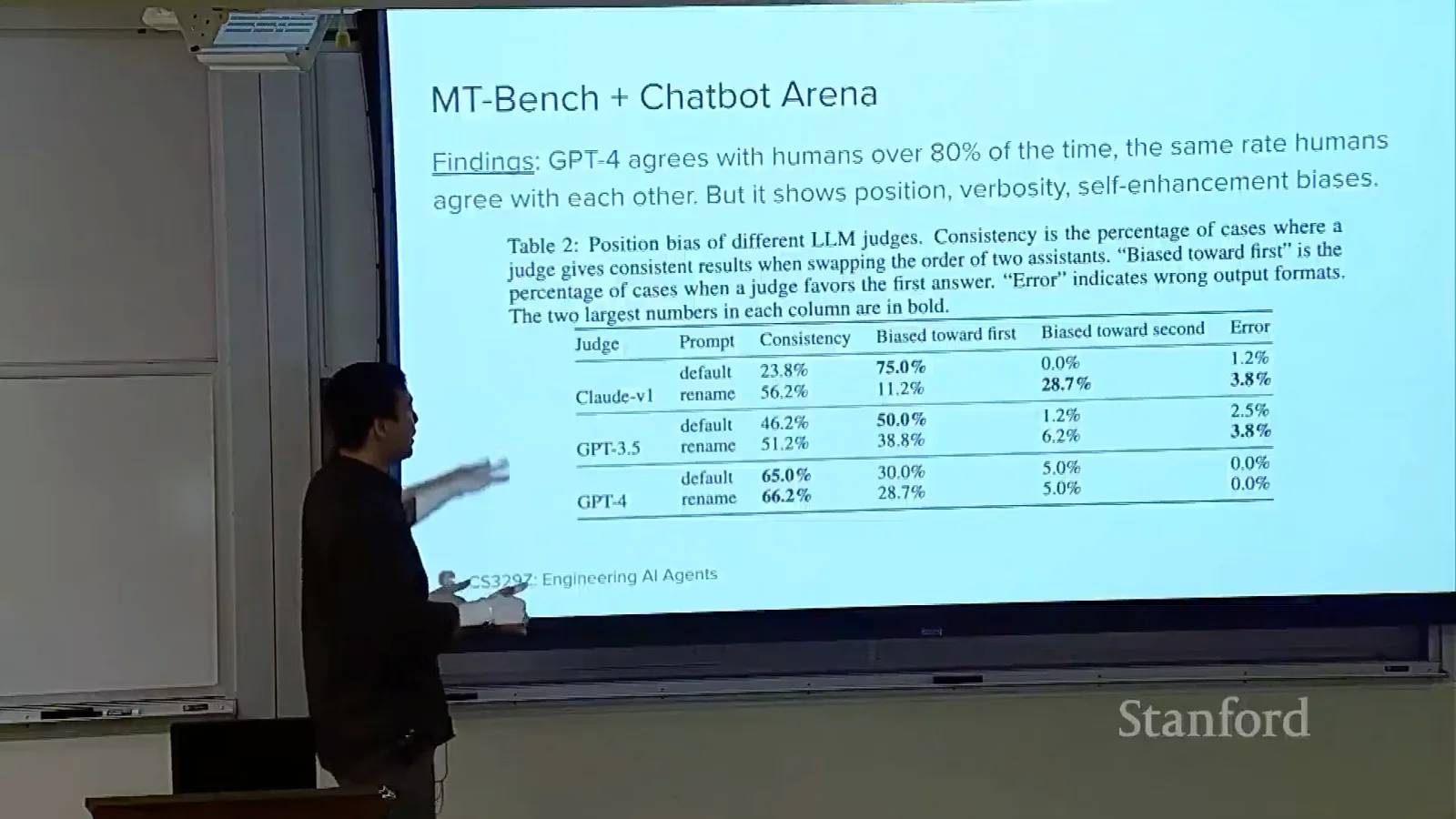
One possible intervention is to train on examples whose answer order has been varied. Research also examines other unwanted cues such as length, which may affect a rating independently of quality.
A public preference platform draws questions from many domains. Researchers can compare judge agreement with people separately for coding, math, extraction and other categories.
Prometheus illustrates an open model trained to grade using user-defined rubrics.
Its training recipe combines instructions, rubrics and examples so the judge can generalize across tasks.
There are different ways to use a rubric: score answers separately, then compare the scores, or directly pick a preferred answer. Yang says he has not seen a paper clearly establishing one as universally superior.
Let an agent inspect what another agent built
A grading agent can interact with sites and examine screenshots and action sequences. Whether models can reliably infer success from a trajectory remains a challenge.
An agent can also grade by interacting with an artifact.
A model-generated game is hard to assess by putting all its code into a prompt, but an agent can click buttons, navigate screens and inspect what happens.
A separate question is whether a model can read an agent's trajectory—the sequence of actions it took—and determine if the task succeeded without seeing a unit test. That shifts attention from the final state alone to the process.
For a website recreation, Yang offers an example in which the original source code is unavailable. An agent can explore the reference site, recording actions such as logging in or changing a price filter.
Those actions can be replayed on the recreated site as a way to check behavior. WebVoyager-style evaluation records the route and screenshots so a judge can inspect the run and final answer.
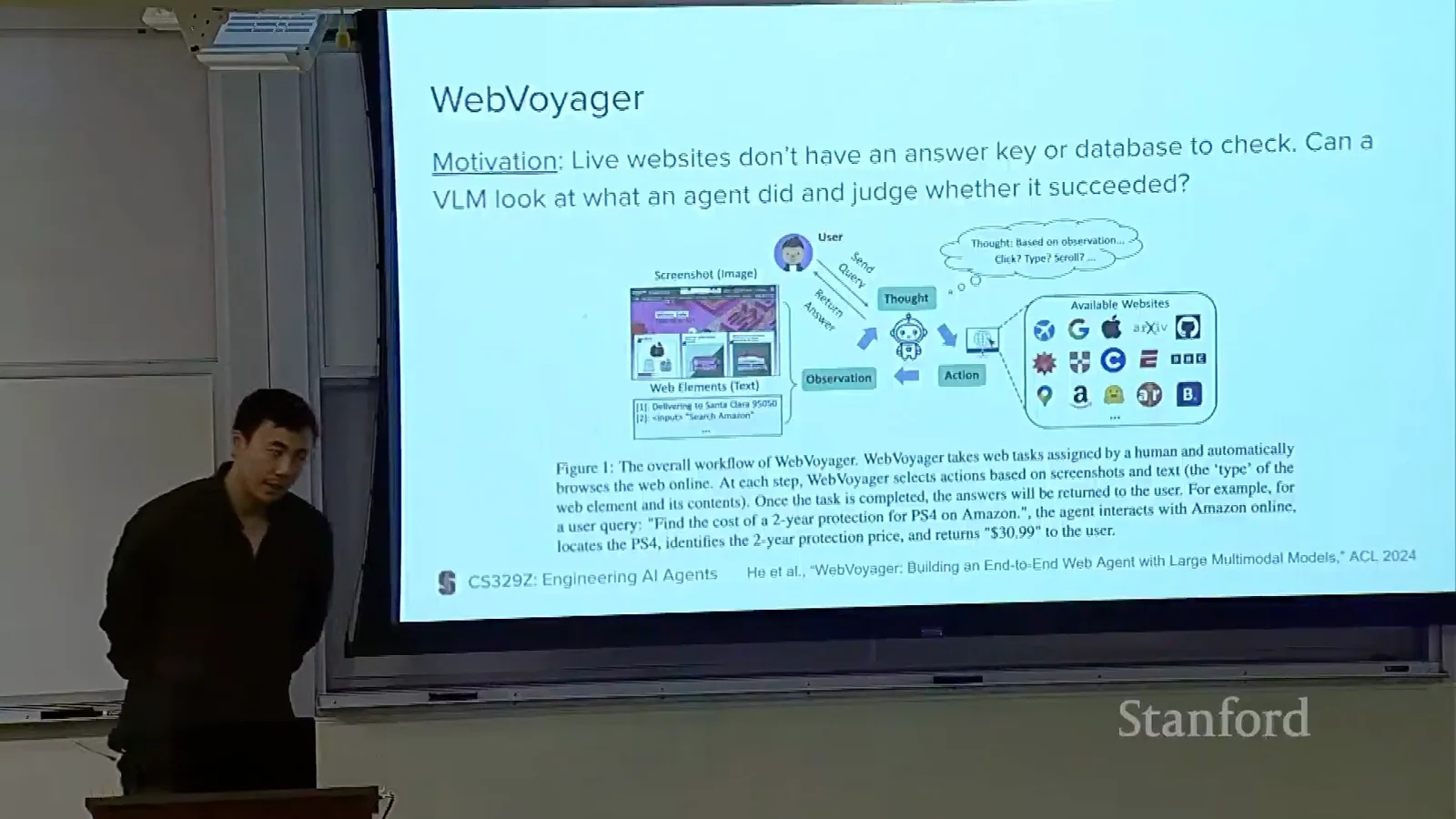
Ablations test which information matters: the full trajectory, tool outputs and screenshots, or only a subset.
When designing an agent judge, choose deliberately which artifacts it needs to see.
For computer-use tasks such as OSWorld, researchers ask whether a model can judge the trajectory and produce feedback without a hand-written check for every task. The result could be fed back as a reward signal.
One approach captions screenshots with a vision model and asks a language model to reason over the descriptions. Another gives a stronger vision model the trajectory directly.
A trajectory might end in an exception even though the user-requested action has already succeeded. A judge should consider the actual state and steps rather than treating the exception alone as failure.
Yang says models have not been especially good out of the box at determining success from trajectories.
Agent-as-a-judge research reports better agreement in some settings but still faces consistency problems.
Control bias and report repeated runs
Swap answer positions and account for verbosity when testing judges. Select a repeated-run metric according to whether one success or consistent success matters.
To test position bias, swap the order of the candidate answers and see whether the same content wins. A change in preference after the swap signals an unreliable influence from presentation order.
Length bias is another issue.
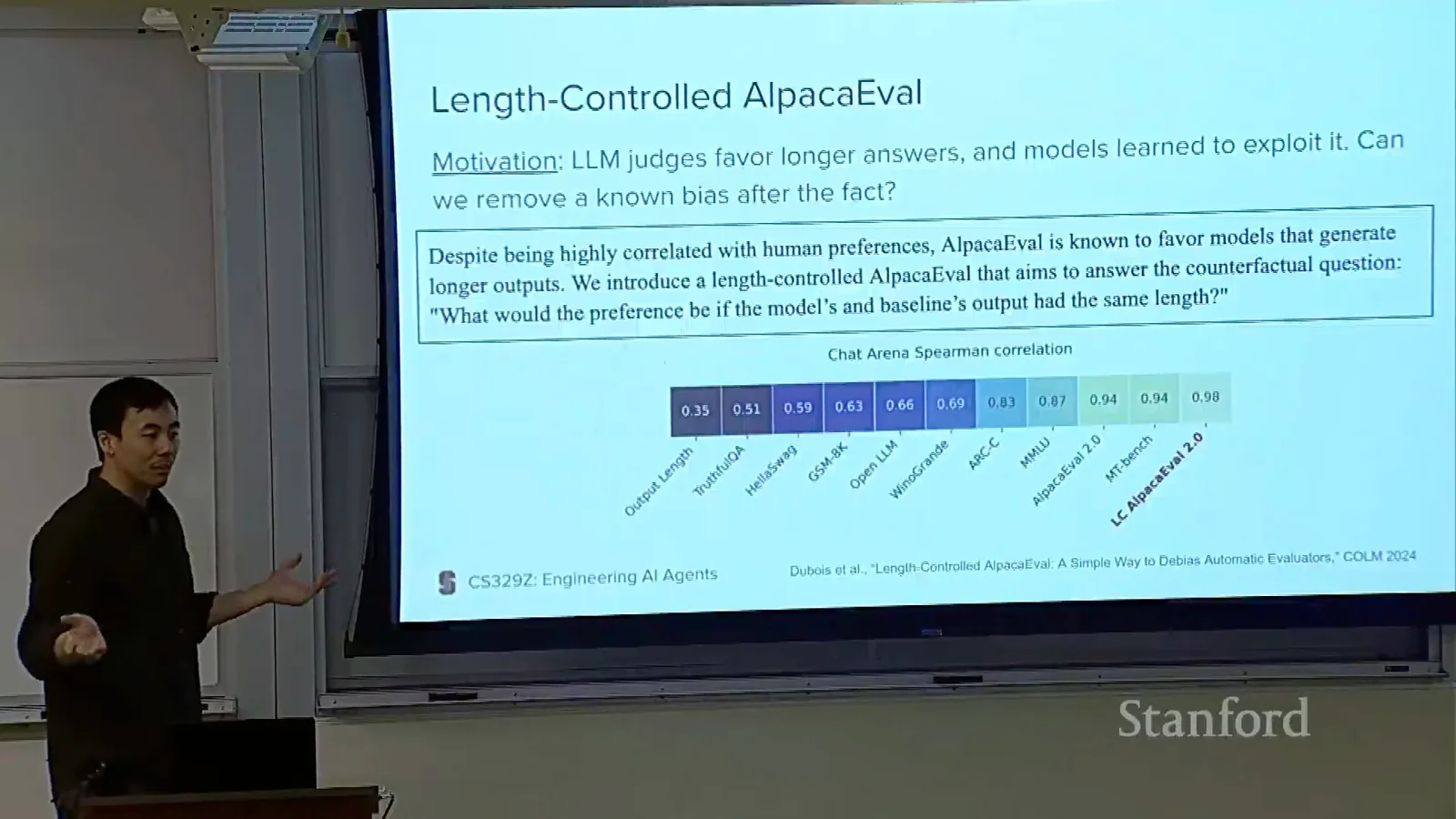
In summarization, an unconstrained judge can favor longer or repetitive answers; length-controlled evaluation can make the comparison less dominated by verbosity.
AutoMetrics explores building task-specific evaluators from a small amount of human judgment.
It generates and filters candidate metrics to find checks that better align with a particular task and group of raters.
When an agent has several runs, the score must fit the question being asked. Pass@k estimates the chance of at least one success in k attempts, useful when a difficult problem only needs one solution.
With five total runs and k set to three, the estimate considers how often a selection of three contains at least one success. The calculation accounts for the ordering of the observed trials.
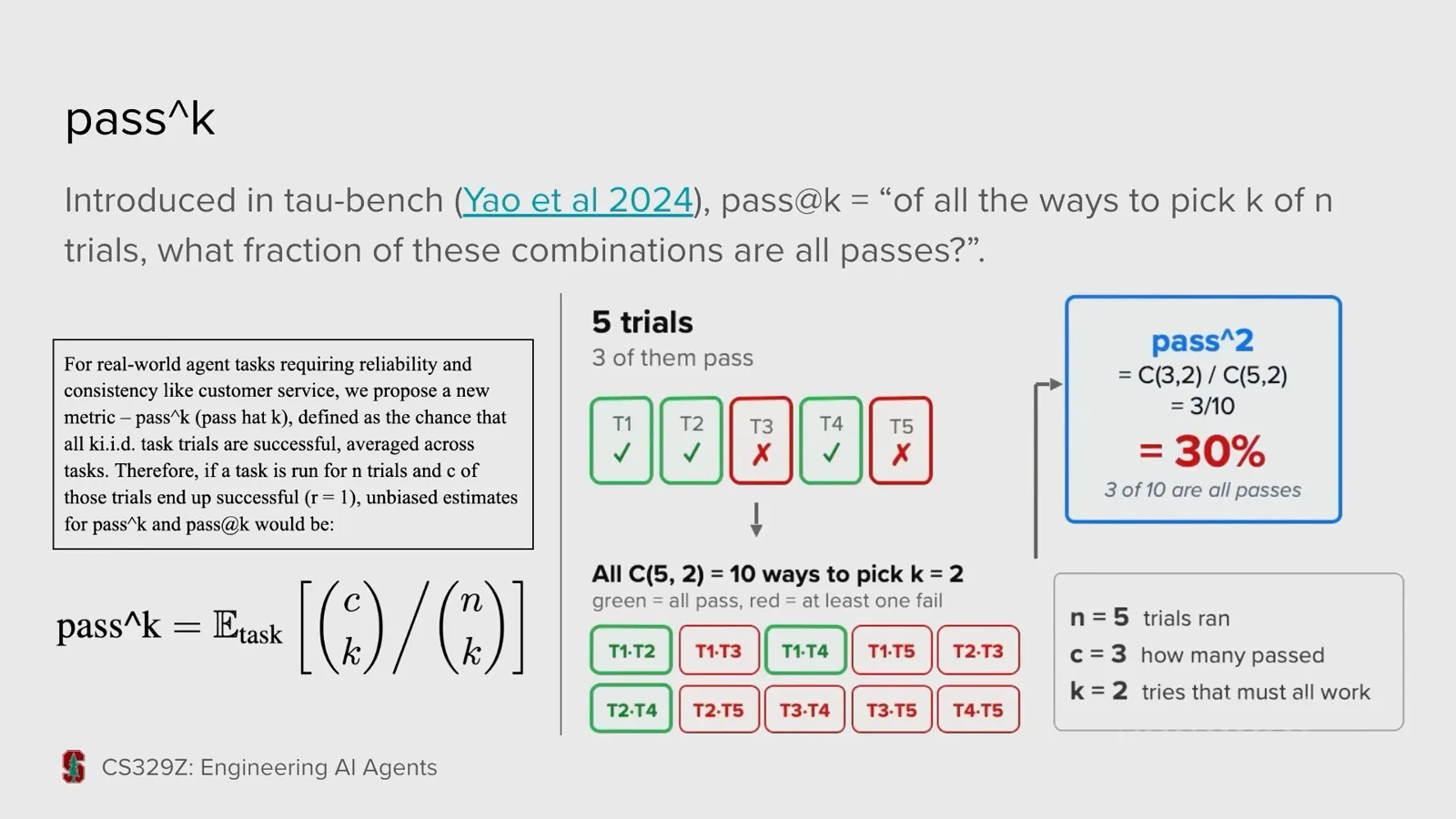
Pass^k asks for all k attempts to succeed, making it better suited to reliability-sensitive applications such as customer service.
Two agents with the same average can look very different under these two measures.
There is no universally correct metric: choose according to whether the task rewards one successful attempt or dependable success every time.
More from this channel
 20:46EN
 Stanford Online· Nov 28, 2026Why momentum matters more at large batch sizesTatsunori Hashimoto · Stanford UniversityA Stanford optimization quiz shows why batch size changes momentum’s value and how learning rate and weight decay interact.
 1:08:53ENStanford Online· Nov 27, 2026How µP and Muon keep neural-network training stable as models widenTatsunori Hashimoto · Stanford UniversityStanford’s Tatsunori Hashimoto explains why scaling rules enable learning-rate transfer and how Muon boosts weak update directions.
 1:10:50ENStanford Online· Nov 27, 2026Andrew Ng: Build Agents Fast, Then Learn From Their FailuresAndrew Ng, Diyi Yang, Fred · DeepLearning.AINg favors early prototypes and later rigorous evaluation; Diyi Yang challenges how much generated code can safely go unreviewed.
 1:18:42ENStanford Online· Nov 26, 2026Tatsunori Hashimoto: Why Batch Size Changes Which Optimizers HelpTatsunori Hashimoto · Stanford UniversityA noisy quadratic explains when momentum pays off; transformer weight norms show why the effective learning rate can drift.
 1:21:11ENStanford Online· Nov 26, 2026John Yang: An Agent Benchmark Must Measure More Than a ScoreJohn Yang · Stanford UniversityThe task, harness and evaluation rules all change the result; harder tests also need to stay realistic and reproducible.
 1:14:57ENStanford Online· Nov 25, 2026John Yang: Better Agent Training Starts With Choosing the Right DataJohn Yang · Stanford UniversityFilter tasks for reliable tests and useful difficulty; even successful agent runs can contain mistakes worth excluding.