In 30 seconds
Ryan Carson walks Peter Yang through his AI-assisted startup workflow: an OpenClaw executive assistant, scheduled tasks, cloud-based development and testing, and marketing workflows. He discusses setup friction, permissions, errors, and the tradeoff between customizing tools and doing the work. The episode includes a WhisperFlow sponsor segment.
- 1An executive assistant built around prioritiesRyan describes a customized OpenClaw assistant with scheduled checks and a written priority map.
- 2Remote maintenanceHe uses a separate coding agent to inspect and help repair the assistant’s configuration.
- 3Separate identity and permissionsThe assistant has its own accounts and selected access to Ryan’s calendar and email.
- 4Prospecting and troubleshootingRyan demonstrates scheduled research and outreach and describes debugging an email behavior.
- 5Cloud development and testsHe uses a cloud environment and scheduled browser playbooks to exercise user flows.
- 6From idea to pull requestRyan records requirements, asks an agent to build and test, then reviews feedback and uses a landing playbook.
- 7Marketing and design systemsHe discusses advertising, content workflows, and brand reference materials created with a designer.
Takeaways
- Ryan combines written priorities, skills, and scheduled tasks for his assistant.
- He gives the assistant distinct accounts and selected permissions, and describes the need to inspect its behavior.
- Scheduled browser tests and documented playbooks support his cloud development process.
- Agents can help with research and marketing, but outreach, spending, and code changes require suitable controls and review.
- His staffing and productivity claims reflect his own situation and are not measured comparisons.
Read the edited text by chapter
A solo founder’s assistant
Ryan introduces his customized assistant and recurring tasks.
Founder Ryan Carson joins Peter Yang to describe how he uses AI agents while building his startup. He emphasizes that setup is still difficult and that his approach depends on written context, repeatable workflows, and ongoing maintenance. The episode contains a WhisperFlow sponsor segment.
Ryan’s OpenClaw assistant, R2, uses a set of instructions and a priority map to help with scheduling, inbox checks, tasks, and business research. He describes recurring checks and communication through Slack. His own experience with scheduling reliability is specific to the setup and product version he tested.
The assistant runs on a separate machine, which Ryan accesses remotely. He uses a coding agent to inspect configuration and troubleshoot problems when the assistant fails. A second tool can help diagnose issues, though changes still require appropriate review and a way to recover if they fail.
Priorities and scheduled checks
Skills, cron jobs, accounts, and permissions.
Ryan shows how a scheduled task invokes an executive-assistant skill and reads longer-term priorities. He gives the assistant a distinct email and GitHub identity and selected access to his own calendar and inbox. The exact permissions determine what it can do; a separate account alone does not guarantee safe behavior.
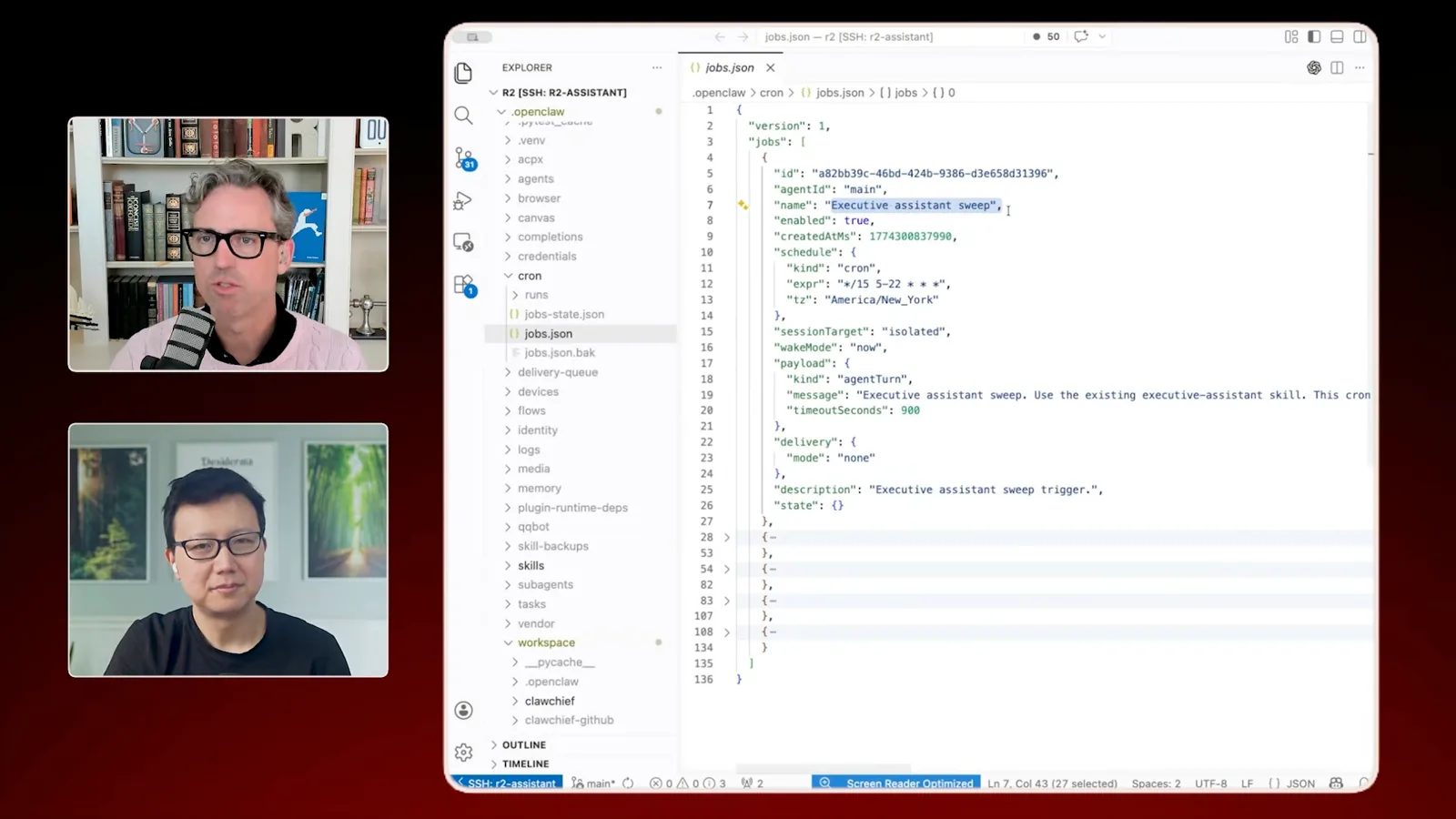
He says he is delaying hiring while learning business functions himself with help from agents, despite having raised funding. His comparisons between agent and human onboarding are personal judgments, not measured evidence that one can replace the other across roles.
Research and outreach
Prospecting, task tracking, and correcting unexpected behavior.
Ryan describes a scheduled prospecting workflow that researches potential contacts and tracks outreach in a spreadsheet. In his setup it can send messages; he discusses instructions to avoid duplicate contact and an email behavior he had to investigate. External communications and access to sensitive data need clear authorization, careful controls, and monitoring.
A simpler weekly view
Ryan combines agents with a paper priority list.
For weekly priorities, Ryan recently returned to a paper list because it gave him a better view of the week. He also tries to balance customizing his assistant against the time spent maintaining tools, preferring an existing platform with selected skills and scheduled tasks.
Cloud development
Development environments, playbooks, and scheduled tests.
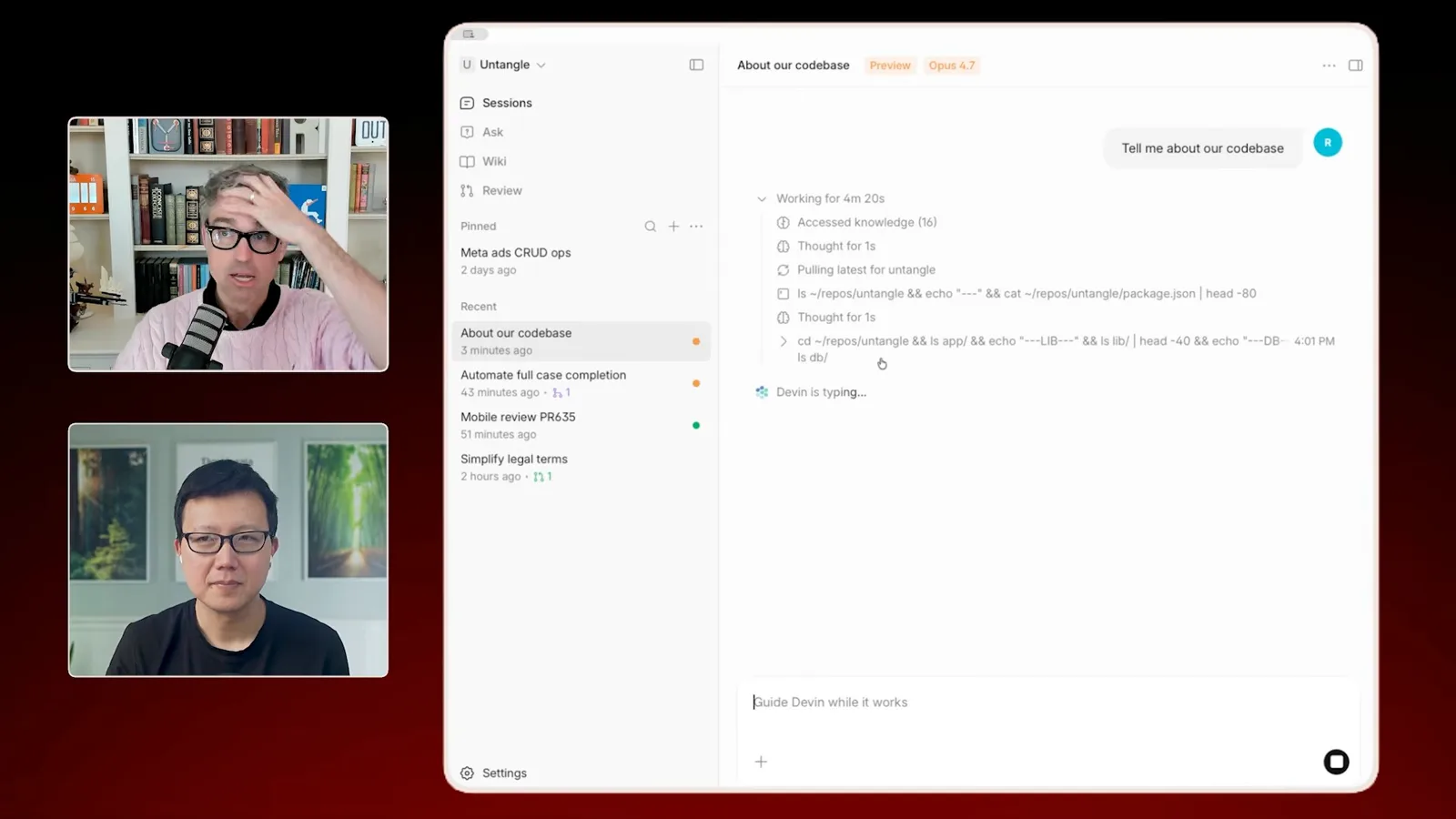
For development, Ryan uses cloud environments and playbooks. He describes scheduled browser tests that exercise an end-to-end user journey and record results. Automated testing can provide useful evidence, but a successful run does not establish that every failure mode or security issue has been covered.
Shipping and marketing
From requirements to code, advertising, and brand assets.
His feature process begins with a spoken description and an agent-assisted requirements document. He then delegates implementation and testing, reviews feedback, and uses a playbook to land a pull request. His reported shipping rate and preference for automated review are individual experiences; teams should choose review and release controls for their own risk.
Ryan also describes using agents for advertising analysis and content production. He says he first paid a designer for brand work and reference images, then used those assets to guide subsequent content. He plans eventually to hire people for functions he has learned to operate himself. The speakers conclude that setting up and refining systems can be useful, while recognizing that it takes substantial work.
More from this channel
 21:47EN
 Peter Yang· Nov 9, 2026PodcastFable 5.2 won four creative tests; Opus resisted pressure betterPeter Yang compared five tasks and found Fable stronger at creative outputs, while Opus more often challenged misleading pushback.
 46:40ENPeter Yang· Nov 8, 2026Podcast · 2 speakersAshley Alexander: How AI Helps Me Care for My Parents With CancerGuest Ashley Alexander · Host Peter YangA caregiver uses AI to prepare for appointments, organize records and ask better questions—while keeping doctors at the center of treatment.
 17:50ENPeter Yang· Nov 4, 2026PodcastPeter Yang’s Five Steps for Using AI to Help Care for His MotherYang uses a shared care brief and organized records to navigate appointments, while making time for family.
 15:03ENPeter Yang· Nov 3, 2026PodcastHow Peter Yang Used an AI Phone Agent to Negotiate His Internet BillAn AI call negotiated a lower price and faster service, but Yang still had to approve the change himself.
 33:09ENPeter Yang· Nov 1, 2026Podcast · 2 speakersJaclyn Konzelmann: When AI Can Build More, Choose What Deserves to ExistGuest Jaclyn Konzelmann · Host Peter YangGoogle Labs pairs short strategy documents with prototypes, user co-creation and lessons from experiments that end.
 13:05ENPeter Yang· Oct 28, 2026PodcastPeter Yang Tests Genie 4: Convincing Worlds, Unfinished GameplayFive live demonstrations show scenes that respond to prompts and sound, alongside inconsistent actions and limited game mechanics.