In 30 seconds
Nan Yu expects AI to change more than administrative work: it can assist with strategy, data analysis and research. The Linear product leader sees product taste, empathy and responsibility as enduring skills, alongside new work supplying agents with context and checking results. His team aims to build a usable core in roughly 10% of the available time and improve it through progressively wider feedback. He demonstrates AI-assisted issue triage and a coding agent while keeping a person accountable.
- 1Hire for durable ownershipYu says Linear avoided hiring product managers solely to maintain documents and updates.
- 2Strategy is also exposed to AIYu expects organized reasoning and prioritization to become less distinctive, while people retain responsibility.
- 3Give agents the right contextDesign the workflow that supplies information, identifies gaps and checks output.
- 4Get a usable core in 10% of the timeLinear uses an early working version and progressively wider feedback to improve quality.
- 5Review AI suggestions for incoming issuesLinear suggests ownership and duplicates; Yu approves a merge after checking the result.
- 6Keep a person responsible for agent workYu delegates a website change to a coding agent but reviews the resulting pull request.
Takeaways
- Build a usable core early, then widen the feedback group in stages.
- Supply agents with the information and tools they need, and check their work.
- Practice empathy by examining a user’s incentives, pressures and fears.
- Treat AI-assisted strategy and analysis as inputs to decisions a person owns.
- Turn actual AI failures into evaluation cases as a product develops.
Read the edited text by chapter
Why Linear kept its product team small
Yu explains the roles shared by engineers and designers and why he avoided hiring for administrative work.
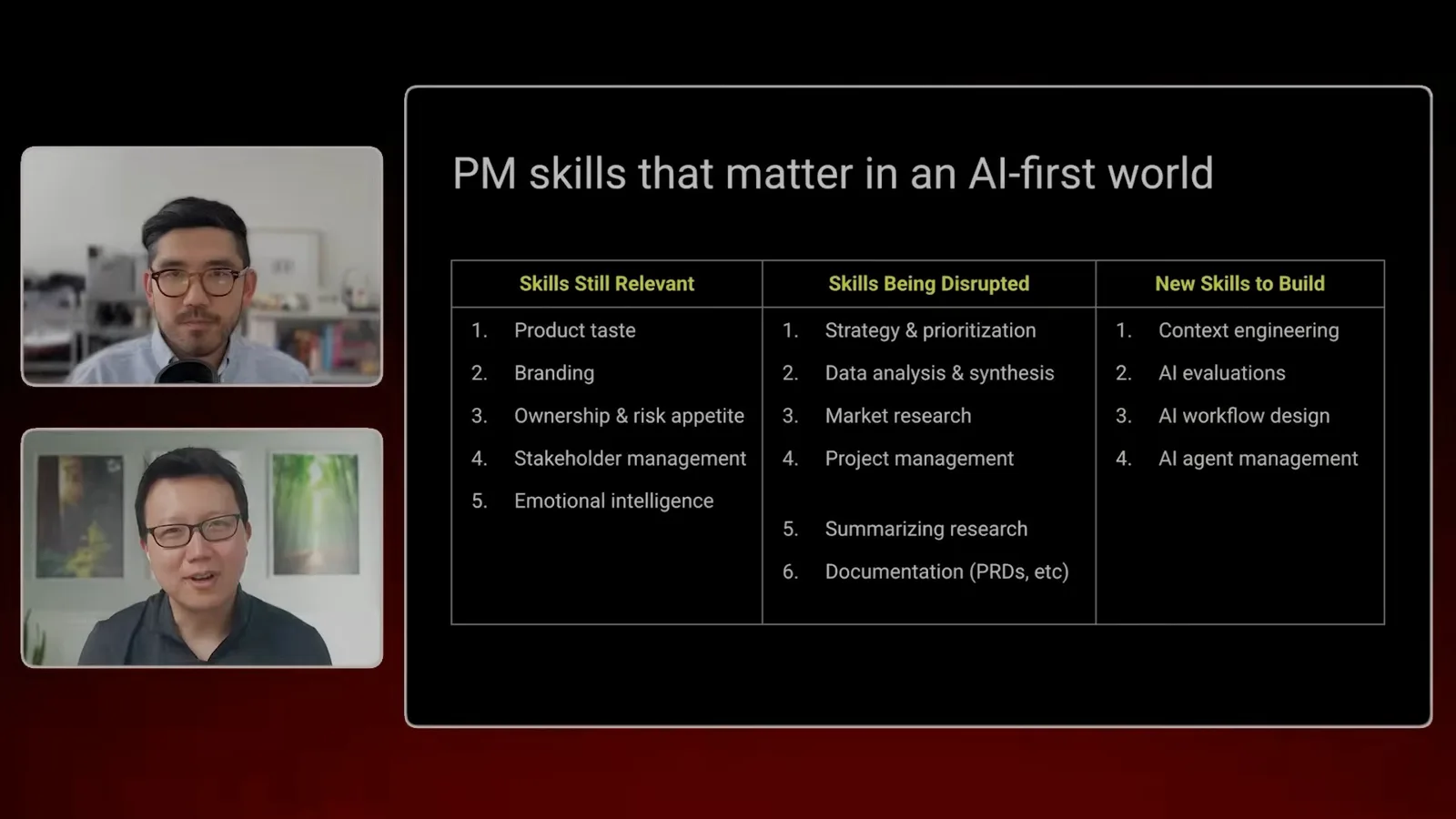
Linear had only two product managers, Peter Yang says. Head of product Nan Yu explains that skilled designers and engineers share discovery and business thinking, and that the company deliberately avoided hiring people merely to maintain documents and status updates. He expects computers to increasingly handle that mechanical work.
Taste, ownership and empathy
Yu connects product judgment to users’ emotions and responsibility for outcomes.
Yu describes product taste as sensing how an interaction will feel to a particular audience, often before being able to articulate why. He connects branding to small touchpoints such as names and first impressions, and says a personal or product brand can create emotional resonance before someone tries a product.
Ownership means both pursuing a good outcome and accepting responsibility when a calculated risk fails, Yu says. Stakeholder management remains important even in a small company: colleagues may disagree, and a product manager must understand how much room there is to experiment and when to follow another person’s approach.
To practice empathy for business customers, Yu imagines doing their job under their specific incentives, pressures and fears. He sees that emotional understanding as connected to product taste, branding and working with colleagues.
Which familiar PM tasks AI may change
Yu argues that reasoning, analysis, research and documentation are becoming more accessible to AI.
Yu challenges the assumption that AI affects only the less important parts of a product manager’s work. In his view, models can already help organize evidence and reason through strategy and priorities, so those activities may become less distinctive even though a person remains responsible for the decision. Yang describes supplying documents to AI and questioning its proposed strategy.
The same pattern applies to routine data work, Yu argues: a model can help write a database query, reducing the gap between someone who knows the query language and someone who previously needed an analyst. He expects the value of interpretation to rise, while noting that AI’s abilities are uneven across tasks.
Yang says automated research can replace some preliminary market surveys. Yu distinguishes that first pass over existing material from high-touch research built on long-term relationships and direct conversations, where a researcher obtains information that is not already in a public report.
Much project management depends on tracking details, noticing changes and keeping everyone informed. Yu thinks AI gives computers enough ability to interpret information to make use of their existing diligence. He separates that from caring whether a design actually feels right to a user.
Summaries and documentation both gather source material into a useful form, Yu says; the hard part is updating them when the underlying decisions or facts change. Yang asks AI to incorporate stakeholder feedback and highlight edits so he can check them.
Context and agent management
The speakers describe providing information and reviewing agent work.
The new skills include deciding what information a model needs, evaluating its output and designing a workflow that gets it the right context at the right time. Yu suggests giving an agent a way to notice missing information and tools to retrieve it. Managing agents also means judging how detailed an instruction each task requires.
Yu says documents increasingly have a machine audience as well as a human one. An issue with clear reproduction steps helps Linear’s automation find related work and suggest ownership, while also helping a colleague who reads it. Yang keeps the main document concise and puts additional context in appendices.
Use feedback to build craft
Linear makes a working core early, then expands access in stages.
Asked how Linear balances speed and craft, Yu says software can be improved through repeated releases. His rule of thumb is to have a working core experience after roughly 10% of the allotted time, so the team can actually use it and apply its judgment to the result.
Linear expands access in nested stages: developers first, then the rest of the company, selected beta customers, a wider beta and production. The first version need not cover every edge case; the main user path should work, and feedback from people who use it reveals what needs attention next.
For AI features, Yu says his team initially builds without a large evaluation suite, then turns actual failures and user expectations into tests as the audience grows. This lets the team adjust prompts and build checks around cases it has encountered.
Make deliberate product trade-offs
Yu describes where Linear chooses defaults and where it preserves flexibility.
Keeping a business product simple requires choices, not a single rule that always says yes or no to customers. Yu says Linear leaves high-level company decisions flexible, while making stronger defaults for the minute-to-minute work of individual contributors, who make up most of its users.
Analyze customer requests and triage issues
Yu demonstrates connected analysis and suggestions for incoming work.
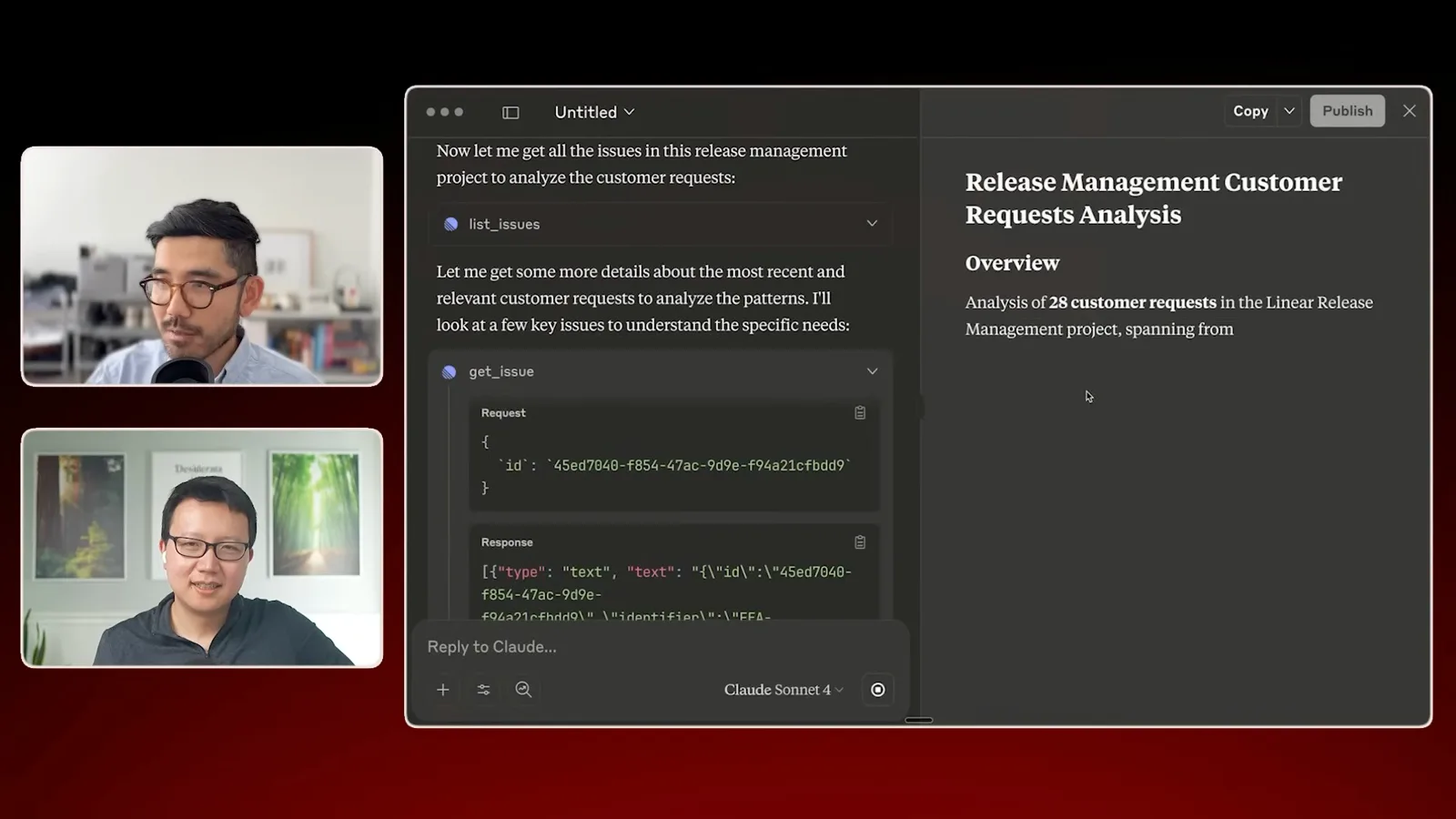
Yu connects Claude to Linear through MCP, a way for AI tools to access external systems. He asks it to analyze customer requests for a release-management project. It finds 28 requests, groups themes and provides a starting point for further questions; Yu says it aligns with what he heard in customer interviews.
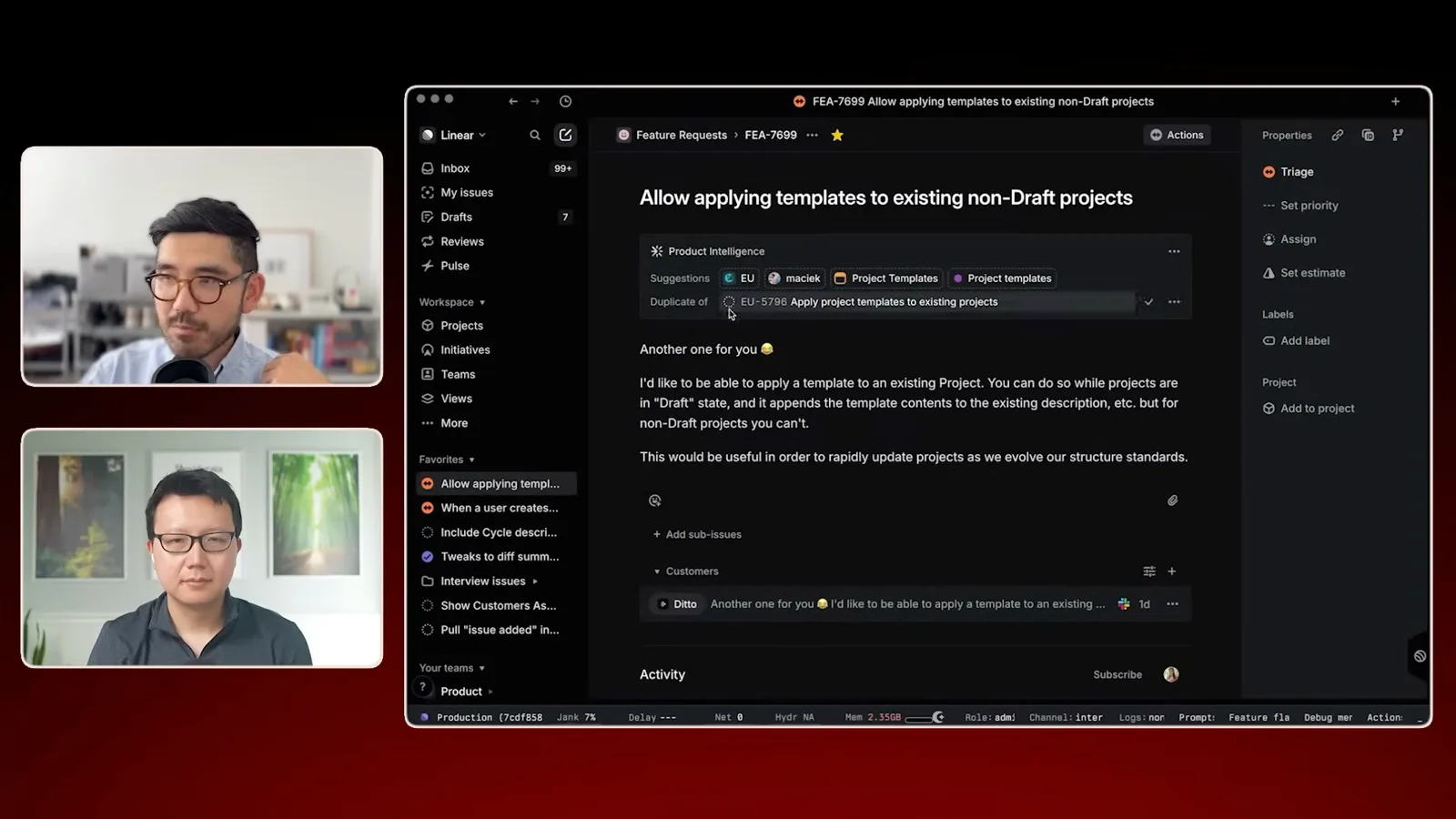
Linear’s product intelligence suggests a team, owner, project and label for an incoming request, and explains a possible duplicate. Yu reviews and accepts the duplicate suggestion, combining customer requests under the existing issue. He says this turns some backlog triage from manual research into reviewing recommendations.
Delegate code questions and changes
Agents inspect a codebase and propose a website change, with a person accountable.
For another request, Yu asks a third-party agent in Linear to inspect the code and determine whether calendar synchronization already exists. It reports that it does. The demonstration shows a way to investigate a product question without immediately interrupting an engineer.
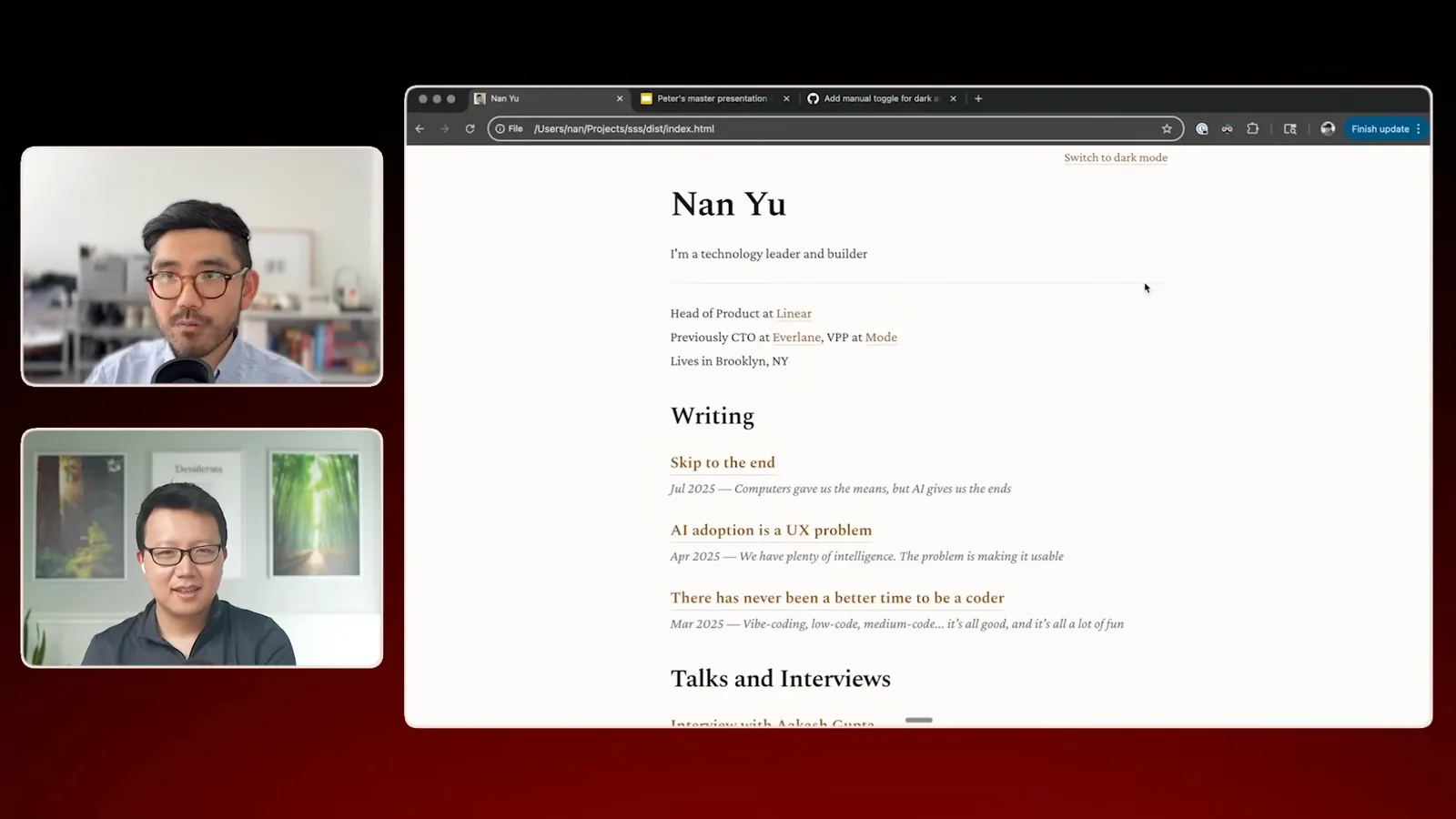
Yu switches to a personal workspace before demonstrating code changes. He writes an issue requesting a plain-text light/dark theme switch that remembers the user’s choice, and delegates it to Codegen. He stresses that a human remains accountable for the outcome even when an agent performs the work.
The agent produces a pull request. Yu checks out the branch and tries the new link, which switches his site’s appearance. He says an engineer can delegate several suitable issues asynchronously, then inspect or request changes to the results. Yang adds that the agent’s work should be checked carefully.
Yu expects work-management tools to coordinate people and agents together: agents can make decisions, perform tasks and report back, but people must remain involved because an agent cannot be held accountable for an outcome in the same way a person can.
More from this channel
 46:40EN
 Peter Yang· Nov 8, 2026Podcast · 2 speakersAshley Alexander: How AI Helps Me Care for My Parents With CancerGuest Ashley Alexander · Host Peter YangA caregiver uses AI to prepare for appointments, organize records and ask better questions—while keeping doctors at the center of treatment.
 17:50ENPeter Yang· Nov 4, 2026PodcastPeter Yang’s Five Steps for Using AI to Help Care for His MotherYang uses a shared care brief and organized records to navigate appointments, while making time for family.
 15:03ENPeter Yang· Nov 3, 2026PodcastHow Peter Yang Used an AI Phone Agent to Negotiate His Internet BillAn AI call negotiated a lower price and faster service, but Yang still had to approve the change himself.
 33:09ENPeter Yang· Nov 1, 2026Podcast · 2 speakersJaclyn Konzelmann: When AI Can Build More, Choose What Deserves to ExistGuest Jaclyn Konzelmann · Host Peter YangGoogle Labs pairs short strategy documents with prototypes, user co-creation and lessons from experiments that end.
 13:05ENPeter Yang· Oct 28, 2026PodcastPeter Yang Tests Genie 4: Convincing Worlds, Unfinished GameplayFive live demonstrations show scenes that respond to prompts and sound, alongside inconsistent actions and limited game mechanics.
 1:06ENPeter Yang· Oct 26, 2026PodcastPeter Yang on Setting Up Payroll for a One-Person BusinessIn a paid partnership, Yang describes the paperwork he encountered and a payroll product integrated with a business account.