In 30 seconds
In September 2026, Berman first reviews Claude Opus 5.5 and interviews Thariq Shihipar about model efficiency, evaluation and Claude Code. Team members show early projects before the stream turns to GPT-6 Sol and Luna; launch claims, historical prices and personal impressions are kept in context.
- 1Opus launch benchmarksBerman reviews Anthropic’s reported coding and knowledge-work results.
- 2Incremental self-improvementShihipar describes many small contributions to model development.
- 3Early game demosAlex describes a long-running Unreal project and its remaining limitations.
- 4Sol and Luna pricesBerman reads API prices from the September 2026 announcement.
- 5A same-day synthesisA generated chart combines selected launch figures but is not a controlled comparison.
Takeaways
- Reported benchmark scores and task costs depend on the evaluation and effort setting.
- Shihipar describes recursive improvement as many incremental contributions rather than a sudden autonomous leap.
- Early game demonstrations were informal and did not include reliable token-cost accounting.
- Sol and Luna’s displayed launch prices were lower than those of larger models, with different reported scores.
- Same-day charts and company announcements are not a controlled head-to-head comparison.
Read the edited text by chapter
Opus 5.5 launch
Berman reviews reported benchmarks, pricing, efficiency and safety claims.
Berman opens this September 2026 stream with Anthropic’s Claude Opus 5.5 launch. He says he and his team had early access and plans an interview with Thariq Shihipar and demonstrations from Alex and Brian.
Anthropic describes Opus 5.5 as approaching Fable 5.1 on many tasks while costing less than Opus 5 on typical work. Berman is enthusiastic, but these launch claims and his impressions are not independent guarantees.
The displayed Anthropic table reports 66.4% on Terminal-Bench 4.0 and 54.4% on FrontierCode for Opus 5.5, alongside results for other models. Berman stresses the coding gains; comparisons apply to the reported test conditions.
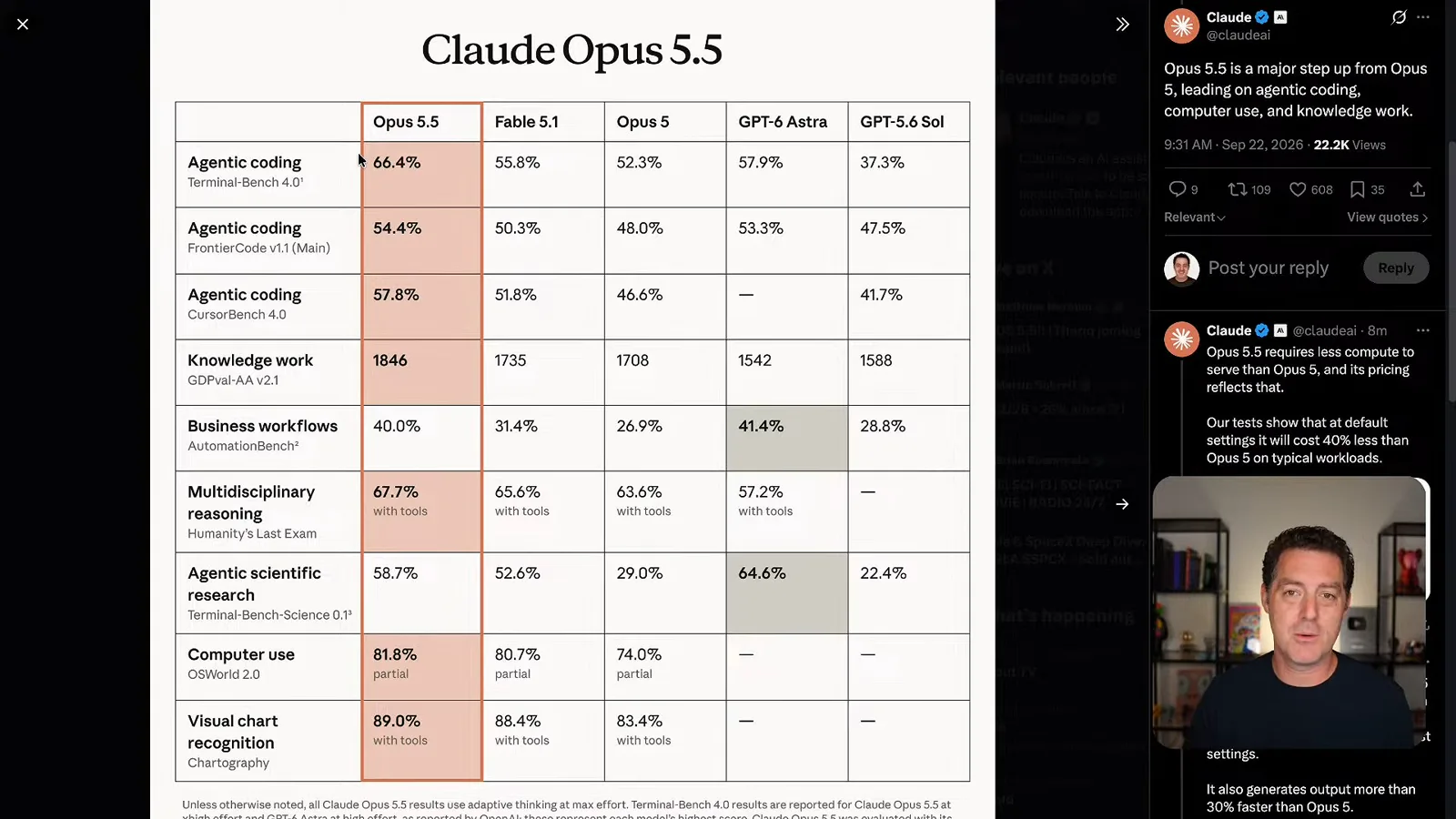
Berman examines reported knowledge-work and reasoning scores, including GDPval-AA and Humanity’s Last Exam. He notes that the model does not lead every evaluation, including the displayed AutomationBench and science test.
He also reviews computer-use and chart-recognition results. Small differences in a specific benchmark are not the same as a universal ranking across real applications.
The launch-era table lists Opus 5.5 at $4 per million input tokens and $20 per million output tokens, compared with $5 and $25 for Opus 5. Berman initially misspeaks and then corrects the comparison.
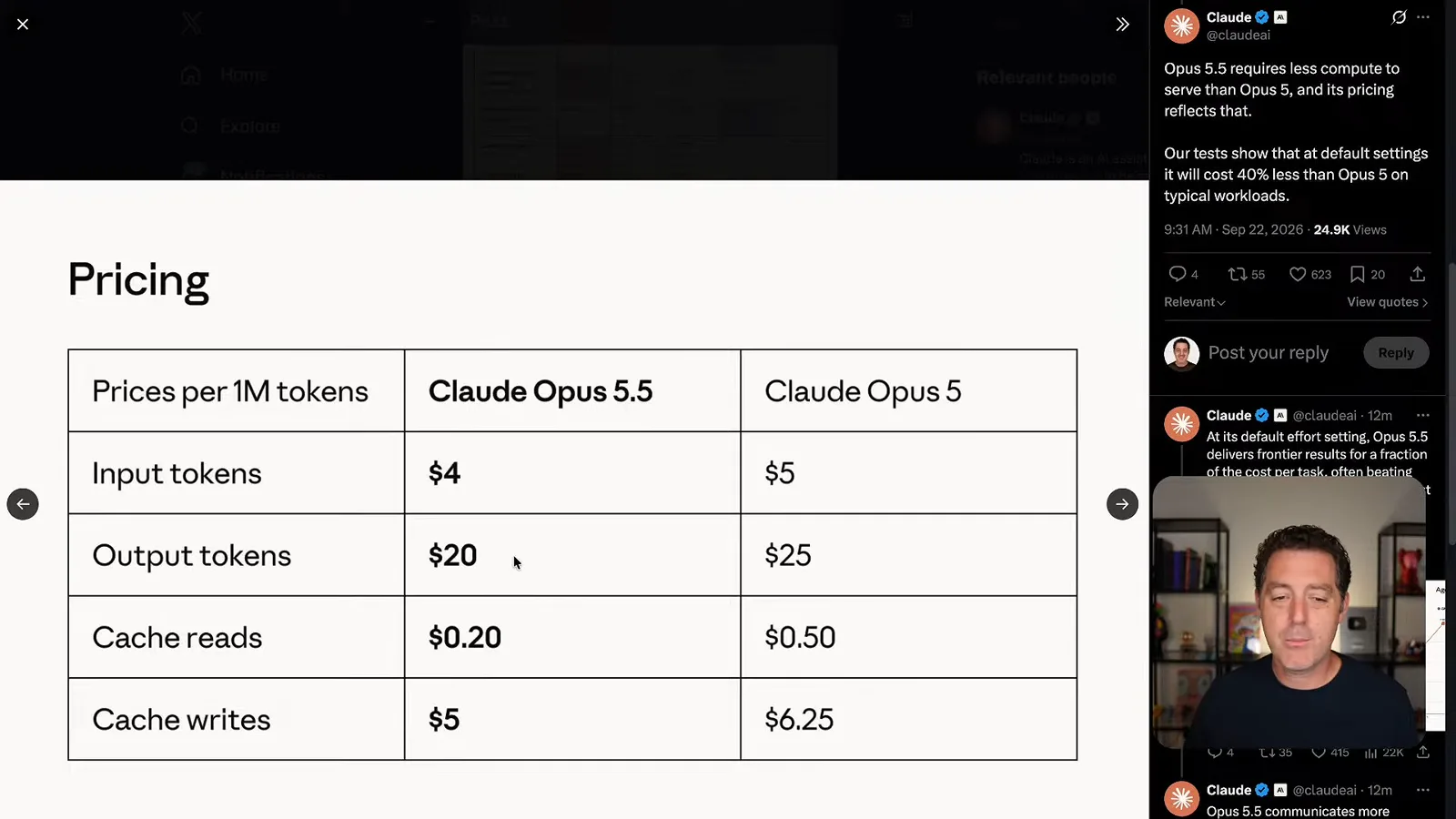
Anthropic claims output is more than 30% faster and typical default-effort tasks cost 40% less than with Opus 5. Berman explains that task cost depends on both token prices and how many tokens a task consumes.
The displayed AutomationBench plot compares quality against estimated cost per task at several effort settings. Berman favors points that are both higher-scoring and cheaper, while the trade-off remains workload-specific.
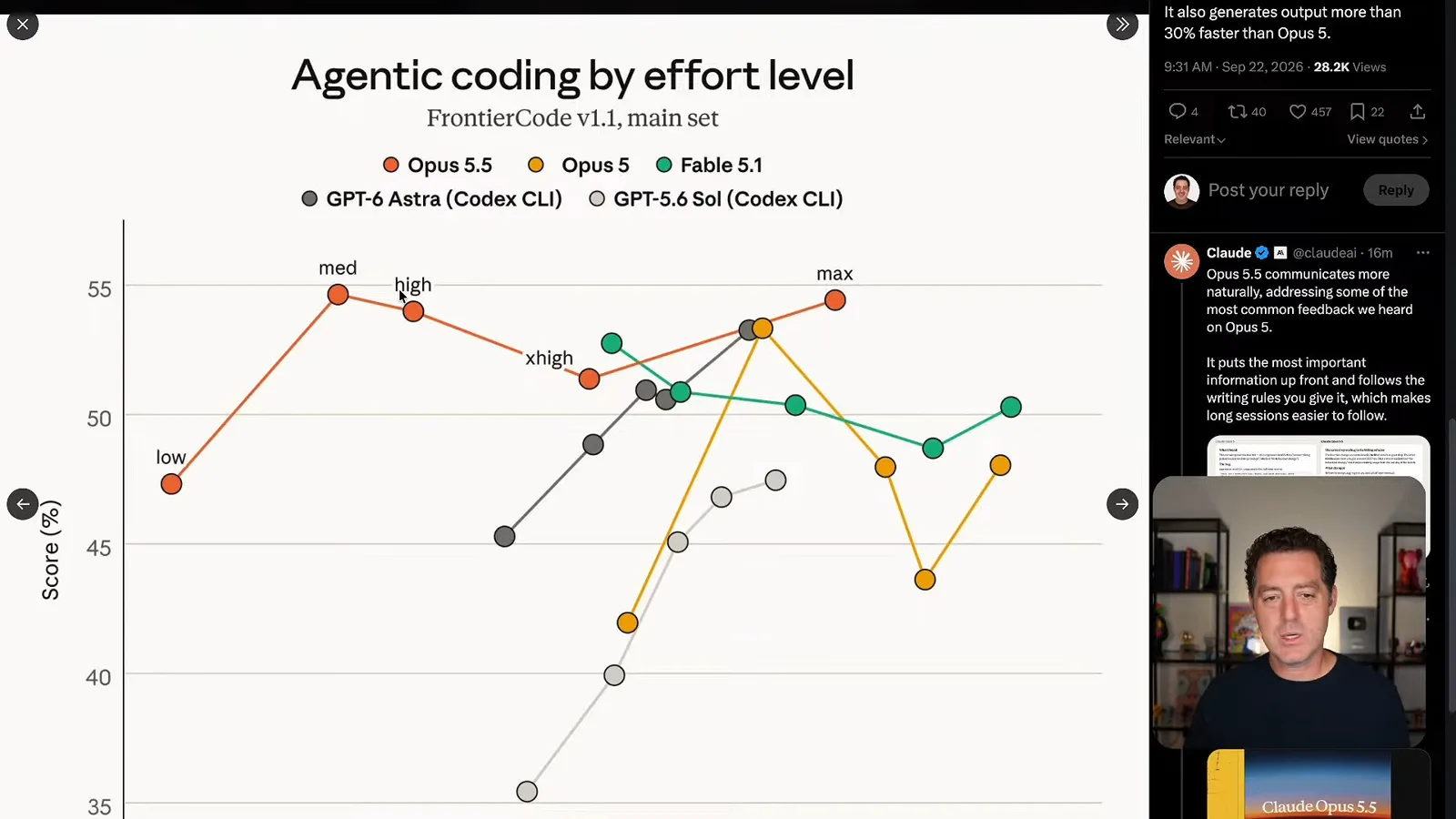
On FrontierCode, the plotted scores vary non-monotonically by effort: in the displayed results, medium effort can score higher than maximum effort at a lower estimated cost. Berman recommends experimenting with settings rather than assuming more effort always wins.
Berman reviews the GDPval-AA and Terminal-Bench cost curves and calls them useful for comparing knowledge work and coding. These figures come from the launch presentation and should be interpreted with their benchmark methodology.
Anthropic also says the model communicates more concisely. Berman considers that valuable when switching among many agents, because shorter progress reports can reduce the amount of context a person must read.
The host reads the company’s safety claims and mentions external evaluators. He distinguishes biological and cybersecurity use as areas where Anthropic describes additional safeguards and verification; he is uncertain about details of a separate incident.
Interview with Thariq Shihipar
The Anthropic engineer discusses model use, evaluation and the Claude Code harness.
Thariq Shihipar, then a member of Anthropic’s technical staff working on Claude Code, joins the stream. He describes Opus 5.5 as a potential everyday model and Fable 5.1 as useful for planning or high-stakes discrete work.
After resolving a microphone problem, Shihipar repeats that his recommendation reflects both capability and cost. He gives planning, code review and security as examples where someone might choose the more expensive model for a particular task.
Asked about recursive improvement, Shihipar says Claude helps build Claude through many incremental contributions, including writing code. He cautions against imagining an abrupt switch in which the model suddenly does everything itself.
Shihipar describes a pattern in which frontier capabilities become less expensive and more accessible over time. He presents it as the company’s approach and expectation, not a guarantee for every model or customer.
Berman asks whether the 5.5 name signals an inflection like Opus 4.5. Shihipar says not to read too much into the numbering, while expressing excitement about the new release.
On Anthropic’s call to pace frontier development, Shihipar distinguishes evaluating newer capabilities from making already assessed capabilities broadly accessible. He says the company considered its classifiers and fallbacks robust enough for this release.
Asked whether evaluation windows are becoming longer, he says additional evaluators require time but he cannot predict the net effect. His stated priority is confidence from the company and outside evaluators before release.
Berman asks about the precise access given to outside evaluators. Shihipar says he does not know the details for this release and offers to check, rather than confirming a particular arrangement.
Shihipar recounts using the model to redesign his personal site and says responsiveness, cost and small visual details matter alongside raw capability. Berman observes that increasingly capable models are difficult to distinguish with simple demos.
Asked what needs improvement, Shihipar points to computer and browser use, memory and adapting to a user without interrupting unnecessarily. He frames these as product challenges that determine whether people can use model capabilities effectively.
The interview turns to the Claude Code harness. Shihipar says the team removed some system-prompt material, adjusted tools and introduced evaluations for skills and plugins so older instructions do not unnecessarily constrain a newer model.
He says tool calling has improved and sees potential in managed cloud agents, while acknowledging that product teams still need to find better ways to expose model capability. These are his assessments during the launch interview.
Early demos
Alex and Brian show games and animation while the stream encounters presentation difficulties.
Alex and Brian join after receiving early access. The team works through screen-sharing and stream-latency problems before showing examples; the visible demos are not controlled evaluations.
Alex says he asked the model to build an Unreal Engine game inspired by Dark Souls. He describes a roughly 28-hour run, multiple worlds and boss encounters, and says the result still needs polish.
The livestream’s screen share is laggy, while Alex says the game runs smoothly on his machine. He cannot provide a reliable token count and does not know the answer to some implementation questions, limiting what the demonstration establishes.
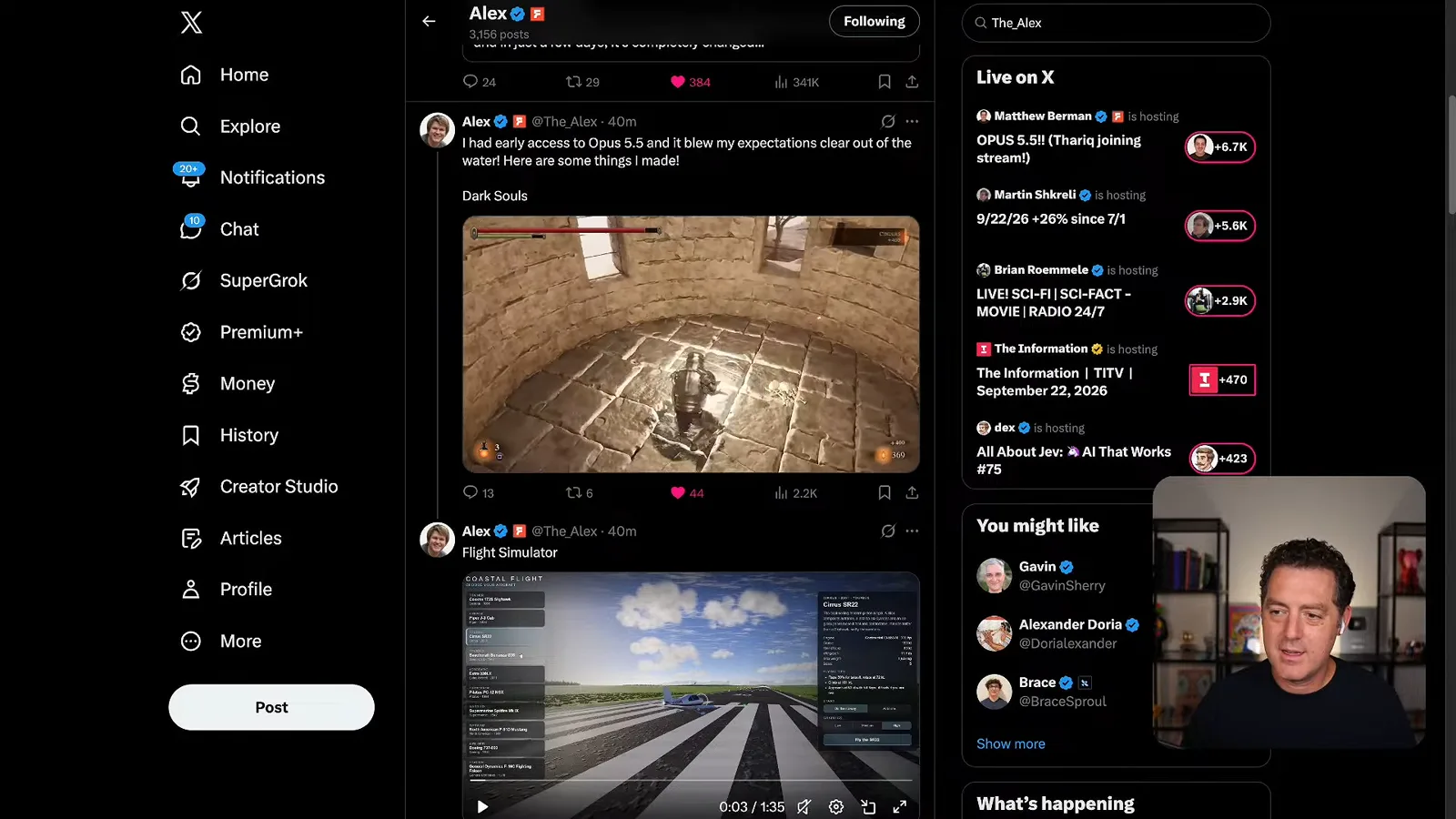
They switch to a recorded clip to show the game’s combat and discuss the boss’s behavior. Alex says he would not have been able to build the project unaided; that personal comparison is not a measured development-time study.
Alex also shows a flight simulator, a level-building game inspired by Mario Maker and a rocket game. He describes varying prompt counts and run times, and the group notes that some visuals remain uneven.
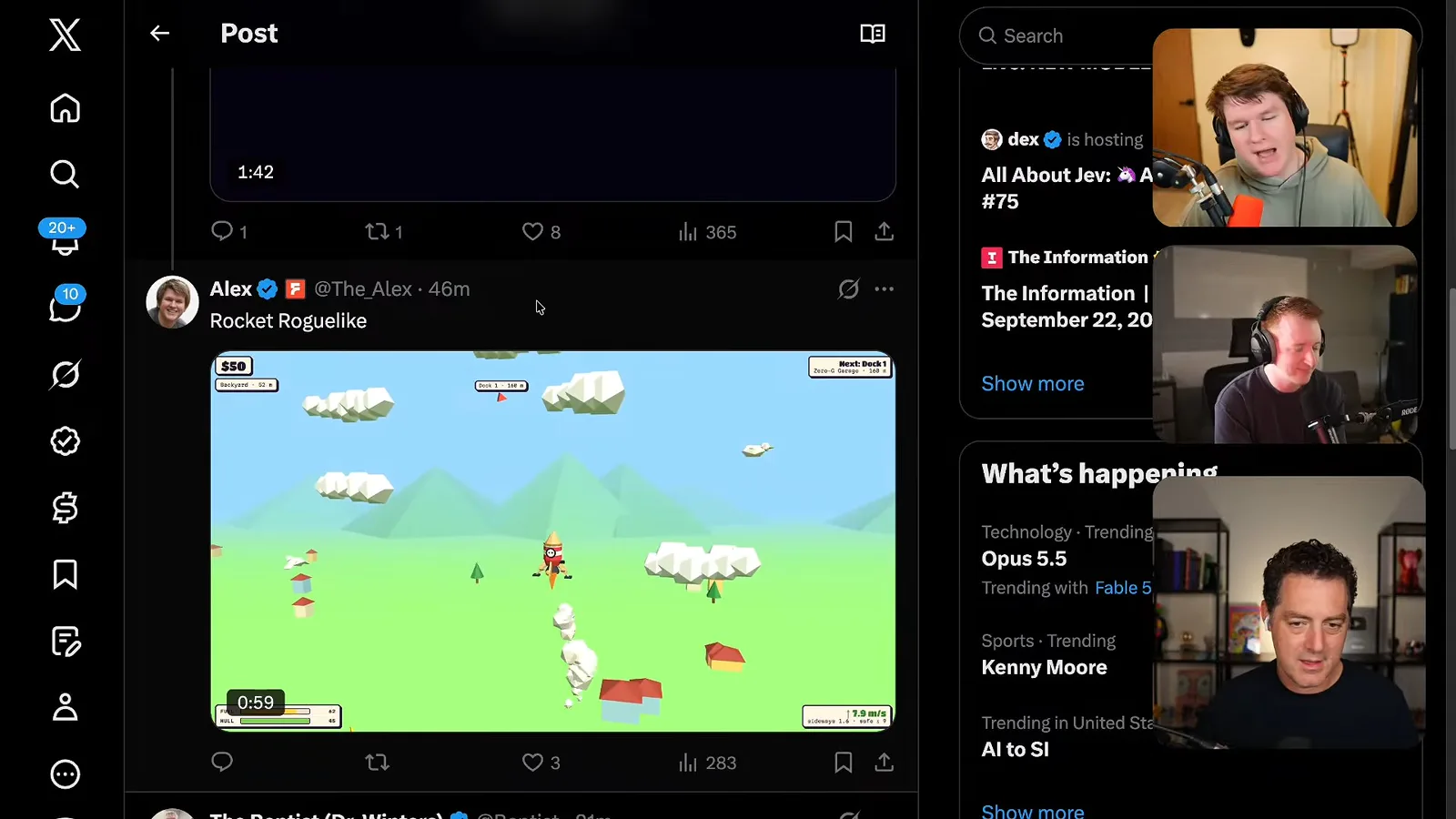
Brian presents an animation built through repeated prompting rather than a single video-generation request. He says he iterated on details such as shadows; audio problems prevent a full presentation on the stream.
Brian describes a puzzle-game workflow in which multiple candidates were compared in a bracket and one, Tidekeeper, was selected. The team begins trying it, then is interrupted by news of another model release.
Waiting for another launch
Berman reviews an index and waits for information about Sol and Luna.
After the guests leave, Berman reviews a third-party intelligence index and reiterates his positive impression of Opus 5.5. An index aggregates chosen tests; its ranking should not be read as proof of superiority on every task.
Viewers report seeing GPT-6 Sol and Luna in their apps before Berman can find the announcement. He waits for the official information and later says he had early access without knowing the models’ identities.
While waiting, he discusses other agent products and speculates about future OpenAI hardware and personal-assistant plans. These are predictions or reports from the livestream, not confirmed product commitments.
GPT-6 Sol and Luna
He examines launch-era pricing, benchmarks and effort settings.
Berman finds the OpenAI announcement and introduces GPT-6 Sol and Luna as faster, less expensive options alongside Astra. He reads the company’s stated comparison and notes that the models serve different budgets and tasks.
The September 2026 pricing shown is $2 per million input tokens and $10 per million output tokens for Sol, and $0.10 and $0.50 respectively for Luna. These are historical API prices in the stream, not a statement of current pricing.
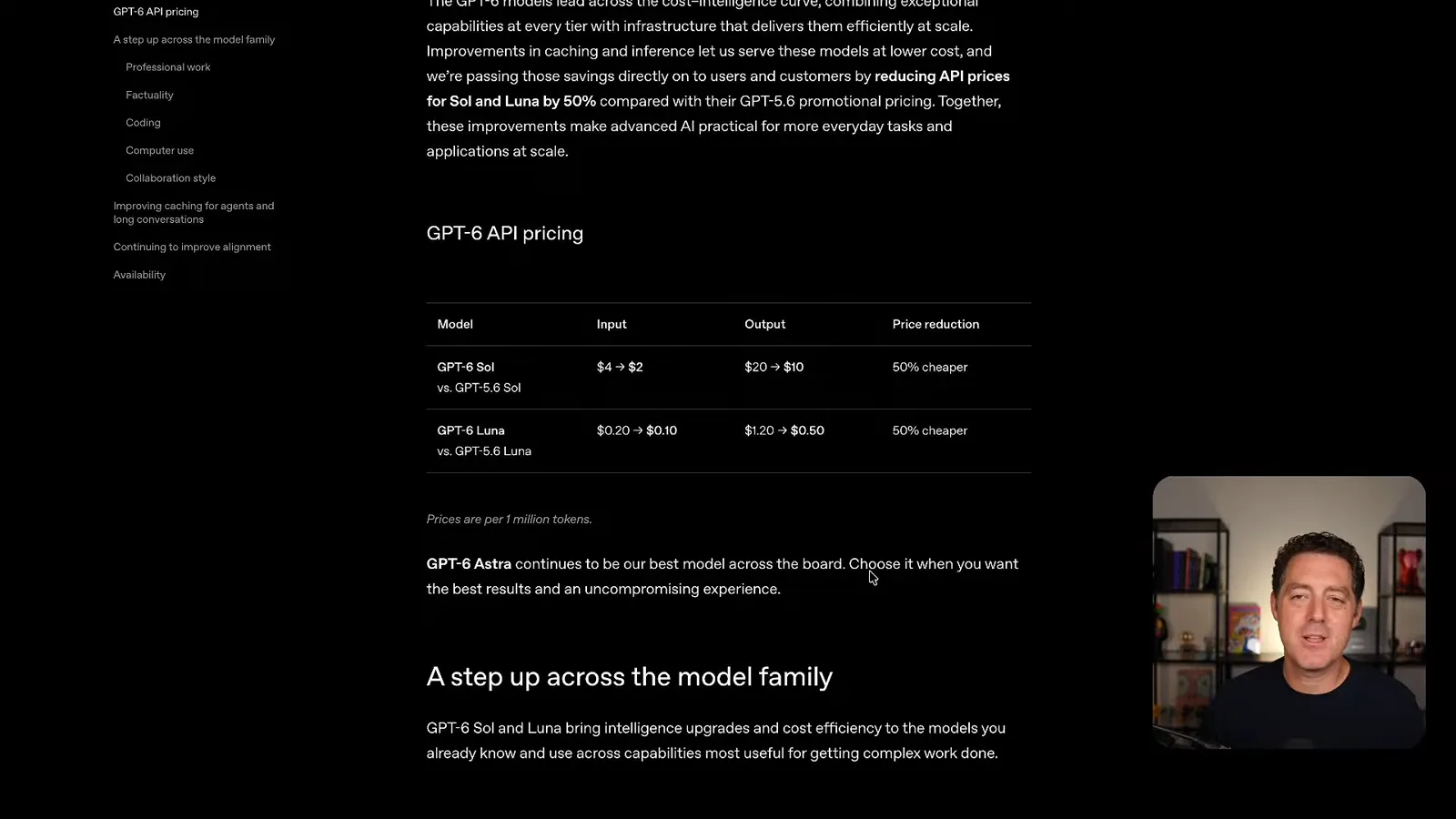
He reads OpenAI’s AutomationBench chart, comparing estimated cost per task and score at different effort levels. He says Sol improves on the prior Sol in the displayed setup while Luna costs much less but scores lower.
Berman looks at reported factuality and other agent benchmarks, emphasizing that rankings and cost can change with effort settings. The figures are company-reported and do not include the just-released Opus 5.5 in every comparison.
On DeepSWE, he highlights a reported Luna result of 66.6% at an estimated $0.22 per task and compares it with more expensive settings. The observation concerns the reported benchmark, not a guaranteed result on any user’s repository.
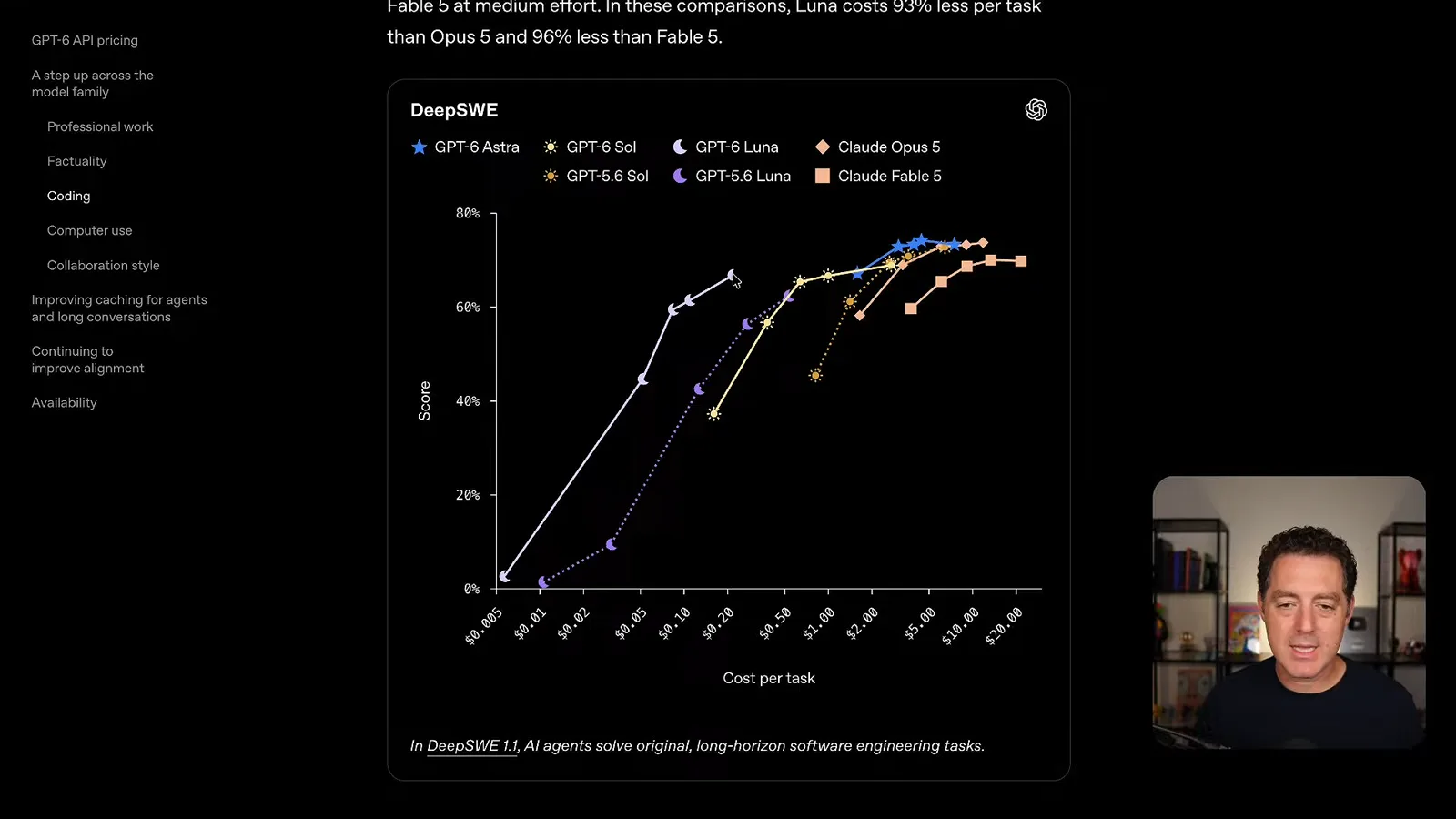
He looks at computer-use results and notes that Luna trails Astra in the displayed comparison. He reads availability information as it stood on launch day; access and product names can change later.
Comparing the releases
A generated chart supports a discussion of price and performance trade-offs.
Berman speculates that both companies’ cheaper releases may reflect a focus on efficiency, while acknowledging that model architectures and internal plans are not established by the charts.
He asks Astra to generate a chart comparing the day’s launches and uses it to discuss API prices and selected benchmark scores. The chart is a secondary synthesis generated during the stream, not a controlled head-to-head evaluation.
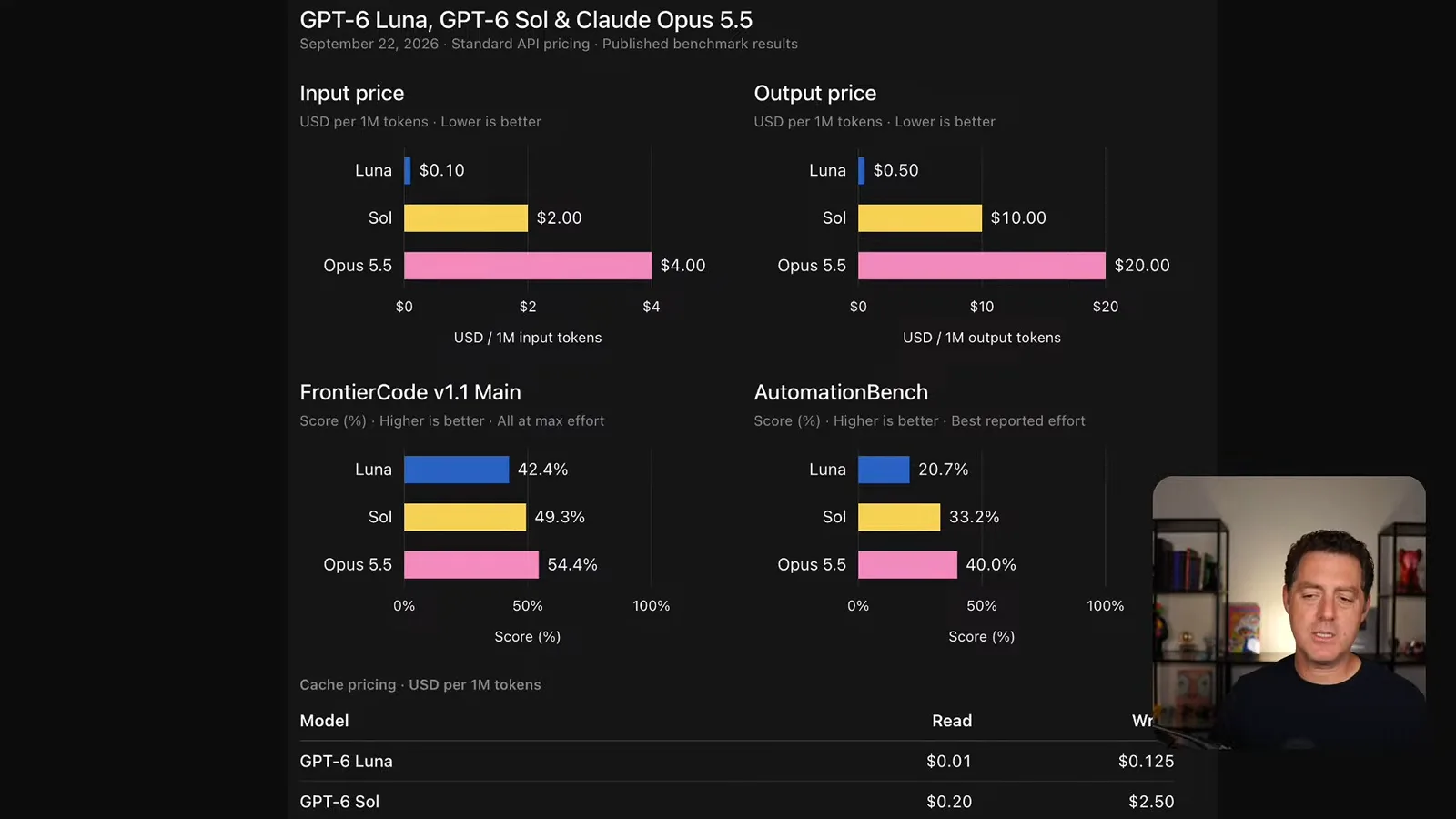
Berman interprets the price and score differences as a trade-off: paying for the strongest reported result may cost substantially more than choosing a cheaper model. He stresses that the right choice depends on the task and available quota.
He closes by saying he plans more testing and may use Opus more if its quota is generous. The launch-day discussion combines company claims, limited demonstrations and personal preferences, leaving independent comparison for later.
More from this channel
 25:50EN
 32:20EN
 0:22EN
 45:08EN
 0:32EN
 12:14EN